
The politics of cross-cover will determine how miserable your residency feels between 5 PM and 7 AM. And nobody really teaches you how it works. They just hand you the pager and say, “You’ll be fine.”
You will not be fine. Not unless you understand the unspoken rules.
Let me walk you through what actually happens behind the scenes when you’re on cross-cover—and how to stop being the person everyone quietly decides to dump on.
What Cross-Cover Really Is (From the Attendings’ Side)
Cross-cover is not “just covering patients overnight.” That’s the sanitized version.
To the people running the hospital—program directors, chiefs, attendings—cross-cover is a pressure valve. It’s how they keep services staffed on paper, meet ACGME rules, and not blow the budget on more night float or more residents. They know it’s rough. They also know it’s where weak residents expose themselves.
I’ve sat in faculty meetings where someone pulls up the “problem list” of residents. You know what’s on it?
“Frequently calls me overnight for minor issues.”
“Multiple nursing complaints: does not respond to pages promptly.”
“Day teams report cross-cover notes are useless.”
That’s code for: this person cannot handle cross-cover politics.
Here’s the harsh truth: nobody is grading your cross-cover based on how many CBCs you ordered. They’re grading you on three things:
- Do nurses and day teams trust you?
- Do you keep patients safe without waking the attending for nonsense?
- Do you avoid creating more work and chaos for the day team?
Everything else is decoration.
The Unwritten Hierarchy: Who Gets Dumped On and Why
Let me be blunt. Some residents consistently get dumped on overnight. Same patient load. Same hospital. Radically different experience.
This is not random. People make decisions based on what they’ve seen from you before.
Here’s the hierarchy that quietly forms in every residency:
| Tier | How Staff See You | What You Get Overnight |
|---|---|---|
| Tier 1 | Calm, decisive, fair | Reasonable pages, real issues only |
| Tier 2 | Nice but disorganized | Extra FYIs and CYA pages |
| Tier 3 | Avoidant, slow to respond | Way more pages, escalations, notes |
| Tier 4 | Unsafe or rude | Pages to attending, formal complaints |
Nobody announces this. You just start noticing:
- The same nurses always page you for every tiny electrolyte issue.
- Certain day teams leave you “just in case” plans for everything.
- Or the opposite: people handle more at the bedside and only call you when it’s real.
How do you move up the ladder?
Not by being a pushover. By sending a consistent signal: “I’m available, I’m not lazy, and I don’t make you regret calling me. But I also won’t order nonsense.”
Let me show you how that plays out in real situations.
The Golden Hour: How You Start a Cross-Cover Night
Your night is decided in the first 30–60 minutes. This is where most interns blow it.
You think cross-cover starts when the day team signs out. It doesn’t. It starts with how prepared that sign-out is—and how you respond to it.
1. How You Listen to Sign-Out
You’re tired. They’re tired. People start speed-reading sign-outs like an audiobook on 3x.
This is where you lose.
When I was chief, I could tell in 5 minutes who was going to drown overnight based on sign-out behavior. The struggling ones:
- Don’t ask questions. Just nod.
- Never clarify contingency plans.
- Don’t write anything down in a way they’ll actually use at 3 AM.
The strong ones ask targeted, political questions. Not endless, anxious ones.
You say things like:
- “Who are the two patients you’re most worried about tonight?”
- “If this guy spikes again, what’s your threshold for calling the attending vs just getting blood cultures and fluids?”
- “Any family dynamics or landmines I should know about? Anyone who tends to blow up overnight?”
You’re not just asking medical questions. You’re asking risk questions. Risk for escalations, complaints, attending calls, disaster.
Then you write the answers in a way that’s useful. Short, blunt phrases in your sign-out:
- “Likely to call. Daughter anxious. Keep updated.”
- “If SBP < 90 → 500 cc LR, recheck, call night senior if still low.”
- “Code status conversation incomplete. Do NOT delay if decompensates.”
When something blows up at 2 AM, this is the difference between you sounding competent and sounding lost.
The Politics With Nurses: Stop Being the “Easy Target”
Here’s what residents never get told:
Nursing isn’t trying to torture you with pages. They’re trying to not get burned.
If they have three different residents to page, and:
- One never answers
- One is rude and dismissive
- One answers, is reasonable, and doesn’t punish them for calling
Guess who gets the page? Every time.
I’ve heard nurses at the station say it out loud: “Don’t bother paging X, they’ll just yell. Call Y, at least they’ll do something.” That “Y” becomes the dumping ground.
So how do you not get buried while still being approachable?
Script #1: The “I’ve Got You, But Let’s Be Smart” Approach
Nurse: “Patient’s potassium is 3.4, can we get IV K, and also mag level?”
Weak response: “Sure, I’ll put it in.” (And you just signaled: I’ll do anything you ask, no pushback.)
Arrogant response: “This is stupid, I’m not ordering that. Call day team.” (You just bought yourself a reputation problem.)
Strong response:
“Thanks for letting me know. 3.4 is ok for tonight in this patient. Let’s recheck in the morning labs. If it drops below 3.0 or you see VT on the monitor, page me immediately. I’m writing that plan now so days see it.”
You:
- Acknowledge the concern.
- Give a clear threshold.
- Put the plan in writing so the nurse feels protected.
That nurse is now less likely to call you again for the same thing.
Script #2: When You Need to Push Back Without Starting a War
Nurse: “Can you give something for sleep? Patient isn’t sleeping and is upset.”
You glance at the chart: 83-year-old, delirious last night, borderline hypotensive.
You say:
“I get that it’s rough when they can’t sleep. With his age and blood pressure, sedatives are risky—we can literally tip him into worse delirium or a fall. What has helped him before? Lights off, cluster care, maybe a sitter? I’ll put an order for melatonin, but I’m going to avoid stronger stuff tonight for safety.”
Here’s what that does politically:
- You are telling the nurse: I’m thinking. I care.
- You’re explaining your reasoning in clinical, not emotional, terms.
- You’re giving something (melatonin, maybe non-pharm) so it doesn’t feel like a flat “no.”
Nurses do not expect you to say “yes” every time. They expect you not to be lazy, rude, or dismissive. Show your work once or twice, and they’ll back off a lot of soft asks.
The Day-Team Trap: How Not to Get Blamed at 8 AM
The other half of cross-cover politics lives in the morning.
Day teams absolutely talk about how you handled their patients. Do not kid yourself. I’ve sat in those workrooms.
“This guy decompensated overnight and all cross-cover did was give fluids.”
“She ordered morphine on a guy whose BP was 80/40, what was she thinking?”
Or, more subtly: “Cross-cover was great, note was clear, and they called me when it mattered.”
Day team impressions get back to chiefs and PDs. Quietly. Over time. And your name ends up in either the “we trust them” bucket or the “watch them” bucket.
The Rule: Never Surprise the Day Team With a Disaster You Knew Was Coming
The worst sin in cross-cover is not missing some obscure lab. It’s seeing a pattern and doing nothing, then dropping a bomb on the day team in sign-out.
If something is clearly smoldering—BP trending down over hours, borderline lactate, rising oxygen requirements—you have two jobs:
- Act.
- Document your thought process and flag it.
That might mean:
- “Pt with rising O2 needs from 2L to 6L over 4 hours, CXR ordered, started cefepime/azithro, VBG pending, MICU fellow aware, will reassess for transfer if worsens.”
Then in your sign-out: “Watch Mr. X in 24B. I think he’s early sepsis. I started antibiotics and called MICU, but he may need higher level of care today.”
You’re covering your patient. You’re also covering yourself.
Because if that guy codes at 9 AM and the attending reads your note and sees nothing, guess what story gets told.
“He was getting worse all night and nobody did anything.”
When your note shows you recognized it, escalated appropriately, and communicated it? The conversation changes:
“Okay, this was evolving. Cross-cover actually did a good job. We just lost the race.”
That matters.
When to Call the Attending (and How Not to Sound Clueless)
This is the part that terrifies juniors. They either under-call and look unsafe, or over-call and get a reputation as “the needy one.”
Here’s the behind-the-scenes reality: attendings are less annoyed by being called than by being called badly.
If you wake them up at 3 AM and sound scattered, have no data, and no suggestion, you will get labeled. Fast.
You want the opposite label: “They only call when it matters, and they always sound organized.”
So you adopt a formula. I’ve seen hundreds of residents try to wing it. The ones who last have a tight mental script.
The 60-Second Call Structure That Attendings Actually Respect
When you call:
One line: “This is Dr. X, cross-covering for Y service, about Mr. Z in room 12B, admitted for [reason]. I’m worried about him because [short reason].”
10–15 seconds: Vital trend and one-liner:
- “He was stable on 2L, now on 6L with increased work of breathing, sat 89% on 4L, now 92% on 6L. BP stable 120s, HR 110s. No fever.”
10–20 seconds: What you’ve already done:
- “I examined him—diffuse crackles, no wheeze, no JVD. I got a stat CXR and VBG, started duonebs, and gave 40 IV lasix as he’s 10 kg up from baseline.”
10–15 seconds: What you’re asking / proposing:
- “I’m calling to ask if you’d like to step up to BiPAP on the floor or move him to MICU now. My sense is we should at least get MICU involved.”
That’s it. Short, focused, and it shows you’re thinking.
After a few calls like that, your attendings relax. They stop dreading your name on caller ID. And that completely changes how much grace you get in borderline situations.
Ordering Tests and Meds: The “Don’t Make More Work” Rule
This is where cross-cover folks quietly get hated: they shotgun labs and imaging that don’t answer the right question and dump all the interpretation on days.
You think, “Let days sort it out.” Day teams think, “What was this person doing?”
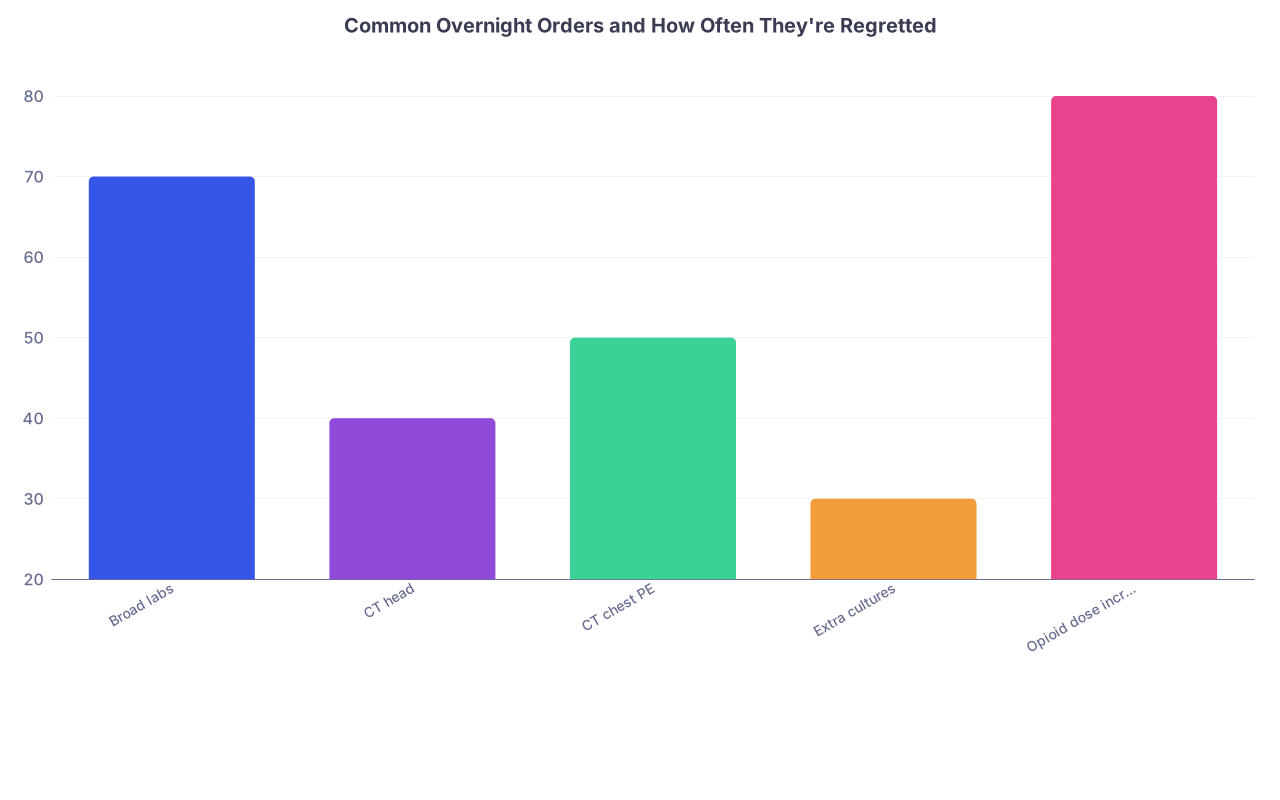
Here’s the rule: if you order it, either act on it or clearly label it as “for day team to interpret further.” And keep it tight.
| Category | Value |
|---|---|
| Broad labs | 70 |
| CT head | 40 |
| CT chest PE | 50 |
| Extra cultures | 30 |
| Opioid dose increases | 80 |
That bar chart? That’s roughly how attendings complain in real life. Broad labs and opioid increases get regretted constantly.
Labs
If a patient looks well, vitals are stable, and it’s 2 AM, you almost never need a giant panel “just because.”
You do need targeted labs when:
- There’s a real change in status (hypotension, tachycardia, new confusion).
- You’re about to do something risky (transfuse, start high-dose diuresis, etc).
But if you blast a BMP, CBC, mag, phos, LFT, troponin on every vague “feels off,” day teams notice. They deal with meaningless small abnormalities, redraws, calls from lab. You become “that person.”
Targeted is respected. Shotgun is not.
Imaging
I’ve seen cross-cover residents order CTs like they’re ordering a salad. CT head for any mild confusion. CT A/P for any abdominal complaint.
What actually impresses attendings is restraint with a clear plan.
- “No red flags on neuro exam, vitals stable, glucose normal, no trauma or anticoagulation. I think we can hold CT head and reassess in the morning unless she worsens.”
If you talk like that, seniors and attendings stop second-guessing you.
When you do order a big study overnight, you’d better document why. Something like:
“Ordered CT A/P for acute severe abdominal pain with peritoneal signs, WBC 20, lactate 4, concern for ischemic bowel vs perforation. Will call surgery based on results.”
That’s medicine. Not defensive chaos.
The List: Your Only Real Weapon Overnight
The cross-cover list isn’t busywork. It’s your survival tool and your reputation in one document.
When I review residents, I don’t care how pretty their notes are. I care what their cross-cover lists and sign-outs look like. That’s where you see thinking.
You want your list to show three things:
- You know who’s sick.
- You know who might become sick.
- You know what each team cares about in the morning.

| Category | Value |
|---|---|
| 7pm-9pm | 40 |
| 9pm-11pm | 55 |
| 11pm-1am | 70 |
| 1am-3am | 60 |
| 3am-5am | 45 |
| 5am-7am | 50 |
Those “busy” peaks? If you go into them without a clean, prioritized list, you drown.
Your list should not be a novel. It should be compact, brutal, and honest. Things like:
- “402B: DNR, likely end-stage CHF, family wants ‘everything non-ICU.’ Low threshold to call family overnight if worsens.”
- “514A: On heparin drip for PE, known bleeder, monitor for drop in Hgb. Any melena/BRBPR → STAT CBC, call senior.”
- “608C: Post-op day 1, surgeon very particular, wants notified for any SBP < 100. Do not adjust pressors without calling.”
This is political intelligence, not fluff.
You don’t write for yourself alone. You write for:
- The day team trying to see what happened.
- The nurse trying to prove they alerted you.
- The chief or attending reviewing a bad outcome.
If your list and cross-cover notes show awareness and planning, you’ll be shocked how much heat you avoid when things go sideways.
Knowing When to Say “No” (And When You Absolutely Can’t)
You can’t survive cross-cover by saying yes to everything. You also can’t survive by being the brick wall.
The art is knowing which “no” is politically safe.
Safe to say no:
- Non-urgent home meds at 2 AM that are cosmetic, not critical.
- Repeat labs for stable, well patients that won’t change management until morning.
- “Sleep aids” in a delirious, unstable, or very elderly patient.
Dangerous to say no:
- Sustained abnormal vitals with no clear explanation.
- New severe pain, especially chest, abdomen, or neuro.
- Recurrent pages about the same concerning symptom.
If a nurse calls you a second or third time about the same issue and you still say no without seeing the patient, you’re writing your own future complaint.
Sometimes the politically smartest move is to go lay eyes on the patient, even if you’re 90% sure it’s nothing. The nurse thinks, “They came. They tried.” That memory buys you fewer pages later for borderline stuff.
How Seniors and Chiefs Actually Judge Your Cross-Cover
Let me give you the actual rubric that lives in people’s heads. They don’t show it to you, but they use it.
| Dimension | Red Flag Behavior | Trusted Behavior |
|---|---|---|
| Responsiveness | Ignores or delays pages | Calls back quickly, even if brief |
| Judgment | Overcalls attendings or misses big issues | Calls for the right stuff, handles minor issues |
| Documentation | Cryptic, missing notes | Short, clear, time-stamped plans |
| Team Relations | Nursing complaints, day team angry | Nurses defend them, teams feel supported |
You want to be in the “trusted” column even if your medical knowledge isn’t perfect yet. Knowledge grows. Reputation sticks.
Seniors and chiefs forgive:
- Not knowing the perfect antibiotic.
- Forgetting a lab here and there.
- Needing help on borderline ICU vs floor decisions.
They do not forgive:
- Not calling back pages.
- Being arrogant to nurses.
- Hiding or minimizing overnight events.
- Leaving disasters for days without any attempt to stabilize.
If you avoid those four, you will be fine, even in brutal programs.
A Few Very Real Scenarios You’ll Face
Let me walk you through three classic cross-cover landmines and how a politically savvy resident handles them.
Scenario 1: “Patient Looks Different”
Nurse: “Patient just looks different. Vitals are okay, I just don’t like how he looks.”
If you blow this off, you will eventually get burned. This is the “gut feeling” that precedes badness more often than not.
Wrong move: “Well, vitals are fine, call me if they change.”
Right move:
“Okay, thanks for telling me. I’ll come take a look.”
At bedside:
- Quick ABCs.
- General impression: work of breathing, responsiveness, skin, perfusion.
- Check monitor yourself, maybe a quick glucose and bedside EKG if something feels off.
Then you either:
- Document: “Nurse concerned about appearance, evaluated, vitals stable, exam reassuring, no intervention now, will recheck in X hours or sooner if change.”
Or
- Start real workup if your own gut agrees with the nurse.
Nurses remember who takes their intuition seriously.
Scenario 2: The Angry Family at Midnight
Family: “We want to talk to the doctor now. No one’s telling us anything.”
This is a political situation, not just medical.
Wrong move: “I’m just cross-cover, I don’t know. Talk to the day team.”
Strong move:
“I’m cross-covering tonight, so I wasn’t here for the daytime discussions, but I’m happy to review the chart and explain what I can from the notes and plans. I’ll be honest about what I can’t answer without the primary team.”
You give them:
- A simple explanation of what’s going on.
- Reassurance that the primary team will circle back in the morning.
- A realistic timeline: “Dr. X usually rounds between 9–11 AM, and I’ll leave a note for them about your concerns.”
Then you chart. Because when that family complains later, the note that you tried goes a long way.
Scenario 3: The “Can We Change the Code Status” Call
Nurse: “Family is asking to change code status. Can you come talk to them?”
This terrifies juniors. And yes, it’s loaded.
What you should not do is launch into your own full, fresh goals-of-care discussion at 2 AM if you have zero background on prior conversations.
But you also can’t say, “Not my problem.”
Savvy move:
“I can definitely talk with them tonight about what they’re hoping for and what they understand. For any big change in code status, I want to make sure the primary team is involved too, since they know the full picture best. I’ll document our discussion and flag the team for the morning.”
Then you go:
- Explore their understanding and values.
- Clarify what “full code” actually means in plain language.
- Identify whether they’re already leaning towards DNR/comfort.
If the patient is actively decompensating and you know they’re end-stage, yes, you may need to change status then and there. But those are the cases where calling your senior/attending is nearly always appropriate. And everyone will back you for involving them.
The Long View: Why Cross-Cover Politics Actually Matters
Here’s the part you won’t appreciate until later.
The way you handle cross-cover is exactly how attendings imagine you will handle being out in the real world. Nights. Weekends. When you’re the only one in the building who’s “the doctor.”
They don’t care if you can recite UpToDate at noon conference if you fall apart at 3 AM.
A resident who:
- Calls back quickly.
- Shows up when it matters.
- Thinks before ordering.
- Involves the right people when needed.
That resident gets invited back as a fellow. Or hired as faculty. Or written a glowing letter that actually says something.
Years from now, you won’t remember most of the individual cross-cover nights. What you’ll remember is whether you always felt underwater, or whether at some point, about halfway through residency, the pager stopped owning you.
You won’t get there by being the smartest one in the room. You’ll get there by understanding the politics of cross-cover and using them, deliberately, to build trust instead of resentment.
Handle that, and you won’t just avoid getting dumped on.
You’ll become the person everyone actually wants on the other end of the pager when everything goes to hell at 3 AM.