
Is Intern Year Really Just Scut Work?
What if I told you that the average intern is writing or co‑signing orders that alter mortality risk, not just “checking boxes” and “calling consults”? That the “it’s all scut, no real doctoring” line you hear from bitter seniors is flat-out wrong for most specialties and hospitals?
Let’s unpack that myth with actual data instead of trauma bonding in the call room.
Where the “Pure Scut” Myth Comes From
The scut narrative did not come from nowhere.
You show up as an intern and your life suddenly revolves around:
- Pre‑rounding on more patients than your brain can hold
- Reordering “lost” labs
- Calling the lab. Again.
- Faxing SNF paperwork like it’s 1997
- Med recs with zero family, zero records, and a confused 87‑year‑old
So the emotional experience of intern year? Feels like administrative quicksand with a stethoscope.
But that’s not the same as “no real responsibility.” Those are different claims. One is about how soul-crushing some tasks are. The other is about whether you’re actually taking care of patients in a meaningful way.
The first is true. The second, on average, is nonsense.
The classic toxic attending line I’ve heard: “You’re here to be the pen. I’m the brain.” That’s not teaching; that’s abdication disguised as hierarchy. But it also doesn’t reflect what most interns are actually doing across U.S. programs if you look at workload, order entry patterns, and supervision structures.
Let’s pull in some numbers.
What Interns Actually Do: Data, Not Vibes
We have several useful data sources: ACGME survey data, duty hour/role studies, time-motion studies of residents, and institutional EHR audits looking at who places orders, writes notes, and initiates clinical decisions.
Time-Motion Studies: How Interns Spend Their Day
Multiple time-motion studies across internal medicine, surgery, and pediatrics have tried to quantify resident time use. The numbers vary by institution, but the pattern is stable:
- ~10–20%: Direct patient interaction (bedside time, family conversations)
- ~40–50%: Computer-based work (notes, orders, reviewing data)
- ~10–20%: Educational activities (rounds, didactics)
- The rest: Handoffs, phone calls, walking, waiting, miscellaneous admin
That 40–50% in the EHR is what people casually dismiss as “scut.” But the breakdown shows something different: a lot of that is not “busywork,” it is care coordination and order management that directly changes patient care.
One large academic center audit found interns placed the majority of new inpatient orders during daytime hours in IM and peds services. Not co-signed copies. Initiated. As in: “Start heparin,” “Increase furosemide,” “Stop antibiotics,” “Order CT PE.”
That’s real responsibility. It might feel like clicking boxes. It is not.
Orders, Notes, and Clinical Decisions: Who’s Holding the Pen?
Here’s a simplified snapshot based on published EHR analyses and program self-reports (ballpark but directionally accurate):
| Task Type | Interns (PGY-1) | Seniors (PGY-2+) | Attendings |
|---|---|---|---|
| Inpatient daily notes | ~60–70% | ~20–25% | ~5–10% |
| New medication orders | ~50–60% | ~25–30% | ~10–20% |
| Discharge summaries | ~70–80% | ~10–15% | ~5–10% |
| Cross-cover night orders | ~70–90% | ~10–30% | Rare |
Different hospitals, different cultures. But the pattern is crystal clear: interns are not scribes. They’re the primary implementers of the team’s plan, and often the first ones to adjust it when the patient doesn’t read the script.
Are those orders “independent”? Not fully. Nor should they be. But “supervised” is not the same as “scut.”
The Regulatory Reality: You’re Legally a Doctor, Not a Clerk
It helps to remember what the law and accrediting bodies actually say about you.
Interns are licensed physicians in most states. Hospital bylaws typically allow PGY‑1s to:
- Write orders (sometimes with co-sign restrictions on high-risk meds/procedures)
- Document H&Ps and consults that count for billing with attending attestation
- Respond to pages, perform cross-cover, and initiate emergency care
ACGME has explicit requirements for “progressive responsibility” and for resident involvement in patient management. They are not accrediting “admin assistant apprenticeships.” If a program treated interns as pure scut-machines with no real clinical responsibility, they would be at risk in a serious site visit.
Does that mean every program nails it? Of course not. I’ve seen surgical interns whose first six months were 80% floor work, drains, notes, and dispo hell while chiefs hoarded the OR. I’ve also seen medicine interns in community programs essentially function as mini-hospitalists with very loose supervision. Both extremes are broken in different ways.
But on average, the structural expectation is that you are a physician with supervised but real responsibility. Not an overqualified unit secretary.
Where the Real Responsibility Hides (That Nobody Labels as Such)
The problem is that a lot of high-stakes work doesn’t feel like capital-D “Doctoring” when you are drowning. So it gets mentally filed as “scut.”
Let’s translate some common intern tasks into their actual risk profile and responsibility.
You think you’re “just”:
- Paging cardiology about new A‑fib
- “Updating” meds before discharge
- Reordering labs that the nurse said never came back
- Calling family about goals of care because “no one else has time”
- Doing admission H&Ps at 2 a.m.
Here’s what you’re actually doing:
- Determining whether a patient with A‑fib is unstable and needs immediate escalation versus can wait 30 minutes for a callback. That triage is responsibility.
- Deciding which home meds to resume, hold, or stop forever. That can cause falls, delirium, kidney failure, or readmissions.
- Using your judgment to decide if a “lost” lab needs to be fully redrawn, whether it changes anything, or whether the patient needs immediate action while you wait.
- Being the primary communicator with families about code status, which is legally and ethically consequential. Consent, DNR decisions, conflict management—none of that is “clerical.”
- Gathering the first and often most comprehensive history. Attendings lean heavily on your H&P, whether they admit it or not.
Look at malpractice data: residents are almost always named when there’s a serious inpatient miss. Why? Because they had real involvement in care. Courts and hospitals do not see you as a note-taking bystander.
Specialty Differences: Some Internships Are Heavier on Scut
Now, I’m not going to sugarcoat this. Some intern experiences are unbalanced and closer to the “scut” stereotype than others.
Broad strokes, from what program audits, survey data, and residents repeatedly report:
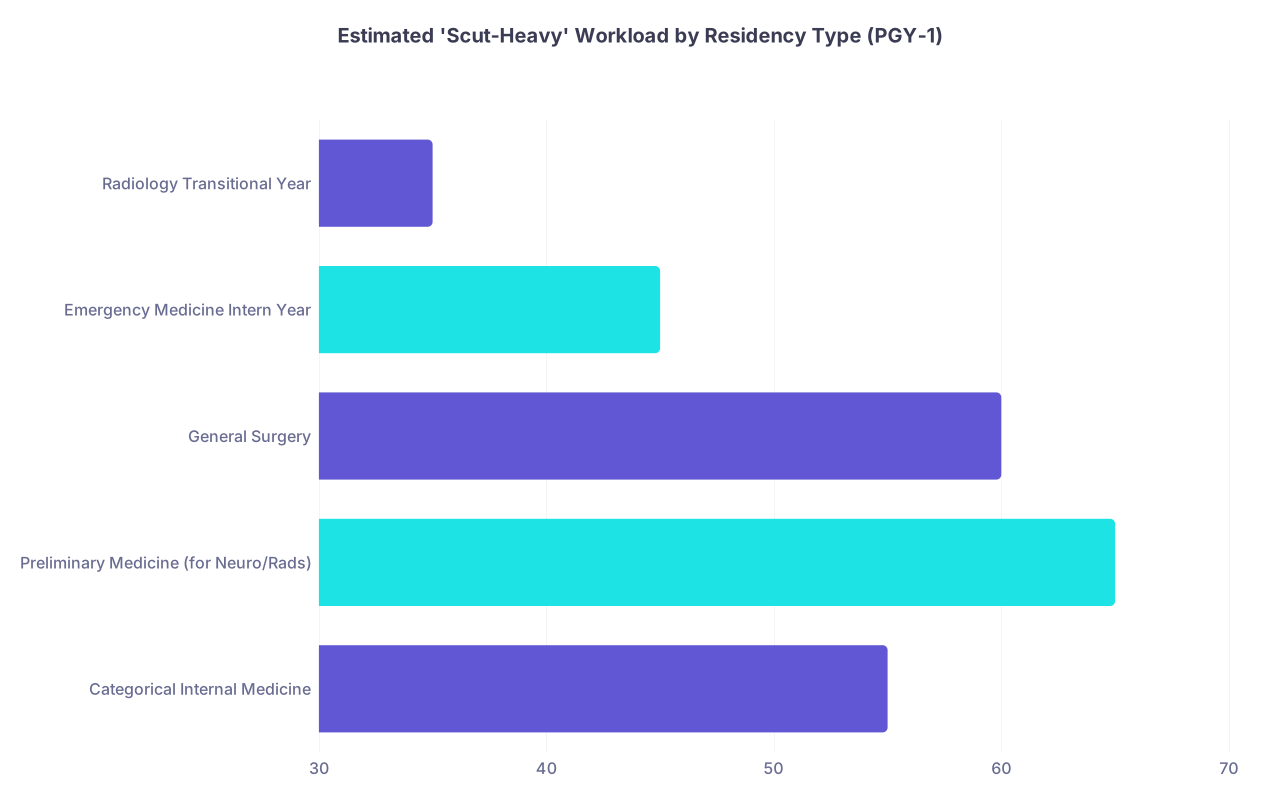
| Category | Value |
|---|---|
| Categorical Internal Medicine | 55 |
| Preliminary Medicine (for Neuro/Rads) | 65 |
| General Surgery | 60 |
| Emergency Medicine Intern Year | 45 |
| Radiology Transitional Year | 35 |
Interpretation (rough, but consistent with lived reality):
- Categorical medicine: Lots of paperwork and orders, but also very high decision-making, especially in community settings. The scut-to-responsibility ratio is not as lopsided as it feels.
- Prelim medicine for non-IM specialties: Often more service-heavy, less investment in your long-term development. This is where “I’m just a warm body” complaints spike. The myth is closest to true here.
- General surgery: High procedural exposure eventually, but floor interns can get buried in discharges, drains, and tracking labs for 30 postop patients. Real responsibility, yes—but the OR-to-floor ratio can feel brutal.
- Emergency medicine: Fewer “clerical” discharges and notes relative to decisions per patient. It’s hard to argue an EM intern is “pure scut” when every shift includes independent initial workups.
- Transitional year / cush prelim: These can actually under-shoot real responsibility, depending on the site. Pleasant, but you may feel undercooked clinically afterward.
So, is “pure scut” real anywhere? At truly malignant or mismanaged programs, yes. But that’s a program design failure, not an inherent feature of intern year.
Supervision vs Autonomy: The Part Everyone Confuses
A lot of interns mistake “I have to run this by someone” for “I’m not really doing anything.”
That’s not how medicine works.
Even ten-years-out attendings run stuff by colleagues, consults, and guidelines. Independence in medicine is never absolute; it’s just progressively higher-level decision-making with different backup patterns.
Here’s what ACGME and most hospitals actually aim for in PGY‑1:
- You initiate the plan based on your assessment.
- You present it and get it modified or approved.
- You implement it via orders and communication.
- You monitor for response and raise alarms when things go sideways.
That’s a full clinical loop. Yes, the attending is the ultimately accountable one. But if you think that makes you “not a real doctor,” you might need to recalibrate what modern team-based medicine looks like.
The Dark Side: When Interns Really Are Used as Scut Labor
Let me be blunt: some places abuse interns. I’ve seen:
- Interns banned from procedures “because coverage” while seniors hoard experience.
- Services where attendings do zero documentation and dump every note, letter, and meaningless template on interns with no teaching attached.
- Call structures where PGY‑1s cover unsafe numbers of cross-cover patients, essentially acting as human alarm systems and order entry terminals all night.
That garbage exists. And it’s not just demoralizing, it’s dangerous. It teaches bad habits: rubber-stamping orders, rushing assessments, viewing patients as “hits” on your list rather than actual sick humans.
But that’s not the inevitable reality of intern year. It’s a sign of a dysfunctional program culture. A healthy service will still have scut, of course, but it will deliberately pair that with:
- Explicit teaching around each “admin” task: why dispo planning matters, how to do clean med rec, how to document to avoid readmission chaos.
- Protection of educational opportunities: cases, procedures, family meetings, OR time.
- Gradual expansion of your decision-making bandwidth, not endless list management.
If you’re in a place that only wants your fingers on the keyboard and never your brain engaged, that’s not “intern year.” That’s exploitation hiding behind tradition.
How to Tell If Your Responsibility Is Real (or You’re Just a Typist)
You cannot fix the entire system as a PGY‑1. But you can be clear-eyed about whether you’re being trained or just used.
A few hard questions I recommend you ask yourself every couple of months:
- Do attendings or seniors ask your opinion first before telling you the plan?
- Are you ever the one deciding, “Is this patient sick enough to escalate right now?”
- When something goes wrong on your patient, do people involve you in the root cause, not just blame you for the paperwork?
- Are you progressively allowed to manage more complex patients, or are you stuck doing the same low-skill tasks month after month?
If the answers are consistently “no,” it’s a red flag. That is closer to the “pure scut” myth being reality, and you should be documenting, escalating, and possibly thinking about transferring.
But if the answers are mostly “yes” and you still feel like it’s all scut? That’s burnout talking, not facts. You’re carrying real clinical responsibility; it just doesn’t look like the heroic fantasy version you had as an MS3.
The Uncomfortable Truth: Scut Is Part of Being a Doctor
There’s one more uncomfortable point nobody likes to say out loud: not all “scut” is actually beneath you.
Care coordination, disposition planning, med rec, chasing records, talking to family—these are not inferior forms of medicine. They are often the highest-yield interventions your patients will ever get.
Plenty of attendings quietly avoid that work by hiding behind “the team.” Then they turn around and tell interns those very tasks are “just scut.” It’s hypocrisy.
No, your entire professional life should not be swallowed by discharge summaries and fax machines. But rejecting that whole category of labor as beneath you is how you become the attending who rounds for 20 minutes and disappears while everyone else cleans up the mess.
The goal is not to eradicate scut. The goal is to ensure it’s shared fairly, linked to learning, and balanced by growing clinical authority.
So, Is Intern Year Pure Scut?
No. For the vast majority of interns in real hospitals, that’s factually wrong.
It’s overloaded with paperwork and administrative sludge, yes. The scut ratio is often absurd. But beneath that noise, you are:
- Writing and executing orders that change outcomes
- Making triage decisions under supervision
- Owning panels of patients, even if you do not fully feel it yet
- Developing the pattern recognition and judgment you’ll lean on for decades
The myth survives because intern year feels degrading at times. Because nobody bothers to name the real responsibility buried inside the chaos. And because some programs really do abuse interns as cheap labor.
But if you look at the actual data—who writes the orders, who documents the care, who gets named in lawsuits, who the system relies on at 3 a.m.—the picture is clear.
You are not “just scut.”
You are a supervised, overworked, sometimes underappreciated physician carrying very real clinical responsibility, wrapped in an infuriating amount of administrative garbage.
Strip away the garbage, and the core is exactly what you signed up for.
Key points:
- Objective data from EHRs and time-motion studies show interns initiate and execute a large share of real clinical decisions, not just clerical work.
- “Pure scut” is usually a sign of a dysfunctional program, not an inherent truth about intern year; when structured well, even unglamorous tasks are tightly linked to real responsibility and learning.