
The mistakes you make on weekend call will haunt you longer than anything you did in med school.
Not because you are a bad doctor. Because weekends are designed—structurally—to make good people screw up: fewer staff, skeleton coverage, new admits stacked on top of sick legacy patients, and everyone too tired to double-check anything. You have to assume the system is not safe and act accordingly.
Let me walk you through the traps I’ve seen residents regret for years—and how you avoid becoming one of those stories people whisper about in sign-out.
1. Walking Onto Call With a Weak Sign-Out
The most dangerous weekend doesn’t start when the pager goes off. It starts when you accept a sloppy sign-out on Friday.
Here’s the classic mistake:
You’re tired, it’s 5:45 pm, handoff board is long, and the outgoing team is talking fast. You nod, click “acknowledge,” and tell yourself, “If something happens, I’ll just look it up.”
That’s how you walk into a minefield blind.
The red-flag sign-out phrases
When you hear these, your alarm bells should go off:
- “Just keep an eye on him.”
- “Stable… for now.”
- “We’re waiting on a CT/MRI/echo/etc.”
- “They were a little hypotensive overnight but they responded.”
- “Blood cultures pending but they look okay.”
- “We think it’s probably just viral.”
Every one of those is a booby trap. On weekends, problems evolve without anyone noticing for hours. That “keep an eye” patient becomes the 4 am rapid response.
What you must clarify before the team leaves
Don’t make the mistake of being “polite” and passive. Be annoying instead. You’ll save yourself.
For each sick or potentially sick patient, insist on:
- Working diagnosis (not just “sepsis”—source? suspected bug?).
- Current clinical trajectory (better, worse, unchanged over last 24 hours).
- Explicit “if/then” plans:
- If fever recurs?
- If MAP drifts under 65?
- If urine output falls?
- If chest pain recurs?
- Pending studies and what you’re supposed to do when they result:
- “If CTA is negative, we stop heparin.”
- “If troponin rising, call cardiology.”
- Code status and family dynamics:
- “Family wants everything,” vs “Already had a GOC conversation; DNR.”
You do not walk out without knowing the one or two patients on each service that could crash. If the outgoing resident shrugs and says, “They’re all fine,” push back:
“Humor me—if someone ruins my night, who is it and why?”
If you skip this, don’t pretend you were “unlucky” when things go bad. You were unprepared.
2. Underestimating Friday Night and Saturday Morning
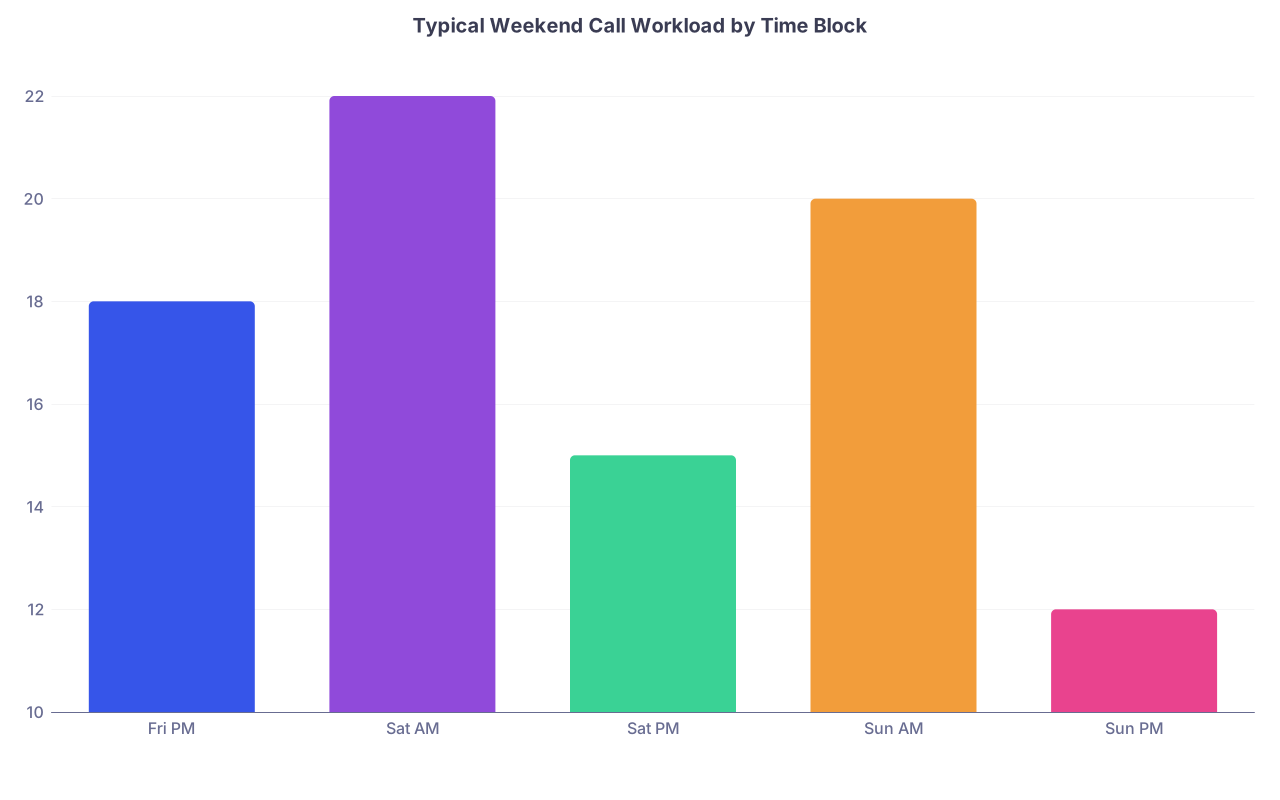
Weekend call isn’t one block of pain. It has phases. The mistake is treating all hours the same.
| Category | Value |
|---|---|
| Fri PM | 18 |
| Sat AM | 22 |
| Sat PM | 15 |
| Sun AM | 20 |
| Sun PM | 12 |
The two worst times:
- Late Friday night (legacy problems + new admissions)
- Late Saturday morning (accumulated issues + day-procedure fallout)
The Friday night trap
You inherit:
- Patients who’ve been in the hospital all week and are “kind of okay”
- Tests ordered all day that result after everyone’s gone
- Marginal vitals brushed off as “we’ll see how they do”
The common mistake:
You sprint to new admissions and ignore the existing floor patients who are quietly circling the drain.
Better approach:
- Before you dive into admits, scroll vitals for the last 24 hours on your list:
- Anyone with:
- Rising HR trend
- Stable but borderline BPs
- New O2 requirement
- New confusion or nursing concern
- Anyone with:
- Make a quick “watch list” of 3–5 patients to eyeball early in the night, even briefly.
Five minutes at the bedside at 7 pm can save you the 3 am “why is this the first time you’re seeing them?” conversation.
The Saturday morning trap
Saturday around 10–11 am is when:
- The early-morning labs are all back.
- Nursing has been stacking “when the doc rounds” questions.
- Family members finally show up and start asking real questions.
- Patients who decompensated mildly overnight and “looked okay” at 6 am turn out… not okay.
The mistake: You do slow, social, thorough rounds on every single patient like it’s a weekday.
Weekend law: You are not there to optimize everything. You’re there to keep people safe and alive until the real team returns.
Prioritize:
- Unstable or potentially unstable patients
- New issues or major overnight events
- Time-sensitive stuff (troponins, imaging, rising creatinine, low Hgb)
- Routine “comfort” items last
If you try to fix everything on every patient, you’ll be buried by noon and miss the truly dangerous stuff.
3. Ignoring Nursing Concerns and Vital Trends
You will regret—deeply—the time you ignored the nurse who clearly tried to warn you.
I’ve watched versions of this play out over and over:
- Nurse at 10 pm: “He just doesn’t look right. HR 110, BP 98/60, RR 22. He was fine this afternoon.”
- Resident: “Those vitals aren’t terrible. Let’s just recheck in a few hours.”
- 3 am: Rapid response. Septic shock. ICU transfer. Chart review shows six hours of warning.
Two things residents routinely blow off
Nursing gestalt
When a good nurse says, “They’re different from before,” don’t argue with numbers. Go see the patient. Now.
You don’t need to stay long. But you do need your own eyes and hands on them.Vital sign trends, not single numbers
99/60 can be okay.
99/60 down from 140/80 over 8 hours with rising HR? That’s not okay.
You should be scanning:
- Rising heart rate over 6–12 hours
- Increasing O2 needs (2L → 4L → 6L)
- Progressive tachypnea
- Creeping fevers
This stuff does not page you automatically. You have to go looking for it.
4. Letting Handoffs Become Garbage
Your Saturday-to-Sunday and Sunday-to-Monday handoffs are extremely high risk. People are tired, rushed, and tempted to just “get out.”

| Step | Description |
|---|---|
| Step 1 | Friday Sign Out |
| Step 2 | Saturday Coverage |
| Step 3 | Saturday Night Sign Out |
| Step 4 | Sunday Coverage |
| Step 5 | Sunday Night Sign Out |
| Step 6 | Monday Primary Team |
| Step 7 | Sick Patient Missed |
| Step 8 | Pending Result Ignored |
Two stereotypical mistakes:
You don’t clean up your own mess before signing out
- Pending CT angio for PE? You “mention it” but don’t write a concrete plan.
- New Afib with RVR? You slow them down but don’t clarify anticoagulation strategy.
You underestimate how little the next person knows
- They’re coming in with even less context than you had Friday.
- Anything you barely understand, they definitely will not.
How to not be the resident everyone curses on Monday
For every high-risk patient you pass off, include:
- One-sentence story: “65F with pneumonia, got worse Friday, better after ICU stepdown, still borderline.”
- Current problem list (not every problem—just active dilemmas).
- Explicit contingency plans:
- “If O2 > 4L or RR > 26, get VBG, CXR, page ICU.”
- “If SBP < 90 after 500 cc bolus, start norepi in ICU – don’t delay for more fluids.”
- Pending results and action:
- “If CT head negative, restart DOAC tonight.”
- “If K+ still >6 after second dose of Lokelma, call renal.”
Garbage in, garbage out. You can either be the resident who breaks this chain, or the one everyone remembers for the worst handoff of the month.
5. Over-Treating… or Under-Treating Overnight Issues
“Do nothing” and “do everything” are both easy. The art is in doing enough.
Two misery-inducing patterns:
Pattern A: Over-treat everything
- Every mild BP drop → full workup, repeat labs, CT scans, IV fluids
- Every 100.5 fever → pan cultures, broad-spectrum escalation, fluid bolus, lactate
What happens?
- You wake people up all night for labs they don’t need.
- You blow up their kidneys with reflexive fluids.
- You create ridiculous Monday morning mess: random meds, unclear plans, iatrogenic problems.
The hidden cost? You become so buried in noise that when someone is actually sick, you’re too tired to see it.
Pattern B: Under-treat subtle deterioration
This is the one people regret for years.
The 88-year-old with pneumonia who’s “a little sleepy” at 1 am.
The GI bleed who “just dropped one more gram” but “looks okay.”
The DKA patient whose gap is closing but they’re still tachypneic and borderline.
You tell yourself, “I’ll recheck in a few hours.”
You don’t. Because five other fires start.
You arrive at 6 am sign-out with a crashing or dead patient and a pit in your stomach.
How to avoid both extremes
Use a simple internal checklist when something feels off:
- Is there a plausible, benign explanation?
- Are they clearly stable right now? (mental status, perfusion, work of breathing)
- What is the worst thing this could be? How likely?
- Can I safely defer action if I set a hard re-check time or threshold?
And then document briefly:
- “Seen at 00:30 for X. Vitals Y, exam Z. Likely A, less likely B. Ordered C. If D occurs, plan E.”
You are not doing this to cover yourself legally. You’re doing it to force your brain to think clearly for 30 seconds instead of acting on reflex or laziness.
6. Ignoring Your Own Fatigue and Cognitive Bandwidth
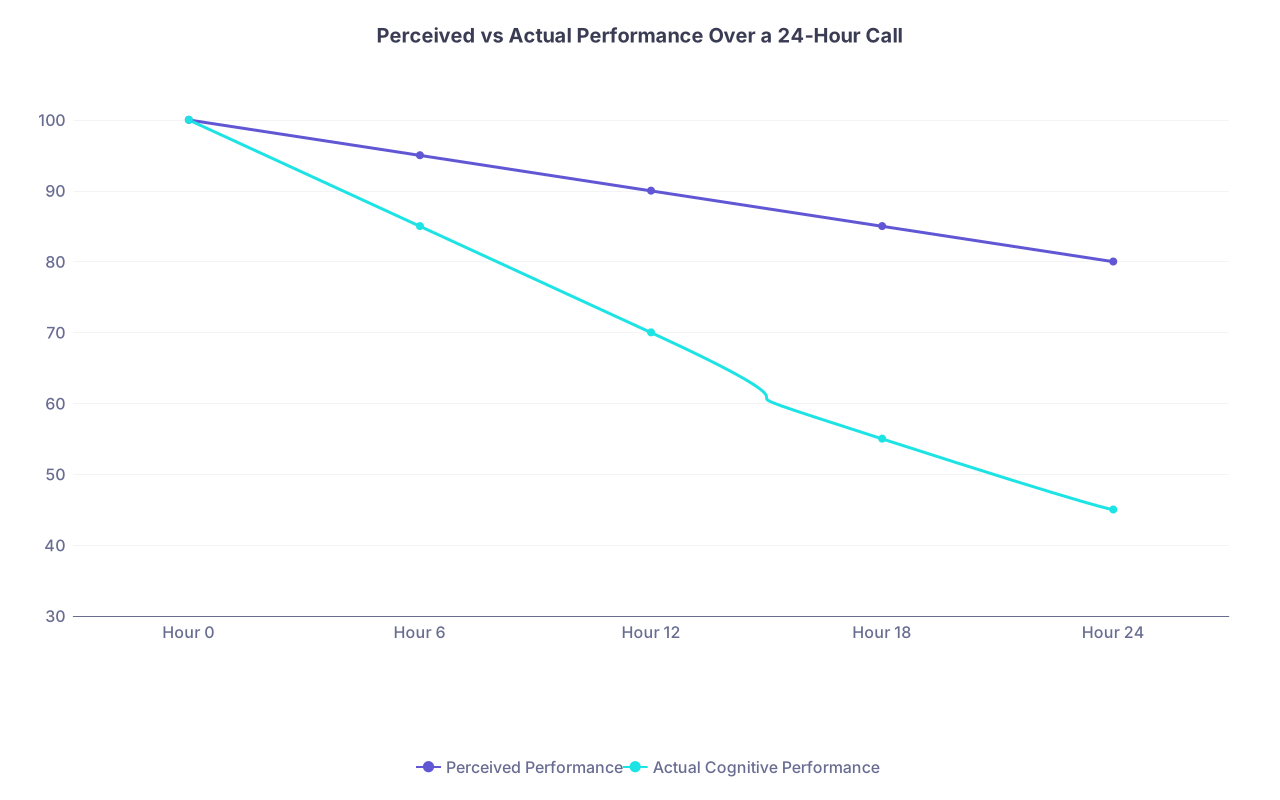
The longer the call, the dumber very smart people become. By Sunday afternoon, you will feel fine. You will not be fine.
| Category | Perceived Performance | Actual Cognitive Performance |
|---|---|---|
| Hour 0 | 100 | 100 |
| Hour 6 | 95 | 85 |
| Hour 12 | 90 | 70 |
| Hour 18 | 85 | 55 |
| Hour 24 | 80 | 45 |
Classic fatigue mistakes:
- Writing orders on the wrong patient
- Confusing similar names/rooms
- Forgetting to finish critical orders you thought you placed
- Misreading labs (dropping Hgb vs stable; K+ 6.5 vs 5.5)
Simple, unsexy protections you better use
You are not heroic if you skip these. You’re reckless.
- Forced “pause” before high-risk orders
- Pressors, insulin infusions, anticoagulation, blood product orders
- Before you sign, literally say in your head: “Correct patient? Correct drug? Correct dose? Correct route?”
- Name-room double check
- Every order set: look at the banner twice.
- Use the damn checklist for admits
- Med rec? DVT prophylaxis? Diet? Code status documented? Essential home meds reordered?
And then this one, which residents love to dismiss:
- Micro-naps over macho nonsense
- If there’s a 20–30 minute lull, set an alarm, lie flat, eyes closed.
- I’ve seen residents go from sloppy to functional with a 15-minute reset.
- You are not “wasting time.” You are preventing yourself from harming someone at 4 am.
7. Abandoning Communication With Families on Weekends
Families do not disappear on weekends. They become more frustrated and less informed. That anger often explodes right when you’re most overloaded.

Common mistake: You dodge all complex conversations because “I’m just the covering resident.”
Then Monday comes and the primary team walks into:
- “No one has told us anything in three days.”
- “Why was nothing done when she got worse on Saturday?”
- “We want to talk to a lawyer.”
You can’t fix everything, but you can avoid racking up justified anger.
What you should say as the weekend resident
You don’t need a full 30-minute family meeting. But you do need to:
- Introduce yourself briefly when they’re clearly distressed.
- Give a simple, honest status:
- “She’s sicker than she was yesterday, mostly because X.”
- “Right now we’re doing A, B, and monitoring C.”
- State limits clearly:
- “I’m covering this weekend, but I’ll make sure the weekday team sees this update.”
- “We don’t need to make big long-term decisions tonight, but if her breathing worsens, we may need a higher level of care.”
If you avoid families completely because it’s awkward or you’re busy, don’t be surprised when you later become “the resident who didn’t tell us” in every complaint email.
8. Discharging Too Fast… or Refusing to Discharge Anyone
Weekend discharges can be either a gift or a bomb.
| Scenario | Risk Level | Typical Outcome |
|---|---|---|
| Weekday team discharge | Low | Planned, coordinated |
| Thoughtful weekend discharge | Moderate | Usually safe if careful |
| Rushed weekend discharge | High | Readmission, complaints |
| Avoid all weekend discharges | Moderate | Bed crunch, ED backups |
The dangerous version
You’re swamped. You see a “ready for discharge” note from Friday:
- “Home today if stable.”
- “Likely DC tomorrow.”
- “SNF pending placement.”
You:
- Skim the chart.
- See no major overnight events.
- Print papers, sign scripts, out the door.
On Monday, you hear:
- They were readmitted Sunday night with the same problem.
- They never got meds because pharmacy was closed.
- PT never cleared them. They fell at home.
The equally bad flip side
Some residents swing fully in the other direction: “I will never discharge on weekends; it’s too risky.”
Now you’ve got:
- Bed block
- ED holds for 24–48 hours
- ICU upgrades delayed because there’s nowhere to send stable step-down patients
That’s not safe either.
The sane middle ground
For weekend discharges, insist on:
- One last systems check:
- Vitals stable trend, not just last spot.
- Labs reasonably stable (no rapidly dropping Hgb/Na/worsening AKI).
- Clear follow-up plan:
- Does the patient know who and when?
- Med access:
- Critical meds (antibiotics, anticoag, insulin) accessible same day?
- Functional status:
- PT/OT actually evaluated if there was any mobility issue.
If any of this is missing and it’s not urgent to send them home, it’s okay to say:
“We’ll have the primary team reassess on Monday.”
Just don’t be lazy and default to that every time because you’re scared.
9. Trying to Be a Hero Instead of Asking for Help
I’ve watched smart residents drag patients through 8 hours of slow deterioration instead of calling for help because:
- “I should be able to handle this.”
- “I don’t want to wake the attending.”
- “The ICU will just yell at me.”
Then, at 5 am, the patient is peri-arrest, and now everyone is awake and furious. Including you.

Here’s the rule no one says bluntly enough
If you’re debating whether to call ICU or the attending, you should have called 10 minutes ago.
People regret the intensive care consults they delayed, not the ones they placed “too early.”
When to escalate:
- You’ve increased O2 requirements twice and they’re still working hard to breathe.
- Hypotension requiring repeated boluses.
- Lactate rising or not improving.
- Mental status declining without a simple, reversible explanation.
- Your gut says: “This patient will not make it another 4–6 hours on the floor.”
And when you feel that ping of guilt—“Am I overreacting?”—say it out loud on the phone:
“I might be over-calling, but I don’t want us to miss something.”
Most decent intensivists and attendings respect that far more than, “We’ve been watching them for 10 hours and now they’re tanking.”
10. Letting Documentation Fall Apart (and Then Getting Burned)
No, you don’t need novels. But if your weekend notes are pure garbage or nonexistent, you will get burned.

The mistake: You tell yourself, “I’ll chart that later,” in the middle of a hectic night.
You never do. Monday comes. Everyone’s mad and asking:
- “Who decided to hold the anticoagulation and why?”
- “Why were antibiotics broadened?”
- “Why wasn’t family called when she worsened Saturday night?”
You did have reasons. You just didn’t leave any trace.
Minimum viable documentation that actually protects patients (and you)
For significant events or changes, a brief note is enough:
- Time seen, why, key findings
- Your assessment of risk (e.g., “Higher concern for PE vs just anxiety”)
- What you did
- What you planned to monitor or recheck
- Any escalation or call for help (or reasons you didn’t yet)
You’re not writing for lawyers. You’re writing so that:
- The Monday team understands what happened.
- Your future self remembers why you did what you did at 2:17 am.
The regret isn’t “I didn’t write a perfect note.”
The regret is “I look negligent because the chart shows nothing.”
11. Leaving Call Without Cleaning Up the Landmines
The last 1–2 hours of your weekend call are not victory lap time. They’re landmine removal time.

| Step | Description |
|---|---|
| Step 1 | Start End of Call |
| Step 2 | Review Sick List |
| Step 3 | Check Pending Critical Results |
| Step 4 | Update Handoffs |
| Step 5 | Close Loops With Nurses |
| Step 6 | Page Primary Teams If Needed |
| Step 7 | Sign Out and Leave |
Big end-of-call mistakes:
- Leaving critical results still unacknowledged because “the day team will see them.”
- Not telling anyone about that borderline patient you’ve been watching.
- Letting the next resident find out about the 6 am rapid response from the EMR instead of your mouth.
Spend your last 45–60 minutes:
- Rechecking the sickest 2–3 patients one more time.
- Reviewing new overnight imaging/labs for major surprises.
- Updating the handoff with:
- “Had RRT at 3 am for X, now Y, still high risk for Z.”
- “CT still pending—needs follow-up this morning.”
- Closing the most urgent loops with nursing:
- “Primary team will be here soon; watch for A/B/C and page them first.”
Then—and only then—walk out.
You’ll still be tired. But you won’t walk through the week replaying the one thing you know you should have done before you left.
FAQs
1. How do I prioritize when everyone seems sick and the pager won’t stop?
Use ruthless triage:
- Airway/breathing issues (increased O2, work of breathing, altered mental status)
- Circulation issues (hypotension, chest pain, new arrhythmia, bleeding)
- Altered mental status without clear benign cause
- Rising lactate, worsening labs in septic patients
- Everything else
And say this to the nurse if you’re delayed:
“I’m tied up with a more unstable patient, but I will get there. If X, Y, or Z happens before I arrive, page me STAT or call RRT.”
You’re not Superman. You’re one human with limited bandwidth—own that and set expectations.
2. How much should I bother my attending on weekend call?
More than you think. Less than every five minutes. A decent rule: if you’d feel sick to your stomach explaining a bad outcome later and admitting you didn’t call, then call. Situations involving possible ICU transfer, major treatment escalation (pressors, new anticoagulation in a borderline patient, major code status shifts), or persistent unease after you’ve seen the patient—those are attending-level problems.
3. What’s the best way to handle a nurse who seems to be paging “too much”?
Don’t be a jerk. Start with a quick in-person or phone reset when things calm down:
“Hey, last night was a lot. I want us on the same page—these are the things I definitely want to be called for right away, and here are things that can wait an hour if I’m tied up. What do you need from me to feel safe?”
Annoying paging is often just poor communication plus lack of trust. Fix that and your night gets much easier.
4. How do I avoid missing subtle deterioration if I’m buried in admissions?
Create a “watch list” at the start of the shift and update it during sign-out and rounds: 3–5 names max. Set mental (or literal) alarms to re-check them every few hours, even if it’s just a quick chart review and brief bedside check. If someone moves from “mildly concerning” to “I’m thinking about them more than once an hour,” you escalate—call a senior, ICU, or attending. That’s the point where people either save the patient or say “we’ll see” and regret it.
5. How do I protect myself emotionally after a bad weekend call outcome?
First, don’t self-isolate. Talk to your senior, attending, or a trusted co-resident. Walk through the timeline honestly—where did you do well, where would you change things next time? Second, separate outcome from process: a death or ICU transfer does not automatically mean you failed. The question is: did you ignore red flags, blow off help, or cut corners? If yes, adjust brutally and move on. If no, then you’re in the reality of medicine: sick people sometimes die despite good care. Learn what you can, and don’t let shame stop you from asking for help on the next call.
Remember:
- Weekend call is structurally unsafe. You stay safe by assuming that and building your own guardrails—better sign-outs, real triage, early escalation.
- The things residents regret most are not the hard calls they made in good faith, but the red flags they brushed off because they were tired, rushed, or worried about bothering someone.
- You do not have to be perfect. You do have to be deliberate: see the high-risk patients early, listen to nurses, document your thinking, and ask for help before it’s obviously too late.