
The fantasy that cutting duty hours would fix resident burnout was wrong. The data are clear: fewer hours help a little, but they do not touch the core of why residents are burning out.
Let me walk through what the numbers actually show, not what program directors wish were true or what residents hope will happen “next reform cycle.”
What We Mean By “Duty Hours” And “Burnout”
Before I start throwing data around, we need working definitions.
Duty hours: almost all major studies anchor on ACGME-style limits.
- Pre-2003: Commonly 100+ hours/week, Q3–Q4 call, 36+ hour shifts.
- 2003 ACGME change: 80-hour weekly limit (averaged), 24+6 shift cap, at least 10 hours off between shifts.
- 2011 tightening: 16-hour cap for interns, somewhat stricter rest rules.
- Mid‑2010s flexibility trials: “Flexible” duty hours (e.g. iCOMPARE, FIRST) allowing longer shifts but still within 80 hours/week.
Burnout: mostly measured using versions of the Maslach Burnout Inventory (MBI) or derivatives.
- Emotional exhaustion
- Depersonalization (cynicism)
- Reduced personal accomplishment
Depending on the cutoff, “burned out” often means moderate-to-high scores on emotional exhaustion and/or depersonalization.
Across large multi‑specialty surveys in the U.S. over the last decade, 35–60% of residents screen positive for burnout at any given time. That is not a rounding error. That is a structural problem.
What Happened When Duty Hours Were Cut?
Let’s start with the biggest structural intervention: the 2003 and 2011 ACGME reforms. The narrative at the time was simple: residents are overworked, so cap the hours and burnout will fall. Reality was more complicated.
2003 ACGME Reform: 80‑Hour Work Week
The 2003 change remains the largest natural experiment we have on duty hours. Multiple cohort and repeated cross‑sectional studies compared residents before vs. after.
Findings were messy but some patterns repeat:
- Sleep duration modestly increased (often by 0.5–1.5 hours per 24‑hour period).
- Self‑reported “chronic fatigue” scores improved slightly.
- Burnout rates? Mostly flat.
You see numbers like this:
- Burnout prevalence pre‑2003: roughly 45–55% in internal medicine and surgery residents.
- Burnout prevalence post‑2003: often still 40–55%, with some programs reporting no significant change after adjustment for year, specialty, and PGY level.
The most honest summary: the 80‑hour rule shaved off some extreme fatigue but did not drive a clear, consistent drop in burnout.
A simple way to frame what happened:
- Input: reduce weekly hours by maybe 10–20 hours for many programs.
- Output: small sleep improvement, marginal changes in fatigue, little change in burnout metrics.
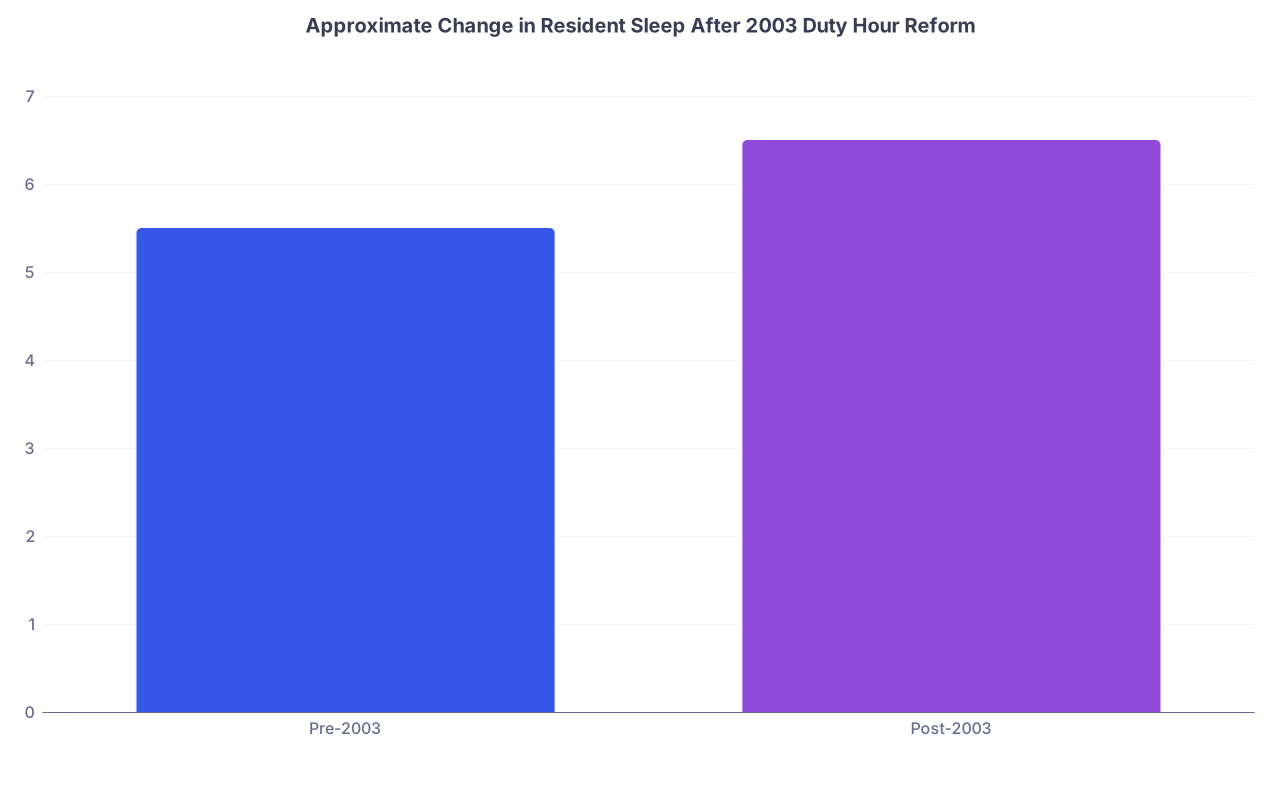
| Category | Value |
|---|---|
| Pre-2003 | 5.5 |
| Post-2003 | 6.5 |
Several large multi‑institution surveys also noted something unintuitive: residents reported similar or higher “work intensity” per hour. Less time, same workload, more compression. Think fewer hours, but more pages per hour, more notes per hour, more discharges per shift.
2011 Reform: 16-Hour Cap For Interns
The 2011 rules — especially the 16‑hour cap for PGY‑1 — spawned a fresh wave of studies. The logic was straightforward: no more 24‑hour calls for interns, so fatigue and burnout should drop.
Reality again refused to cooperate.
A consistent pattern appears in internal medicine and surgery cohorts:
- Sleep: interns sometimes gained about 1 hour of sleep per 24‑hour period.
- Burnout: often unchanged.
- Depressive symptoms: in several analyses, worsened slightly.
Example signal from internal medicine:
- Before 2011: burnout prevalence in interns ~50–55%.
- After 2011: burnout prevalence often remained in the same ballpark, sometimes tipping upward. Depressive symptom scores in some cohorts increased by 10–20% relative.
Attrition and distress did not suddenly improve. Interns had shorter overnight shifts but more handoffs, more fragmentation, and a sense of “less ownership” of patients. Many reported feeling less prepared for senior roles, which correlates with distress and lower self‑efficacy.
In other words, the 16‑hour rule boosted sleep but did not buy the psychological protection people were expecting.
The Flexibility Trials: FIRST, iCOMPARE, And The Illusion Of Longer Hours
Program directors pushed back against rigid duty hours, arguing that continuity and education were suffering. That gave us the big “flexible” duty‑hour trials.
FIRST Trial (Surgery)
The FIRST trial (Flexibility in Duty Hour Requirements for Surgical Trainees) randomized general surgery programs to:
- Standard ACGME rules, or
- Flexible schedules (variable shift lengths, some longer calls), still respecting the 80‑hour cap overall.
Key outcomes:
- 30‑day patient mortality and complications: no significant difference.
- Education outcomes and board exam performance: no meaningful difference.
- Resident satisfaction with well‑being: mixed, small differences. No consistent major win for either side.
On burnout specifically, broad measures of “overall well‑being” and “satisfaction with work‑life balance” did not show dramatic improvements in either group. In some surveys, flexible residents reported more continuity and slightly better educational experience but also felt more tired. Net effect: tiny and not consistently in one direction.
iCOMPARE (Internal Medicine)
The iCOMPARE trial randomized internal medicine programs to:
- Standard duty hours (including 16‑hour caps for interns), or
- More flexible schedules (longer shifts allowed, still ≤80 hours/week).
Outcomes:
- Sleep duration: nearly identical between flexible and standard programs.
- Sleepiness (Epworth Sleepiness Scale) and alertness: no clinically meaningful difference.
- Patient safety measures: no clear deterioration with flexibility.
- Burnout and depressive symptoms: high in both groups, again without large differences attributable to flexibility vs standard.
The core message from these trials: within the 80‑hour framework, tweaking shift length and flexibility does not dramatically change burnout metrics. You can move the levers around inside the same total volume of work, but the psychological load and system friction remain.
What Large Surveys Show: Burnout Is Only Weakly Tied To Hours
The more data you look at, the more one correlation pops out: duty hours alone explain only a small fraction of burnout variance.
Look at broad cross‑sectional surveys of U.S. residents (and residents globally):
- Burnout rates hover between 35% and 60% across specialties.
- If you run multivariable models, total weekly hours usually correlate with burnout, but the effect size is modest and often dwarfed by other factors.
The repeated pattern:
- Residents working 80+ hours certainly have higher burnout than those working 50–60.
- But once you are above roughly 55–60 hours/week, the curve starts flattening. Going from 60 to 70 to 80 hours increases burnout probability, but not linearly.
A simplified conceptual example (to illustrate the shape, not exact values):
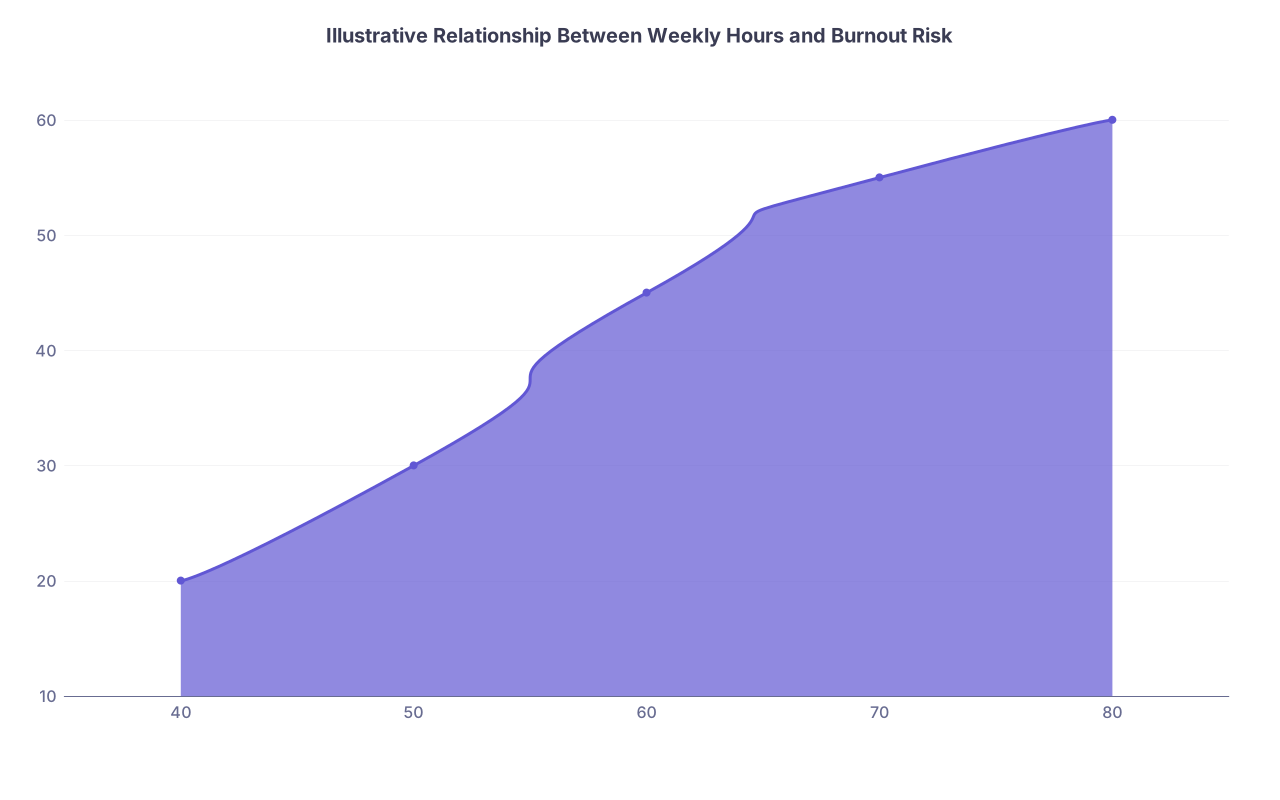
| Category | Value |
|---|---|
| 40 | 20 |
| 50 | 30 |
| 60 | 45 |
| 70 | 55 |
| 80 | 60 |
The exact percentages differ by study, but the relationship is roughly this:
- Big jump between 40 and 60 hours.
- Smaller incremental increase from 60 to 80.
- Massive variance around each point explained by other variables: specialty, autonomy, support, mistreatment, documentation burden.
The data also highlight something uncomfortable: residents with the same hours but worse culture and less support have dramatically higher burnout. That means the institution matters more than most people admit.
The Real Predictors: It Is Not Just How Long You Work
When researchers actually put everything into the same model—hours, specialty, demographics, institutional variables—duty hours are rarely the major driver.
Patterns that show up across multiple studies:
Workload Intensity and Efficiency
- Number of admissions per shift and number of patients per resident strongly predict emotional exhaustion.
- Time spent on documentation vs direct patient care correlates with burnout risk. Residents who report “excessive” EHR work have significantly higher burnout odds, even at the same total hours.
- Compressed work—the same tasks in less time—neutralizes much of the benefit of reduced duty hours.
Control and Autonomy
- Low perceived control over schedule, patient care decisions, and educational content is strongly tied to burnout.
- Residents who feel like “cogs in a machine” burn out faster than those who feel their clinical judgment is respected, regardless of weekly hours.
Mistreatment, Bullying, and Discrimination
- Surveys that include harassment, discrimination, or public humiliation show very strong associations with burnout, depression, and suicidal ideation.
- In some analyses, experiencing recurrent mistreatment raised burnout risk more than working 10 extra hours per week.
Specialty Differences
- Surgical subspecialties, OB/GYN, and EM often report high burnout, but internal medicine and pediatrics are hardly “safe.”
- The more high‑stakes, high‑intensity, and litigation‑prone the field (plus frequent nights), the higher the burnout rates tend to be.
Sleep Debt and Circadian Disruption
- Total weekly hours matter less than chronic sleep debt and circadian chaos.
- Rotating schedules, rapid flip‑flops between nights and days, and constant short‑call/long‑call transitions correlate strongly with both burnout and depressive symptoms.
If you look at the odds ratios in multivariate models, duty hours creep up as modest risk factors. Culture, mistreatment, and unrealistic workload per hour are heavier hitters.
Tradeoffs of Duty Hour Cuts: Where The System Backfires
Every reform has side effects. The data around duty hour reductions show some predictable tradeoffs.
1. More Handoffs, Less Continuity
Shorter shifts mean more transitions of care:
- Increased handoffs raise the risk of communication errors. Several patient safety studies have flagged concerns about this, even as others show net-neutral outcomes due to standardization.
- Residents lose the narrative arc of a patient’s hospitalization. That hits both education and professional satisfaction. You become the person who “admits and signs out,” not the one who sees a diagnosis unfold.
For many residents, that erosion of continuity translates into more frustration and less sense of accomplishment—two drivers of burnout.
2. Compressed Work, Higher Intensity
Programs did not uniformly add more residents or advanced practice providers when duty hours were capped. Work did not magically disappear.
Consequence: the same census and throughput expectations got squeezed into fewer resident-hours.
Residents report:
- Faster pre‑rounding, more superficial charting, more “just get it done” orders.
- Higher cognitive load per hour, less time for teaching or thoughtful care.
The net effect is that an 80‑hour week now may feel more cognitively brutal than an 80‑hour week twenty years ago, purely because of EHR complexity and throughput pressures.
3. “Shift‑Work Mentality” And Professional Identity
This phrase shows up repeatedly in qualitative work: “shift‑work mentality.”
- Older generations call it a loss of professionalism.
- Younger residents call it survival.
Either way, very strict duty hour rules created situations where residents must leave, even when they feel a strong ownership pull: a crashing patient, a near‑complete diagnostic puzzle, an emotionally intense family conversation.
That forced dissonance—between what residents feel they “should” do for their patients and what the rules demand—creates moral distress. Another well‑documented pathway to burnout.
So Do Duty Hours Matter At All?
They do. But not as a magic lever.
From the aggregated data:
- Working extreme hours (90–100+) clearly increases risk of burnout, depression, and medical errors. No real controversy there.
- Moving from truly extreme hours down to ~70–80 reduces some of that risk.
- Below about 60 hours per week, further reductions yield diminishing direct returns on burnout, unless accompanied by changes in culture, workload expectations, and support.
Think of duty hour limits as a necessary but insufficient condition. They prevent worst‑case scenarios. They do not by themselves create a healthy learning environment.
What Actually Reduces Burnout: Evidence‑Based Levers
When institutions move beyond “counting hours” and start analyzing workflow and culture, the numbers look better.
Several interventions with measurable impact:
Protected Non‑Clinical Time
- Programs that carve out real, protected time for didactics and scholarly work (not constantly encroached on by pages and tasks) show lower burnout scores.
- The effect is not huge, but consistent: residents feel their time is valued and that education, not just service, matters.
Staffing and Task Redistribution
- Adding scribes, more nurses, or APPs to offload clerical and low‑complexity tasks allows residents to focus on higher‑value clinical and educational work.
- Studies where task-shifting decreased “note bloat” and scut show meaningful drops in emotional exhaustion.
Predictable Schedules + Smarter Night Coverage
- Standardizing rotation patterns (e.g., dedicated night float blocks with adequate recovery) is better than constant chaotic flipping.
- Residents with more predictable schedules and longer recovery periods between night blocks report better sleep and lower burnout scores, even at similar total hours.
Anti‑Mistreatment Efforts That Actually Bite
- Institutions that track mistreatment, intervene with offending faculty, and visibly hold people accountable show lower rates of resident-reported harassment and, downstream, lower burnout.
- You cannot spreadsheet your way around a toxic attending who constantly belittles residents in front of patients.
Mental Health Access With Real Confidentiality
- Accessible, confidential counseling—without fear of licensing retaliation or program retaliation—correlates with lower severe distress and suicidal ideation.
- The effect size on burnout is modest but not trivial.
None of these require blowing up the 80‑hour cap. They target the structure and culture of work, not just the length.
Comparing Different Approaches Side by Side
Here is a concise comparison of how different duty‑hour policies stack up on key outcomes, based on aggregated findings from large studies and trials:
| Policy Model | Burnout Change | Sleep Change | Patient Outcomes | Education Impact |
|---|---|---|---|---|
| Pre‑2003 (often 90–100+ hrs) | High burnout | Poor | Variable | High volume, variable teaching |
| 2003 80‑hr Cap | Small ↓ or none | Small ↑ | Generally neutral | Mixed, slightly less continuity |
| 2011 16‑hr Intern Limit | Mixed/none | Modest ↑ | Neutral | Concerns about preparedness |
| Flexible 80‑hr (FIRST/iCOMPARE) | Similar | Similar | Neutral | Slight ↑ continuity, mixed satisfaction |
| 80‑hr + Culture/Workflow Changes | Moderate ↓ | Similar or ↑ | Neutral or improved | Better perceived education |
The pattern is obvious: duty hour rules alone mostly shift sleep and continuity at the margin. When combined with culture and workflow changes, burnout actually moves.
What This Means For Residents Right Now
You cannot individually rewrite ACGME policies, but you can be strategic about where you push and what you measure.
From a data‑driven standpoint, three resident‑level moves actually matter:
Track your reality, not the brochure.
- Log actual weekly hours, number of patients, and sleep. Patterns over 4–8 weeks are more useful than anecdotes.
- If your program is parked at 80–90+ actual hours every week despite “official compliance,” that is a quantifiable problem, not just a vibe.
Aim for sleep consistency and recovery, not perfection.
- The data show chronic sleep debt is worse than occasional long shifts. Prioritize consecutive recovery nights when off; protect that time aggressively.
- Fight against subtle creep of extra “just stop by” tasks on post‑call days. Those add up.
Channel complaints into structure.
- When you point out burnout, link it to specific drivers: documentation time, cross‑cover volume, mistreatment patterns, unpredictable flip‑flop overnight calls.
- Program leadership is much more likely to act when you bring pattern‑based data instead of generic distress.
You cannot fix systemic issues alone, but you can influence how your own workload is framed and measured. And programs respond faster when residents show them numbers that tie specific pain points to burnout and, ultimately, to patient safety and recruitment.
Bottom Line: What Studies Actually Say About Duty Hours And Burnout
Compressing this down to the essentials:
- Cutting duty hours from extremes reduces fatigue but has only modest, inconsistent effects on burnout unless accompanied by deeper changes in workload and culture.
- Within the 80‑hour framework, shift length flexibility vs rigidity barely moves burnout metrics; the real drivers are workload per hour, autonomy, mistreatment, sleep disruption, and system inefficiency.
- Programs that combine reasonable duty hours with concrete workflow, culture, and support changes see the only meaningful, reproducible drops in resident burnout. Counting hours is the floor, not the ceiling.