
Only 16% of residents report getting the recommended 7 hours of sleep on workdays. Everyone else is running a chronic sleep deficit while writing orders, pushing pressors, and doing consent for surgery.
The data on resident sleep is no longer ambiguous, and it is not kind. We have enough numbers now—on hours, on errors, on near-misses, on crash risk—to stop pretending this is just about “resilience” or “grit.” It is a system-level math problem. And the math does not work in your favor.
Let’s walk through what the numbers actually show about sleep, error rates, and night float—and what that means for how you should manage your own schedule and risk.
1. How Much Are Residents Actually Sleeping?
The short answer: less than they think, and far less than is physiologically optimal.
Across multiple large surveys:
- Residents average about 5–6 hours of sleep on workdays.
- A non-trivial fraction dip below 4 hours during heavy rotations or call.
One major multicenter survey of internal medicine residents found:
- Mean sleep on workdays: ~6.3 hours
- Mean sleep on days off: ~7.8 hours
- About 40–50% met criteria for chronic sleep deprivation.
And that is self-reported data, which usually overestimates sleep. When you put actigraphy or wearables on people, the numbers drop.
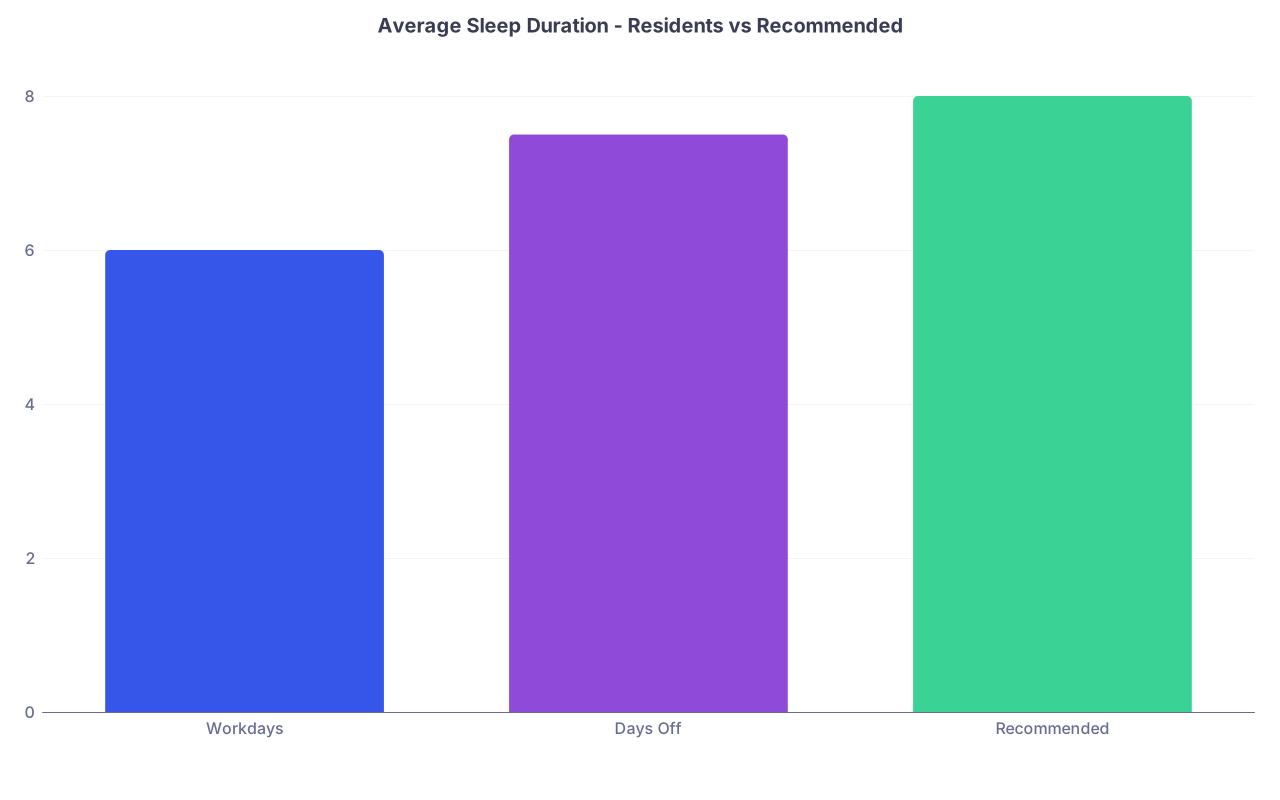
| Category | Value |
|---|---|
| Workdays | 6 |
| Days Off | 7.5 |
| Recommended | 8 |
If you frame it mathematically:
Running at 6 hours per night for 5 nights means you are 10 hours of sleep “in debt” by Friday morning compared with a baseline of 8 hours. That is more than an entire full night of lost sleep stacked into your pre-call brain.
The more you accumulate that debt, the more your cognitive performance, impulsivity, and risk recognition degrade. This is not opinion; this has been measured like a lab value.
2. Sleep Loss and Error Rates: The Hard Numbers
If you strip away all the “I did 120 hours a week and survived” stories, the relationship is brutally linear: less sleep, more errors.
Two core data points I come back to.
2.1 Extended shifts vs shorter shifts
The classic numbers from internal medicine and ICU cohorts:
- Residents working traditional extended-duration shifts (24–30 hours) had:
- About 36% more serious medical errors
- About 5–7 times more attentional failures at night
- Higher rates of diagnostic and medication errors
One widely cited trial of interns showed:
- Serious errors per 1000 patient-days:
- Traditional schedule (with 24+ hour shifts): ≈35
- Reduced-hours schedule (no 24+ hour shifts): ≈22
That is roughly a 37% drop in serious errors by limiting the length of shifts. Same residents. Same training level. Different sleep burden.
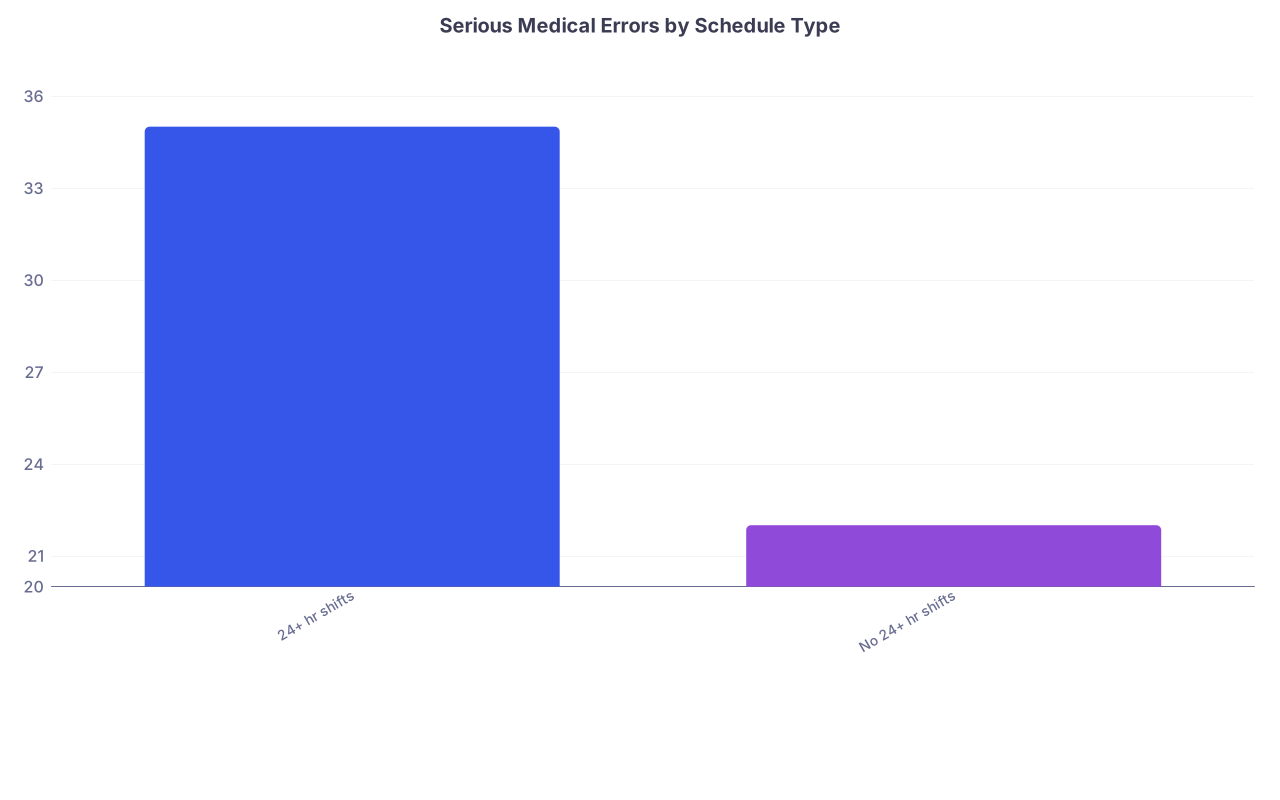
| Category | Value |
|---|---|
| 24+ hr shifts | 35 |
| No 24+ hr shifts | 22 |
Translate that into practice: if you admit 15 patients overnight on a 28-hour call, your probability of making at least one significant error is materially higher than on a better-rested day. You may “feel fine.” Your error rate strongly disagrees.
2.2 Dose-response: hours awake vs impairment
The neurocognitive data are even more damning. Being awake:
- ~17 hours straight (e.g., 6 a.m. to 11 p.m.) produces performance deficits similar to a blood alcohol concentration (BAC) of about 0.05%.
- ~24 hours awake approximates a BAC of 0.10%, which is over the legal driving limit in most countries.
People assume they “get used to it.” The psychomotor vigilance test data show otherwise: performance continues degrading, but subjective awareness of impairment plateaus. You feel “functional” while making more and more mistakes.
The summary: error rates are not random. They track almost monotonically with how long you have been awake and how sleep-deprived you are over the preceding days.
3. Night Float vs Traditional Call: What The Data Actually Say
Programs tend to sell night float as the safer alternative. The data are more complicated than the slogan.
The trade-off is straightforward:
Traditional q4 or q5 call:
- Very long duty periods (24–28 hours)
- Fewer handoffs
- Catastrophic fatigue on post-call days
Night float systems:
- Shorter duty periods (often 12–14 hours overnight)
- More consecutive nights
- More handoffs and continuity gaps
From a numbers perspective, you are swapping one kind of risk for another.
3.1 Sleep on night float vs 24-hour call
On average, residents on a week of night float:
- Sleep longer per 24-hour period than during a heavy call month
- But often shift to very irregular, fragmented daytime sleep
Across studies, typical patterns look like:
| Schedule Type | Mean Sleep / 24h | Longest Sleep Bout | Subjective Fatigue |
|---|---|---|---|
| 24–28 hr Call | 4–5 hours | 2–3 hours | Very high |
| 6–7 Night Float Run | 6–7 hours | 4–5 hours | High |
| Day Shift Rotation | 6–7.5 hours | 5–6 hours | Moderate |
So yes, night float usually means more sleep than a true 28-hour call structure. But you are sleeping against the circadian gradient. A 2 p.m. to 8 p.m. daytime “anchor sleep” does not fully compensate for being awake and cognitively taxed at 4 a.m. every night.
3.2 Errors on night float
Research on error rates under night float vs traditional call is not entirely uniform, but some consistent signals show up:
- Night float decreases errors directly attributable to extreme continuous wakefulness (e.g., 28 hours straight).
- But:
- Increases handoff-related errors and information loss
- Does not eliminate nighttime cognitive slowing from circadian misalignment
The handoff issue is not trivial. In one study, handoff-intensive models showed:
- A measurable increase in preventable adverse events associated with miscommunication, despite shorter shifts.
- Residents rated perceived continuity of care as worse, particularly for complex patients.
You can imagine the pattern:
Admitted at 2 a.m. by night float. Rounded on by day team with limited context. Cross-cover at night has partial picture. Each link in the chain drops 5–10% of the nuance. By day 3, the diagnostic momentum is locked in, even if it is wrong.
So which is “better”? From a pure fatigue error perspective, reducing ultra-long shifts is clearly superior. From a systems risk perspective, night float requires very disciplined handoff and documentation practices to avoid simply shifting the error mode from “zombie MD” to “lost in translation.”
4. The Hidden Cost: Mood, Burnout, and Safety Outside the Hospital
Everyone focuses on medical errors. The other numbers are just as blunt.
4.1 Mood and burnout
Sleep-deprived residents:
- Have significantly higher rates of depressive symptoms and burnout.
- Show impaired empathy scores in standardized assessments.
- Report more cynicism and emotional exhaustion.
You probably don’t need a statistic to know that 3 a.m. on night 5 of float is when you are most likely to snap at a nurse or dismiss a family. But the data back it up: mood and interpersonal function degrade as sleep debt rises.
4.2 Driving safety
Then there is the drive home.
Residents working extended shifts have:
- Roughly double the risk of a motor vehicle crash after a 24+ hour shift.
- About 5 times the risk of a near-miss.
Translate that into expected values: If 100 residents drive home post-call twice a week for a year, you are very likely to see multiple crashes and dozens of near-misses in that cohort. Not rare events. Predictable outputs of an unsafe system.
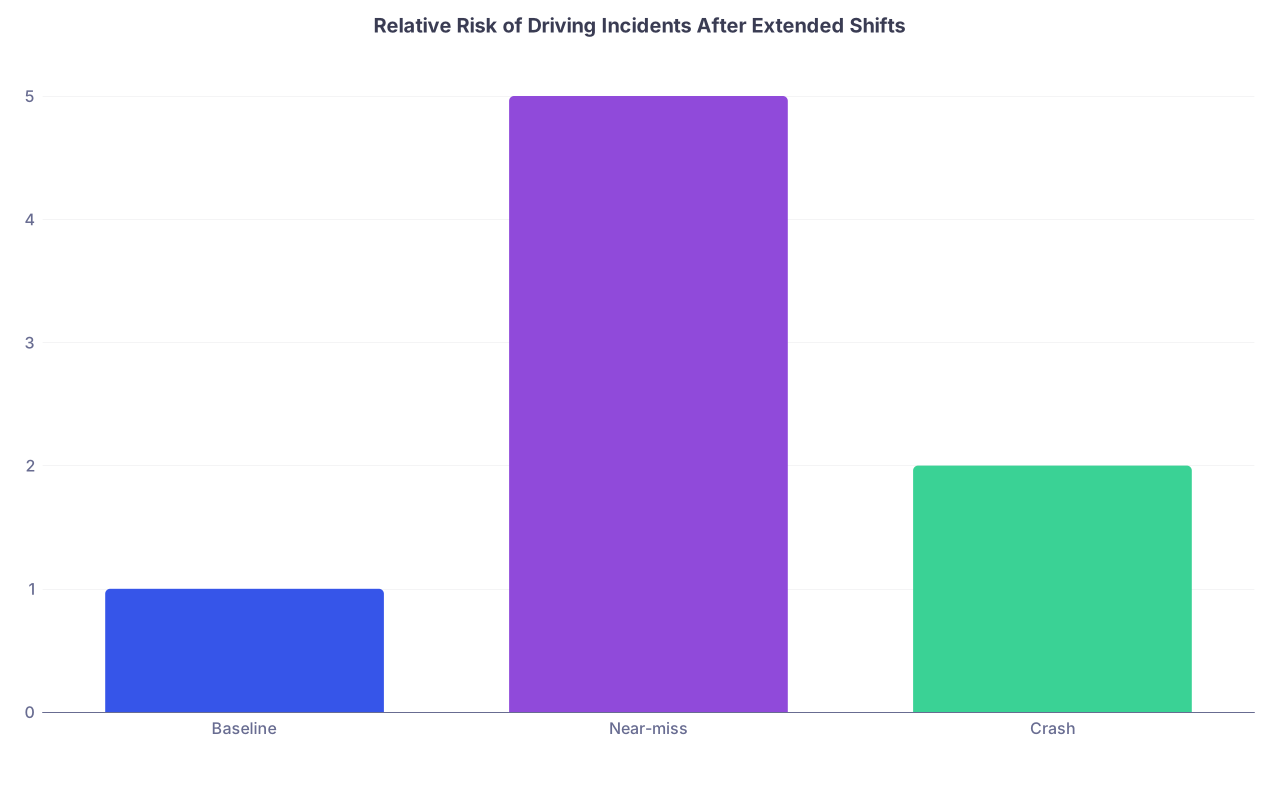
| Category | Value |
|---|---|
| Baseline | 1 |
| Near-miss | 5 |
| Crash | 2 |
When people argue about “professionalism” and “duty,” I look at these numbers and see something else: a structurally tolerated occupational hazard with downstream risk to the public.
5. Circadian Biology: Why Night Float Still Hurts Even With More Sleep
You can white-knuckle your way through a week of nights, but you cannot out-argue your suprachiasmatic nucleus.
Human alertness is not a straight line from “hours slept” alone. It is the interaction of:
- Sleep duration
- Sleep timing
- Circadian phase (your internal 24-hour clock)
This is why a 7-hour sleep from 3 p.m. to 10 p.m. does not “feel” the same as 11 p.m. to 6 a.m.
The circadian low point for most people is somewhere between 3 a.m. and 6 a.m. That is when:
- Reaction times slow
- Lapses of attention spike
- Microsleeps are most likely
Now pair that with typical night float timing:
- Many shifts run roughly 7 p.m. – 7 a.m.
- Peak admissions often between 9 p.m. and 1 a.m.
- Sickest events (codes, decompensations, delirium chaos) skew toward the 2–5 a.m. window
You are forcing your brain to operate at full diagnostic and procedural load exactly when your circadian system is screaming for sleep.
Some residents genuinely shift their circadian rhythm with consistent weeks of nights—going full “vampire schedule.” The problem is rotation structure. Most programs do 5–7 nights on, then flip you back to days. Too short to truly adapt, long enough to deeply disrupt.
6. What Predicts Who Crashes (Metaphorically and Literally)?
Not every resident with low sleep makes the same number of errors. There are patterns in the data that predict who is most vulnerable.
Key risk amplifiers:
Chronic short sleep before a block of nights or call
Residents averaging <6 hours even on off days perform worse under acute sleep loss. They start the rotation already in the red.High workload + low control
Services where:- Admission caps are routinely exceeded
- Cross-cover lists are huge
- There is no buffer for sudden surges
correlate with both higher error rates and higher psychological distress.
Poor handoff systems
Handoffs without:- Structured format (e.g., I-PASS)
- Clear written problem lists and contingency plans
show more preventable harm events, especially at night.
No protected sleep opportunities
Rotations where post-call “rounds” extend past noon, or where night float is interrupted by mandatory daytime meetings, produce measurable performance hits.
I have watched residents show up to 1 p.m. conferences after a 28-hour call because “attendance was mandatory,” then drive home dangerously drowsy. That kind of policy choice is not neutral. The risk is quantifiable.
7. Where Night Float Helps—and Where It Does Not
Let’s be precise instead of arguing in slogans.
7.1 Clear advantages of night float
From the data:
Reduction in extreme continuous wakefulness
Fewer 24–28 hour duty periods. This directly cuts the spike in catastrophic fatigue-related errors.More predictable sleep windows
Even if misaligned with circadian phase, residents can usually get 5–7 hours daily on night float, which is materially better than the 3–4 hours often seen in heavy call months.Better capacity for daytime life (in some cases)
For residents without family obligations, daytime may allow some errands, appointments, and decompression.
7.2 Persistent problems under night float
But night float does not automatically equal safety:
Circadian misalignment remains severe
You still hit your biologic low during peak responsibility hours. Stimulants and coffee do not fully compensate.Continuity and ownership degrade
If you rotate through nights without owning patients longitudinally:- You often make major decisions on incomplete knowledge.
- You miss follow-up on whether your overnight choices helped or hurt.
Burnout can still be high
Social isolation (sleeping during the day, working when everyone else is off) and repeated schedule flipping are strongly associated with burnout and even depressive symptoms.
So the simplistic conclusion “night float fixes it” is wrong. Night float changes the risk profile. It does not eliminate it.
8. Practical Implications: How To Use This Data As A Resident
You cannot redesign your program’s entire schedule. But you can use the numbers to tilt the odds in your favor.
8.1 Treat sleep like a vital sign, not a luxury
When you see your own pattern drop below ~6 hours consistently, you should interpret that the same way you interpret a steadily rising lactate. Something is heading the wrong direction.
You have three basic levers:
Increase total sleep time where possible
That might mean:- Aggressive sleep hygiene on off days (phone in another room, dark room, no doomscrolling).
- Short but real naps on call when safe and allowed. Even 20–30 minutes has measurable benefits on vigilance.
Optimize timing
If you are on nights:- Anchor a consistent “main sleep” block during the day (e.g., 9 a.m.–3 p.m.).
- Avoid splitting sleep into too many fragments; one longer block is usually better for recovery than three 90-minute segments.
Reduce non-essential post-call tasks
Say no where you can. Teaching and research are important. Driving home alive is more important.
8.2 Be extra conservative during circadian low hours
Between roughly 3–6 a.m., assume you are closer to “legally drunk” cognitive function than you feel.
Compensate by:
- Double-checking critical orders (vasoactive drips, anticoagulation, insulin).
- Using checklists for high-risk tasks.
- Looping in a colleague or attending earlier rather than later for marginal calls.
8.3 Treat handoffs as a high-yield safety intervention
Especially under night float:
Write down explicit “if/then” plans:
- “If MAP < 65 sustained despite 2L fluids, start norepinephrine at X, call ICU.”
- “If SpO2 < 90% on 5L NC, escalate to HFNC and page me.”
Maintain clear, updated problem lists.
Vague sign-outs like “AKI, watch I/O” are fertile ground for errors.
The error data heavily implicate sloppy handoffs. Tightening that one piece may compensate for some of the increased fragmentation that night float introduces.
9. Where Programs Are Still Getting It Wrong
Looking at actual schedules and policies, a few repeat offenders stand out.
Nominal limits, real overages
ACGME duty hour rules on paper, but in practice:- Writing notes at home “off the clock”
- Staying late to clean up because the service is overwhelmed
That silent creep turns a 16-hour shift into a 19-hour one without anyone “counting” it.
Post-call bloat
Requiring:- 7 a.m. rounds
- 11 a.m. academic half-day
- 1 p.m. mandatory meeting
on a post-call “off” day is the scheduling equivalent of giving 10 mg morphine IV and then asking the patient to safely drive home.
Whiplash scheduling
Four nights on, flip to days, then back to nights. That is almost engineered to prevent circadian adaptation. The physiology does not keep up with that pace.Cultural gaslighting
Subtle or overt messaging that needing sleep is weakness. This flies directly against the evidence. Fatigue is not a moral failing; it is a repeatable physiologic response with quantifiable performance consequences.
Until these structural issues change, you are essentially working against the gradient.
10. Pulling It Together: The Latest Numbers In One Picture
To make it concrete, imagine three typical weeks for a resident:
- Week A: Traditional call, two 28-hour shifts
- Week B: Night float, 6 consecutive 12-hour nights
- Week C: Day shifts only, capped at 16 hours
If you sketch expected patterns:
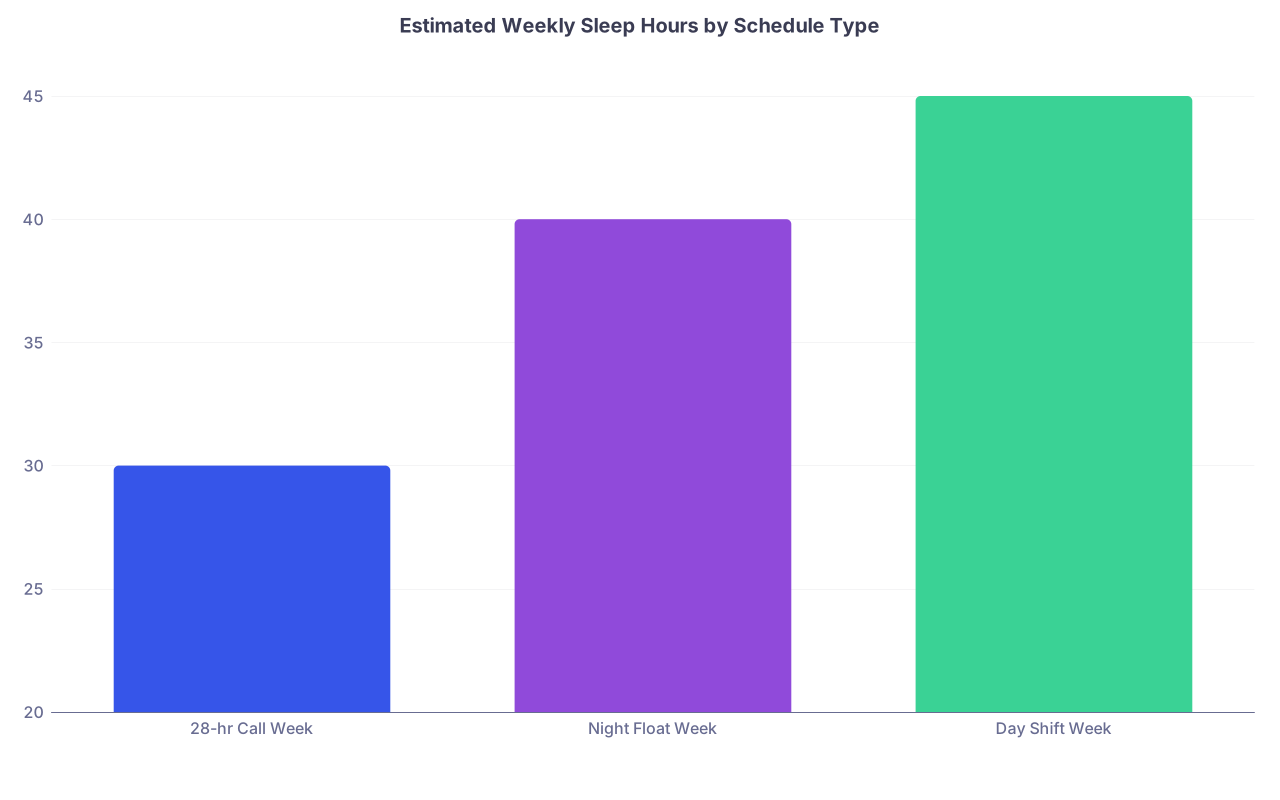
| Category | Value |
|---|---|
| 28-hr Call Week | 30 |
| Night Float Week | 40 |
| Day Shift Week | 45 |
Now overlay that with what we know about errors:
- The 28-hour call week carries the highest risk of catastrophic fatigue-related mistakes and driving crashes.
- The night float week carries moderate ongoing risk from circadian misalignment and higher handoff risk, but fewer true “awake 24+ hours” episodes.
- The day shift week is safest but not risk-free; chronic partial sleep loss still degrades performance.
None of these scenarios give you consistently ideal sleep. This is why I push residents to treat sleep management as a core clinical skill, not an afterthought.




| Step | Description |
|---|---|
| Step 1 | Schedule Type |
| Step 2 | Sleep Amount |
| Step 3 | Sleep Timing |
| Step 4 | Fatigue Level |
| Step 5 | Error Risk |
| Step 6 | Driving Risk |
| Step 7 | Patient Safety |
| Step 8 | Resident Safety |
Key Takeaways
Residents are consistently under-slept, and the deficit shows up directly as higher medical error rates and crash risk; there is no real adaptation, only impaired insight into impairment.
Night float reduces the worst effects of 24–28 hour calls but introduces its own risks via circadian misalignment and increased handoffs; it is a trade, not a cure.
You cannot fully escape the system, but you can materially reduce your personal risk by aggressively protecting sleep, being most conservative during circadian lows, and treating handoffs like a core patient safety procedure rather than a formality.