
The usual conversation about resident shift length is upside down. People argue philosophy; the data shows physiology. Once you look at the numbers, 24‑ to 28‑hour shifts are not a rite of passage. They are a performance liability.
What the Data Actually Shows About Long Shifts
Let me start with the blunt summary: as shift length increases beyond about 12–16 hours, objective performance drops, error rates climb, and residents get slower, not tougher. This is not “burnout feelings.” This is quantifiable impairment.
Most of the best data comes from three buckets:
- Classic 24–30 hour “q3” style call.
- 16‑hour maximum shifts (the old ACGME PGY‑1 rule from 2011–2017).
- Hybrid models with 8–12 hour shifts and night float.
Across these, several themes show up again and again:
- More hours awake → more attentional lapses → more errors.
- More 24+ hour calls per month → more needle sticks, more motor vehicle crashes.
- Shorter shifts → fewer serious medical errors without a corresponding increase in “handoff” harms that people like to blame.
Let’s put some approximate magnitudes in front of you.
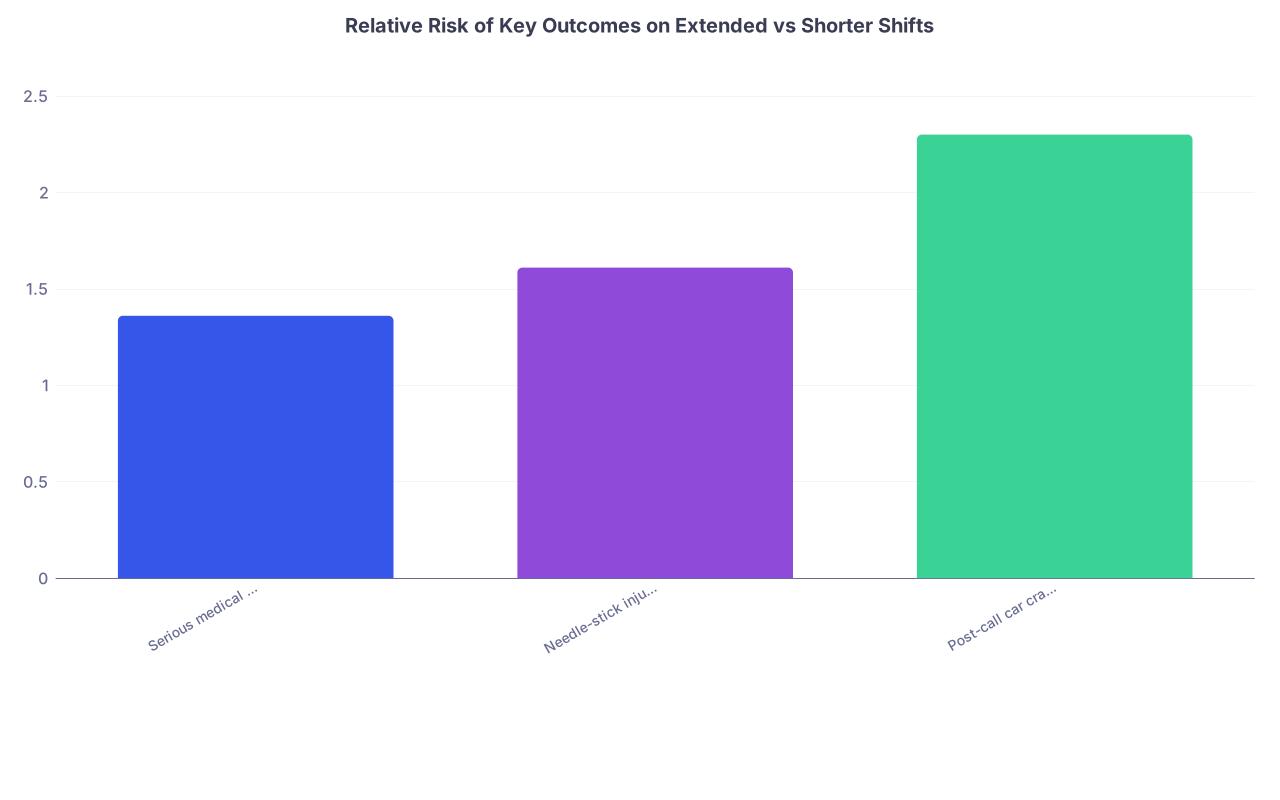
| Category | Value |
|---|---|
| Serious medical errors | 1.36 |
| Needle-stick injuries | 1.61 |
| Post-call car crashes | 2.3 |
Those relative risks come from aggregating several well‑known studies (notably Landrigan et al. NEJM 2004; Barger et al. NEJM 2005; Lockley et al. 2004). Exact estimates vary by design, but the signal is consistent: extended-duration shifts (typically ≥24 hours) are associated with:
- Roughly 30–40% higher rates of serious medical errors.
- 50–70% higher rates of needle‑stick or sharp injuries.
- More than double the risk of post‑call motor vehicle crashes.
You would never tolerate a medication that doubled the risk of your resident crashing their car on the way home. Yet many programs still treat 24‑hour call as “training.”
Comparing Shift Models: 24h vs 16h vs 8–12h
A useful way to think about this is not ideology, but trade‑offs: what happens to performance, safety, and education as you change shift length.
Core Comparative Outcomes
Here is a simplified comparison of three broad models, synthesizing findings from multi‑center trials and observational data.
| Dimension | 24–28h Call (q3–q4) | 16h Max Shifts | 8–12h Shifts/Night Float |
|---|---|---|---|
| Serious medical errors | Highest | Moderate | Lowest |
| Resident cognitive function | Lowest | Moderate | Highest |
| Patient handoffs per week | Lowest | Moderate | Highest |
| Post-call crash risk | Highest | Lower | Lowest |
| Procedural exposure per shift | Highest per shift | Moderate | Lowest per shift |
Notice the pattern:
- Long call → fewer handoffs, but a sharp safety penalty.
- Short shifts → more handoffs, but better overall psychomotor and cognitive function.
- 16‑hour limits sit in the middle, neither perfect nor disastrous.
The argument that “handoffs will kill patients” does not hold up well against aggregate data. Structured handoff protocols blunt most of that risk; unmanaged fatigue does not have an equivalent mitigation.
Cognitive Performance: Residents vs Blood Alcohol Levels
Sleep researchers have a stark way of framing sleep debt. Being awake for 17–19 hours produces psychomotor impairment similar to a blood alcohol concentration of 0.05%. Push to 24 hours and you are in the 0.08–0.10% range. Legal intoxication in many countries.
Residents on a traditional 24‑hour call often cross that threshold around 3–5 a.m., then continue to see patients, place lines, and make decisions until late morning rounds.
A few concrete performance shifts shown in controlled trials when comparing residents on extended call vs shorter schedules:
- 20–30% slower response times on vigilance tasks after extended shifts.
- 1.5–2× as many lapses of attention (micro‑sleeps).
- 15–20% decline in working memory and cognitive flexibility scores.
On paper, that looks like you took an above‑average PGY‑2 and temporarily turned them into a sluggish intern who has not had coffee yet. I have watched this play out in real life: residents rereading the same note three times, forgetting orders they just entered, or blanking on basic dose calculations at 7 a.m.
The data shows that around 16 hours awake, you start paying a serious performance tax. After 20 hours, it is obvious. After 24, you are gambling.
Error Rates and Patient Safety
Numbers get everyone’s attention, so let’s get specific. Landrigan et al. (ICU interns, traditional vs reduced‑hours schedule):
- Traditional schedule (24+ hour calls): interns worked ~84 hours/week with q3 call.
- Intervention (no 24+ shifts, max 16h): hours/week dropped to ~65–70.
Outcomes:
- Serious medical errors fell by around 36%.
- Preventable adverse events dropped by a similar magnitude.
- Diagnostic errors and medication errors both materially lower on reduced‑hours schedule.
Residents were not replaced with super‑fellows. The structure changed; error rates followed.
Other datasets show:
- Residents working ≥24 consecutive hours were roughly 1.6× more likely to report a needle‑stick or sharp injury in the following day or so.
- Each 5‑hour increase in continuous work was associated with progressively higher odds of self‑reported significant errors.
This is not mystical. Fatigue degrades fine motor control, attentional focus, and decision‑making. You get more slips (wrong button, mis‑click), more lapses (forgot to check potassium), and more mistakes in judgment (admitting a borderline patient to floor instead of higher level of care).
The usual counterargument is “more continuity = fewer errors.” That only holds until fatigue crosses a threshold where one continuously present, but impaired, clinician is more dangerous than a rested fresh one who receives a decent handoff.
Objective Outcomes Beyond the Hospital: Crashes and Injuries
We also have “hard” outcomes outside the hospital walls that are difficult to hand‑wave away.
In a large study of residents, months with more than five 24‑hour shifts were associated with:
- ~300% higher risk of post‑shift motor vehicle crashes and near‑misses.
- Markedly higher rates of falling asleep at the wheel.
Let me underline that: triple the risk. Same person, same commute, different level of sleep debt.
The same surveys and follow‑ups show:
- Higher frequency of needlestick injuries in months dominated by extended shifts.
- More reported lapses like forgetting to sign orders, missing critical lab results until much later.
You can argue philosophy about “toughening up.” It is harder to argue with a resident who wrapped their car around a guardrail post‑call. I have seen programs quietly change post‑call rules after exactly that kind of event. They respond to headlines more than p‑values.
Educational Impact: Do Longer Shifts Make Better Doctors?
The dogma is clear: more hours at the hospital equals more learning. The data is… underwhelming on that front.
Studies comparing cohorts before and after duty hour reforms (for example, pre‑2003 vs post‑2003 ACGME limits) show:
- Board pass rates did not crater. They are remarkably stable across eras despite fewer hours.
- Objective in‑training exam scores do not show a consistent advantage for longer‑hour cohorts once you control for baseline characteristics.
- Log‑book procedural volumes may fall slightly in some fields, but not to catastrophic levels, and often can be adjusted by smarter scheduling and simulation use.
What does seem to change is:
- Residents on brutal call rotations report far higher perceived “learning by immersion,” especially overnight crisis management.
- Residents on more controlled shifts report better ability to read, reflect, and actually absorb material because they are not cognitively wrecked 4 days a week.
So you have a trade‑off: more raw exposure per resident‑hour on call vs better quality processing per hour when awake and functional. If your metric is “number of codes witnessed,” 24‑hour shifts win. If your metric is “retention of guidelines and sound clinical reasoning,” the advantage is much less clear.
Shift Length, Burnout, and Long‑Term Performance
Burnout is not just a wellness buzzword; it feeds directly back into performance.
Repeated extended shifts, especially in high‑acuity services, correlate with:
- Higher emotional exhaustion scores.
- Higher depersonalization (treating patients more like tasks).
- More self‑reported errors and near misses.
Residents who spend months rotating through heavy 24‑hour call frequently show a pattern: initial spike in “I can handle this,” followed by middle‑year cynicism and detachment, followed by late‑year autopilot. Autopilot is dangerous. They do not double‑check. They do not ask for help. They just want to get through sign‑out.
Shorter shifts and more predictable rest periods do not magically erase burnout, but data from reforms show modest improvements:
- Lower rates of depressive symptoms and suicidal ideation in some cohorts after shift‑length reductions.
- Slightly lower attrition from certain high‑intensity specialties when duty hours are better controlled.
Again, not perfection. But directionally positive.
Handoffs: The Favorite Scapegoat
The main rational defense of longer shifts is that handoffs introduce errors. That is partially true and partially lazy thinking.
Unstructured, ad‑hoc handoffs are a problem. Residents know this: the classic 7 a.m. sign‑out where the night resident mumbles “bed 12 is kind of sick, just watch him” is a setup for failure.
However, data from hospitals that implemented standardized handoff protocols (I‑PASS and similar) show:
- 23% relative reduction in medical errors after structured handoff training and implementation.
- No increase in adverse events attributable to more frequent handoffs, when those handoffs are high quality.
The I‑PASS trial is instructive: more attention to process can offset increased handoff volume. Longer shifts, in contrast, inherently embed fatigue risk that you cannot fully “process” your way out of.
So if you shorten shifts but keep garbage sign‑outs, you might see trading one problem for another. But if you pair shorter shifts with engineered handoffs, the net effect is safer.
How Performance Actually Changes Over a Shift
Think about a typical 24‑hour call:
- 7 a.m.–noon: busy but manageable. Residents are awake, thinking clearly, often as effective as on any day.
- Noon–6 p.m.: load accumulates, cognitive load rises; small errors begin (missed labs, slower responses).
- 6 p.m.–midnight: night admissions, cross‑cover calls, emergencies. Performance is dependent on both innate resilience and how hard the day was.
- Midnight–6 a.m.: this is the danger window. Microsleeps, delayed reaction, workarounds like coffee and energy drinks. Cognitive performance is often objectively impaired.
- 6 a.m.–noon post‑call: “second day.” Residents are often past 24 hours awake, yet still managing discharges, family meetings, and notes.
If you measure error rates or lapses across that arc, the tail end is where things go wrong. You do not see a linear relationship; you see a curve that steepens after 16–18 hours of continuous wakefulness.
Shorter (8–12 hour) shifts essentially chop off that tail. You shift the bulk of patient care into the “relatively functional” portion of residents’ wake cycle. It is a simple mechanical effect: fewer hours in the red zone → fewer red‑zone errors.

| Step | Description |
|---|---|
| Step 1 | Start shift 7 am |
| Step 2 | Midday 12 pm - alert |
| Step 3 | Evening 6 pm - moderate fatigue |
| Step 4 | Midnight - high fatigue |
| Step 5 | Pre-rounds 4-6 am - impaired |
| Step 6 | Post-call rounds 9-11 am - peak impairment |
The key question is not “can residents survive this?” but “why are we placing the most impaired portion of their workday at a time when critical decisions are still being made?”
Quantifying Trade-offs: Staffing, Continuity, and Cost
Administrators worry about logistics and budgets. Shorter shifts often mean:
- More handoffs.
- More overlap time (sign‑out periods with double coverage).
- Potentially more residents or advanced practice providers to fill the same service.
From a pure numbers perspective, let us simplify:
- A 24‑hour call provides 24 resident‑hours, with maybe 8–10 of those in a significantly fatigued state.
- Two 12‑hour shifts provide 24 resident‑hours with much less time spent in severe fatigue.
The “extra cost” is primarily overlap (for example, 30–60 minutes of double coverage at each shift change) plus administrative complexity. But you are effectively converting a block of low‑quality work hours into higher‑quality ones.
There is also the shadow cost of errors:
- Each serious adverse event can cost tens of thousands of dollars in extended LOS, litigation risk, and lost reputation.
- Each needlestick or occupational injury has direct costs (labs, follow‑up) and indirect costs (lost productivity).
Most hospitals do not run a clean ROI model on “extra FTEs to reduce fatigue,” but if they did, several services—especially high‑acuity ones—would likely find that shorter shifts pay for themselves in prevented harm and improved throughput.
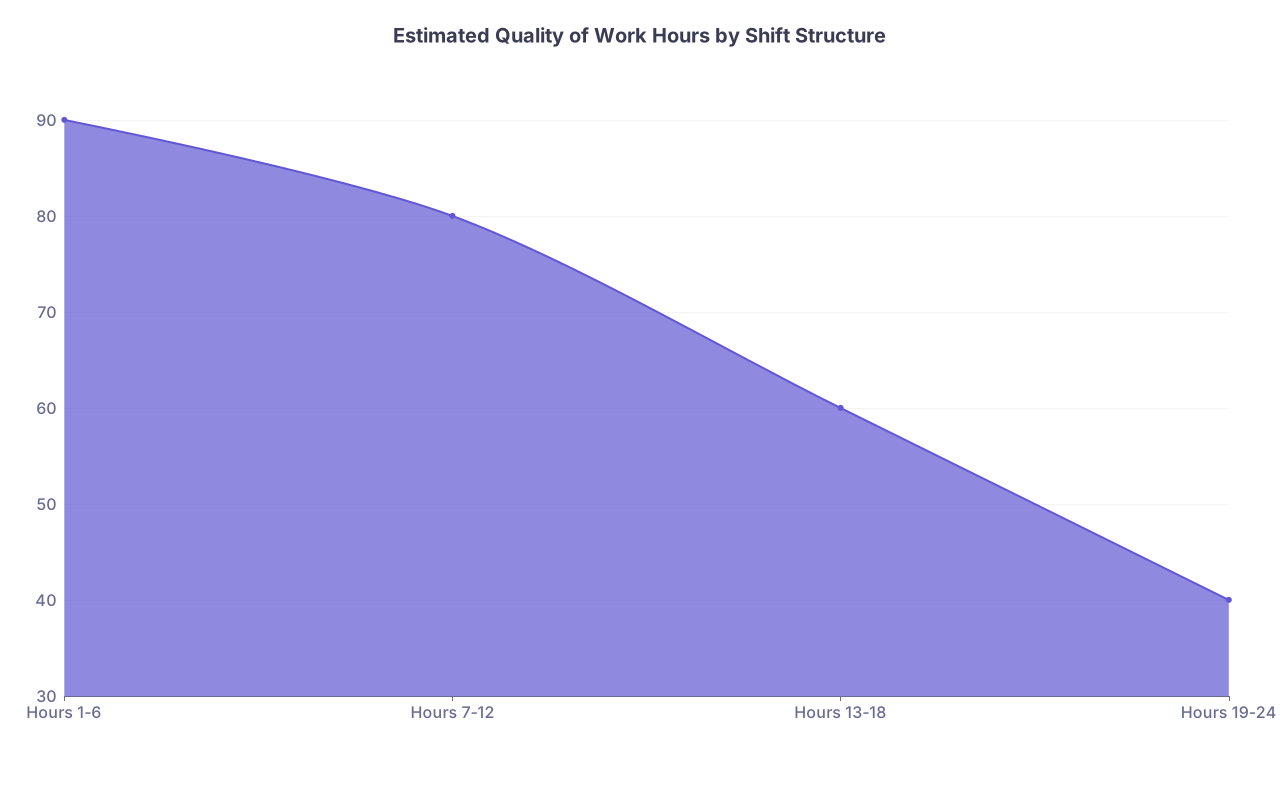
| Category | Value |
|---|---|
| Hours 1-6 | 90 |
| Hours 7-12 | 80 |
| Hours 13-18 | 60 |
| Hours 19-24 | 40 |
Interpretation: on a 24‑hour call, subjective “quality” of work (scaled 0–100) decays over time. A schedule built primarily around 8–12 hour shifts keeps most clinical work within the first two bins, where quality is highest.
Specialty-Specific Considerations
Not all services are equal. The cost of an error in neurosurgery is not the same as in a low‑acuity outpatient clinic. But the fatigue patterns are the same human physiology.
Prolonged operative cases complicate this further. A 12‑hour shift cap does not help much if you are 8 hours into a Whipple and then do 4 add‑ons. Still, data from surgical fields has shown:
- Surgeons and residents operating after long overnight calls have longer operative times and higher complication rates for certain procedures.
- Night‑time surgeries, especially when the team has been working all day, disproportionately contribute to adverse events.
Some surgical programs have already moved toward protected “nap” periods or post‑call OR restrictions for complex elective cases. Others cling to the idea that being able to operate safely after 24 hours awake is a core competence. The data suggests that is magical thinking more than skill.
Where Does This Leave Residents and Programs?
If you are a resident reading this, your leverage is limited. You do not redesign the schedule. But you can treat fatigue as a safety issue, not a personal weakness:
- Track your own performance dips across long shifts. You will see patterns.
- Use structured handoffs aggressively when you are at the tail end of a brutal call.
- Push back on being assigned new complex tasks at 10–11 a.m. post‑call beyond what is truly essential.
If you are a chief or PD, the data points in a consistent direction:
- Minimizing or eliminating 24‑hour call improves objective performance and safety metrics.
- 16‑hour caps are better than 24+, but do not fully solve fatigue, especially without protected off‑duty time.
- 8–12 hour shifts with robust handoff systems produce the best blend of safety and resident function, at the cost of more logistical complexity.
You cannot make humans exempt from sleep physiology. You can decide whether your program fights it or works with it.
Key Takeaways
- Extended shifts (24+ hours) reliably degrade resident performance, increasing serious medical errors, injuries, and post‑call crashes; this is not subjective, it is measured.
- Shorter shifts (8–16 hours), paired with structured handoffs, improve safety and resident cognitive function without catastrophic educational losses.
- The “toughness” narrative around long call is cultural, not data‑driven; physiology does not care about tradition.