
You’re sitting in the residents’ workroom after a brutal call. You’ve just finished notes, your pager is finally quiet, and your program director walks in with a “great opportunity” for you: join a wellness committee, help with the new QI project, maybe sit on the residency recruitment task force.
You are already behind on your own research, your notes, and your life. And now the question in your head is very simple:
Can you actually say no?
Here’s the answer you’re looking for: yes, you can say no to extra committees and projects as a resident. But how you say it — and when — matters a lot.
Let’s break this down so you know what to accept, what to refuse, and how to say no without tanking your reputation.
The Core Truth: You Have the Right to Say No
Residency is not indentured servitude. You’re an employee and a trainee, not the program’s free administrative labor.
There are three categories of “extra” work people try to hand you:
- Required curriculum activities
- Optional but high‑yield opportunities
- Truly extra, low‑yield time sinks
Only category 1 is non‑negotiable.
Things like mandatory QI curriculum, program-required scholarly projects, evaluations, and assigned committees that are explicitly part of the ACGME or program requirements? You cannot realistically say no to those without consequences, because they’re baked into your training.
Everything else? Negotiable.
The hidden problem: programs often present category 2 and 3 the same way — as “great opportunities.” Your job is to learn to tell them apart fast.
How to Decide: Should I Say Yes or No?
Use a simple filter. If something fails this test, you should strongly consider saying no.
Ask yourself five questions:
- Does this align with my actual career goals (fellowship, niche, job type)?
- Will this realistically lead to something tangible: a paper, poster, leadership role, strong letter?
- Do I have protected time for this, or will it steal from sleep / patient care / required tasks?
- What happens if I say no? Real consequence, or just mild disappointment?
- Do I already have 1–2 “big” things on my plate (research project, major QI, leadership role)?
If you already have two major commitments, most residents have no business adding a third, unless it’s an obvious career maker.
To make this concrete, here’s how I’d rate common offers:
| Opportunity | Typical Value for Career |
|---|---|
| Major research project with a known mentor | High |
| Residency recruitment committee | Medium |
| Wellness or social committee | Low to Medium |
| Hospital-wide EHR implementation group | Low |
| QI project tied to publication/presentation | High |
Notice something: not everything “leadership” is equally valuable. Some committees are glorified meeting clubs that generate minutes, not outcomes.
When Saying Yes Makes Sense (and When It Doesn’t)
You’re not trying to avoid all extra work. You’re trying to avoid unpaid, uncredited, unprotected extra work that burns you out and doesn’t move you forward.
Good reasons to say YES:
- It gets you a strong letter from someone whose name matters in your field
- It directly helps your fellowship or job application (e.g., ICU QI if you want CCM)
- It leads to guaranteed output: abstract, poster, publication, leadership title
- You are light on your CV and truly need content
- There is built‑in protected time or coverage
Bad reasons to say YES:
- You feel guilty
- “Everyone else is doing something”
- The person asking is senior and you’re scared to disappoint them
- It sounds vaguely impressive but you cannot articulate how it helps you
- You’re saying yes because you’re too uncomfortable to say no
If the main value is “looks good on the CV,” ask yourself: for what? Fellowship directors can spot fluff. “Wellness committee member” without any concrete outcomes is not a game-changer.
Exactly How to Say No (With Scripts)
You do not need a 10‑minute justification. You need a clean, respectful boundary.
General rule:
Thank → Acknowledge value → Brief reason → Clear no → Optional redirect.
Here are real, usable scripts.
Script 1: Overcommitted Already
“Thanks for thinking of me for this. It does sound like a good initiative. Right now I’m at capacity with my research project and [other role], and I can’t take this on and do it well. I’ll have to pass this year.”
Short. Direct. You’re not asking for permission; you’re stating a limit.
Script 2: Not Aligned With Goals
“I appreciate you reaching out. I’m trying to focus my extra time on projects directly tied to [cards fellowship / hospitalist job / med ed], so I’m going to pass on this committee so I can keep that focus.”
You’re allowed to prioritize your own career.
Script 3: With Your Program Director
People get scared here. You can still say no, but be strategic.
“Dr. Smith, I appreciate you thinking of me. I want to be sure I do the things I’ve already committed to at a high level — especially my [research / chief-level responsibilities / existing QI project]. I’m at my limit for additional committees this year. If there’s something that would be especially helpful for [fellowship in X / academic job], I’d be open to swapping one of my current roles for that, but I can’t just add more.”
You’re signaling:
- You’re responsible
- You care about quality
- You’re not a doormat
Script 4: Email Decline
“Hi Dr. ___,
Thank you for thinking of me for the [committee/project]. I appreciate the invitation.
At this time I’m fully committed to my existing [research/QI/leadership] responsibilities and clinical duties, and I would not be able to participate meaningfully in an additional project. I’ll need to decline this invitation, but I’m happy to support in smaller, ad‑hoc ways if something specific comes up that fits my schedule.
Best,
[Name]”
Copy‑paste, adjust, send. Done.
Politics: Will Saying No Hurt You?
Short answer: If you say no selectively and professionally, no, it will not hurt you. It may actually help.
Here’s why:
Residents who say “yes” to everything quickly become the people who are overextended, behind on actual requirements, and visibly stressed. Faculty notice that too.
People you do not want to become:
- The resident who shows up to every committee meeting but has zero completed projects
- The resident who volunteers a lot and then flakes because they’re overwhelmed
- The resident everyone uses as free labor because “they never say no”
Saying a thoughtful no makes you look like:
- Someone who understands bandwidth
- Someone who values quality over scattered activity
- Someone who is less likely to drop the ball
The rare scenario you actually need to watch: a single powerful individual who expects automatic yeses. You know who this is in your program. With them, you may need a slightly softer “no” or offer a compromise (short-term, well-defined role instead of an open‑ended commitment).

How to Protect Yourself Before You Commit
Before you agree to anything, ask very specific questions. Vague answers are a bad sign.
Use this pre‑commitment checklist:
“Who else is on this?”
If it’s all residents and no faculty champion, odds of real output are lower.“What are the concrete deliverables and timeline?”
If they can’t name any, this is probably a time sink.“How many hours per month, realistically?”
Push them to give a number. Then double it in your head.“Is there any protected time or schedule adjustment?”
If the answer is “no, we just all make it work,” that’s code for: you’ll do this off the clock.“What would success look like for me personally?”
If they cannot answer that, it’s not designed with your development in mind.
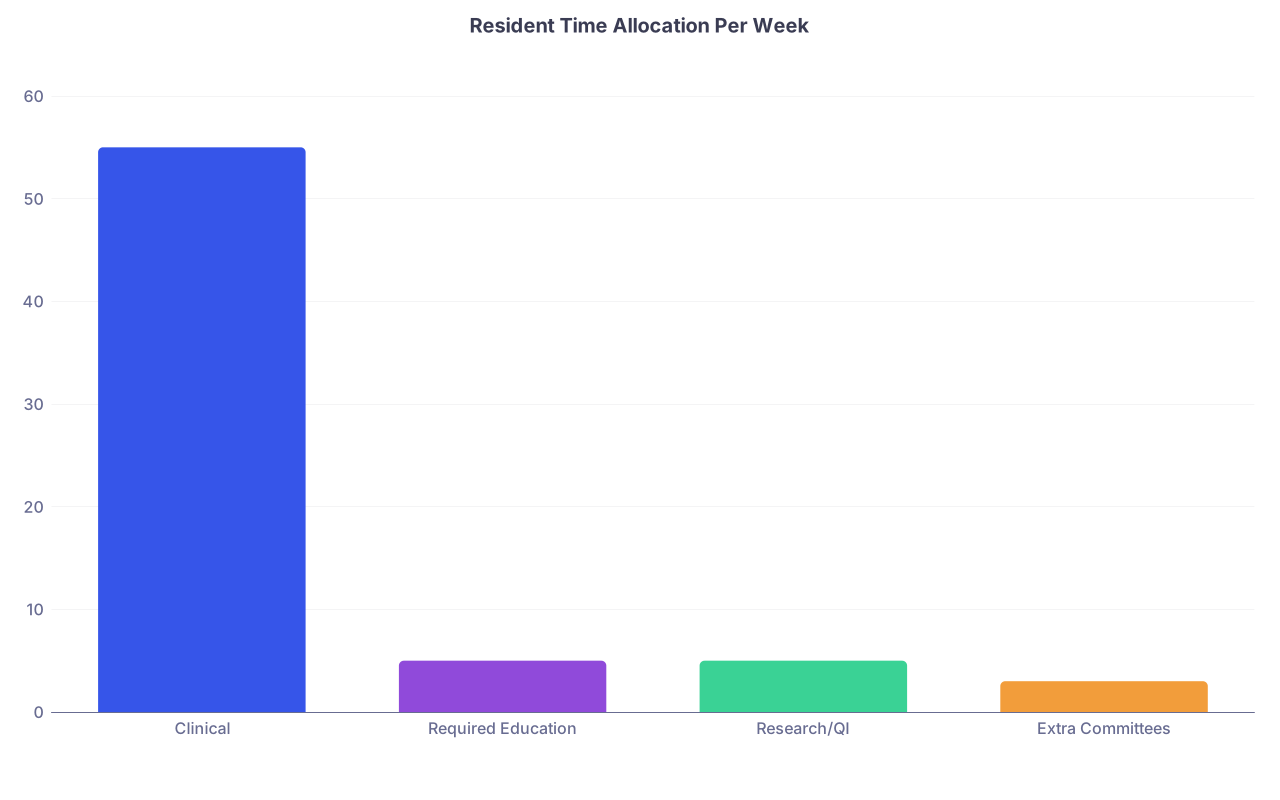
| Category | Value |
|---|---|
| Clinical | 55 |
| Required Education | 5 |
| Research/QI | 5 |
| Extra Committees | 3 |
Look at that last bar. That’s where your sanity disappears if you’re not careful.
What If You Already Said Yes and Regret It?
Happens all the time. You got pressured on a busy day, you agreed, and now you hate it.
You can still pull back, but do it early and directly. The earlier you do this, the less damage.
Script for backing out:
“Dr. ___, I wanted to follow up about the [committee/project]. After looking realistically at my clinical schedule and my existing commitments, I’m concerned I won’t be able to participate at the level this deserves. I think it’s better if I step back now so you can identify someone who can contribute more consistently, rather than staying on and not following through.”
This is not unprofessional. This is damage control. Way better than silently ghosting or doing sloppy work for six months.
If they push back hard, you repeat:
“I understand it’s inconvenient, but I would rather be honest about my capacity now than commit and not follow through. I’m happy to help with one clearly defined, short‑term task if that’s useful, but I can’t maintain an ongoing role.”
Special Cases: When Saying Yes Matters More
There are a few situations where saying yes is smart even if you’re tired.
You have a weak CV for your target fellowship
If you’re gunning for something competitive (derm, ortho, GI, cards, etc.) and your application is thin, you probably need at least 1–2 solid projects. You still do not need five committees. You need a focused, high‑yield project.You’re trying to break into academic medicine
Academic careers are built partly on committees and QI — but again, not volume. Results. A single “Resident rep, Hospital Sepsis Task Force” with concrete outcomes can be gold. Five wellness committees with nothing to show for it? Not helpful.It’s directly sponsored by someone powerful in your field
If the fellowship PD for your dream subspecialty says, “I’m starting a multi‑site QI project and I’d like you on it,” that’s not one you casually decline. You can still clarify scope, but the bar to say no is higher.
| Role | Yield |
|---|---|
| First author on QI project with publication | Very High |
| Residency wellness potluck organizer | Low |
| Residency recruitment sub-committee lead | Medium |
| Multi-center study coordinator with PI | High |
| Social media coordinator for residency | Low to Medium |
How to Keep Your Reputation Strong While Saying No
There’s a simple pattern shared by residents who say no and still get great letters:
They over‑deliver where they do say yes.
If you’re clearly excellent on the wards, responsive with pages, present in didactics, and you complete the projects you actually commit to? Most reasonable faculty will not care if you’re not on three extra committees.
Things that help your reputation far more than random extra roles:
- Being the resident who closes the loop on tasks without being reminded
- Showing up prepared to presentations or conferences you’re involved in
- Finishing one strong project end‑to‑end (proposal → execution → abstract/poster)
- Being honest with your limits and not vanishing mid‑project

| Step | Description |
|---|---|
| Step 1 | Offered new committee or project |
| Step 2 | Politely decline |
| Step 3 | Consider swapping not adding |
| Step 4 | Accept and commit fully |
| Step 5 | Aligns with my goals? |
| Step 6 | Realistic time and support? |
| Step 7 | Already 2 major commitments? |
That’s the entire framework in one diagram. If you remember nothing else, remember that flow.
FAQ: Saying No to Extra Committees and Projects as a Resident
1. Can my program punish me for saying no to optional committees?
If something is truly optional, they should not be retaliating. Could a petty person give you a weaker “professionalism” comment? In rare toxic environments, yes. But in most programs, a calm, respectful “no” with a clear reason does not harm you, especially if you’re strong clinically and complete what you do commit to.
2. How many extra projects or committees should I have as a resident?
For most people: one main scholarly/research/QI project plus maybe one meaningful committee or leadership role is plenty. More than that, and quality drops. You’re a resident, not a full‑time admin. Programs sometimes forget that.
3. What if I’m an intern — should I say yes to anything extra right now?
Intern year is usually not the time to stack committees. You’re still learning how to be a doctor. If you take on something, keep it lightweight and flexible. Many of the strongest fellows I know essentially did nothing extra intern year, then picked smart projects PGY‑2.
4. How do I know if a committee is just “CV fluff”?
Ask: What are the actual outputs from the last year? Policies changed? Papers? Posters? Real initiatives? If no one can answer that and the main deliverable is “we meet monthly to discuss X,” you’re probably looking at fluff.
5. Is it unprofessional to say I need to protect my time or avoid burnout?
No. You do not have to say “burnout” directly if you’re worried about how it lands, but you absolutely can say, “Given my current clinical load, I don’t have the capacity to take this on and do a good job.” That’s professionalism, not weakness.
6. What if my co-residents are all saying yes and I feel behind?
You’re not behind if you’re intentional. Many residents accumulate a mess of half-finished projects and low-impact roles. You’re better off with one meaningful completed project than five shallow ones. Focus on quality and alignment with your goals, not keeping up with the loudest person in your class.
Key points to walk away with:
- You can say no to extra committees and projects, and you should — frequently.
- Say yes only when it clearly aligns with your goals, has realistic time/support, and leads to tangible outcomes.
- Protect your reputation by over‑delivering on what you do accept, and being honest and direct when you decline.