
The real question is not “How many extra shifts can you pick up?” The real question is “How many can you pick up without quietly wrecking your brain, your performance, and your future career?”
Let me be blunt: most residents dramatically overestimate how much extra work they can safely do.
You want a number, so I’ll give you one first, then we’ll unpack it.
For most residents, a realistic safe ceiling is:
- 0–2 extra shifts per month on intense inpatient rotations
- 2–4 extra shifts per month on lighter outpatient/elective rotations
Anything above that, done consistently for months, is usually a bad trade.
Now let’s talk about why.
1. The Hard Limits: What You Legally Can and Cannot Do
There are two very different questions here:
- What is legal/allowed by rules and contracts?
- What is safe/smart for your brain, your body, and your future?
They’re not the same.
ACGME rules and moonlighting
If you’re at an ACGME-accredited program in the U.S., you’re living under these constraints:
- 80-hour work week limit, averaged over 4 weeks
- 1 day off in 7, averaged over 4 weeks
- At least 8 hours off between shifts (sometimes 10 depending on program/policy)
- Max 24 hours of continuous in-house clinical work, plus up to 4 hours for wrap-up/education
Most programs also have a specific moonlighting policy that says something like:
- Moonlighting (internal or external) must not interfere with your required duties or education
- You must be in good standing (no remediation, low professionalism concerns, etc.)
- Moonlighting hours count toward the 80-hour limit
If your PD is telling you that moonlighting “doesn’t count” toward 80 hours, that’s not just wrong. It’s unsafe and reportable.
| Limit Type | Common Standard |
|---|---|
| Weekly hours (max) | 80 (4-week average) |
| Max continuous shift | 24 + 4 hours |
| Days off | 1 in 7 (average) |
| Moonlighting | Must count in 80 |
So from a rules perspective, the first filter is:
- Are you staying under 80 hours/week on average, including extra shifts?
- Are you still getting 1 day off in 7?
- Are you respecting your minimal rest between shifts?
If the answer is no, you’re already past the line. That’s not “pushing it.” That’s unsafe and non-compliant.
2. The Real Limit: Your Brain and Performance
Here’s the harsh truth: residents already function near the edge of safe fatigue on many rotations. Extra shifts push you over that edge fast.
How fatigue actually hits you
What I’ve seen over and over:
- First 1–2 extra shifts: you feel productive, a little tired, but fine.
- Around 3–4 extra shifts per month:
- You start making more small errors (missed orders, late follow-up on labs)
- Your patience drops — with nurses, patients, even co-residents
- Studying dies. Step/boards prep gets pushed “to next month”
- Above that, consistently:
- You lose insight into how impaired you are
- Your charting gets sloppier, handoffs get shorter, details get dropped
- People start quietly saying, “She’s always tired,” or “He seems off lately.”
Sleep deprivation doesn’t warn you. You feel “okay” until something goes wrong.
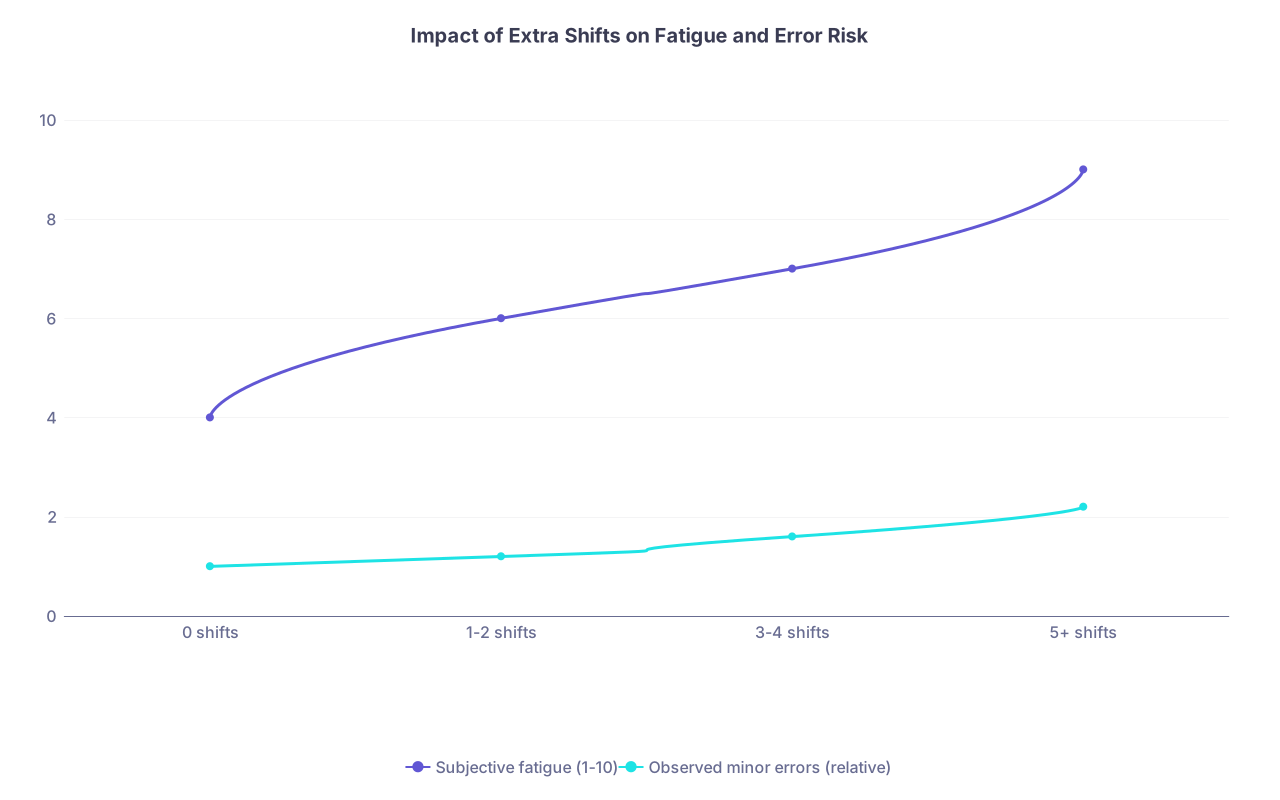
| Category | Subjective fatigue (1-10) | Observed minor errors (relative) |
|---|---|---|
| 0 shifts | 4 | 1 |
| 1-2 shifts | 6 | 1.2 |
| 3-4 shifts | 7 | 1.6 |
| 5+ shifts | 9 | 2.2 |
So when people ask, “How many can I safely pick up?”, the honest answer is:
- Your subjective feeling is not a reliable guide.
- You have to set rules before you get desperate for cash.
3. Rotation-by-Rotation: A Practical Framework
Instead of a single magic number, use this framework to decide what’s reasonable month by month.
Step 1: Categorize your current rotation
Think about this month:
- High-intensity inpatient:
ICU, CCU, busy medicine/surgery wards, trauma, nights, ED in some programs - Moderate intensity:
Floors at a sane program, consult services, L&D, psych inpatient at a reasonable census - Lower intensity / outpatient:
Clinic months, electives, research, radiology, some gen psych outpatient
Now apply this rule-of-thumb:
| Rotation Type | Typical Week Hours | Safe Extra Shifts/Month |
|---|---|---|
| High-intensity inpatient | 65–80 | 0–2 |
| Moderate inpatient | 55–65 | 1–3 |
| Outpatient/elective | 40–55 | 2–4 |
If you’re already at or flirting with 70–80 hours/week, you really should not be stacking extra shifts. Even if “everyone else does it.”
Step 2: Check your real weekly hours
Most residents lie to themselves here.
If your schedule says:
- 6 days/week, 12–13 hours/day → that’s already 72–78 hours
- Nights with pre/post calls often quietly exceed counted hours
- Add commute, charting at home, studying — now the effective load is even higher
Be honest: if your normal week is already > 65 hours, your room for extras is minimal.
Step 3: Look at your month in context
Ask yourself:
- Are you coming off a brutal month?
- Is next month brutal (ICU, heavy wards, ED nights)?
- Are you prepping for Step 3, in-training exam, boards, fellowship interviews?
If any of those are true, dial down the extras. You don’t cram rest and learning into tiny gaps and expect no long-term cost.
4. The Money Question: When Extra Shifts Make Sense (And When They Don’t)
Let’s be honest. You’re picking up extra shifts for money, not for “experience.”
When extra shifts are a rational choice
Extra shifts can be worth it when:
- You have high-interest debt you’re knocking out
- You’re saving toward a specific, time-limited goal (move, exam fees, visa costs, childcare support)
- You’re on a lighter month and truly under 55–60 hours/week
- Your extra shifts are:
- Predictable
- Well-compensated
- Not destroying your sleep schedule
But be strategic. Don’t just say yes to everything.
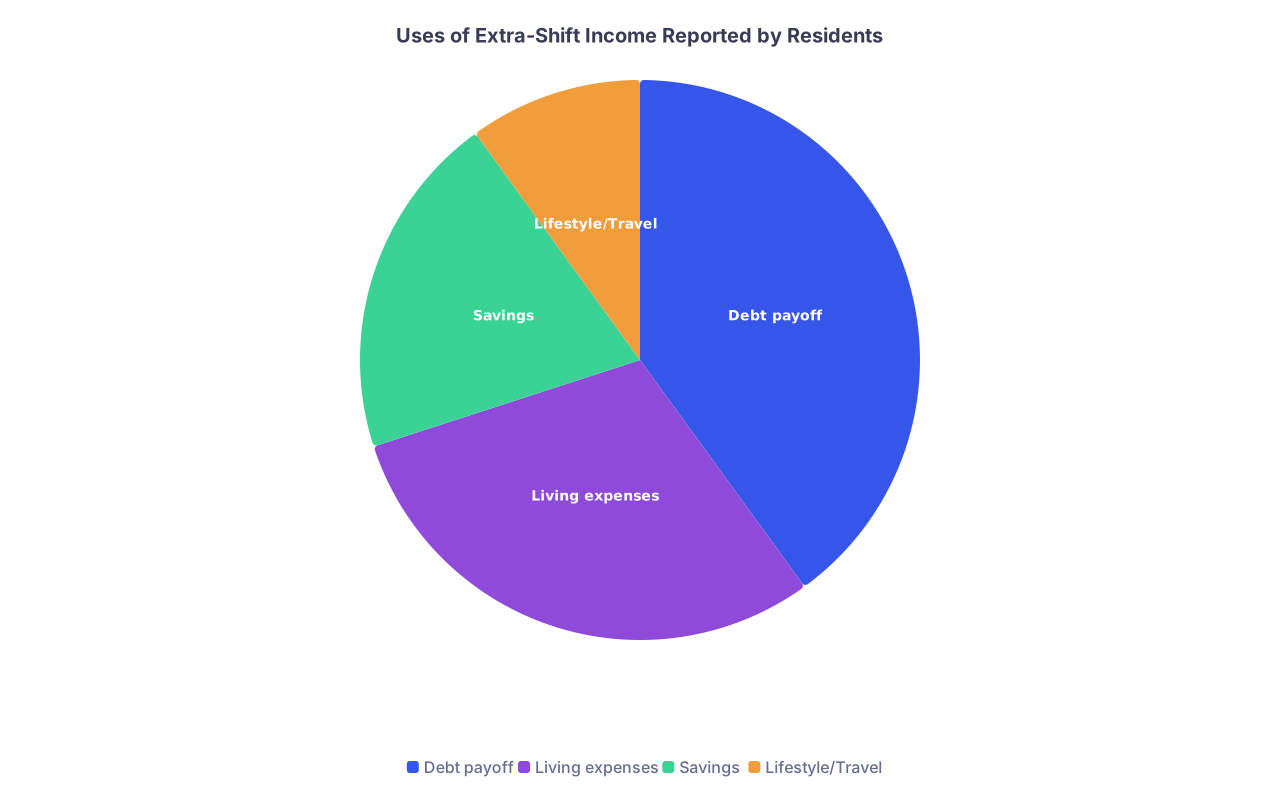
| Category | Value |
|---|---|
| Debt payoff | 40 |
| Living expenses | 30 |
| Savings | 20 |
| Lifestyle/Travel | 10 |
When extra shifts are a bad trade
Red flags:
- You’re using them to patch chronic overspending (DoorDash, new car, constant takeout)
- You’re consistently taking 4–6+ per month on already-busy rotations
- You’re reading less, performing worse, or getting feedback about being “tired/distracted”
- You’re snapping at nurses, consultants, or co-residents more
If your baseline financial situation is so tight you feel forced into constant extra shifts, you don’t need more shifts. You need a budget reset and probably some lifestyle cuts for a year.
5. Internal vs External Moonlighting: Not All Shifts Are Equal
“Extra shifts” usually fall into three buckets:
- Internal moonlighting — Additional shifts in your own hospital (e.g., cross-cover, ED, observation unit)
- External moonlighting — Urgent cares, small EDs, telemedicine, SNF coverage
- Extra coverage within your program — Covering co-residents’ calls/clinics for pay or favors
Each has different risk.
| Shift Type | Workload | Autonomy/Risk | Typical Pay |
|---|---|---|---|
| Internal moonlighting | Moderate | Medium | Medium |
| External moonlighting | Variable | High | High |
| Extra program shifts | Moderate | Low-Med | Low-Med |
Internal moonlighting
Pros:
- Familiar system, EMR, backup
- Usually counted in your hours and visible to leadership
- Often slightly controlled by the program
Cons:
- Still piles on fatigue
- Easy for leadership to assume “you’re fine” and keep offering
Reasonable if you’re on an easy month and you cap yourself.
External moonlighting
Here’s where people get in trouble.
Pros:
- Better pay
- Different environment, sometimes actually less stressful
- Can buffer your finances significantly
Cons:
- You’re often more independent (less backup if something goes bad)
- Liability is on you; your name is the one on charts
- Travel time, credentialing, and mental overhead
- Easy to underestimate how drained you are when leaving your main job
This is where I’d be extra strict:
- Only on PGY-2+ once you’re clinically solid
- Only if your PD formally approves and you’re in good standing
- Only when you’re clearly under 60 hours/week in your main job
6. A Simple Decision Algorithm You Can Actually Use
Let’s make this practical. Before accepting an extra shift, run yourself through this:

| Step | Description |
|---|---|
| Step 1 | Current rotation |
| Step 2 | Max 0-2 shifts per month |
| Step 3 | Check weekly hours |
| Step 4 | Skip extra shifts |
| Step 5 | Check sleep and mood |
| Step 6 | Check future months |
| Step 7 | Limit to 1-2 shifts |
| Step 8 | 2-4 shifts if under 80 hours |
| Step 9 | High intensity? |
| Step 10 | >65 hours per week? |
| Step 11 | Rested and stable? |
| Step 12 | Brutal month coming? |
And add three non-negotiables:
- If you’re >80 hours in any week with the extra shift → do not take it.
- If you’re not getting one full day off most weeks → do not add more.
- If your partner/friends/coresidents are all saying “you’re cooked” → believe them.
7. Warning Signs You’re Overdoing It
If you see these, you’re already past “safe”:
- You start falling asleep in conference or at the computer
- You’re re-reading the same note line 3–4 times and still zoning out
- You realize on the drive home you don’t fully remember leaving the hospital
- You’re floating through shifts on autopilot, not actively thinking through cases
- Feedback starts hinting at concerns: “You seem tired,” “Missing some details,” “Check your notes more carefully”
Listen to this: You are not less vulnerable to fatigue just because you’re “used to it.” You’re just less aware of how impaired you are.

When this starts happening, your question is no longer “How many extra shifts can I pick up?” It’s “How many do I need to cancel?”
8. My Actual Recommendation by PGY Level
Let me answer the question the way people really ask it: “What would you tell your own intern/PGY2/PGY3?”
PGY-1 (Intern year)
My honest advice: Do not plan on regular extra shifts.
If you do anything:
- 0–1 extra shift per month max
- Only on very light rotations
- Only once you’ve proven to yourself that you can manage your core schedule without drowning
Your job PGY-1 is to become competent and safe. Extra shifts work against that for most interns.
PGY-2
You have more autonomy, more comfort, and maybe some moonlighting options.
- On heavy months: 0–2 extra shifts max, and many will be 0
- On light months: 2–3 shifts is often tolerable
- Pay attention to exam years (in-training, Step 3, boards prep)
PGY-3 and beyond
You know your limits better now, but that can tempt you to push them.
- Light clinic/elective months: 3–4 extra shifts can be reasonable
- Do not normalize doing 5–6 extra shifts every month for a year
- Be more conservative if you’re chief, applying to fellowship, or leading teams
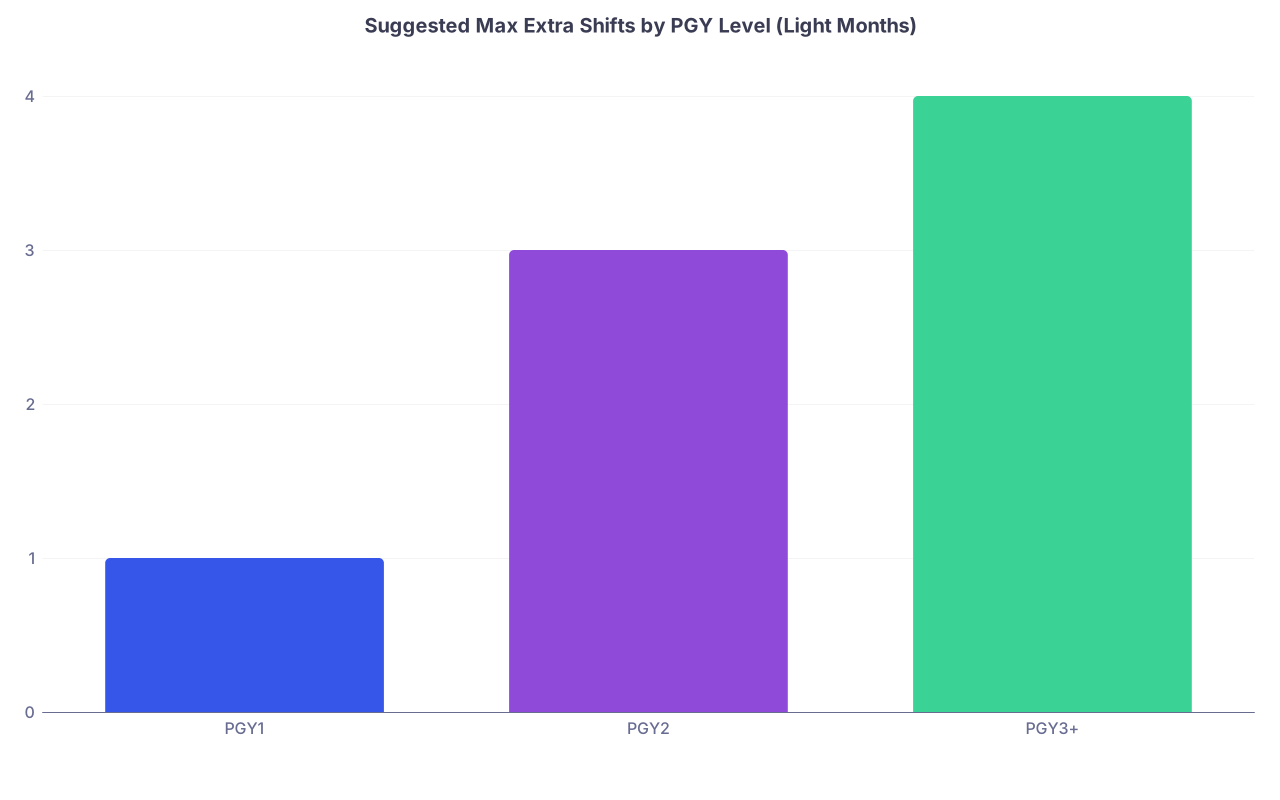
| Category | Value |
|---|---|
| PGY1 | 1 |
| PGY2 | 3 |
| PGY3+ | 4 |
9. How to Say “No” Without Burning Bridges
Programs and attendings will always “offer opportunities.” You don’t have to take them all.
Some scripts that work:
- “I’m already close to my 80-hour average this block, so I need to pass this time.”
- “I’ve noticed I’m more tired lately and I don’t want that to affect my patient care, so I’m limiting extra shifts this month.”
- “Next month is ICU for me, so I’m protecting some recovery time right now.”
That’s professional, safety-focused, and hard to argue with.
If you’re constantly being pressured: document your hours, talk to your chief or PD, and remember you’re allowed to say no.
FAQ: Extra Shifts in Residency
1. What’s the absolute maximum number of extra shifts I could pick up in a month?
If you’re strictly talking about compliance, you can’t exceed an 80-hour weekly average over 4 weeks, plus need one day off in 7. In reality, this often caps you around 3–4 extra shifts at most on a light month. Anything beyond that is usually breaking rules or playing games with “unlogged” hours, which I don’t recommend.
2. Is it ever safe to moonlight during ICU or night float rotations?
Generally, no. ICU and night float are already right at the edge of safe fatigue. Adding extra shifts on top, especially external moonlighting, is where real patient safety issues show up. I’d treat heavy ICU or nights as no-moonlighting zones unless your hours are unusually low and you’re genuinely well-rested (rare).
3. How do I know if I’m the kind of person who can “handle more”?
You’re probably not as special as you think. Residents who say, “I function great on 4 hours of sleep” almost never do. Look at objective markers instead: Are attendings happy with your performance? Are you reading at home? Are you safe driving home? If those are slipping, it doesn’t matter how tough you feel.
4. Should I prioritize extra shifts or studying if I want a competitive fellowship?
Studying. Every time. Extra shifts give you short-term money. Strong clinical performance, solid exam scores, and good letters give you career-long earning power and job options. It’s not even close. A few thousand dollars now is not worth a weaker fellowship match.
5. What if I already signed up for too many shifts and feel overwhelmed?
First, admit it early. Talk to the scheduler or whoever coordinates moonlighting and say, “I overcommitted and I’m concerned about safety and hours.” Most places would rather reshuffle than have a resident burn out or make a serious error. If they push back, loop in a chief or PD and reference 80-hour rules and patient safety. Protecting yourself and your patients is not selfish.
Key points to walk away with:
- For most residents, a sane ceiling is 0–2 extra shifts on heavy months, 2–4 on lighter months, staying under 80 hours/week.
- Legal does not equal safe — if your learning, mood, or performance are sliding, you’re doing too much.
- Money problems are real, but you can’t fix them by quietly sacrificing your long-term career and health on the altar of a few extra shifts.