
What is the one documentation habit you have right now that would make your co-residents quietly curse your name on sign-out?
If your first thought is, “I don’t think my documentation causes extra work for anyone,” then you are almost certainly making at least one of these mistakes.
Let me be blunt. Most of the misery around notes, orders, and the EMR is not from the system itself. It is from other people’s sloppy documentation. The half-done progress note. The vagueness that forces you to click through 10 tabs. The admission H&P that reads like a copy-paste crime scene.
You have enough real work. You do not need to inherit more because someone upstream documented badly. And you absolutely do not want to be the person doing that to your team.
Below are the documentation mistakes that reliably generate extra work, confusion, and rework for you, your co-residents, nurses, consultants, coders, and attendings. And how to stop making them.
Mistake #1: Burying the Plan (or Not Having One)
The fastest way to create chaos for your team is simple: write a long note with no clear plan.
You have seen this:
Assessment: “Sepsis, pneumonia, AKI, DM2, HTN, CHF, COPD, anemia.”
Plan: “Continue current management.”
That is not a plan. That is an invitation for the night float to waste 15 minutes reverse‑engineering what is actually happening.
Here is what goes wrong when the plan is unclear or buried:
- Cross-cover has no idea what you wanted.
- Consultants cannot tell what is active vs. old.
- Nurses page more because they are uncertain.
- Day team spends the first hour of rounds decoding your note instead of seeing patients.
The specific sub-mistakes:
No problem-based structure
Dumping everything into one paragraph instead of listing problems with corresponding actions.“Will monitor” nonsense
“Will monitor vitals.” “Will monitor labs.” You are not describing a plan, you are describing existing reality. It adds zero value.Key decisions not stated clearly
You thought about VTE prophylaxis, pressor thresholds, or code status, but none of that appears in the note.Plan spread across multiple sections
Half of the plan in HPI, bits in “Assessment”, leftovers in “Orders”. No single location with “Here is what we are doing.”
How to avoid it
Use a problem-based format every time:
-
- Ceftriaxone + azithro (D2/7)
- Follow lactate q6h x2 more
- IVF: no more boluses; start 100 mL/hr LR, reassess I/O daily
-
Put anything “the on-call person needs to know” at the top of the plan, not buried in paragraph 4.
Ban vague actions from your vocabulary:
- “Monitor”
- “Optimize”
- “Supportive care”
Replace with: what is being monitored, how frequently, and what triggers an action.
If someone can read your assessment/plan and safely cross-cover the patient without calling you, you did it right.
Mistake #2: Copy-Paste That Lies to Everyone
Let me guess. You are busy. You copy yesterday’s note, change one or two things, and move on.
Then it starts:
- The “admission” date says 3 days ago, but your note reads “Today, patient presents with…”
- The cardiac exam says “No JVD” on a patient with 12 L positive balance and visible neck veins.
- The ROS says “No shortness of breath” right above “Patient on 4L NC for dyspnea.”
Some of this is funny until it burns you. Or the team.
What copy‑paste does when used badly:
- Adds rework: The next person has to figure out which parts are actually current.
- Destroys trust in the chart: Nurses, consultants, and attendings stop believing your documentation and call anyway.
- Creates billing/compliance problems: Coders cannot bill correctly if your note is a disconnected wall of stale text.
- Sets up patient safety issues: Outdated medication lists, old code status, wrong oxygen support… this is how errors propagate.
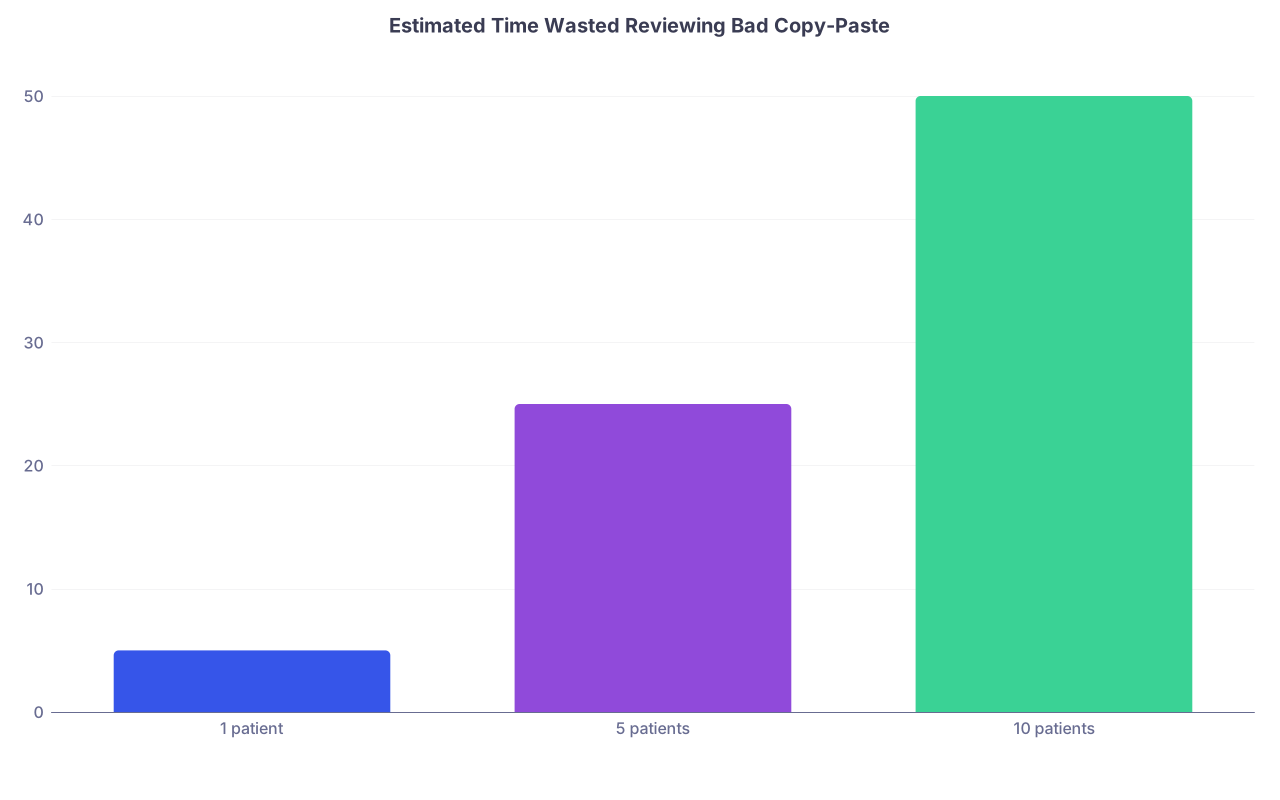
| Category | Value |
|---|---|
| 1 patient | 5 |
| 5 patients | 25 |
| 10 patients | 50 |
That is minutes per day per resident, gone, just from decoding junk.
Common copy-paste disasters
- Old consultant recs still in the note when the service has already signed off.
- “Will obtain CT chest” still present three days after it was obtained (and now you are on CT #3).
- Med rec from admission still pasted in daily notes—no updates, no reconciliation, and half the list wrong.
How to avoid it
Copy structure, not content. Keep your problem list, format, and headings, but rewrite the actual data.
Use this simple rule:
If it is objective data that changes (vitals, labs, imaging, exam), do not copy-paste. Pull it fresh or summarize today’s changes.Build short, reusable templates or smart phrases, not entire notes.
For example:.pna_plan– “CAP, non-ICU: ceftriaxone + azithro, 5–7d total, follow WBC, fever curve, wean O2 as tolerated…” Then customize.
Before signing any note, scan for:
- Wrong date/time words (“today”, “yesterday”, “on admission”)
- Previous attendings’ names
- Old hospital day counts
- Orders that already happened
If your note contradicts reality, fix it. Or do not be surprised when someone assumes the rest of your documentation is unreliable.
Mistake #3: “I Know What I Mean” Abbreviations and Vague Language
You are tired. You type “patient hypotensive overnight, IVF given, now better.”
Better than what. From what to what. Which fluid. How much. Over what time. Based on what threshold.
This is where vague documentation quietly kills efficiency.
Here is what vague language forces others to do:
- Pull flowsheets and vital trends to reconstruct what happened.
- Hunt through MAR to see what was actually given.
- Call nurses or cross-cover to ask, “What did you guys do overnight?”
Abbreviation and vagueness traps
Non-standard or local abbreviations:
- “NK” – no idea if you mean “no complaints,” “non-ketotic,” or “not known.”
- “CR” – complete response, creatinine, chest radiograph? Depends on service.
Meaningless modifiers:
- “Slightly better,” “seems worse,” “stable” (famous last word) without numbers.
Undocumented thresholds:
- “If BP low, give bolus” – what is low?
- “Call if fever” – which temperature?
How to avoid it
Be explicit around critical events (hypotension, rapid responses, new O2 needs, changes in neuro status):
Instead of:
“Hypotensive at night, improved with fluids.”
Use:
“22:30 – MAP dropped to 58 from baseline 70s. 1 L LR bolus given over 1 hr, MAP improved to 68–72. No pressors. No change in MS.”
For thresholds, define them:
- “If SBP < 90 or MAP < 65, notify MD and consider 500 mL LR bolus.”
- “Notify MD if temp ≥ 38.5 C or new O2 requirement > 2 L from baseline.”
Stick to approved abbreviations. Every institution has a list of banned ones (qd, U, etc.). Use them anyway, and you will create confusion and maybe a safety event.
If someone outside your specialty read the note, would they know exactly what happened? If not, it is too vague.
Mistake #4: Disconnected Notes and Orders
One of the most dangerous and time-wasting patterns: the note says one thing, the orders do something else.
Examples you have definitely seen:
Note: “Stop IV fluids, patient volume overloaded.”
Orders: IVF still running at 125 mL/hr all day.Note: “Transition from IV to PO antibiotics.”
Orders: IV ceftriaxone still scheduled, no oral agent ordered.Note: “DNR/DNI after discussion with family.”
Orders: Full code in the system.
What this creates:
- Endless pages: “The note says one thing but the MAR says another, which is correct?”
- Cross-cover uncertainty: they do not know which source to trust.
- Real danger: The patient gets what is ordered, not what you wrote. Your team spends time cleaning up the fallout.
Why this happens
- You wrote the note before placing or changing the orders, then got interrupted.
- You changed your mind later but never updated the note.
- You copied yesterday’s assessment without reconciling with today’s order changes.
How to avoid it
Develop a rigid sequence when you can:
- See patient.
- Decide plan.
- Place/adjust orders.
- Then write note reflecting what is actually ordered now.
If you change something after the note:
- Add a quick addendum: “13:45 – Started heparin gtt per new Afib w RVR, see orders.”
- Or at minimum, update the plan so the next reader is not misled.
Always do a 30-second “note vs orders” check before signing:
- Does the documented antibiotic match the MAR?
- Does the fluid plan match the active infusion?
- Does the code status section match the chart?
If your note says one thing and the system does another, you are making your team spend time parsing and correcting your work. Do not do that to them.
Mistake #5: Admission H&Ps That Tell a Story but Not the Case
An admission H&P is not a creative writing exercise. Yet many residents treat it like narrative therapy: three pages of HPI with almost no usable structure for downstream care.
Here is where bad H&Ps cause repeat work:
- Consultants re-take the whole history because yours is unusable.
- Day team essentially re-does the admission on rounds.
- Coders call for clarification or down-code the case.
- Every new provider spends extra time filtering out irrelevant details.
The usual H&P mistakes
Missing clear one-line summary.
No quick “This is a who-with-what.”No organized problem list.
Comorbidities scattered randomly with no sense of which are active vs. background.No actual admission reasoning.
Diagnostic thinking is absent. It reads like a transcript. No explanation of why you chose to admit, or what you are ruling out.Social history that is either missing or useless.
“Lives at home” is not enough. PT/OT and case management then have to do more detective work.
How to avoid it
Your H&P should answer, in order:
Who is this patient in one sentence?
- “82-year-old woman with HFpEF, CKD, and dementia admitted with acute hypoxic respiratory failure likely from decompensated HF vs pneumonia.”
Why are they here now?
Key timing, triggers, and red-flag features only. Trim the noise.What is your working differential for the main problem?
It does not have to be brilliant. But it must exist.What is the initial plan, problem-based:
- Diagnostics
- Therapeutics
- Disposition thoughts (even if vague at admission)
What is relevant for discharge planning?
Baseline function, support at home, prior SNF, DME, adherence.
A clean, structured H&P saves every single person who touches that chart time and uncertainty. A messy one forces them to re-create what you should have done on day 1.
Mistake #6: Ignoring Discharge Documentation Until the Last Second
If you enjoy staying late, this is how you do it: ignore discharge documentation until 3:45 PM when transport has already arrived.
Resident special:
- DC summary started after the patient is literally in the wheelchair.
- Med reconciliation done in a rush with copy-paste from admission list.
- Follow-up instructions vague: “Follow up with PCP” (no name, no time frame, no reason).
The fallout:
- Nurses have to track you down to clarify instructions.
- Pharm and case management chase you for missing pieces.
- Receiving SNF or rehab calls with questions that should have been answered in the summary.
- Readmissions because the outpatient team cannot tell what actually happened.
What goes wrong specifically
No clear hospital course by problem.
So the next provider cannot tell what was actually treated, ruled out, or left pending.New meds without indication or stop date.
Now your co-residents see patients on triple PPI or indefinite high-dose steroids.Critical results or follow-ups not mentioned.
- “Positive culture grew MRSA, needs clinic visit in 1 week for final sensitivity result.”
If this is only in the micro tab and not in your summary, it will be missed.
- “Positive culture grew MRSA, needs clinic visit in 1 week for final sensitivity result.”
How to avoid it
Start discharge work days before discharge is likely.
On hospital day 2–3, begin a running hospital course section in a draft DC summary:
- “PNA – started CTX/azithro, day 3/7, weaning O2…”
- “AKI – peaked Cr 2.1, improving to 1.6 with fluids; likely pre-renal from…”
Update it briefly each day. Then on discharge day, you are editing, not starting from zero.
In the summary, clearly state:
- Why they were admitted.
- What you actually did.
- What is still pending.
- What the outpatient team needs to follow or stop.
Be explicit with new meds:
- “Prednisone 40 mg daily x 4 more days (end date: MM/DD), for COPD exacerbation.”
If your discharge summary makes the outpatient provider say, “I know exactly what happened and what I need to do now,” you just saved multiple people a lot of time.
Mistake #7: Ignoring the Non-Physician Team in Your Documentation
Residents often write notes as if only attendings and consultants will read them. That is wrong. Your documentation is also used by:
- Nurses
- Case managers
- Social workers
- Pharmacists
- Physical and occupational therapists
- Coders and quality reviewers
When your notes ignore their needs, you create more work for everyone.
| Role | Critical Documentation They Need |
|---|---|
| Nurses | Goals for vitals, fluid status, O2, lines, diet, mobility |
| Case Managers | Baseline function, support system, discharge plan |
| Pharmacists | Indications for meds, renal/hepatic function, duration |
| PT/OT | Prior level of function, fall history, home setup |
| Coders | Specific diagnoses, severity, complications documented |
Common misses that generate extra pages and tasks
- “Advance diet as tolerated” with no mention of SLP eval despite aspiration risk.
- Vague mobility plan: “OOB.” To where. With what assistance.
- No documented discussion of SNF vs. home despite obvious need for resources.
- Lack of rationale for off-label or high-risk meds, so pharmacy holds and pages.
How to avoid it
In your plan, include at least one line addressing:
- Nursing-relevant instructions: parameters, goals, what to call for.
- Disposition trajectory: “Likely needs SNF vs home with HH; CM consulted.”
- Mobility: “Ambulate with assist x2, walker; fall risk high.”
When you make a big change that affects nursing workflow (new restraints, new lines, changes in monitoring), document the reason and the expected duration.
If you do not spell out what you want, someone will have to track you down to ask. That is time you will spend later that you could have invested in one extra sentence now.
Mistake #8: No Timeline, No Context
Residents frequently write notes as if everyone has been following the patient from day 1. They have not.
The nocturnist seeing the patient on hospital day 12 has not memorized the hospital course. Neither has the new consultant or the covering attending.
What they see:
- A daily note that explains what you did today, divorced from what changed yesterday, last week, or since admission.
- No sense of how the main problem evolved.
Then they have to:
- Scroll back through 10–20 older notes.
- Open 5 imaging reports.
- Compare lab trends themselves.
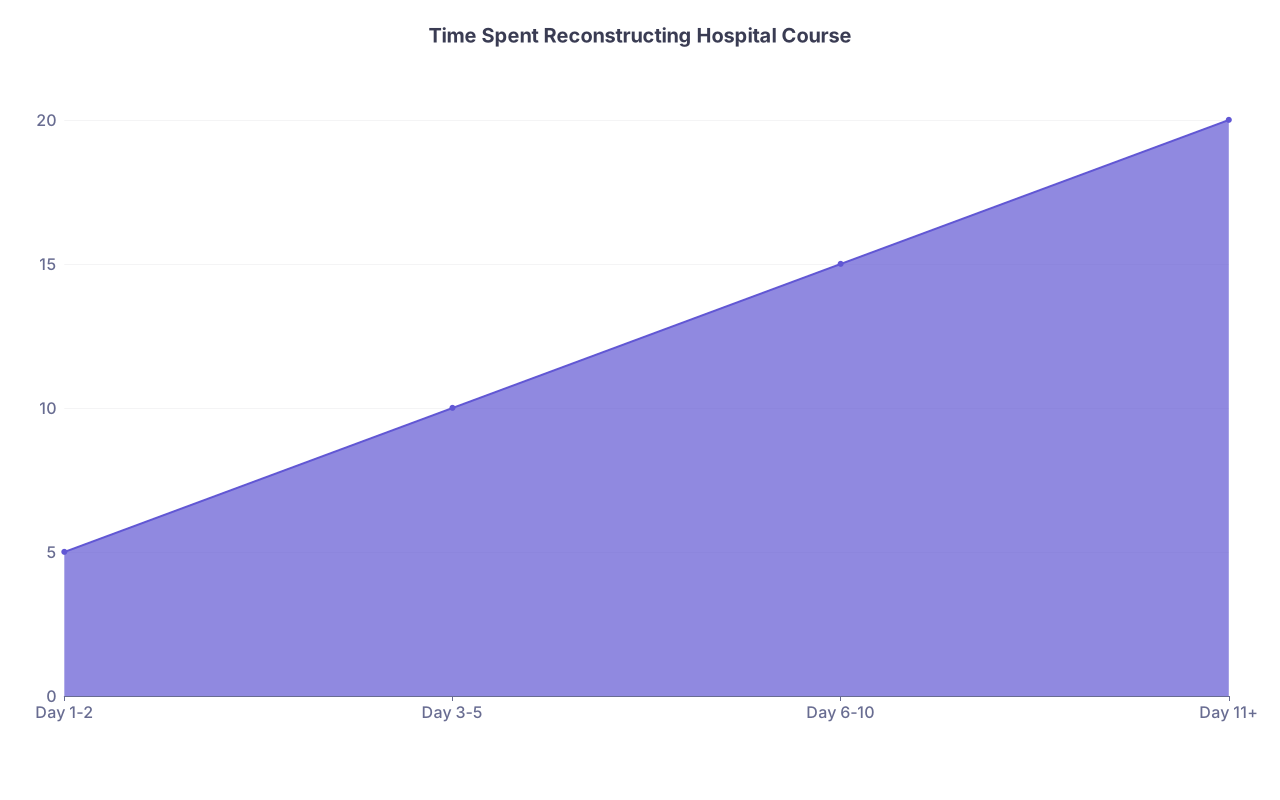
| Category | Value |
|---|---|
| Day 1-2 | 5 |
| Day 3-5 | 10 |
| Day 6-10 | 15 |
| Day 11+ | 20 |
Every extra minute spent reconstructing the timeline is an avoidable documentation failure.
How to avoid it
You do not need a novel. You need micro-timelines.
In the main problem section, add 1–2 lines of context:
- “HF exacerbation – Day 4. Initially required 4 L NC, now on RA. Net even prior 2 days after -3 L on HD 1–2.”
For tricky or long stays, include a “Hospital course so far” paragraph every few days in your note:
- “Since admission for pancreatitis on 1/2, pain improved, tolerating diet, but developed new fevers on 1/5 with CT showing peripancreatic fluid collection…”
When handing off a complex patient, make sure your written note mirrors your verbal sign-out structure: main issues, what has happened, what you are watching for.
If someone brand new can understand the patient’s trajectory in under a minute from your note, your future self and team will thank you.
Mistake #9: Documentation That Fails at Handoff
You already know that bad sign-outs create risk. What you may not realize is how much your written notes affect handoffs, both within and across services.
Classic problems:
- “Problems to watch” not reflected anywhere in the chart.
- Labs or imaging “to follow up” not listed in the plan.
- Scut tasks not documented (blood cultures drawn, pending MRI, etc.).
So the on-call resident ends up:
- Re-ordering tests because they cannot tell whether they were done.
- Calling radiology or lab to figure out if something is pending.
- Missing key follow-ups because they were only mentioned verbally.
How to avoid it
Use your daily note to support your sign-out:
Include a mini “To Follow” section in the plan for any pending:
- Significant labs (e.g., troponin trend, cultures, drug levels).
- Imaging that will change management.
- Consultant recommendations awaited.
When something is not done for a reason, write it:
- “CT angio NOT ordered due to CKD4; pursuing VQ instead.”
- Prevents the next team from repeating the same thought process or ordering harmful tests.
Align your written plan and sign-out document. If your sign-out says, “If fever again, broaden to vanc/zosyn,” your note should have that rationale too.
You reduce your own pages at night when your written plan already answers, “What should I do if X happens?”
A Quick Visual: What Good vs Bad Documentation Does to Your Team

| Step | Description |
|---|---|
| Step 1 | Your Documentation |
| Step 2 | Team trusts notes |
| Step 3 | Team doubts notes |
| Step 4 | Fewer pages and clarifications |
| Step 5 | Faster rounds and decisions |
| Step 6 | Less rework |
| Step 7 | More calls to clarify |
| Step 8 | Repeat history and exam |
| Step 9 | More time wasted |
| Step 10 | Clear, aligned, up to date? |
You decide which branch your team lives on.
What You Should Do Today
Do not try to fix all of this at once. You will fail and revert to old habits. Start small and concrete.
Today, on your next patient:
- Open your last note on that patient.
- Look only at the Assessment & Plan.
- Ask yourself:
- Is there a clear, problem-based structure?
- Would a new cross-cover resident know exactly what to do tonight from this plan?
- Do the orders in the chart actually match what I wrote?
Then:
- Rewrite the plan for one patient so that the answer to all three questions is “yes.”
- Update orders to match.
Do this consistently for a handful of patients a day. Your documentation will stop creating extra work for your team and start quietly removing it.
Open one of your notes right now and read the plan as if you are the night float who has never seen the patient. Where do you have to pause and think, “Wait, what do they actually want me to do?” Fix that line.