
The way most residents handle pages on busy nights is wrong. You are not supposed to be a human notification center. You are supposed to be a clinician who uses a system.
If your “system” right now is:
- Answer whatever just paged you
- Pray nothing crashes while you are stuck in a room
- Hope you did not forget that order from 45 minutes ago
…then yes, you are going to feel buried every single call night.
You need an algorithm. Not in the cute productivity-guru sense. In the actual “if X, then Y” sense. A repeatable decision tree that tells you:
- What to handle now
- What can safely wait
- What to delegate or bounce back
- How to document, so you do not get burned later
Let me give you one that actually works on the floor.
Step 1: Build a 4-Level Priority Framework (Before the Chaos Starts)
You cannot sort pages in real time if you have not defined the buckets ahead of time. Most residents never do this explicitly. They just “go by feel.” That is how you miss a septic patient while you are reordering diet preferences.
Use this four-level framework and commit it to memory.
| Level | Label | Response Time Target |
|---|---|---|
| P1 | Life/limb | 0–5 minutes |
| P2 | Clinical | 5–20 minutes |
| P3 | Task | 20–60 minutes |
| P4 | FYI/Admin | Batch later |
P1 – Life/Limb Threats (0–5 minutes)
Criteria: Anything that smells like:
- Airway compromise
- Hemodynamic instability
- Rapid neuro change
- Active significant bleeding
- Serious arrhythmia / acute chest pain
Classic P1 pages:
- “Pt in 624 unresponsive / not waking up.”
- “BP 70s/40s, MAP 50 on your patient.”
- “HR 180s, symptomatic, STAT.”
- “New focal weakness, face droop on your stroke patient.”
- “Hematemesis, large volume, BP dropping.”
Action:
- Drop everything else. Literally.
- Call back immediately on the phone en route if not already on the unit.
- Announce “I am coming now” to the nurse.
- If you are on multiple services, text or call cross-cover/consult if you will be tied up.
P2 – Clinical But Stable (5–20 minutes)
Criteria: Clinical decision needed, but patient is not crashing:
- New fever
- New oxygen requirement but stable vitals
- Concerning but not catastrophic labs (K 2.9, Hgb 7.0, Na 125, etc.)
- Pain not controlled but patient otherwise stable
- Delirium, agitation without imminent danger
Examples:
- “Temp 38.9, HR 108, BP stable, what do you want?”
- “K 3.0, replete?”
- “Pt more short of breath, now on 3L instead of 1L, sats 93%.”
- “Pt confused and trying to pull lines.”
Action:
- Call back within 5–10 minutes.
- Decide if this can be handled by orders alone or needs a bedside eval.
- If you are physically going soon anyway (same unit), group P2 bedside checks with other tasks.
P3 – Task Work (20–60 minutes)
Criteria: Routine but legitimate care tasks:
- Sleep meds, PRNs beyond standing orders
- Bowel regimens, diet changes, routine fluids
- Non-urgent lab/radiology questions
- Clarifying home meds without immediate consequence
Examples:
- “Pt asking for something to sleep.”
- “Pt constipated x2 days, wants something.”
- “Diet order missing; can you place.”
- “Can you sign this lab or imaging request?”
Action:
- Add to a running to-do list.
- Batch similar tasks: meds, orders, documentation.
- Close a P3 cluster every 30–60 minutes between higher-priority issues.
P4 – FYI / Admin / Can Wait (Batch Later)
Criteria: No change in management now:
- “FYI pt refused labs/vitals/meds.”
- Family update requests when patient is stable.
- “Can we change the dressing order wording?”
- Discharge planning questions for the morning team.
Action:
- Quickly acknowledge by text or brief call: “Noted, ok to continue, will defer to day team for final plan.”
- Add non-urgent follow-ups to a low-priority list if absolutely necessary.
- Batch documentation later if needed.
Step 2: A 6-Question Triage Script for Every Page
You have 10–20 seconds when you read/hear a page to make a decision. Your brain wants to panic. Do not let it.
Run this script mentally, every single time. I mean it. This is the algorithm.
Is the patient alive and stable right now?
- If unclear or “no” → Treat as P1. Call immediately.
- If “yes, vitals fine” → proceed.
What is the vital sign situation?
- Ask explicitly: “What are the current vitals, and how do they compare to baseline?”
- Unstable or rapidly changing → P1 or upper P2.
- Mild abnormalities, stable trend → P2/P3.
Is there a clear symptom or exam change?
- New neuro deficit, new chest pain, new SOB, new severe pain → P1/P2.
- Chronic complaint with no change → usually P3.
Is there time-critical treatment tied to this?
- Time-sensitive antibiotics, anticoag decisions, stroke, STEMI, sepsis bundles → escalate priority.
- Routine prn not given yet → lower priority.
Can this be solved without seeing the patient?
- Lab repletion, med reordering, clarifying orders → may be handled remotely if vitals are stable and nurse is comfortable.
- Any doubt → you go see them (but still sort P1 vs P2).
Does this need you, or can someone else own it?
- Pharmacy, RT, charge nurse, on-call consultant, cross-cover senior.
- If you are not the right owner, redirect politely but firmly.
You can literally keep a sticky note on your workstation with those 6 questions for your first month of nights.
Step 3: The Live Queue – How to Track Pages So You Stop Forgetting
Your brain is not a queue manager. Stop pretending it is.
On a busy night you need a simple, visual system. Whiteboard. Paper. iPad note. I prefer paper because batteries do not die at 3 a.m.
Here is the structure that works:
| Column | Purpose |
|---|---|
| Time | When page received |
| Patient/Bed | Who is this about |
| Priority (P1–P4) | Your triage category |
| Task / Issue | Short description (3–5 words) |
| Status | Pending / In progress / Done |
| Follow-up | Labs to recheck, call family, etc. |
Example during a chaotic hour:
- 22:10 – 624B – P1 – “Hypotension BP 70/40” – IN PROGRESS
- 22:12 – 618A – P2 – “Fever 39, new” – PENDING
- 22:15 – 630C – P3 – “Sleep med request” – PENDING
- 22:17 – 622D – P2 – “K 2.9, replete?” – PENDING
- 22:20 – 615A – P4 – “Refused vitals” – NOTED
Protocol:
- When paged, write it down immediately before doing anything else.
- Assign P1–P4 on the spot. Do not leave it blank.
- After finishing any P1, re-scan the list for other P1/P2 items before touching P3.
- Cross off or mark “Done” with a quick checkmark and a tiny note if needed (“ordered K, recheck 03:00”).

| Step | Description |
|---|---|
| Step 1 | Receive Page |
| Step 2 | Write in Queue |
| Step 3 | P1 - Call now, go see |
| Step 4 | Assess vitals and change |
| Step 5 | P2 - Call in 5-10 min |
| Step 6 | P3 - Batch in 20-60 min |
| Step 7 | P4 - Note, batch later |
| Step 8 | Patient stable? |
| Step 9 | Acute change or risk? |
| Step 10 | Task or FYI? |
You will feel less anxious the moment the queue is on paper instead of swimming in your head.
Step 4: Standard Responses for Common Pages (So You Do Not Reinvent the Wheel)
A big chunk of “overwhelm” is cognitive. You are solving the same class of problem over and over again as if it is new. Stop doing that.
Let me give you templates for the most common night pages. You adapt to your hospital’s policies and attending preferences.
1. “Patient is more short of breath”
Triage:
- Ask: “Current vitals? O2 sats and device? Baseline? Any chest pain?”
- If sats < 90% on usual oxygen, new tachypnea, or hemodynamic changes → P1/P2.
Standard Response:
- If clearly unstable → “Put them on NRB / increase O2, call RT, I am on my way now.”
- If mildly worse but stable:
- “Increase O2 to keep sats > goal, get stat CXR, CBC, BMP, lactate if concerned for sepsis, ABG/VBG if very symptomatic; I will come see them in the next 15–20 minutes unless they worsen.”
- Document: “Paged for increased SOB, vitals…, exam…, plan…”
2. “Fever / New 38.5+”
Triage:
- Ask: “How do they look? Vitals trend? Source suspected? Immunocompromised?”
- Fever plus hypotension, tachycardia, or altered mental status → escalate.
Standard Response (stable):
- Quick orders: blood cultures x2, urine with culture, CXR if pulmonary source, lactate if any concern.
- Check if they have an antibiotic plan from the day team or known source.
- Decide: start empiric antibiotics now versus wait if truly low risk.
- See the patient if any red flag whatsoever.
3. “Need something to help them sleep”
This is where nights go to die if you are not disciplined.
Protocol:
- Ask: “Have they tried non-pharm? Lights off, TV off, minimized vitals?”
- Check MAR for existing PRNs or prior night meds.
- If not elderly or delirious risk: you may consider a low-dose familiar agent.
- If elderly/delirium-prone: very cautious; often say, “Let us avoid sedatives; can we try melatonin / non-pharm first?”
- Priority: almost always P3.
4. “Pain not controlled”
You cannot blow these off, but you also cannot let them hijack your whole night.
Protocol:
- Ask: “Pain scale now? Where is the pain? Any change from baseline? Vitals?”
- Check current orders – often there is an unused PRN that just needs to be given.
- If using opioids, think about intervals and totals, renal/hepatic function.
- For clearly new or significantly worse pain (esp. chest/abdomen) → elevate to P2 and go examine.
Step 5: Protecting Your Time Without Burning Bridges
You are not only triaging patients. You are triaging people: nurses, RTs, family, consultants. Some call appropriately. Some dump. Your job is not to absorb all dysfunction.
Here is the blunt reality:
- If you say “yes” to everything immediately, everyone will default to paging you for everything.
- If you set zero boundaries, your P3 and P4 load will get absurd, and your P1 and P2 patients will suffer.
Simple Phrases That Change Behavior
You do not need to be rude. Just consistent.
For low-priority or misdirected pages:
- “For issues with X (e.g., central line dressing changes), charge nurse or IV team usually manages that first.”
- “This sounds stable; I will handle this when I finish with a higher-acuity patient. If vitals change, please repage and label it urgent.”
- “This is best decided by the primary team in the morning; I will note it for them.”
For setting expectations:
- “I am currently in a room with an unstable patient. I will call you back about non-urgent issues once I am out, likely in 20–30 minutes.”
- “If their blood pressure drops below ___ or HR goes above ___, page me back immediately as urgent.”
If you repeat these lines calmly and consistently, staff will start triaging for you. They are not your enemy. They are simply responding to whatever you reward.
Step 6: Use Data – Where Is Your Time Actually Going?
Most residents feel overwhelmed at night but have no concrete sense of why. You can fix that in three shifts.
On your next three busy nights, track three things:
- Number of pages per hour
- Category (P1–P4)
- How many required you to physically go to bedside
Then look at the pattern.
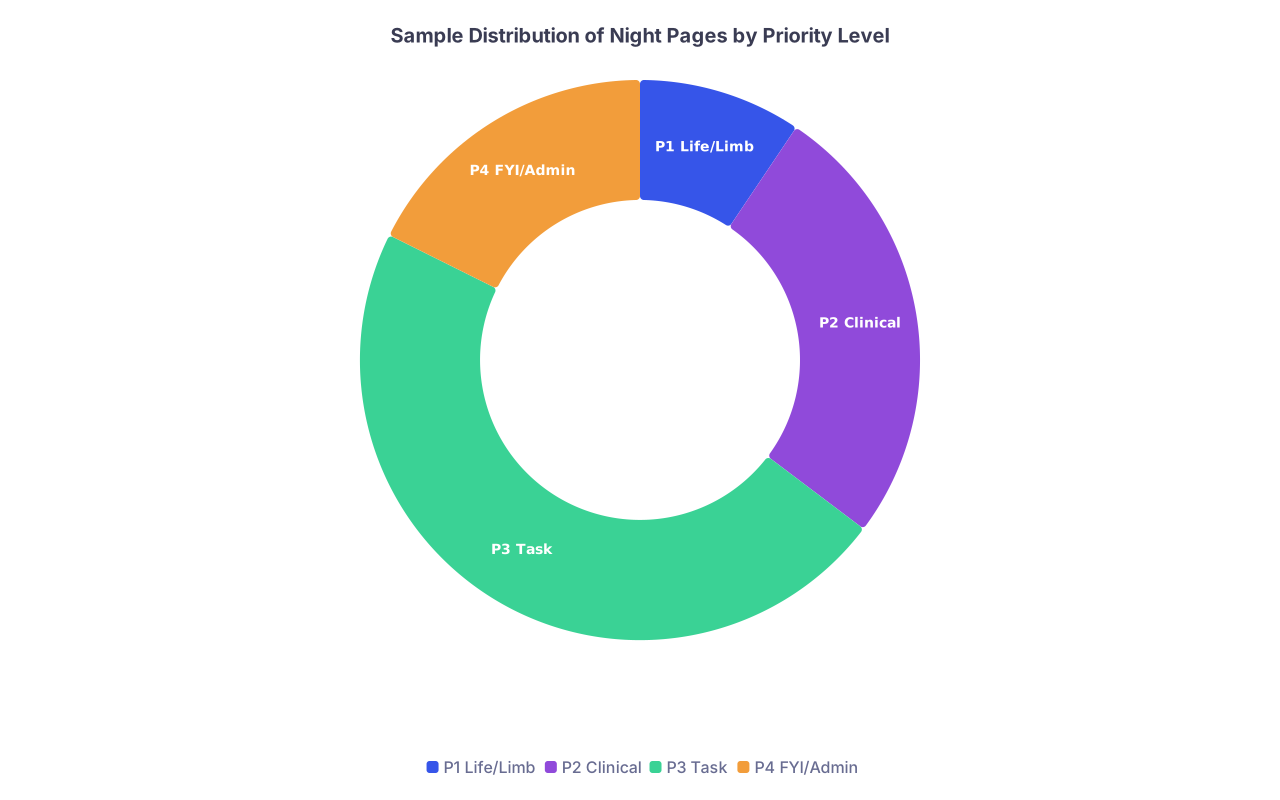
| Category | Value |
|---|---|
| P1 Life/Limb | 8 |
| P2 Clinical | 22 |
| P3 Task | 40 |
| P4 FYI/Admin | 15 |
If your breakdown looks anything like:
- P1: 5–10%
- P2: 20–30%
- P3: 40–50%
- P4: 10–20%
Then your overwhelm is from:
- Too many P3 tasks hitting you randomly instead of batched
- Too many P4s that could be redirected or deferred
- P2s that are not standardized (you reinvent the workup every time)
What you do with that:
- Build order sets in your brain: “fever bundle”, “mild SOB bundle”, “hypotension checklist”.
- Tighten your boundary language for P4s.
- Ask your day team to put better anticipatory orders (bowel regimen, sleep strategy, pain ladder) to prevent a chunk of P3 pages.
Step 7: A Minimal Night Checklist So You End the Shift Clean
Even with good triage, nights are messy. Stuff falls through. You catch it with a 5-minute pre-sign-out checklist.
Right before sign-out:
- Re-scan your queue sheet. Anything not crossed off? Either:
- Do it now if <2 minutes
- Or hand off explicitly to day team with context
- Check:
- Any labs you ordered whose results you never reviewed?
- Any imaging done with no one having looked at it?
- For any scary event overnight:
- Make sure there is a concise note (even 3–4 lines) documenting:
- What happened
- What you found
- What you did
- What needs follow-up
- Make sure there is a concise note (even 3–4 lines) documenting:
You do this for two reasons:
- Patient safety, obviously.
- Self-protection. Unclear night events with no documentation are how you get pulled into unpleasant conversations days later.
Step 8: Training Your Brain – The First 5 Nights Using This System
If you are used to constant firefighting, switching to an algorithm feels strange. You will want to go back to reacting.
Force yourself through these stages:
Night 1–2: Just Label and Log
Goal:
- Write down every page.
- Assign P1–P4 each time, even if you do not change your actual behavior yet.
Outcome:
- You start to see how much of your night is P3/P4 noise.
- Your awareness goes up. That alone calms things slightly.
Night 3–4: Time Targets
Goal:
- P1: call back and move within 1–2 minutes.
- P2: respond within 5–10 minutes.
- P3: batch into 30–60 minute blocks.
- P4: batch into 1–2 times per night.
Outcome:
- You begin to delay P3 and P4 without guilt because you have a system.
- You notice fewer interruptions while dealing with true P1/P2 issues.
Night 5+: Refine and Personalize
Now you adjust:
- Create your own quick-fever, SOB, hypotension order patterns.
- Decide which P3 issues you are comfortable handling by protocol vs going to bedside.
- Start negotiating with day teams: “We get 10+ bowel/sleep calls overnight; can we standardize orders?”

Step 9: What To Do When Everything Is P1 or P2
There are nights when the system is not enough. Three rapid responses at once. Two septic patients and an upper GI bleed. This happens.
Here is the protocol for those truly awful nights:
Declare the situation early.
- Tell charge nurse: “I have three unstable patients at once; I will need help prioritizing and extra eyes.”
- Call your senior or backup: “I am saturated with high-acuity issues, I need another body.”
Rank the P1s by reversibility and resource.
- Airway or active code > hypotension > arrhythmia > others
- If RT or anesthesia is present, use them aggressively.
Stop doing P3 and P4 entirely.
- You are allowed to ignore sleep meds and administrative nonsense when three people are trying to die.
- Have a standard line: “I am involved with multiple unstable patients; I can only address life-threatening issues right now. Please repage later for routine matters.”
Leave breadcrumbs.
- When you move from one crisis to another, leave a 1–2 line note or at least a timestamp on your sheet: “Code 624B started 01:10; transferred to ICU 01:40.”
- This is for your own brain and for handoff.
The algorithm does not make brutal nights easy. It just lets you fail in a controlled, defensible way instead of random chaos.
Step 10: One More Layer – Making Day Teams Your Ally
Some of your night chaos is baked in by bad daytime planning. You cannot fix all of it, but you can fix some.
After particularly rough nights, say something very specific at morning sign-out. Not “last night was busy.” Concrete:
- “We got 7 calls about constipation between 11 p.m. and 4 a.m. Please consider routine bowel regimen orders on admission.”
- “We keep getting paged for sleep meds on delirium-prone patients; can we set a standard plan in the daytime notes?”
- “Three nights in a row we were called about unclear code status on decompensating patients. Can you tighten goals-of-care discussions on admission?”
You do not need to rant. Just data + request. Over a month, this nudges your environment toward sanity.
Your Next Step (Do This Before Your Next Call Night)
Do not file this as “good ideas.” Turn it into practice.
Before your next shift:
- Take one index card or small notepad.
- On the front, write:
- P1: Life/limb (0–5 min)
- P2: Clinical (5–20 min)
- P3: Task (20–60 min)
- P4: FYI (batch)
- On the back, write the 6 triage questions in shorthand:
- Alive/stable now?
- Vitals + trend?
- New symptom/exam change?
- Time-critical tx?
- Need to see vs order only?
- Me vs someone else?
Put that card in your pocket. When the first page hits, pull it out and actually use it. Not in theory. In real time.
Then after the shift, look at your scribbled list of pages and ask one thing:
“Where did I let P3 and P4 steal time from P1 and P2?”
Fix that on the next night. That is how you stop drowning and start practicing medicine, even at 3 a.m.