
Resident conflict is not a personality problem. It is a leadership test you either pass with skill or fail by avoidance.
You are not just there to write notes and push orders. As a resident, you are also middle management in a dysfunctional, high-stress system. Conflict on your team is guaranteed: between seniors and interns, between co-residents, between residents and nurses. What separates a solid resident from a train wreck is not whether conflict happens. It is how you handle it in the moment.
This is not another “use I-statements and be empathetic” lecture. I am going to give you concrete, word-for-word scripts and stepwise protocols you can use tomorrow on rounds, in sign-out, or in the workroom when things blow up.
Use this as a playbook. Steal the lines. Adapt the structure. The goal is simple: keep patient care safe, keep the team functional, and keep yourself out of the program director’s office for the wrong reasons.
Step 1: Recognize Conflict Early (Red-Flag Behaviors)
Most residents react too late. They ignore the tension until it explodes in front of an attending or a nurse.
Here are the early warning signs you need to act on:
- Snapping or sarcasm in front of others (“Guess I’ll just do everything myself… again.”)
- Eye-rolling, visible frustration, or side conversations during rounds
- Passive-aggressive comments in the chart or group chat
- Repeated “forgetting” of tasks assigned by a specific person
- Rounding turning into an argument about whose plan is “right,” not what is safest
If you notice these, you are already in the “do something now” zone.
Quick internal checklist (takes 10 seconds):
- Is patient safety at risk right now?
- Is this conflict visible to others (attending, nurses, students, family)?
- Are emotions high enough that logic is not landing?
If the answer to any of those is “yes,” you move from passive observer to active de-escalator.
Step 2: Know Your Job in the Conflict
Your job changes depending on your role on the team.
| Your Position | Primary Responsibility | Main Tool |
|---|---|---|
| Senior/Chief | Own the team climate | Structure + Scripts |
| Co-intern/Co-resident | Stop the bleeding, pull aside | Neutral questions |
| Off-service resident | Protect patient care, then escalate | Concise summaries |
If you are the senior:
You are responsible. Not for everyone’s feelings, but for the behavior and the tone of the team. You do not get to shrug and say, “They just don’t get along.”
If you are a co-intern / peer:
You are not HR. You are the “emergency brake.” Your job is to halt the public meltdown and suggest a private conversation or loop in the senior.
If you are off-service:
You are not expected to fix the entire dynamic. You are expected to clearly state: “This is affecting patient care” and escalate to your senior/chief/attending.
Now let us get into actual words.
Step 3: On-the-Spot De-Escalation Script (Public Conflict)
Scenario: On rounds, the senior and intern start arguing about whether to discharge a patient. Tone is sharp. The nurse is standing there. The attending is watching this get awkward.
Your priorities:
- Stop the escalation.
- Protect the patient discussion.
- Move the emotional part offline.
Here is a stepwise script that works:
3.1 Step 1 – Interrupt the Spiral (Respectfully but Firmly)
You need a clean, neutral interrupt. You are not taking sides; you are slowing things down.
Useful lines:
- “I want to pause for a second so we can regroup.”
- “Let us hold on. I think we are starting to talk past each other.”
- “Can we take 10 seconds and reset how we are approaching this?”
If you are the senior, use your authority:
- “Okay, I am going to pause us here. We will circle back to this after we finish rounds.”
If you are the peer/intern:
- “Hey, can we pause this for a minute and finish the patient plan first?”
3.2 Step 2 – Recenter on the Patient
Immediately pivot back to something concrete and clinical. This gets everyone out of ego mode for a moment.
Lines you can use:
- “For this patient, the key question is: are we confident they are safe to go home today?”
- “Let us list what would make us comfortable with discharge versus staying.”
- “If we had to make a decision in the next 5 minutes, what data do we still need?”
The trick: you are not pretending nothing happened. You are just moving the argument out of the public stage.
3.3 Step 3 – Politely Bump the Emotional Part to Later
Once you have stabilized the case discussion, you explicitly say this needs follow-up, but in private.
Script:
- “There is some tension here that we should talk through, but not in front of the rest of the team. After rounds, let us take 10 minutes and reset.”
If the attending is present and conflict is messy:
- “I think there are some workflow and communication issues we should clarify as a smaller group. After we finish patient care, could we briefly regroup as a resident team?”
You are signaling: “We see this, we are not ignoring it, but we are also not doing this performance in front of everyone.”
Step 4: The Private De-Escalation Meeting (20-Min Protocol)
This is where most people blow it. They either:
- Avoid the conversation entirely
- Ramble with no structure
- Turn it into a blame session or therapy session
You need a short, structured, repeatable protocol. Here is one that works in roughly 15–20 minutes.
Break it into five phases:
- Set the frame
- Get each person’s short version
- Identify the concrete problem(s)
- Agree on behavioral changes
- Close and document (mentally or in a brief email if needed)
4.1 Phase 1 – Set the Frame (2 minutes)
You open with a clear agenda and ground rules. This is non-negotiable.
Script (as senior or neutral facilitator):
“Alright, I pulled us together because what happened on rounds felt tense and it is starting to affect the team. I am not here to pick sides. I am here to make sure:
- Patient care is safe
- We can function together without people feeling disrespected
- We leave this with clear agreements on how we will work together
Two ground rules:
- We talk about specific behaviors, not personalities.
- We keep this focused on what we can change going forward.”
Then:
“I am going to ask each of you to give a short version of what is going on from your perspective. Two minutes each. No interruptions.”
You control the structure. Calm, direct, no drama.
4.2 Phase 2 – Each Person’s Two-Minute Version (6 minutes)
Let each person speak. You time-box it mentally. You intervene only if it becomes personal attacks.
Prompt:
- “Can you walk me through what has been frustrating you, in two minutes?”
If it starts to go personal (“They are lazy,” “They never listen”):
You cut in with:
- “Pause. I want you to rephrase that in terms of specific behaviors or examples. For instance: ‘On X day, Y happened and I felt Z.’ Try again with that frame.”
Do this for each person. Allow them to speak without interruption.
Your job:
- Reflect back key facts and key feelings, without endorsing either side.
Example:
“So I am hearing from you that when discharge recommendations are changed at the last minute without you being updated, you feel dismissed and you worry it makes you look disorganized in front of the attending.”
Then to the other:
“And I am hearing from you that when orders are not in by the time the attending comes by, you feel like you are carrying extra weight and that your concerns about safety are being ignored.”
You are translating from attack mode to understandable concerns.
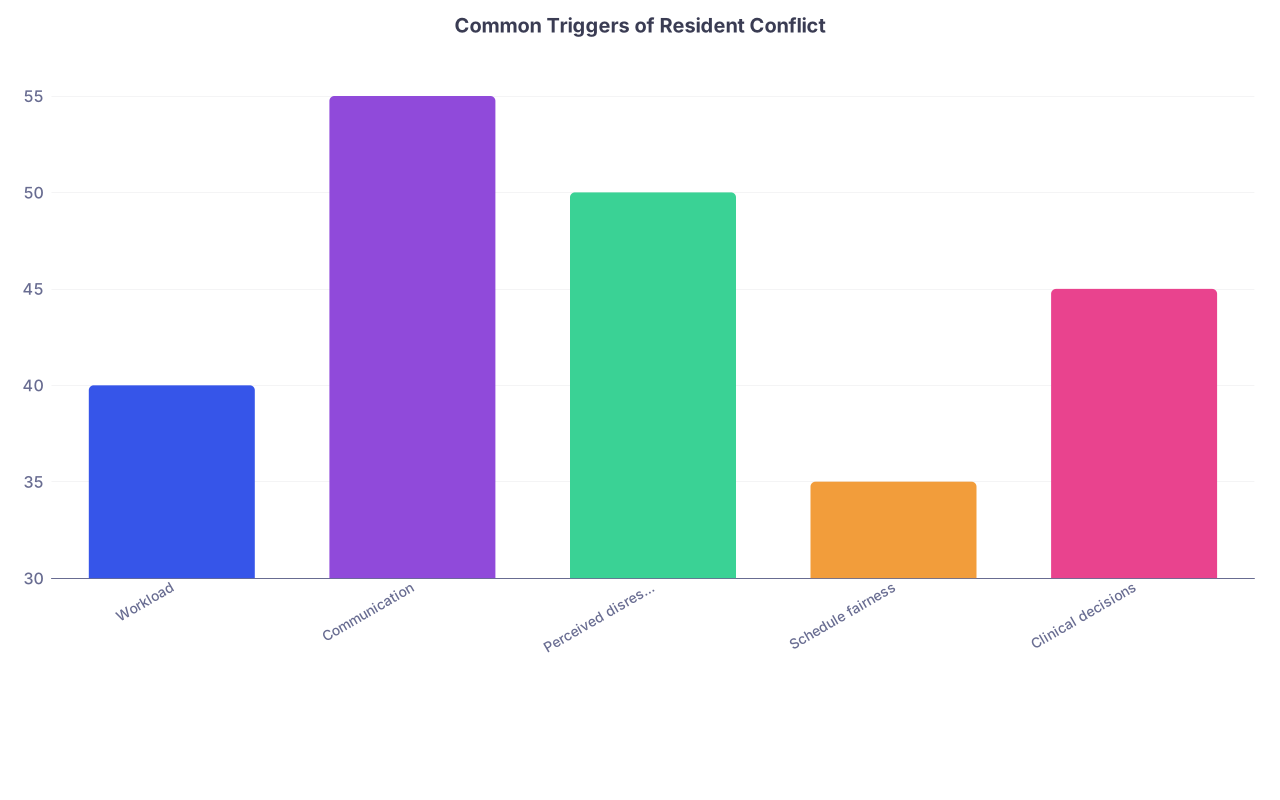
| Category | Value |
|---|---|
| Workload | 40 |
| Communication | 55 |
| Perceived disrespect | 50 |
| Schedule fairness | 35 |
| Clinical decisions | 45 |
4.3 Phase 3 – Identify the Real Problems (5 minutes)
Now you move from stories and emotions to problems you can actually fix.
You ask a very simple, powerful question to each:
- “If we narrow this down, what are the top one or two specific things that, if different, would make working together much easier?”
You are fishing for:
- “I need to know the plan before we go in the room.”
- “I need you to tell me directly if you want something done, not hint at it.”
- “I need you to stop criticizing me in front of the nurse.”
- “I need help prioritizing tasks when the list is long.”
Write them down if you have to. Then summarize:
“Okay, let me see if this is accurate. The main issues are:
- Real-time communication about plan changes
- How feedback is delivered (public vs private)
- Clarity around task priorities and timeline
Did I miss anything critical?”
You want clear, actionable problems, not vague labels like “you do not respect me” or “you are too sensitive.”
4.4 Phase 4 – Turn Problems into Explicit Agreements (5–7 minutes)
This is the part everyone skips. They vent, feel “heard,” and then… nothing changes.
You force the conversation into action mode:
“Let us turn each of these into a specific agreement or behavior change.”
Take them one by one.
Example 1: Communication about plan changes
- “What would ‘better’ look like in real life?”
- Intern: “If you are going to change the dispo or major parts of the plan, just tell me directly right after rounds before putting in orders.”
- Senior: “Okay, I can do that. In return, I need you to tell me if you are behind so I am not expecting orders in that are not there yet.”
Turn it into a line:
- “Agreement: For any major plan change, [Senior] will tell [Intern] directly within 10 minutes of deciding. [Intern] will tell [Senior] if they are behind on orders so expectations can be adjusted.”
Example 2: Public criticism
- “What guideline can we agree on for feedback?”
- Intern: “If you have a problem, can you tell me in private instead of in front of the nurse or attending?”
- Senior: “Yes, that is fair. In return, I need you to be open to that feedback and not shut down.”
Formalize:
- “Agreement: We will give critical feedback in private whenever possible. If something urgent has to be said in public for patient safety, we will acknowledge it afterwards and debrief briefly.”
You are basically doing a micro-contract. Out loud.
Finish with:
“Do both of you feel like these agreements are realistic for the rest of this rotation?”
You want explicit yes-es.
4.5 Phase 5 – Close the Loop (2–3 minutes)
You end with three things:
- A reset statement
- A check for remaining landmines
- A plan to briefly check back later
Example closing script:
“I appreciate both of you being direct about this. Rotations are stressful; conflict is not a personal failure, it is just a sign we need clearer systems and communication. From my side, what I am watching for is:
- Patient care is safe
- No more public blow-ups
- We stick to the agreements we just made
Anything else either of you needs to say right now to feel we can move forward professionally?”
Then:
“I will check in briefly at the end of the week to see how this is going. If we slip back into old patterns, we will adjust. But for now, let us run with this.”
If the conflict was serious or repeated, you can tell them:
“I will send a short summary email of the agreements we came up with so we all remember. This is not going into some permanent file; it is just to keep us honest.”
Step 5: Scripts for Specific Common Scenarios
Now let us get even more concrete. Here are targeted scripts for situations you will almost certainly see.
5.1 Senior Belittling an Intern in Front of Others
You are the intern’s co-resident. Senior snaps on rounds:
“Why is this not done yet? I told you this three times. Do I have to do everything myself?”
On-the-spot script (you, calmly):
“Let us pause. We are getting into process feedback in front of the nurse and patient. Can we finish the clinical plan and then talk about workflow as a smaller group afterwards?”
Later, privately, to the senior:
“When you called them out like that in front of the nurse, they shut down completely. If you want more from them, you will get better results with direct private feedback. I am happy to help structure that if you want.”
To the intern (also privately):
“I saw that interaction. It was rough. We are going to work on shifting that kind of feedback to private spaces. For now, let us figure out what support you need so that specific task does not fall through again.”
You are validating, but also holding standards.
5.2 Two Interns Passive-Aggressively Sniping All Day
They are rolling eyes, making comments, complaining to nurses.
Script to pull them together:
“I can see there is tension between you two, and it is starting to spill out in front of patients and staff. That is not acceptable on this team, and it is not good for either of you. Let us take 15 minutes right now in the workroom and figure out what the main friction points are and how we are going to function professionally for the rest of this month.”
Then run the 5-phase protocol from Step 4.

| Step | Description |
|---|---|
| Step 1 | Notice tension or conflict |
| Step 2 | Interrupt immediately |
| Step 3 | Plan private conversation |
| Step 4 | Recentre on patient plan |
| Step 5 | Defer emotional part to later |
| Step 6 | Private 5-phase meeting |
| Step 7 | Create explicit agreements |
| Step 8 | Monitor and follow up |
| Step 9 | Is patient safety at risk? |
5.3 You Are in the Conflict (You Lost Your Cool)
You snapped at your co-resident. You regret it. Good. Now fix it like a professional.
Own it quickly and specifically.
Script:
“About earlier – I raised my voice and that was not okay. I am frustrated about the workload, but that is not on you personally. Here is what I actually need: when we are behind, I need to know earlier so I can redistribute or call for help. Going forward, if I slip into that tone again, feel free to say, ‘Can we talk about this later, not like this?’ and I will back off.”
Do not make it about your personality. Make it about what you will do differently.
Step 6: When and How to Escalate
Sometimes the conflict is beyond “resident solves it.” Examples:
- Repeated undermining, bullying, or targeted comments
- Safety issues from sabotage or withholding information
- Discrimination, harassment, or anything that makes someone feel unsafe
You are not doing anyone favors by “handling it quietly” in those situations.
If you are senior and your internal alarm is going off:
Script to the people involved:
“I want to be transparent. Some of what is happening here goes beyond normal conflict and gets into territory that affects safety / professionalism / equity. I am going to loop in [chief/residency leadership] so we can get more support on this. This is not about punishing anyone; it is about not letting this fester into something worse.”
Email or page to chief/residency leadership (tight, factual):
“On [date], during [context – e.g., rounds on Blue Team], there was significant conflict between [Resident A, PGY-2] and [Resident B, PGY-1]. I attempted on-the-spot de-escalation and held a brief follow-up meeting using a structured approach, but there are ongoing concerns about [e.g., public belittling, undermining in front of nurses, reluctance to speak on rounds, etc.].
I am concerned this may be affecting patient care and team climate. I would appreciate guidance and possible involvement.”
Short. Specific. No dramatics.

Step 7: Protecting Patient Care While Conflict Simmer
Sometimes, despite your best efforts, the dynamic is still tense. You will not fix it in one conversation. That is fine. Your minimum job is to firewall patient care from the mess.
Concrete steps:
- Assign clear roles on rounds.
“You present, you write orders, I will handle bedside discussions and dispo.” - Use written checklists for daily tasks and who owns them.
- Have 5-minute pre-round and post-round huddles:
“Any concerns about communication? Any tasks at risk of being dropped?” - If someone is freezing out the other (not telling them plan changes), you insert yourself:
“All plan changes get said out loud in our pre-lunch touch base. Non-negotiable.”
You are building systems that make it harder for conflict to cause real harm.
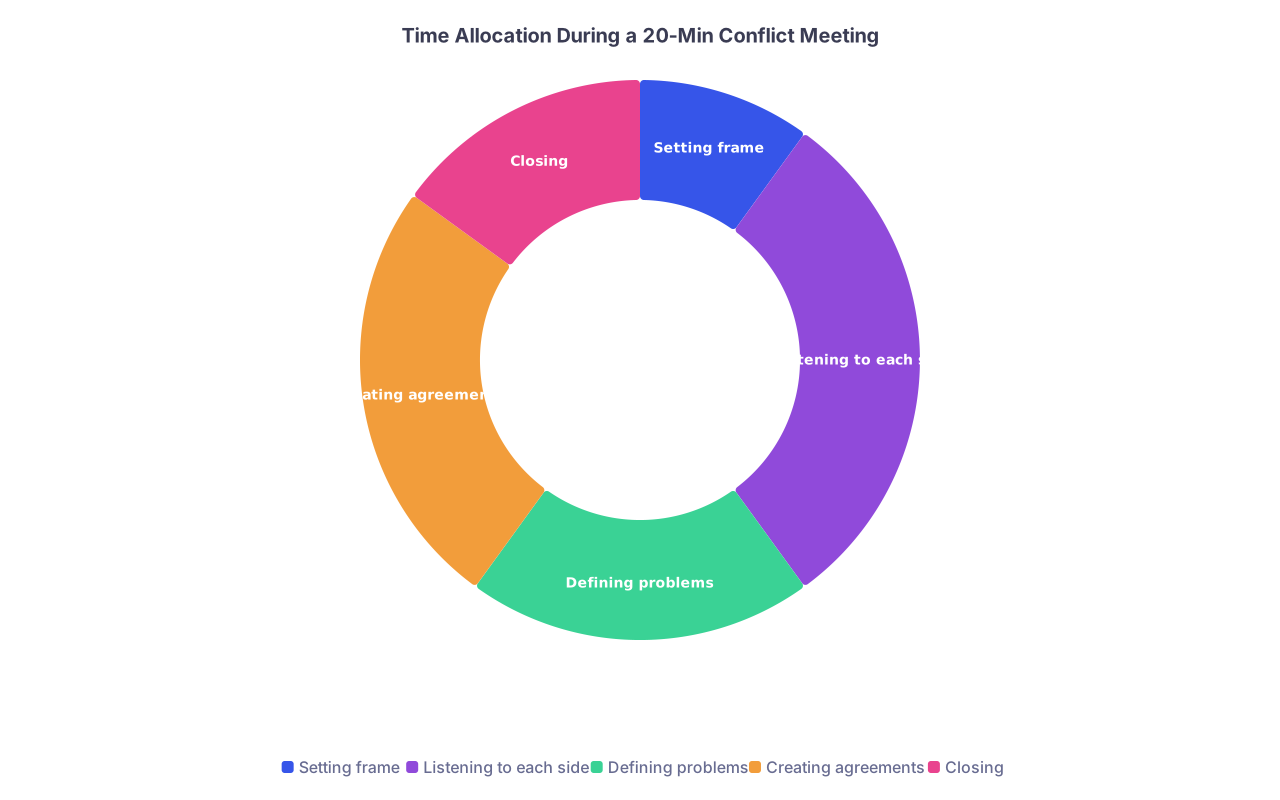
| Category | Value |
|---|---|
| Setting frame | 10 |
| Listening to each side | 30 |
| Defining problems | 20 |
| Creating agreements | 25 |
| Closing | 15 |
Step 8: Training Yourself to Stay Calm in the Moment
None of this works if you lose your own cool. The residents I have watched handle conflict best do a few simple things consistently:
- They buy themselves 3–5 seconds before speaking.
Silent breath in. Short pause. Then: “Let us pause for a second.” - They lower their voice when others raise theirs.
- They keep their body language open – not leaning in, not looming, not pointing.
- They do not chase every accusation. They move back to structure:
“Okay, that is one example. Let us focus on what we want to change going forward.”
If you know you are reactive, script a default line and practice it:
- “I am more frustrated than I want to be right now. Let us finish this patient’s plan and come back to this in 15 minutes.”
You are not a robot. You get irritated. Fine. The question is whether you have a default productive behavior when that happens.

Quick Reference: 10 Phrases That Defuse Resident Conflict
Keep these in your back pocket:
- “Let us pause for a second and regroup.”
- “I think we are talking past each other. For this patient, the key question is…”
- “We should not have this conversation in front of the team. Let us come back to it after rounds.”
- “Two ground rules: we talk about behaviors, not personalities, and we focus on what we can change going forward.”
- “Give me the two-minute version of what is frustrating you. No interruptions.”
- “Rephrase that in terms of a specific example – ‘On X day, Y happened and I felt Z.’”
- “If we narrow this down, what one or two specific changes would make this much easier?”
- “Let us turn that into a concrete agreement for the rest of this rotation.”
- “Do both of you feel like this plan is realistic day to day?”
- “I appreciate you both being direct. I will check in at the end of the week to see how this is going.”
You will not use all of them. You do not need to. Pick three that feel natural and start there.
Final Takeaways
- Conflict on resident teams is predictable, not a personal or program failure. Your job is not to “avoid conflict,” but to structure it and de-escalate it.
- Use a simple, repeatable protocol: pause publicly, recenter on the patient, then handle the emotions and workflow privately with a short, structured meeting that ends in clear behavioral agreements.
- Protect patient care and the team climate. When dynamics cross into bullying, discrimination, or safety issues, escalate early and clearly instead of trying to be a hero in silence.