
Last year I watched an intern walk out of sign-out at 6:58 pm, proud he’d “kept it short.” By 7:45, the night float senior was on the phone with the ICU attending, furious, trying to rescue a patient whose “stable anemia” turned out to be an active GI bleed nobody had bothered to frame correctly. The intern wasn’t lazy. He just didn’t know the hidden rules.
Let me tell you what your seniors actually expect of you at sign-out. Not the sanitized “check-back communication” nonsense from the mandatory module. The real thing—the version people judge you on when you’re not in the room.
Why Sign-Out Is Where Interns Quietly Rise or Quietly Die
Here’s the part they don’t say aloud: most seniors decide whether you are “safe,” “solid,” or “a liability” largely from how you sign out.
Not notes. Not prerounds. Not even how fast you respond on Epic. Sign-out.
Why? Because sign-out is where we see:
- Whether you understand what matters on a patient
- Whether you can anticipate and think ahead
- Whether you respect other people’s time and sleep
- Whether I can trust you when I’m not physically there
And attendings? Many of them never see you actually write orders or place lines. But they absolutely hear from their seniors: “Yeah, she gives a clean sign-out” or “His sign-out is terrifying.” That gets baked into your “global” evaluation.
So if you’re an intern, treat sign-out like a high-stakes procedure. It is. You can absolutely hurt people by doing it badly. And you can absolutely win people over by doing it well.
The Unspoken Goal: Protect the Night Team’s Brain
Most interns think the goal of sign-out is “tell the next team what’s going on.” Close, but not quite.
The real goal is to decrease cognitive load for someone who will be covering:
- 30–80 patients
- On little sleep
- With interruptions every 2–3 minutes
- For problems you created or inherited
Your senior at 2 am isn’t scrolling through your detailed note. They’re looking at 2–3 words next to a name and trying to guess: “Is this one going to explode on me or can I safely ignore them while I run to that rapid response?”
If you remember only this: your job in sign-out is to make it so the night team can manage your patients without thinking too hard. That’s the hidden standard.
The Skeleton Every Good Sign-Out Follows (Even If No One Teaches It)
Let’s strip this down. Every high-quality sign-out has three pillars:
- Snapshot
- Story
- Safety net
1. Snapshot: The One-Line ID That Actually Matters
Seniors expect your first sentence to answer: “Who is this human and why are they in a hospital bed right now?”
Weak:
“Mr. Smith, 72-year-old male with a history of CAD and COPD.”
No. That’s autopilot garbage.
Strong:
“Mr. Smith, 72-year-old with CAD and COPD, here for NSTEMI day 2, on heparin drip, stable on the floor.”
Notice the difference. The second one tells me:
- Why he’s here
- Where he is in the course
- What the “active machinery” is (heparin)
- That he is currently stable
That’s what seniors want, consistently, for every patient. One clean mental hook.
2. Story: Only the Parts That Change Overnight
Most interns dump the H&P. No one wants that. It’s not that we’re lazy. It’s that it’s irrelevant to the next 12 hours.
Here’s the real filter:
Only say what will influence actions or decisions tonight.
Intern version:
“She came in with three days of abdominal pain, nausea, vomiting, went to CT, they saw some inflammation around the pancreas, lipase was 782, GI saw her this morning…”
Senior expectation:
“She’s here with gallstone pancreatitis, NPO, on LR at 200, pain finally controlled with dilaudid, GI planning ERCP tomorrow.”
When you talk, I’m silently checking: “Are you talking to show me you know the whole story, or are you telling me what I actually need?”
If you consistently give me tomorrow’s-irrelevant noise, I file you under “doesn’t get it.”
3. Safety Net: The “If X, Then Y” That Separates Adults From Children
This is where seniors really judge you. Anticipation.
Safety net = “If this predictable thing happens, here’s what to do or who to call.”
Example of bad sign-out:
“Blood pressure’s been soft but okay.”
Good sign-out:
“He’s been 90s/50s all afternoon but mentating well, lactate down from 3 to 1.5, we’re okay with 90s given his baseline. If MAP drops below 60 or mental status worsens, please call MICU, attending is aware he could declare himself.”
The second tells me:
- You understand the physiology
- You’ve involved the right people
- You’ve mentally run the failure scenario
That’s senior brain behavior. When interns do this, they immediately jump, in our minds, from “needs close supervision” to “I can trust them.”
What Seniors Are Thinking But Won’t Say While You’re Signing Out
Here’s the internal monologue of a decent senior during your sign-out. No one will tell you this to your face, so I will.
- “Take it from the top” = You’ve lost the plot. I can’t follow. Start over.
- “What’s the plan if they worsen?” = You obviously haven’t thought about it. I’m prompting you to grow up.
- Silence while typing = I’m rewriting your sign-out because it is unusable.
- “Anything actually worrying you about this person?” = You’re giving me a book report, not a clinical handoff.
There are also warning signs that set off alarm bells:
- You say “doing fine” about someone on pressors or high-flow.
- You say “stable” but their vitals were a mess all day.
- You never mention code status on a sick patient.
- You don’t mention any contingency plans for anyone.
In the back of my mind, I’m thinking: If your sign-out is this sloppy when I’m listening, what’s happening when I’m not?
The Types of Patients Seniors Expect You to Treat Differently
Not all patients are equal in sign-out. Again, no one teaches this formally, but seniors all do this mental triage.
| Tier | Patient Type | Senior Expectation Level |
|---|---|---|
| 1 | Actively unstable | Very detailed, clear plans |
| 2 | Potential to decompensate | Focused, anticipatory |
| 3 | Comfort care / hospice | Clear boundaries, goals |
| 4 | Boring, truly stable | Brief, minimal |
| 5 | Discharge tomorrow | Quick, confirm tasks |
Let’s walk through what this means in practice.
Tier 1: Actively Unstable
These are your high-flow oxygen, borderline pressors, GI bleed, sepsis-just-admitted people.
Senior expectation:
- Full today-trajectory: where they started, where they are now
- What’s been done, what’s not working yet
- Exact thresholds that should trigger escalation
- Names: which consultants are already involved and who explicitly said, “Call me if X”
If you say, “Kind of sick, but okay right now,” you’ve failed. I need actionable granularity.
Tier 2: Could Decompensate
Think CHF with rising creatinine, borderline O2 needs, newly post-op, brittle diabetics, severe alcohol withdrawal.
Here we want clear watch points.
Weak:
“Respiratory status has been okay today.”
Strong:
“On 2L nasal cannula, satting 92–94%, walking to bathroom without desaturations. If O2 requirement goes above 4L or they can’t walk to the bathroom without dropping below 88%, I’d get a CXR and consider paging surgery/hospitalist.”
It does not need to be perfect. It just needs to show you understand what deterioration looks like for this disease.
Tier 3: Comfort Care / DNR with Limits
This is where interns screw up and seniors get really, really angry.
You must draw the line for the night team.
Disaster sign-out:
“She’s DNR/DNI, but we’re still treating.”
Proper sign-out:
“She’s DNR/DNI. Family and patient agreed to no escalation beyond current setting—no ICU, no pressors, no BiPAP. They’re okay with antibiotics and fluids. If she worsens, goal is comfort only: please focus on symptom control and don’t call rapid unless nursing feels unsafe.”
If you don’t clarify this, you set up a brutal 3 am showdown with a terrified nurse, a panicked night float, and a furious family. Ask me how I know.
Tier 4: Truly Stable Boring Patients
Here’s the secret: seniors like when you say “nothing active, just routine care” on someone for whom that’s true.
The mistake interns make is treating everyone like Tier 4.
If someone’s floor-stable, home tomorrow, no weird labs, no pending procedures, no oxygen, no major psych issues? You’re allowed to say:
“Totally stable, no active issues, just finishing IV antibiotics day 3 of 5, can be summarized in the list.”
That shows me you can prioritize. Music to my ears.
Tier 5: Discharge Tomorrow
We want one thing: “Can I safely get them out if nothing blows up?”
You should answer:
- Are scripts ordered?
- Follow-up arranged?
- Any overnight labs or imaging that could derail discharge?
Bad:
“Going home tomorrow.”
Better:
“Planned discharge tomorrow if AM creatinine still <1.5. All scripts queued, PCP follow-up scheduled for next week.”
Now if I’m the night senior and things are quiet, maybe I help you and double-check a med or two. Because you did your homework.
The Mechanics: How to Not Make Your Senior Hate You in the First 5 Minutes
Let’s talk execution. Small things that intern manuals never mention, but seniors absolutely notice.
Be Ready Before Start Time
If sign-out is at 6:30, you should have:
- Updated your sign-out template
- Closed today’s major loops (stat labs, pending CTs)
- Checked vitals on anyone sick-ish in the last 1–2 hours
When you show up breathless, still typing, saying “Oh wait, what happened with that CT…?” I’m already annoyed. It tells me you don’t understand that sign-out is part of patient care, not an afterthought.
Use the Template, But Don’t Worship It
Epic/Meditech/Cerner templates are mediocre at best. Seniors use them as scaffolding, not scripture.
The hidden rule: you’re allowed to ignore fields that don’t matter and add free-text where it does.
If the “Assessment/Plan” box is a wall of text and your verbal sign-out is just you reading that wall back to me? I’m gone. I’m glancing at my phone. I’ve tuned you out.
Instead, think:
- Line 1: Who / why here / day of hospitalization
- 2–3 lines: Today’s story, changes, interventions
- 1–2 lines: Overnight watch items and contingency plans
That’s it.
Advanced Move: How to Handle “I Don’t Know” Without Looking Incompetent
You will be asked something during sign-out that you don’t know.
“I don’t know” is actually fine. How you say it matters.
Bad:
“I don’t know, I didn’t look at that.”
Better:
“I’m not sure what GI ultimately decided—note wasn’t in yet. They saw him around 4. Based on the consult request, question was early scope vs medical management only. I’d check for a GI note or page them if there’s any decompensation.”
Even better next time:
You anticipate that exact gap before sign-out and fill it. That’s how your trajectory goes from “scary intern” to “sharp intern” in a month.
What Seniors Expect During Night Cross-Cover… And Remember in the Morning
This part is rarely written down, but it absolutely colors how we treat you.
Seniors expect that the way you prepare sign-out changes how many dumb pages they get overnight. They notice trends.
Let me give you a real breakdown we did once on night float:
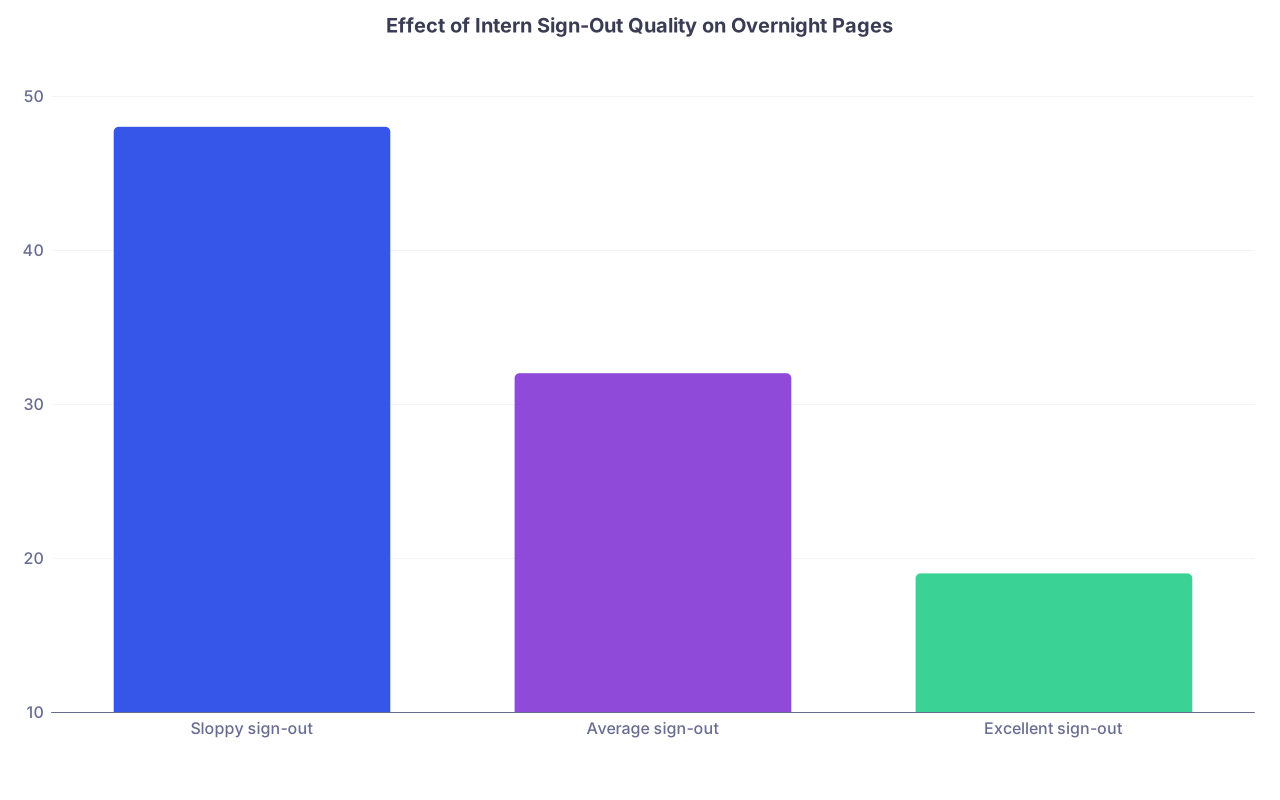
| Category | Value |
|---|---|
| Sloppy sign-out | 48 |
| Average sign-out | 32 |
| Excellent sign-out | 19 |
On weeks when the day interns gave weak sign-outs, our cross-cover pages shot up. Nurses were confused, orders were missing, thresholds unclear. We could literally predict which intern had been on based on the type of overnight chaos.
That’s why seniors care so much about your handoff. It’s not theoretical.
How to Practice Without Making It Awkward
You’re not going to master this just by reading.
Here’s what I’ve seen work for interns who get very good, very fast:
- Before sign-out, pick your three “sickest or trickiest” patients.
- For each, write one contingency sentence: “If X overnight, do Y / call Z.”
- Run those three by your senior before sign-out and ask, “Does this sound right?”
You’ll get tiny calibrations:
“Actually, for this guy, if his pressures soften, I’d do fluids first, not call MICU immediately.”
By week 2, you’ll start predicting those calibrations. By month 2, you’ll be the one teaching the other interns.
Common Ways Interns Accidentally Undermine Themselves at Sign-Out
A quick rogues’ gallery, from years of watching this up close:
- Calling everyone “stable” because they’re not literally coding
- Never mentioning code status on anyone
- Hiding uncertainty instead of saying, “I’m not sure, I’d do X, then Y”
- Over-explaining unimportant details and under-explaining actual risk
- Trying to sound smart instead of trying to be useful
- Leaving “to-do” items in their head instead of on the list: “Oh yeah, I was going to recheck a BMP, can you order that?” (No. You should have.)
When you fix these, your reputation changes shockingly fast. Two or three strong sign-outs in a row and seniors relax around you. That’s not trivial—people give better evals when they’re not secretly worried you’ll hurt someone.
A Simple Mental Checklist You Can Run Before Every Sign-Out
Before you open your mouth on each patient, silently ask yourself:
- “If I were cross-covering, what would I be scared of tonight for this person?”
- “Did I give enough information for someone half-asleep to handle that?”
- “Did I draw clear lines: what to ignore, what to watch, what to act on?”
If the answer is yes to all three, you’re doing better than 80% of interns.
Quick Flow: How Sign-Out Should Actually Feel
Let me stitch this together in one clean example. This is what seniors are hoping to hear from you.
Mr. Johnson, 68-year-old with HFrEF, here with acute decompensated heart failure, hospital day 2, on the floor.
Today we diuresed him with IV lasix, net negative 2L, he feels better, still on 2L nasal cannula, satting 93–95%. Creatinine nudged from 1.1 to 1.3.
Overnight, just watch his sats and pressures. If he needs more than 4L or his SBP drops below 90 with symptoms, I’d get a CXR and page the hospitalist; they know he might need step-up or a change in diuresis. Code status is full.
That’s it. Clean, focused, and actually useful.

| Step | Description |
|---|---|
| Step 1 | Update list and vitals |
| Step 2 | Identify sickest patients |
| Step 3 | Create snapshot and story |
| Step 4 | Add contingency plans |
| Step 5 | Clarify code status |
| Step 6 | Give verbal sign-out |
| Step 7 | Night team manages overnight events |
FAQ (Exactly 3 Questions)
1. What if my senior’s style is totally different from what you’re describing?
Every senior has quirks. Some want more details, some want only headlines. But underneath, most of them are judging the same core things: do you understand why the patient is here, what happened today, and what might go wrong tonight? Ask directly: “For sick patients, how detailed do you want me?” Then layer that preference on top of the principles here. Style can vary. Safety can’t.
2. How do I handle a chaotic day when I just haven’t seen all my patients well?
Own it early. Before sign-out say, “Today was rough, I didn’t get to reassess X and Y this afternoon. Here’s what I do know, and here’s what I would have checked if I had more time.” Then give your best effort at contingency planning. Seniors are far more forgiving of a stretched intern who’s transparent than of someone pretending everything is fine when it clearly isn’t.
3. Should I write long sign-out notes so I don’t miss anything?
No. A bloated sign-out is as useless as a thin one. Think of the written part as a reference card, not a mini H&P. Short, structured, and focused on “what matters tonight” beats long and comprehensive every time. If your written sign-out is so long that no one can scan it in 5–10 seconds, it’s not helping the night team; it’s just creating more noise.