
The honest answer: most residents are running on less sleep than is safe.
Let me be blunt. The amount of sleep you need to function safely is not the same as the amount the system lets you get. And that gap is exactly where errors, burnout, and car crashes live.
Here’s what the evidence – and real-world residency – say about how much sleep you actually need if you want to function safely, think clearly, and not wreck your brain and body.
The Real Number: How Much Sleep Do Residents Need?
For safe functioning on clinical duty, most residents need 7–8 hours of sleep per 24 hours. Not 4. Not “I’m fine on 5.” That’s bravado talking, not data.
Here’s the key breakdown:
- Absolute minimum for safe performance: about 6 hours in a 24-hour period, and even that’s pushing it if done repeatedly
- Optimal range for clinical reasoning, mood, and safety: 7–8 hours
- Chronic level where performance clearly drops: <6 hours per night, most nights
Sleep research on physicians and trainees is pretty unforgiving. Performance after:
- 17–19 hours awake looks like a blood alcohol content of about 0.05
- 24 hours awake looks closer to 0.08–0.10 (legally drunk in most places)
You wouldn’t want a drunk intern managing pressors in the ICU. But we routinely expect residents to do the functional equivalent after a 24+ hour call.
So if you want a single number: target at least 7 hours per 24 hours, defend 6 hours as a hard floor, and treat anything below that as a safety risk, not a badge of honor.
What Actually Happens in Residency
Now let’s talk reality, not fantasy.
Typical patterns I’ve seen (and lived):
| Rotation Type | Typical Sleep on Workdays | Post-Call Sleep | Chronic Risk Level |
|---|---|---|---|
| Outpatient / Clinic | 6–7.5 hours | N/A | Moderate |
| Ward days (q4–q5) | 5.5–7 hours | 2–5 hours nap | High |
| ICU days | 5–6.5 hours | Variable | High |
| 24-hr call (q4–q7) | 2–4 hours during call | 3–6 hours after | Very High |
On a relatively humane outpatient month, you can often hit 7 hours if you’re disciplined. On ICU or busy inpatient services with 24-hour calls, your average over the week can easily slide down toward 5–6 hours, even if you “catch up” post-call.
The problem: you can’t truly “bank” or fully “catch up” lost sleep. Chronic partial sleep deprivation builds up a sleep debt that your brain quietly pays for with:
- Slower reaction times
- Poorer diagnostic accuracy
- Shorter fuse with staff, patients, and family
- Microsleeps (those terrifying 1–5 second blackouts you deny having)
And most residents underestimate how impaired they are. That’s not opinion—that’s been shown in controlled studies.
How Sleep Loss Actually Harms Safety
Let’s connect this to what you care about: not harming patients, not harming yourself, and not sabotaging your career.
Cognitive performance
Sleep loss hits the exact functions you rely on every day:
- Working memory: Keeping the plan in your head while orders pile in
- Executive function: Prioritizing tasks in a crashing patient
- Attention: Not missing that subtle hypotension trend at 3 a.m.
- Judgment: Deciding when to call your attending (or when you’re out of your depth)
After a typical 24-hour call with 2–3 hours of fragmented sleep, your reasoning and attention are measurably worse. You’ll say, “I feel okay.” The data say otherwise.
Patient safety
We’ve seen:
- Higher error rates on post-call patients
- More prescription errors and charting mistakes when residents are sleep-deprived
- Attending physicians more often catching mistakes on morning rounds after heavy-call nights
Nobody announces, “By the way, that near-miss yesterday was because I got 3 hours of sleep.” But if you look under the hood, fatigue is often sitting there quietly.
Your health and long-term brain function
Chronic short sleep (under 6 hours/night) has been linked with:
- Higher rates of depression and anxiety
- Weight gain, insulin resistance, blood pressure issues
- Burnout and leaving medicine early
And before you say, “It’s just a few years, I’ll catch up later”—chronic deprivation leaves a mark. Memory, mood, and stress resilience don’t just bounce back overnight.
How Much Sleep Do You Need on Different Schedules?
Let’s get more concrete. Here’s what “functioning safely” should look like across common scenarios and what to aim for.
1. Day float / regular day shifts
If you’re doing standard days (e.g., 6 a.m.–6 p.m. or 7 a.m.–7 p.m.):
- Goal: 7–8 hours at night
- Bare minimum you might get away with occasionally: 6 hours
- Pattern that will fry you in 2–3 weeks: 4.5–5.5 hours consistently
If you’re consistently waking up at 4:30 a.m., you should be asleep by 9:30–10 p.m. to be in the safe zone. Most residents aren’t. They’re scrolling, catching up on notes, or doing life stuff.
If you’re always in the 5–6 hour range on these “lighter” rotations, consider that a red flag—because on ICU or call you’ll slide even lower.
2. 24-hour call (or 28-hr with handoff)
On 24-hour call, the system is basically saying: we know you’ll be impaired, but we’re accepting that risk. You shouldn’t.
To function as safely as possible:
- Night of call: Expect 0–4 hours of fragmented, low-quality sleep
- Post-call day: You need a real sleep period of 4–6 hours at a minimum
- Following night: Aim for a full 7–9 hours
- Weekly average: Try to keep your 7-day average ≥ 6.5 hours per 24 hours
If post-call you’re getting home at 1 p.m., sleeping 2 hours, then staying up until midnight, you’re torching yourself. That feels like “reclaiming your day,” but physiologically it’s shooting your week in the foot.
Here’s what a safer pattern looks like:
- Home by 1–2 p.m. → sleep until 5–6 p.m.
- Light dinner, minimal stimulation
- Back in bed by 10–11 p.m., sleep until your normal wake time
Not perfect. But your 24-hour period ends up with closer to 7–8 hours across the post-call afternoon and night.
3. Night float / nights
Nights are brutal because you’re fighting your biology. There is no version of this that feels good.
Still, you can reduce the damage:
- Total daily sleep goal: 7–8 hours combined (daytime main sleep + evening nap if possible)
- Realistic minimum for functional safety short-term: 6 hours total in 24 hours
- Red zone: consistently <5 hours per 24 hours
Some residents do best with:
- Home by 8–9 a.m.
- Sleep 9 a.m.–3 p.m. (6 hours)
- Short nap 7–8 p.m.
Others prefer:
- Short nap before night shift
- Longer sleep block in the late morning/early afternoon
If you’re getting only 4 hours/day on nights, your reaction times and decision making are genuinely dangerous by the end of a 5–7 night stretch.
How to Tell If You’re Actually Too Sleep-Deprived
You can’t judge this only by how you “feel.” Sleep-deprived people consistently overestimate how fine they are.
Watch for these red flags:
- You reread the same note paragraph 3–4 times and still can’t process it
- You “lose time” on the drive home and can’t remember part of the route
- You catch yourself staring at the MAR or EMR screen thinking, “What was I doing?”
- You’re snapping at nurses for normal requests
- You’re relying on UpToDate or MDCalc for things you usually know cold
- Microsleeps: brief head nods, eyelids drooping, jerking awake
If two or more of these are happening regularly, you are not functioning safely—no matter what your co-residents say they can tolerate.
Practical Ways to Protect Sleep (Without Quitting Residency)
You’re not redesigning the system. But you can control more than you think inside a broken one.
1. Set a personal “floor”
Decide now: I don’t go below 6 hours in 24 hours more than 1–2 days in a row without fixing it.
That might mean:
- Dropping non-essential stuff (moonlighting, extra projects, social obligations) during heavy rotations
- Saying no to “just one more” late-night TV episode
- Being ruthless about out-of-hospital charting—batch it, do it faster, then sleep
2. Use short naps strategically
On brutal stretches, a 20–30 minute nap can salvage your night:
- Pre-night shift nap: 30–90 minutes in late afternoon
- Call-night micro-naps: 10–20 minutes when the pager is quiet and someone can cover
Avoid 1+ hour naps unless you have time to wake up fully afterward; sleep inertia can make you more useless for a bit.
3. Build a wind-down routine that works in 20 minutes
You don’t have the luxury of a 2-hour bedtime routine. You do need some signal to your brain that sleep is happening.
Typical fast routine:
- Screens off or on very dim, warm mode
- 5–10 minutes of something repetitive (same podcast, same playlist, same page of a book)
- Dark, cool room (eye mask and ear plugs are your best friends on days/nights)
If you’re lying in bed ruminating about patients, try a quick brain dump: write 5–10 bullet points of what’s stressing you, then tell yourself: “This is for tomorrow-me.”
4. Protect your commute
If you’re even thinking “I might be too tired to drive,” you’re already over the line.
Safer options:
- Call a co-resident for a quick check-in before driving
- Ask a partner/friend to pick you up on your heaviest calls
- Use a rideshare home and back the next day if you’re wrecked
- If you must drive: windows down, cold air, no cruise control, and if your eyes blur or you lose focus even once—pull over. Nap 15 minutes.
Residents have died on post-call drives. This is not hypothetical.
5. Use days off to stabilize, not just binge
Your day off is not a test of how much you can cram in.
Better plan:
- Anchor your sleep: still aim for 7–9 hours
- One longer sleep (maybe 9–10 hours) is fine, but don’t wreck your circadian rhythm with 4 a.m. bedtimes
- Some sunlight, some movement, one fun thing, and one life-admin thing. Then rest.
You’re not in college anymore. You don’t bounce back the same way, especially in a system constantly taxing you.
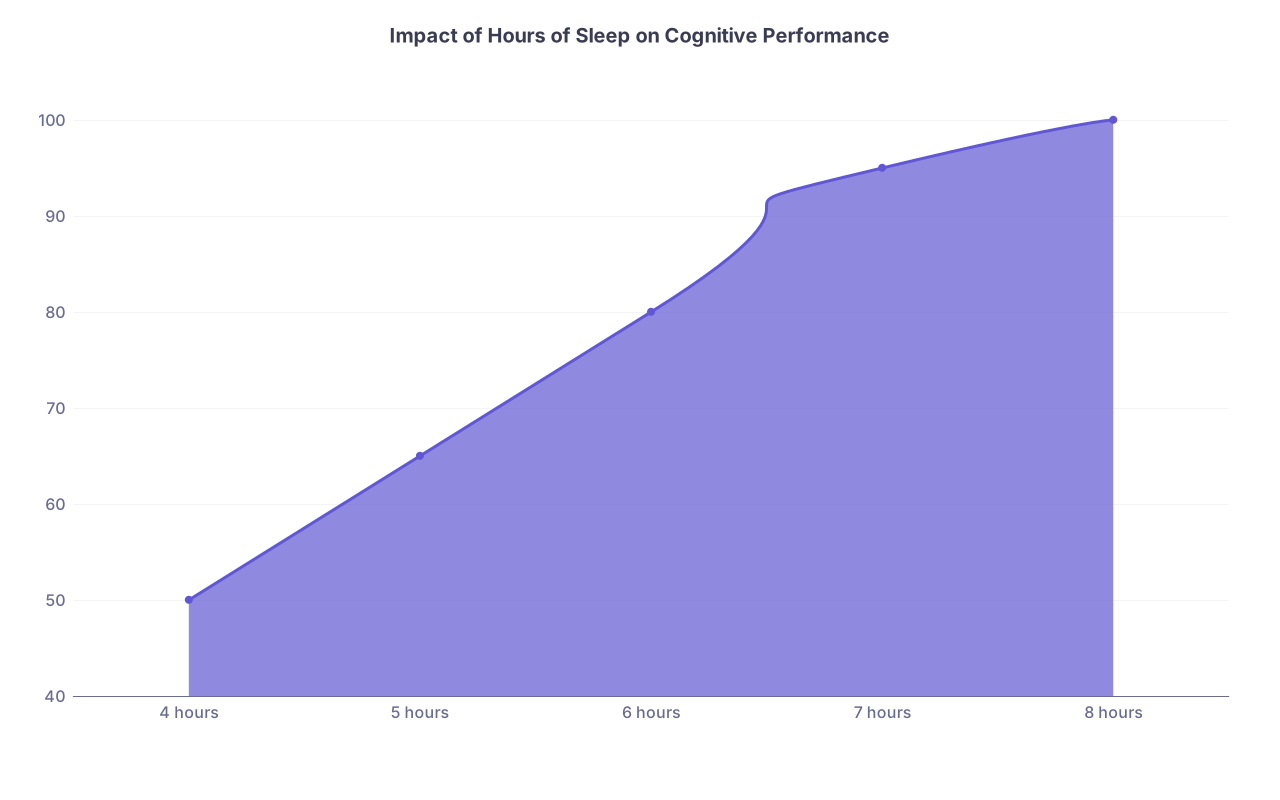
| Category | Value |
|---|---|
| 4 hours | 50 |
| 5 hours | 65 |
| 6 hours | 80 |
| 7 hours | 95 |
| 8 hours | 100 |
When You Should Actually Speak Up
Yes, culture says “tough it out.” But you’re not an endless resource.
You should escalate (to chief, program director, or attending) when:
- You’re routinely getting <5 hours per 24 hours on a rotation, despite doing your part efficiently
- You’re having near-misses or actual errors clearly tied to fatigue
- You’re experiencing microsleeps on rounds, in the ICU, or while doing procedures
- You’ve had one drowsy-driving close call
Don’t frame it as “I’m weak.” Frame it as “This is a patient safety and duty hours issue.”
Some programs will blow you off. Some will take it seriously. But silence guarantees nothing changes.

| Step | Description |
|---|---|
| Step 1 | Current Sleep per 24 hours |
| Step 2 | Maintain habits |
| Step 3 | Monitor and protect off days |
| Step 4 | High risk - add naps and cut extras |
| Step 5 | Critical risk - escalate and seek help |
| Step 6 | 7 hours or more |
| Step 7 | 6 hours or more |
| Step 8 | 5 hours or more |
Bottom Line: How Much Sleep Do You Actually Need?
Here’s the answer distilled:
- You need 7–8 hours per 24 hours to function safely and protect your brain, mood, and body.
- You should treat 6 hours as an absolute floor, not a goal.
- Anything below 6 hours, especially repeatedly or around night shifts/calls, is a safety hazard—for patients and for you.
You are not special enough to beat basic neurobiology. Nobody is. The residents who “do fine on 4 hours” are quietly making more mistakes, burning out faster, and normalizing a broken system.
You can’t fully fix residency. But you can:
- Know the real numbers
- Defend your minimums
- Treat sleep as non-optional safety equipment, not a luxury