
What do you actually do when you wake up with a fever on your ICU block, you can barely stand up, and you’re on the schedule as the only night resident?
Let’s cut to it: yes, it is sometimes okay—and necessary—to call in sick during a busy residency block. But there’s a right way to decide, and a right way to do it, and residents screw this up in both directions all the time.
You’re caught between three pressures:
- Don’t screw your co-residents
- Don’t compromise patient care
- Don’t destroy your own health and make everything worse
You need a framework. Not vibes. Not guilt. A framework.
The Core Principle: Patient Safety First (Including You)
Residency conditioning tells you: “Just push through.” You’ve heard it in call rooms and sign-out rooms:
- “Unless you’re in the ICU as a patient, you show up.”
- “We didn’t have sick days when I trained.”
- “It’s just a cold. You’ll be fine.”
I’m going to be blunt: that mindset gets people hurt. It’s outdated, and it’s bad medicine.
Here’s the actual rule that matters:
If your illness makes you unsafe to practice, it’s not just okay to call in sick — it’s your duty.
Unsafe means:
- You can’t think clearly enough to make sound clinical decisions.
- You’re likely to spread something serious to vulnerable patients.
- You’re physically not able to do key tasks (e.g., can’t walk a unit safely, can’t operate, can’t stay awake).
If you’d be worried about a colleague caring for your family member in your condition, you shouldn’t be working.
A Simple Decision Framework: Should You Call In?
Use this 4-question check. Be honest. Not “resident honest,” actual honest.

| Step | Description |
|---|---|
| Step 1 | Wake up sick |
| Step 2 | Call out sick |
| Step 3 | Go in, inform senior |
| Step 4 | Fever or vomiting? |
| Step 5 | Can keep down fluids and meds? |
| Step 6 | Too foggy to think clearly? |
| Step 7 | High risk patient exposure? |
| Step 8 | Can safely complete shift? |
Now in plain language.
1. What are your actual symptoms?
Red flags that usually justify calling out:
- Fever ≥ 100.4°F (38°C) with systemic symptoms
- Active vomiting or severe diarrhea
- Tested positive for COVID/flu or clear severe viral illness
- Severe migraine you can’t think through, even with meds
- New confusion, dizziness, or presyncope
- Uncontrolled pain that prevents normal function
- Anything requiring the ER for you (obvious, but people ignore this)
On the fence symptoms (case-by-case, talk to your chief/PD if unsure):
- Mild URI with no fever, normal vitals, and you can function on OTC meds
- Mild headache you can control
- Mild GI upset with no fever, no frequent bathroom trips
- Allergies/benign conditions with no cognitive impact
If you’re actively contagious and on a heme-onc, transplant, NICU, or medicine floor full of immunocompromised patients, your threshold to stay home is lower. Yes, even during a brutal block.
2. Can you think clearly and make safe decisions?
This is the part residents lie to themselves about.
Ask yourself:
- Could I safely consent a patient for a procedure?
- Could I safely staff 15 sick patients on morning rounds?
- Would I trust “this version of me” with a crashing patient?
If your brain is mush from fever, migraine, or meds, that’s it. You’re done. You don’t belong at work that day.
3. Are you putting patients at real risk of infection?
If you’re on:
- OB, NICU, BMT, solid organ transplant, heme-onc, ICU, or geriatrics
and you’re hacking up a lung, febrile, or have a known viral infection? Working sick is reckless.
If you’re on:
- Clinic, consults, or a generally healthy population, with mild non-febrile symptoms and full masking policies
then maybe you can safely work, if cognitive function is intact.
4. Is this a pattern or a one-off?
Hard truth: patterns of “sick calls” the day after golden weekends, before hard calls, or around exams raise real concerns. And your chiefs do notice.
One serious illness a year? Nobody decent will bat an eye.
Four “GI bugs” during the hardest months? People will talk.
I’m not saying don’t call out. I’m saying: if this is starting to look recurrent, you also need to address the underlying issue—burnout, mental health, chronic disease—not just call out repeatedly without support.
How to Call In Sick the Right Way
There’s a professional way to do this, even when you feel awful.

Step 1: Know your program’s policy before you’re sick
Every program has some version of:
- Who you contact first (chief, senior on call, program coordinator, sick line).
- How early you must notify (ideally at least 2 hours before).
- Who logs it for duty hours and GME documentation.
If you don’t know, ask your chief or senior now, not when you’re hugging the toilet at 4:30 am.
Step 2: Decide early and be direct
Don’t wait until 6:59 for a 7 am shift and then send a vague text.
If you’re clearly unsafe:
- Notify as soon as you know you can’t safely work.
- Call, don’t just text, unless your program explicitly says text is fine for sick calls.
A simple script that works:
“Hey [Chief/Senior], I woke up with [102 fever and vomiting since 3 am], I can’t keep fluids down, and I don’t feel I can safely work today. I need to call out sick.”
Notice what’s not in there: apologizing 17 times, asking permission, or offering to come in “for a few hours” half-conscious.
Step 3: Give relevant, minimal information
You don’t owe your chief your full medical chart, but you do owe them enough to plan coverage responsibly.
Good level of detail:
- Contagious? (probable, confirmed, unknown)
- Expected duration? (1 day vs “I’m in the ER with appendicitis”)
- Any urgent needs (e.g., you have the only pager at home)
Bad:
- Oversharing, texting photos, asking them to diagnose you.
Step 4: Don’t “work from bed” unless explicitly asked and you’re truly able
Trying to “chart from home,” answer all messages, and micromanage while febrile isn’t heroic; it’s dumb.
If they ask: “Can you call families from home today?” and you can safely do that, fine. But your main job when you’re really sick is to get better and return truly functional—not half-broken for a week.
What About Mental Health? Is That “Sick Enough”?
Short answer: yes. But it needs the same rigor.
If you’re:
- Having active suicidal thoughts
- In complete panic and non-functional
- So depressed or anxious you can’t focus on labs, orders, or tasks
then you are not safe to practice. That’s not you being weak. That’s you being honest.
The problem is residents either:
- Ignore this completely and push through until they crash, or
- Call out for mental health repeatedly without telling anyone what’s happening, then get labeled as “unreliable.”
Here’s the better path:
- For an acute crisis, you can absolutely call out sick: “I’m having an acute mental health issue and I’m not safe to work today. I’m seeking care.”
- For ongoing depression/anxiety/PTSD, talk to your program leadership, GME, or an employee assistance program. You may need accommodations, therapy, meds, or even formal leave. That’s not failure; that’s management.
If your PD is dismissive or unsafe about mental health, document everything and loop in GME or HR. You’re not stuck with one unsupportive person forever.
The Ugly Truth: Yes, There Are Consequences—But You Can Manage Them
Let’s be honest: some programs handle sick calls like adults. Others are petty.
Potential consequences if sick calls pile up:
- Extra calls later in the year to “pay back”
- Performance concerns or “professionalism” conversations
- Gaps in evaluations from missed days
- Visa/graduation timing issues if you miss too much time
That doesn’t mean you shouldn’t ever call in sick. It means you should:
- Avoid last-minute non-urgent appointments during hard blocks.
- Schedule elective procedures during easier rotations or vacations when possible.
- Communicate patterns early: “I have Crohn’s with intermittent flares. Here’s how I manage it, and here’s what I need when I have a severe flare.”
Here’s the key: one or two legitimate sick days per year, handled professionally, won’t wreck your career. Chronic unreliability without transparency can.
| Situation | Calling Out Is… |
|---|---|
| 102°F fever, chills, vomiting all night | Clearly justified |
| Confirmed COVID or flu on day 2 of symptoms | Clearly justified |
| Severe panic attack, can’t leave apartment | Clearly justified |
| Mild sore throat, no fever, feel okay | Questionable |
| “Food poisoning” every third post-call day | Questionable pattern |
How to Protect Relationships With Co-Residents
Your co-residents will remember two things:
- How often you called out
- How you acted when they needed to call out
You can call out and still be a solid teammate.
- Don’t minimize their burden. “I know this screws the team today and I really appreciate you covering. I wouldn’t call out if I was safe to be there.”
- Be consistent. If you call out sick one week then show up hungover another, they’ll notice. And they’ll judge you for it (rightfully).
- Offer payback within reason. Not “I owe you 10 calls now,” but “When I’m better and there’s a swap you need, I’ll do my best to help.”
Don’t go overboard and promise the impossible. Just don’t vanish and pretend your absence had zero impact.
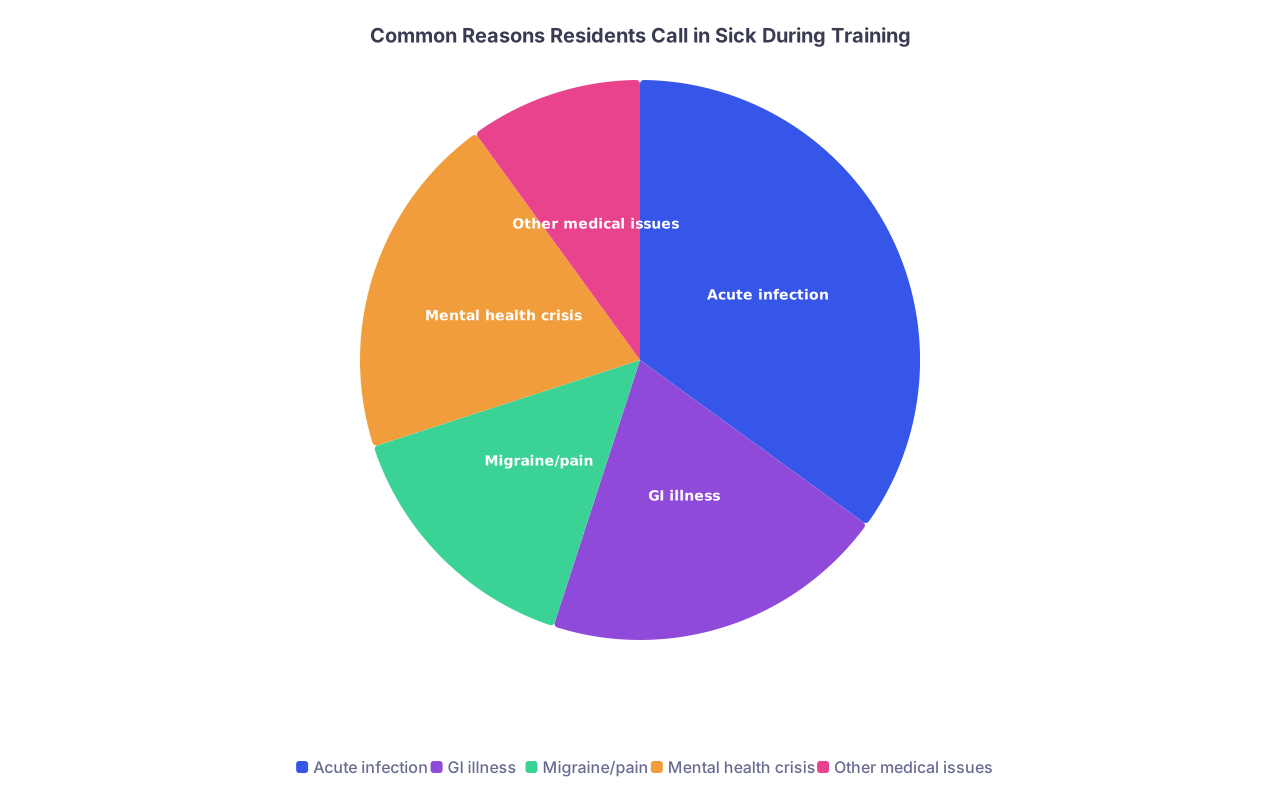
| Category | Value |
|---|---|
| Acute infection | 35 |
| GI illness | 20 |
| Migraine/pain | 15 |
| Mental health crisis | 20 |
| Other medical issues | 10 |
When You Should Not Call In Sick
There are also bad reasons to call out, and program directors are not stupid.
Bad calls:
- Mild inconvenience: you’re tired, mildly sniffly, but fully functional.
- Avoidance: you hate this attending or this service and “don’t feel great.”
- Poor planning: you have an unapproved appointment that could’ve been moved.
- Social reasons: weddings, concerts, trips you didn’t put on your schedule properly.
You want a simple test?
If a co-resident told you the exact reason you’re about to call out, would you think, “fair” or “you’ve got to be kidding me”?
If it’s the second, don’t call out. Fix your planning, set boundaries, or use vacation days.
How to Recover and Return Without Drama
Once you’re past the acute part:
- Let your chief or senior know when you’re likely ready to return.
- If you were hospitalized, had surgery, or had a serious mental health episode, you may need clearance (occupational health, your physician, sometimes a form).
- When you’re back, don’t overshare, but you can say, “Yeah, I was pretty wiped; thanks for covering.”
And then? Show up. Be present. Be solid. People care a lot more about patterns than one bad day.
Your Next Step Today
Do this now, not when you’re half-conscious someday at 4:45 am:
Open your program handbook or messages and figure out exactly:
- Who you contact when you’re sick
- How you contact them (call/text/email)
- How far in advance they expect notification
Write that down in your phone under: “If I’m Sick – Who to Call.”
Future you, at 5:00 am with a 102 fever, will be very, very grateful.