
You’re on hour 17 of a 28‑hour call. It’s 2:37 a.m. A nurse calls: “Hey, your patient in 412 is more short of breath and the blood pressure is 84/52.”
You’re staring at the vitals on the screen, running through differential, trying to decide:
Do I keep working this up myself?
Or is this the moment I wake up my senior or attending?
This is exactly the line you have to walk as a resident: be appropriately independent, but not stupidly independent. So let me be very clear:
If you’re debating whether to call, you’re already a lot closer to “yes, call” than you think.
Let’s walk through when to escalate, how to do it without sounding clueless, and the situations where not calling is actually the unsafe move.
The Core Rule: Safety > Pride
Here’s the mental model I want you to use overnight:
If this patient got transferred to the ICU, coded, or had a bad outcome in the next 6–12 hours, would I be comfortable explaining my decisions to my attending?
If the honest answer is “no” or “I’m not sure” → you escalate.
Here are the three big triggers that should almost always prompt a call:
- An acute change in status that you don’t fully understand or can’t stabilize
- A decision that significantly changes the patient’s course (ICU transfer, OR, thrombolytics, end-of-life decisions, etc.)
- Something that feels “off” and is making you nervous, even if the numbers aren’t terrible yet
If your gut is screaming, don’t ignore it. I’ve seen more regret from people who “didn’t want to bother anyone” than from people who woke up their attending for something that turned out to be stable.
Red Flag Situations: You Call. Every Time.
If you remember nothing else, remember this list. These are “don’t think, just call” situations.
| Situation Category | Example Triggers |
|---|---|
| Airway/Breathing | New O2 need, sats <90% on usual O2, stridor |
| Circulation | SBP <90, MAP <65, new chest pain, arrhythmia |
| Neuro | New focal deficit, acute confusion, seizure |
| Sepsis/Shock | Lactate rising, hypotension, escalating pressor needs |
| Code Status/Goals | New DNR request, end-of-life decisions |
Now let’s spell these out in more detail.
1. Airway and Breathing Issues
These are never “wait and see.” You call your senior or attending if:
- New or rapidly increasing oxygen requirement
- Oxygen saturation < 90% despite intervention
- Work of breathing clearly increased: accessory muscles, tripod position, single-word sentences
- New stridor, wheezing not responding to initial nebs, or concern for airway edema
- Suspected pulmonary embolism, flash pulmonary edema, or massive aspiration
If you’re wondering, “Should this person be on a higher level of care?” → yes, that’s an attending-level decision. Escalate.
2. Hemodynamic Instability
If any of these pop up, you don’t manage them in isolation:
- SBP < 90 or MAP < 65 that’s not clearly transient
- Need for multiple fluid boluses without firm explanation
- New ST changes or concerning EKG in chest pain
- New arrhythmia: Afib with RVR, VT, bradycardia with hypotension, anything you’re not comfortable with
- Suspected GI bleed with ongoing drop in Hgb, melena/hematemesis, or hemodynamic changes
You can absolutely start basic interventions — fluids, repeat vitals, STAT EKG — but loop in your senior/attending early. Not when the patient is circling the drain.
3. Acute Neurologic Changes
You call for:
- New focal neurological deficit, even subtle (facial droop, weakness, slurred speech)
- Change in mental status without an obvious benign cause
- Suspected stroke, TIA, or intracranial bleed
- Seizure or post-ictal patient who isn’t waking up as expected
“Probably just sundowning” has burned many people. If it’s a new change, don’t blow it off.
4. Sepsis and Deteriorating Infections
- Hypotension in an infected patient
- Lactate rising or failing to clear
- Escalating oxygen needs in pneumonia, COVID, or any infection
- Concern the patient needs ICU level care (pressors, BiPAP, closer monitoring)
You might initiate fluids, blood cultures, broad-spectrum antibiotics — fine. But where that patient belongs and what escalation of care they need should absolutely involve your senior or attending.
5. Big-Picture Care Decisions
These are not your solo calls as a junior:
- New DNR/DNI decisions
- Withdrawing care or shifting to comfort measures only
- Family meetings where goals of care are likely to change
- Discharging a complex or unstable patient overnight
If a nurse asks, “Family is here and wants to talk about hospice,” that’s not a quick bedside chat. Escalate.
6. Procedural or High-Risk Medication Decisions
Examples:
- Starting heparin or DOACs in a borderline/complicated case (recent surgery, high bleed risk)
- Thrombolytics (tPA for stroke, etc.) — always an attending-level decision
- Any invasive procedure you’re not confident in: central line overnight in a marginally stable patient, chest tube, paracentesis on an anticoagulated cirrhotic, etc.
You can say: “I think we may need X. I’d like to run it by you before I proceed.” That’s mature, not weak.
“Gray Zone” Cases: How to Think About Them
The hard part isn’t the obvious crash. It’s the in-between: not great, not dying, and you don’t want to be the resident who calls for every little thing.
Here’s the filter I use:
If:
- The situation could get significantly worse before morning, and
- Your current plan might not be what your attending would’ve chosen, and
- You’d feel exposed explaining your solo decision…
…then you call.
Examples of gray zone but escalate:
- Borderline vitals in a frail elderly patient who “just doesn’t look right”
- Persistent tachycardia (HR 120–130) without a clear cause after reasonable workup
- A lab result that doesn’t match the clinical picture (e.g., troponin bump in someone with atypical symptoms)
Use the phrase: “I’m not comfortable with this patient staying on the floor without you being aware.”
That’s honest. And it’s the right move.
How to Call Your Senior or Attending Without Sounding Lost
Half the fear is: “I don’t want to sound dumb.”
Fine. Then don’t. Structure your call.
Use a tightened-up SBAR (Situation, Background, Assessment, Recommendation).
Before you call, quickly gather:
- Latest vitals and trend
- Relevant physical exam changes
- Key labs/imaging (what’s back, what’s pending)
- What’s already been done (fluids, meds, oxygen, etc.)
- Code status
Then present like this:
“Hi Dr. Smith, sorry to wake you. This is Dr. Lee, the night resident on 6W.
Situation: I’m calling about Ms. Jones in 612. She’s a 68-year-old with CHF and pneumonia who’s now hypotensive to 82/50 and more short of breath.
Background: She came in yesterday with SOB, on 2L NC at baseline. Tonight she’s on 4L, sats 91–93%. Her BP was 120s earlier. Lactate on admission was 1.8.
Assessment: On exam she’s tachycardic to 120, increased work of breathing, bibasilar crackles, JVD, warm extremities. I’m worried about either worsening sepsis or cardiogenic component.
Recommendation: I’ve drawn a repeat lactate, ordered a CXR, started a small fluid bolus of 250 mL given her CHF, and called RT. I’m concerned she may need higher level of care and wanted your input and for you to be aware.”
You don’t need to be right about the diagnosis. You just need to be clear about:
- What changed
- What you’ve done
- What you’re worried about
- What you’re asking for (input, ICU transfer, bedside eval, etc.)
Special Situations by Level of Training
As an Intern (PGY-1)
Bias toward over-escalation, not under. Your job isn’t to be the hero. It’s to be safe.
You should almost always call your senior for:
- Any red-flag situations above
- Any ICU transfer consideration
- Any procedure you’re not comfortable with
- Any case where you’re thinking “discharge vs keep” overnight
- Any time a nurse says “I’m really worried about this patient”
Then your senior helps decide if the attending gets called.
As a Senior
You’re now the filter. Your rules:
- Loop in the attending for: ICU transfers, step-down requests that aren’t obvious, major management changes, bad news calls, big goals-of-care changes, potential OR cases.
- If you’re considering physically going to the bedside for a sick patient → strongly consider also updating the attending.
- Never be the person who sits on a deteriorating patient to “see what happens” just to avoid calling.
Attending expectations vary. Know your attending’s style at sign-out:
- “Call me for any transfer to ICU/step-down.”
- “Call me if someone’s on pressors.”
- “Text me labs unless it’s a crash, then call.”
Clarify this early. Then err on the side of safety.
How Often Is “Too Often” to Call?
Residents worry about this a lot. Let me be blunt:
Program leadership will forgive “calls too frequently” long before they forgive “didn’t call and the patient crashed.”
No one is tracking your call count on a spreadsheet. What they do track (in their heads) is: “Do I trust this person when they say the patient is OK?”
- Calling for the right reasons (clinical concern, big decisions)
- Bringing a clear story and a preliminary plan
- Owning your uncertainty instead of hiding it
If an attending ever makes you feel bad for escalating a truly concerning situation, that’s their problem, not yours. Patient safety beats their sleep.
Quick Decision Flow: Call or Not?
Here’s a simple mental flow you can run at 3 a.m.

| Step | Description |
|---|---|
| Step 1 | Recognize change or issue |
| Step 2 | Stabilize basics and call senior |
| Step 3 | Call senior and likely attending |
| Step 4 | Call senior to discuss |
| Step 5 | Document plan and monitor closely |
| Step 6 | Acute risk to airway, breathing, circulation, neuro, or sepsis? |
| Step 7 | Major change in care plan or level of care? |
| Step 8 | Am I uneasy or unsure about safety till morning? |
If you hit “yes” anywhere, you’re not wrong to call.
Common Pitfalls That Get Residents in Trouble
I’ve seen residents burned by the same mistakes over and over:
- Normalizing abnormal: “He’s always a little hypotensive.” Then tonight he’s septic and crashing.
- Letting “just” minimize risk: “She’s just a little tachycardic” + “just slightly hypoxic” + “just a bit confused” = very sick patient.
- Waiting for labs before calling: You don’t need the lactate back to know the septic patient is bad. Call, then follow the results.
- Not documenting your concern and escalation: If you were worried enough to call, write a brief note. It helps everyone downstream.
How to Communicate with Nurses When You Do (or Don’t) Escalate
Nurses are your early warning system at night. When they say “I’m uncomfortable,” you listen.
Good phrases to use:
- “You’re right, this is concerning. I’m going to call my senior/attending so we’re all on the same page.”
- If you decide not to escalate yet: “Here’s what I’m going to do now, and here are the exact parameters where I’ll escalate right away.”
That second part is key. You’re not dismissing; you’re drawing a clear line.
One More Thing: Your Future Self
Ask yourself: If I print this chart note and my phone log 6 months from now and put it in front of QA, would I be okay with what it shows?
- “Significant change in status → resident recognized → took action → escalated appropriately.” Good.
- “Worsening vitals for hours → minimal documentation → no escalation.” That’s the nightmare scenario.
Let your future self judge whether you should call. That version of you is always more conservative.
| Category | Value |
|---|---|
| PGY-1 | 6 |
| PGY-2 | 4 |
| PGY-3+ | 3 |
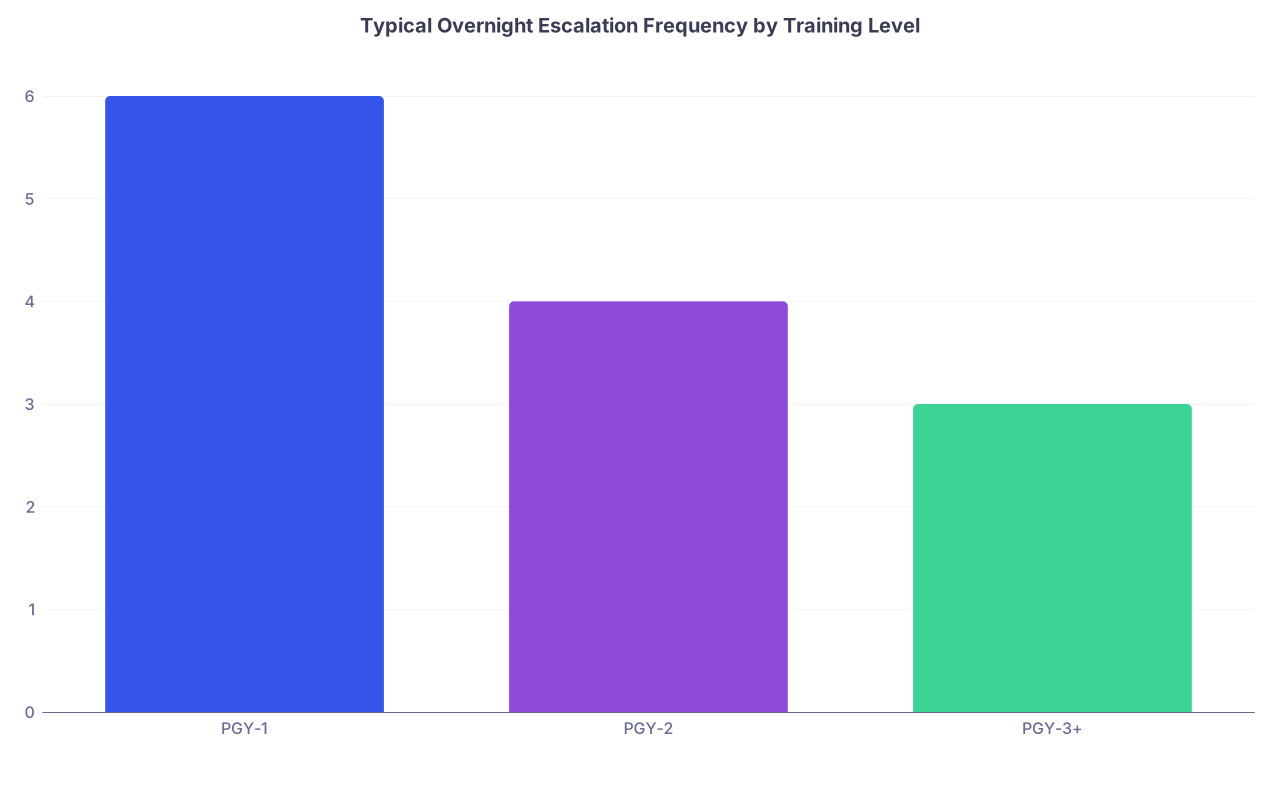
(As you get more senior, you usually still escalate — you just do it earlier and more deliberately, not less.)
FAQ: Overnight Escalation
1. What if I call my attending and they sound annoyed?
Happens. You can’t control their mood; you can control your judgment. Stay calm:
“Understood. I was concerned about X and didn’t feel comfortable managing this without updating you.”
If they later say, “You didn’t need to call for that,” file away the content (helps calibrate) but don’t let it scare you off from calling next time when you’re truly concerned.
2. Should I ever call the attending directly without my senior?
Yes, in true emergencies where delay is harmful or your senior is unreachable. Example: Code situation, airway crash, obvious need for immediate attending-level decision.
In most programs, though, the default is: call senior first, attending second. Know your local culture.
3. What if I’m wrong and it turns out to be nothing?
Then you got practice thinking through a sick patient, presenting concisely, and mobilizing resources. That’s not wasted. I’d rather you “over-call” a borderline case than “under-call” a disaster.
4. How do I document overnight escalation properly?
Simple, focused note:
“Called senior Dr. X at 02:15 regarding new hypotension and increased O2 requirement. Discussed assessment and plan including fluid bolus, repeat labs, and increased monitoring. Attending Dr. Y updated at 02:35; agreed with plan, will reassess in AM.”
Short, factual, shows that you recognized, acted, and escalated.
5. What’s one specific rule I can follow if I’m totally unsure?
Use this:
If a patient’s status changes in a way that makes you stop what you’re doing and think hard for more than 60 seconds, you at least call your senior.
Don’t debate it for 30 minutes at the computer. Make the call.
Open your current call list (or think about your last overnight) and pick one patient who made you even slightly uneasy.
Ask yourself, honestly: “If I had to do that night over, would I loop in my senior or attending earlier?”
If the answer is yes, write down one sentence you’d use to start that call. Keep it in your notes app. Use it the next time your gut starts to buzz at 2:37 a.m.