
Attendings keep score. They just pretend they do not.
Every program director, every service chief, every senior attending has an internal list of “top residents,” “solid residents,” and “the ones we need to watch.” It is rarely written down. It is almost never discussed with you directly. But it drives your letters, your fellowship support, which cases you get, and who gets protected when things go bad.
Let me walk you through how that list is actually built, because it is not what the glossy residency brochures tell you.
The Real Hierarchy: How Attendings Mentally Sort You
First, understand this: there is a ranking system in every attending’s head. They will never say “rank,” but they absolutely use words like:
- “Rock solid”
- “High trust”
- “Can leave them alone”
- “Needs a lot of oversight”
- “Would not want them covering nights alone”
Those phrases are code. When attendings talk to each other, they are not trading your Step scores. They trade stories. Vignettes. The overnight catastrophe you handled. The discharge you botched. How you reacted when a nurse pushed back. These aggregate into a mental tier system.
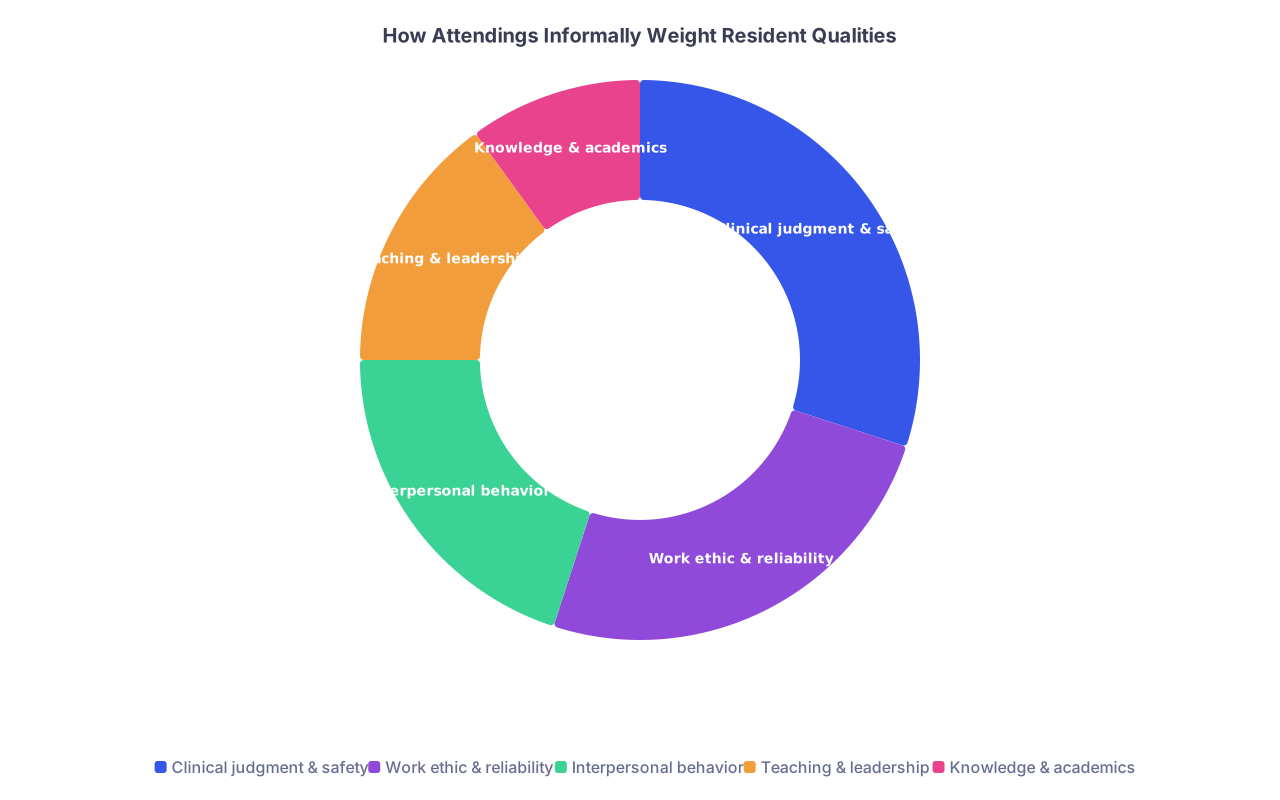
| Category | Value |
|---|---|
| Clinical judgment & safety | 30 |
| Work ethic & reliability | 25 |
| Interpersonal behavior | 20 |
| Teaching & leadership | 15 |
| Knowledge & academics | 10 |
Most attendings I have worked with would privately weight things roughly like that. Notice what is missing: raw intelligence as its own category. You are assumed to be smart enough already. The ranking is about whether they trust you with patients, with the team, and with their reputation.
Let me break down the criteria they actually use.
1. Clinical Judgment: The “Would I Let Them Fly Solo?” Test
This is number one. Period.
Attendings are constantly asking themselves a silent question: “If my name is on the chart and I am not physically here, do I trust this resident to do the right thing?”
They are not looking for perfection. They are looking for directionally correct judgment under pressure.
Here’s what actually moves you up or down:
How you respond to uncertainty
Nobody expects you to know everything. They do expect you to recognize when you are out of your depth.
The residents that rise in the mental rankings say things like:
- “I am not comfortable sending him home yet because X, Y, Z. I would like your input on this plan.”
- “I considered PE, ACS, and sepsis; here is why I think sepsis is most likely and what I have done so far.”
The ones who plummet say:
- “Yeah, I think he’s fine,” with no reasoning.
- “I was going to discharge her, but nursing was worried,” as if that’s an annoyance, not a signal.
Attendings notice which one you are. Every time.
Pattern recognition vs cookbook medicine
By second year, attendings can tell if you are just regurgitating UpToDate or if you are actually seeing patterns.
The quiet ranking goes up when:
- You pre-emptively order the right test before they tell you.
- You call the rapid response on a “funny feeling” patient and you are right—or at least not wildly wrong.
- You escalate appropriately: not every troponin gets a code STEMI, not every low BP is septic shock.
I have heard attendings say in the workroom: “She has great clinical instincts; I do not worry when she is on nights.” That sentence alone can move you into the top tier for that attending permanently.
Safety brakes
There is a specific type of resident attendings hate: the cavalier one.
The resident who pushes for a risky discharge to clear the list. The one who does a procedure they are not ready for, without calling for help, because they want to look independent.
When those residents screw up, attendings remember—and they talk.
The quiet “bottom-tier” label often gets applied after one bad safety lapse, even if you never hear about it directly. You will just feel it: fewer chances, more micromanagement, tepid letters.
2. Reliability: Are You a “Set-and-Forget” or a “Check-Everything” Resident?
This one is more brutal than people admit.
Attendings do not want to supervise chaos. They want residents they can mentally “set-and-forget” on routine tasks and only step in for complexity. Reliability is the currency that buys you autonomy.
Here is what they measure—quietly, relentlessly.
Follow-through on tasks
The fastest way to drop in the hidden rankings? Incomplete work.
- “Did you call cardiology?” – “Oh, I was going to but then I got busy.” (Translation to attending: I cannot trust you with critical steps.)
- “Did the family get updated like we discussed?” – “Not yet, I will do it later.” (They know you will not.)
Top-tier residents close loops. Labs followed. Studies checked. Families called. Orders in immediately after rounds, not at 4 PM.
If you are chronically “almost done,” attendings will label you—internally—as unreliable. That label sticks.
Time honesty
Here is something residents do not realize: attendings always know when you are lying about time.
If you say: “I will have those notes done within the hour,” and then nothing is signed for three hours, they note it. If you claim: “I tried calling three times,” but there is one call in the chart, they note that too.
The residents who rise say things like:
- “I will need a couple of hours to get this all done; can we prioritize which notes you actually care about?”
- “I missed that lab check; that is on me. I have fixed the orders and called the nurse.”
Owning failure paradoxically moves you up in their mental ranking, because now you are predictable. Covering, minimizing, vague excuses—that moves you down.
Dependability under fatigue
Every attending has a quiet list of “call them if things hit the fan” residents and “please let anyone else be on” residents.
This list is built on night float impressions, cross-cover calls, and late admissions.
They remember:
- The PGY-2 who, at 3 AM, calmly took care of a crashing GI bleeder and called for help early.
- The PGY-1 who vanished for 45 minutes during a busy admit night and came back with Starbucks.
You may think nights are a blur and nobody is keeping score. They are. Especially then.
3. Interpersonal Behavior: How You Treat “Lower Status” People
This is the silent career killer no one warns you about.
Attendings get an unfiltered read on you from people you think do not matter: nurses, clerks, respiratory therapists, night pharmacists, even the unit secretary. Those people talk. Attendings listen.

How you handle pushback
The number of residents who look great upwards and behave terribly sideways or downward is higher than you think. They vanish from the attending’s favorites list the moment they are exposed.
Red flags attendings absolutely care about:
- Arguing with nurses over small orders just to be “right”
- Rolling eyes, sighing, or snapping when paged
- Talking about patients in a dismissive or mocking way within earshot of staff
You may think you are being funny. They hear “unsafe and immature.”
What makes attendings quietly promote you?
- You take nurse concerns seriously, even when you think they are wrong.
- You respond to pages without obvious irritation.
- You de-escalate rather than escalate confrontations.
I have heard more than once: “Look, his medical knowledge is average, but everyone loves working with him. I would take that over a genius jerk any day.”
And yes, “genius jerk” is a direct quote.
Reliability with families and patients
Attendings look very carefully at how you behave in front of patients and families.
They notice if:
- You sit down when delivering bad news, or at least stay in the room long enough to answer questions.
- You throw them under the bus (“The attending wants…” instead of “We recommend…”).
- You deflect responsibility or say “I don’t know” in a dismissive way instead of “I will find out.”
Residents who can calm an angry family without calling the attending in get bumped up immediately. That is a rare and deeply valued skill.
4. Team Dynamics: Leadership Long Before You Have a Title
By your second and third years, attendings are not just asking “Are you safe?” They are asking, “Would I trust this person running a team? Leading a code? Teaching interns?”
Leadership is not about being loud. It is about how the team feels when you are around.

| Step | Description |
|---|---|
| Step 1 | Intern Year |
| Step 2 | Dependable Worker |
| Step 3 | Early PGY2 |
| Step 4 | Informal Team Lead |
| Step 5 | High Trust Senior |
| Step 6 | Go To Resident |
Do interns look better or worse under you?
This one is huge.
Attending thought process:
- “When she is the senior, the interns are organized, notes are done, pages are handled, and there is less drama.”
- Versus: “Whenever he is the senior, the team is frazzled, sign-out is a mess, and things fall through.”
They also watch your teaching on the fly. Not whether you give formal chalk talks. But how you respond when an intern asks, “Why are we doing this?”
Do you say, “Because cardiology wants it,” and move on? Or do you give a 90-second, clear, digestible explanation that does not humiliate them?
The former is forgettable. The latter quietly puts you into the “future chief” or “future faculty” mental bucket.
Protecting the team vs throwing them under the bus
Attendings hate seniors who blame downwards. Hate.
If your reflex in a complication debrief is, “Well, the intern forgot to check the labs,” you have just exposed yourself. Strong seniors say:
- “We missed that lab. I should have caught it as the senior; we will change the way we follow up.”
- Then privately coach the intern.
Attendings rank “team-protective” seniors far above the “cover-my-ass” types. The protective ones get stronger letters, more notable cases, and better advocacy for jobs and fellowships. The bus-throwers get lukewarm support at best.
5. Knowledge and Work Ethic: How Much You Actually Care
Notice I am putting knowledge here, not at the top. That is intentional.
Once you are at a baseline of not being dangerous, attendings do not rank you solely on how many arcane papers you’ve read. They rank you on how you use knowledge and how much you clearly give a damn.
Preparedness vs last-minute scramble
Attendings absolutely clock:
- Whether you read about your cases that night and come back sharper the next day.
- Whether you show improvement in specific areas they mentioned.
- Whether you make the same reasoning mistakes week after week.
They are not expecting you to quote NEJM from memory. They are looking for a trajectory. Upward or flat.
A resident who is a bit slow early but clearly improving every week will rise above the “naturally brilliant but lazy” one by PGY-3. I have seen this happen repeatedly.
Curiosity at the right volume
There is a difference between genuine curiosity and performative question-asking to look smart.
Attendings tend to like:
- Targeted questions that show you actually thought about the case.
- Questions that tie back to the patient in front of you.
- Admitting you do not know and then following up later with what you found.
They tend to roll their eyes (internally) at:
- Grandstanding questions during rounds that derail care to show off.
- Asking basic questions that are clearly in the note you did not read.
- Rapid-fire questions that feel like you are trying to “stump” them.
Curiosity that improves care? Up in the rankings. Curiosity that wastes time? Down.
6. Reputation Drift: How One Story Becomes Your Entire Identity
Here is the part nobody tells you and you only discover when you are on the other side of the table.
Your reputation is not built evenly across all days and rotations. It is built on moments.

The anchoring effect
Attendings are just as biased as everyone else. The first strong impression they get often colors every later interaction.
If your first month with them was:
- You as an intern who chased results, communicated well, and showed humility → they anchor you as “high potential.”
- You as the flailing, defensive, chronically late note-writer → they anchor you as “needs a lot of work.”
Every later good or bad performance is filtered through that early belief. It takes several contradictory experiences to move that anchor.
This is why your early impressions on a service matter much more than you think. How you show up the first 48–72 hours of a rotation can decide if you are in that attending’s “top third” or “bottom third” list for a very long time.
Narrative stickiness
Here’s the cruel part: one dramatic story can outweigh twenty quiet days of solid work.
Examples I have actually heard spread across services:
- “He is the guy who missed the tamponade in the ICU and dismissed nursing concerns.”
- “She is the one who stayed all night to help a family after that unexpected death.”
- “He is the resident who yelled at the ED nurse about bed placement.”
Those stories get retold. To other attendings. To fellows. To program leadership. You become “the resident who X…” even if that was one terrible or one exceptional day.
That is why the “interpersonal behavior” and “safety” domains weigh so heavily. The stories there are emotionally charged, and emotional stories travel.
7. How This Quiet Ranking Actually Shows Up In Your Career
You will never see an official “attending rank list.” But it leaks through in patterns. If you are paying attention, you can tell exactly where you stand with most attendings.
| Signal Category | High-Rank Resident Experience | Low-Rank Resident Experience |
|---|---|---|
| Autonomy | Attending co-signs your plans with small tweaks | Attending rewrites plans and micromanages notes |
| Case Opportunities | Offered complex procedures and interesting cases | Given basic, low-risk tasks only |
| Feedback Style | Nuanced coaching, invited to ask questions | Vague criticism, little specific guidance |
| Letters & Advocacy | Strong, detailed letters and name-dropping support | Generic letters, lukewarm advocacy |
| Leadership Roles | Asked to be chief, sit on committees, teach | Rarely approached for additional responsibilities |
Autonomy and trust
When attendings trust you, they will:
- Let you run family meetings without them physically present.
- Let you decide on borderline admissions/discharges (with quick confirmation).
- Co-sign your notes with minor edits instead of rewriting everything.
If you find every attending constantly re-doing your plans and documentation, that is not just “their style.” That is feedback, whether they say it or not.
Who gets the opportunities?
Case assignments are not random.
The resident who gets the big case, the central line in the crashing patient, the first crack at an interesting consult—those are not always about seniority or “fairness.” They are often about the attending’s internal ranking.
Who do I want in the room for this? Who will learn the most and also not make me look bad? They will not say that out loud. But they are thinking it.
You should interpret who gets chances as a live-read on who is in their top tier and who is not.
How To Deliberately Climb Their Unspoken List
You are not powerless in this game. You cannot control every story that gets told about you, but you can stack the deck.

| Step | Description |
|---|---|
| Step 1 | Day 1 of Rotation |
| Step 2 | Clarify Expectations |
| Step 3 | Close Every Loop |
| Step 4 | Own Mistakes Quickly |
| Step 5 | Be Decent to Staff |
| Step 6 | Read About Your Patients |
| Step 7 | Ask Focused Questions |
| Step 8 | Debrief Performance |
A few core moves that reliably bump you upwards:
Day-1 expectations talk
Ask: “What do you value most in residents on this rotation?” Most attendings will tell you their ranking rubric if you ask directly. They are weirdly honest when prompted.Relentless loop-closing
Make it a point of pride that if your name is on something, it is truly done. Labs checked, calls made, families updated. Over time, you become “the resident I do not have to double-check.”Quick, clean ownership of mistakes
Not, “Sorry, I was busy,” but “I missed X; I have done Y and Z to fix it, and here is how I will prevent it next time.” That tone alone converts angry attendings into invested mentors.Be the resident nurses recommend
Quiet, consistent respect. Respond to pages, explain decisions, listen. When the attending hears “We love working with her,” your stock goes up more than with any conference presentation.Call early, not late
If you are stuck, call. You will never be ranked down for calling with a borderline case. You will absolutely be ranked down for calling too late.Show a learning curve
After feedback, make it visible that you adjusted. “Last time we did X; today I tried Y based on what you said.” That is catnip for most attendings.