
The wrong reason to moonlight as a resident is “because everyone else is doing it.”
You moonlight for one of three legitimate reasons: you need the money, you want the clinical reps, or you’re positioning yourself for a specific career. Everything else is noise.
Let’s walk through whether you should moonlight, and how to do it without burning yourself out or getting yourself in trouble.
The Core Question: Should You Moonlight At All?
Here’s the honest answer:
Moonlighting can be excellent for some residents and a terrible mistake for others.
You probably should seriously consider moonlighting if:
- You’re PGY‑2 or higher in a program that explicitly allows it.
- You’re consistently finishing duties on time and not chronically exhausted.
- You have meaningful financial pressure (high-interest loans, family to support, very high cost-of-living).
- You want more independence and see gaps in your current clinical exposure (e.g., community ED work, hospitalist shifts).
You probably should not moonlight (yet) if:
- You’re an intern (or early PGY‑2) still struggling to keep up with your primary job.
- You’re barely passing in-service exams or your program director has hinted you’re behind.
- You’re frequently post-call and barely functional on days off.
- Your motivation is “FOMO” or because other residents brag about big checks.
Here’s the rule of thumb I give residents:
If moonlighting would make you consistently worse at your core residency job, you have no business doing it. The ACGME doesn’t care how broke you are. Your program director cares even less. They care if you’re unsafe.
Key Factors You Must Weigh Before Moonlighting
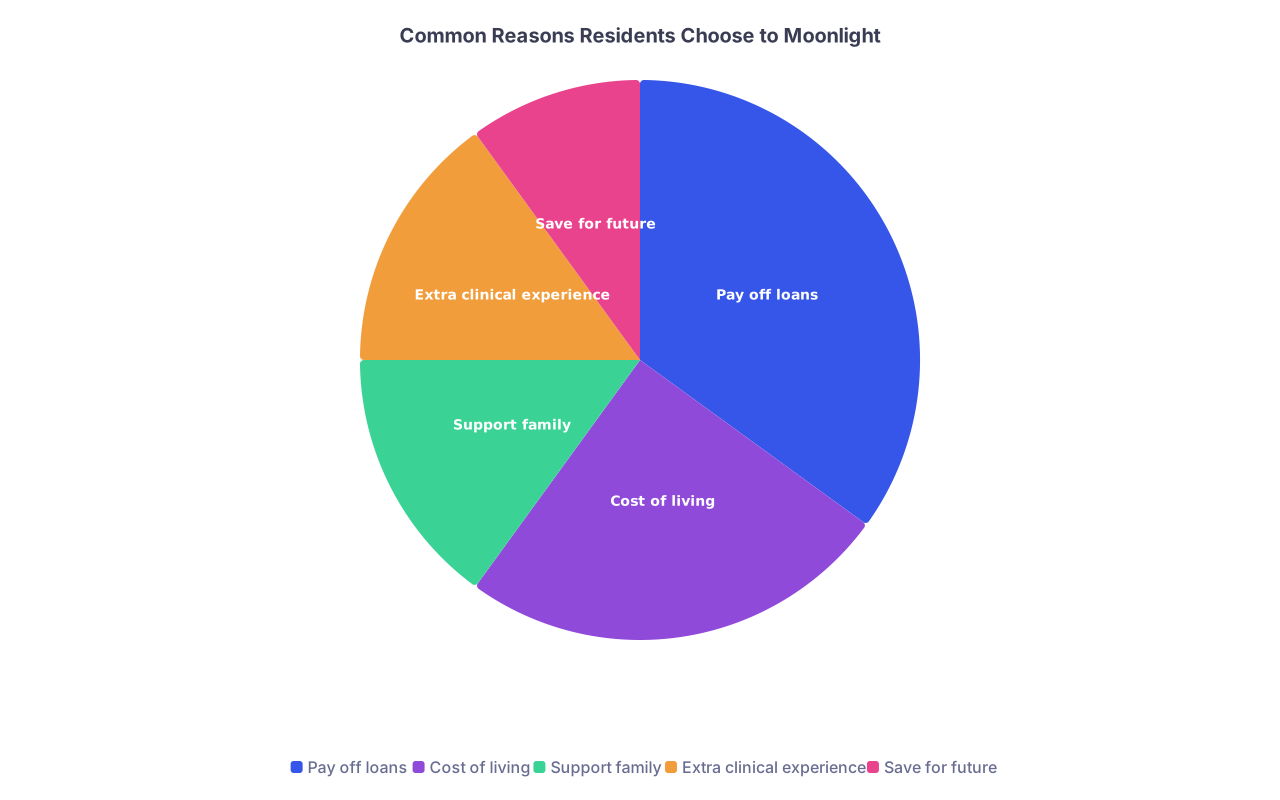
| Category | Value |
|---|---|
| Pay off loans | 35 |
| Cost of living | 25 |
| Support family | 15 |
| Extra clinical experience | 15 |
| Save for future | 10 |
1. Legal, ACGME, and Contract Restrictions
This is the boring part. Ignore it and you can wreck your career.
You need clear answers to all of these:
Does your specialty and PGY level allow moonlighting under ACGME rules?
- Internal medicine, EM, family med: moonlighting is pretty common by PGY‑2/3.
- Surgical subspecialties, neuro, OB: more variable and often discouraged until late.
What does your program allow?
Ask your program director directly. The actual question to ask:
“For residents at my PGY level, what are the formal rules and expectations about moonlighting, including limits and approval processes?”What does your GME office and contract say?
Many contracts include:- Written prohibition on outside clinical work without written approval.
- Requirements that moonlighting hours count toward the 80-hour work week.
- Malpractice coverage limitations (many hospitals do not cover you outside their system).
Licensing requirements:
- In many states, you cannot moonlight with just a training license; you need a full unrestricted medical license.
- That usually means you need to have passed Step 3 and met state-specific requirements.
If any of this is fuzzy, you’re not ready to moonlight. Get clarity on paper first.
2. Work-Hour Limits and Fatigue: The Non-Negotiables
Every moonlighting hour still counts toward the 80‑hour work week and one-day-off-in-seven rules.
Ask yourself bluntly:
- Are you already hitting 70–80 hours many weeks?
- Are you mentally sharp post-call?
- Do you fall asleep on your commute or miss details on sign-out?
If the answer to any of that is “yes,” you should not be adding shifts.
Here’s a rough guide:
| Average Residency Hours/Week | Suggested Max Moonlighting Hours/Week |
|---|---|
| 45–55 | 8–12 |
| 55–65 | 4–8 |
| 65–75 | 0–4 |
| >75 | 0 |
If you need to ignore basic sleep to make moonlighting “fit,” it doesn’t fit.
3. Malpractice Coverage and Risk
This is where people get burned.
You must know, in writing:
- Who is providing malpractice insurance for your moonlighting shifts?
- What are the coverage limits?
- Does it include tail coverage if you leave?
- Are you acting as an “independent contractor” with zero backup if something goes sideways?
Do not assume your residency program’s malpractice covers outside work. It almost never does.
Red flags:
- The site expects you to “just use your residency ID” or credentials.
- No formal onboarding, no clear contract, no mention of malpractice.
- They say “everyone else is fine” when you ask who covers liability.
If you cannot point to the policy document that names you and the coverage, you’re not covered.
4. Financial Reality: Is the Money Worth It?
Let’s be blunt. Some moonlighting gigs pay very well; others are more headache than help.
Typical range (rough ballpark):
- Inpatient or ED shifts in low-cost areas: $90–130/hour
- Community ED or urgent care in underserved areas: $120–200/hour
- Telemedicine or low-acuity work: $60–120/hour
But raw rate isn’t the whole picture.
You also need to think about:
- Extra taxes (this is 1099 income in many cases — think self-employment tax).
- Commute time.
- Emotional cost: post-call, missing family time, no real days off.
If you’re working 10 extra hours a week at $100/hr, that’s $1,000/week pre-tax. Not trivial. But if it pushes you from “tired” to “dangerously burnt out,” the cost is higher than the dollars.
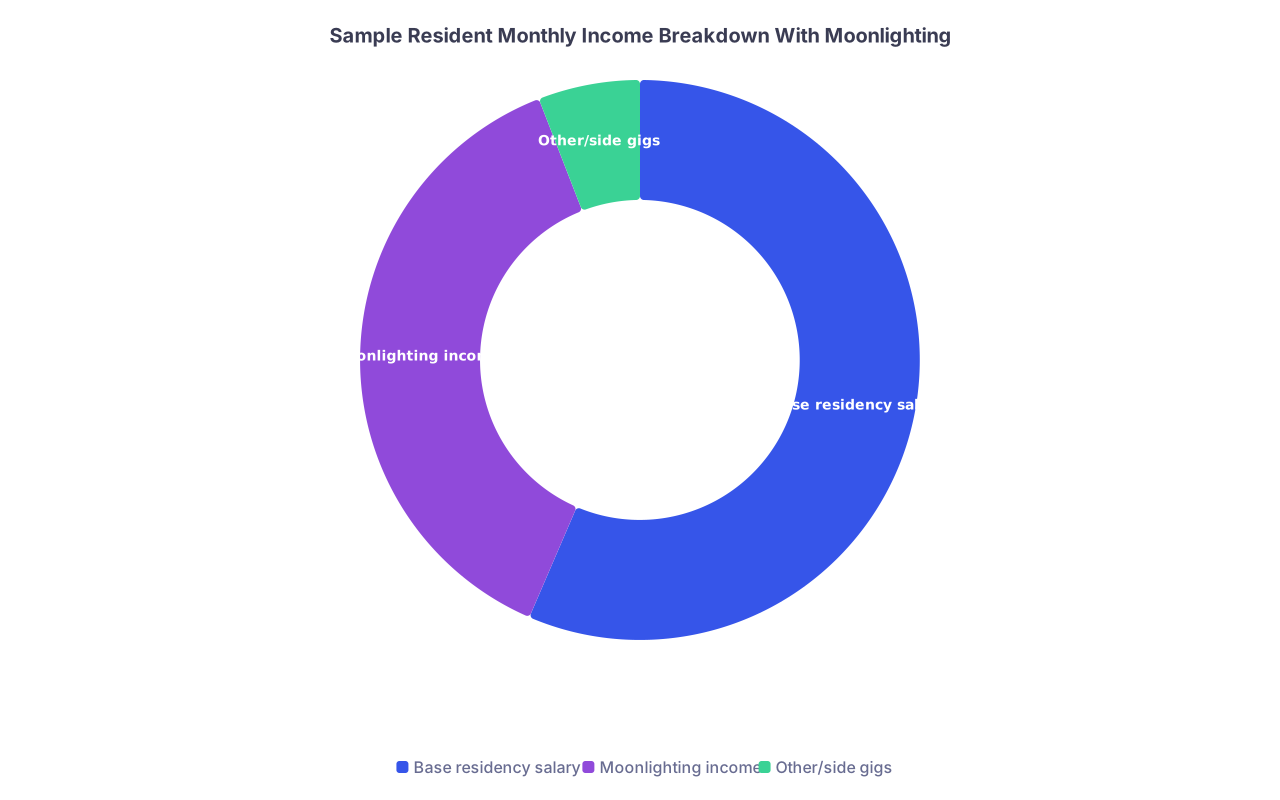
| Category | Value |
|---|---|
| Base residency salary | 4800 |
| Moonlighting income | 3200 |
| Other/side gigs | 500 |
One practical move:
Before committing, test your schedule for a month by pretending you have moonlighting. Block off two 6-hour chunks per week and dedicate them to something cognitively demanding (board prep, research). If by week three you’re wrecked, you’re not ready.
5. Impact on Learning and Performance
Here’s where a lot of residents lie to themselves.
Moonlighting can either:
- Sharpen your skills (especially in EM, hospitalist-style internal medicine, and family medicine), or
- Erode your learning because you’re constantly tired, cranky, and checked out on real teaching days.
Ask:
- Do I have any warning signs from faculty? Comments about attention to detail, missed follow-up, disorganization?
- Am I happy with my in-service exam performance?
- Do I still have major gaps in bread-and-butter topics?
If your main job performance is anything less than solid, fix that first.
On the flip side, good moonlighting can be huge for:
- Building comfort with independent decision-making.
- Learning to manage risk and disposition in real-world, non-tertiary settings.
- Seeing a different patient population than your academic hospital.
That’s where it’s truly valuable — not just the paycheck.
Types of Moonlighting: Which Make Sense for You?
Not all moonlighting is the same. And not all of it is appropriate for each specialty or PGY level.

Common categories:
In-house moonlighting in your own hospital/system
- Often the safest option.
- You know the EMR, culture, consultants.
- Malpractice usually through the same system.
- Example: Night cross-cover shifts for general medicine; low-acuity observation unit.
External hospitalist or ED coverage
- Community EDs, critical access hospitals, or small inpatient units.
- Higher autonomy, often higher pay.
- More risk: less backup, different EMR, new staff and expectations.
Urgent care or retail clinic shifts
- Mostly low-acuity, primary care style complaints.
- Good for FM, IM, EM, peds residents.
- Often less stressful but can be deceptively risky if you’re the only clinician.
Telemedicine
- Can be done from home.
- Wide range in quality and standards.
- Must be very clear about licensing and state rules.
Match the type to your career goals. An EM resident doing inpatient nocturnist work three towns over? That’s probably suboptimal. An IM resident doing local hospitalist shifts on the same EMR? Much better.
How to Decide: A Simple Framework
Here’s the decision tree I’d actually use.

| Step | Description |
|---|---|
| Step 1 | Interested in moonlighting |
| Step 2 | Do not moonlight |
| Step 3 | Trial 1–2 shifts per month |
| Step 4 | Gradually increase if desired |
| Step 5 | Program allows it? |
| Step 6 | Full license and Step 3 done? |
| Step 7 | Baseline hours < 70 and rested? |
| Step 8 | In good standing academically? |
| Step 9 | Malpractice clearly covered in writing? |
| Step 10 | Financial or educational benefit clear? |
| Step 11 | Any impact on performance or wellness? |
Translation into questions you should answer honestly:
- Am I allowed? (Program, GME, ACGME, license.)
- Am I safe? (Hours, fatigue, support, malpractice.)
- Is it actually worth it? (Money, learning, career alignment.)
- Does it still feel worth it after 1–2 months? (Reassess.)
Practical Tips If You Decide To Moonlight
Once you’ve decided to go ahead, do it like an adult, not like a desperate intern grabbing whatever shows up in the group chat.

Get everything in writing.
Schedule, hourly rate, malpractice coverage, expectations, supervision, EMR training.Start slow.
One shift every 2–4 weeks at first. You’ll think you can handle weekly right away. Prove it to yourself first.Protect your post-call days.
Do not schedule moonlighting the day immediately after a heavy call or ICU stretch. That’s how errors happen.Be transparent with your program.
Tell your PD how many shifts you’re doing and where. If you hide it and something goes wrong, you’re on an island.Track your hours meticulously.
Every moonlighting hour counts. If your program gets flagged for duty-hour violations, your extra shifts will not be popular.Monitor your own wellness and performance.
Slower notes? More sign-out misses? More irritability? That’s your warning sign. Cut back.
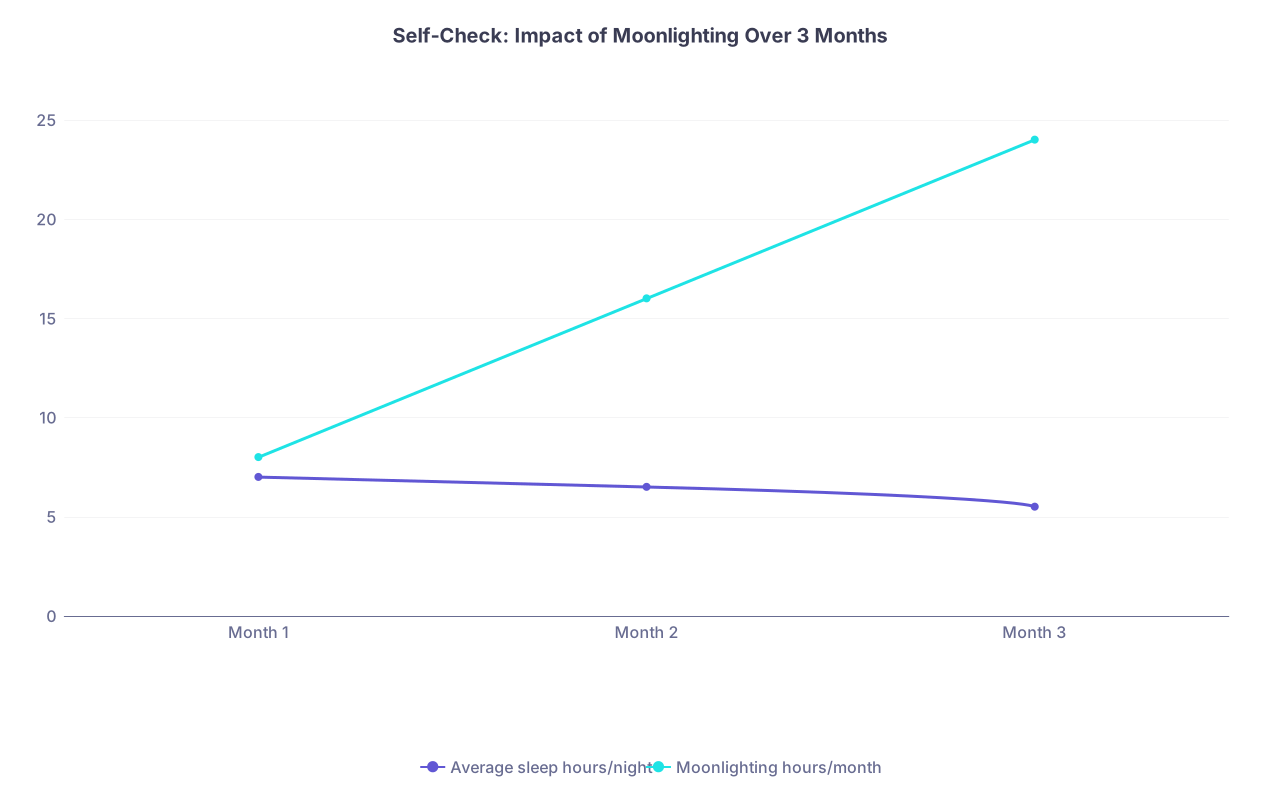
| Category | Average sleep hours/night | Moonlighting hours/month |
|---|---|---|
| Month 1 | 7 | 8 |
| Month 2 | 6.5 | 16 |
| Month 3 | 5.5 | 24 |
That kind of trend is exactly what you want to avoid.
When Moonlighting Is Clearly a Bad Idea
I’ve seen residents ignore this list and regret it. Don’t be that person.
You should not moonlight if:
- You’re on remediation or probation.
- You’re in a high-intensity rotation block (ICU, heavy surgery months) and barely treading water.
- You’re dealing with major personal issues (illness, childcare crisis, depression, burnout).
- You see moonlighting as your “only way out” of money problems — that usually leads to overscheduling and collapse.
And if your gut says, “This feels sketchy” about a particular site? Walk away. There will be other gigs.
The Bottom Line: Should Residents Moonlight?
Moonlighting is a tool. Not a badge of honor.
You should seriously consider moonlighting if:
- You’re mid-to-late residency, stable and performing well.
- Your program and GME explicitly allow it.
- You have a clear financial or educational reason.
- You have safe coverage, reasonable hours, and a plan to reassess.
You should absolutely not moonlight if:
- Your core training or health will take the hit.
- You’re fuzzy on malpractice or licensing.
- You’re doing it because of pressure, comparison, or ego.
Use it strategically, not impulsively.
FAQ: Residents and Moonlighting
What PGY year is it safest to start moonlighting?
Usually PGY‑2 at the earliest, and more commonly PGY‑3+. By then, you know your specialty’s bread-and-butter cases, your program knows your strengths and weaknesses, and you have more control over your schedule. Many programs flat-out ban intern moonlighting, and frankly, I think that’s wise.Does moonlighting really help with loan repayment in a meaningful way?
It can. An extra $1,500–3,000/month, applied aggressively to high-interest loans, shortens your repayment timeline and cuts interest significantly. But if the cost is exhaustion and failed boards, it’s a terrible trade. Use a loan calculator with realistic after-tax income before you decide shifts are “necessary.”Should I choose in-house or external moonlighting first?
Start in-house if you have the option. Same EMR, same consultants, familiar nursing staff. Less cognitive overhead and usually clearer malpractice coverage. External gigs make more sense once you’re comfortable and know exactly what you’re getting into.What red flags should make me decline a moonlighting opportunity?
No written contract. Vague malpractice coverage. “Everyone just uses their residency ID.” No orientation, no clear backup, or being placed in over-your-head scenarios (solo coverage, no immediate attending available) that exceed your training level. Those are all signals to walk away.Can moonlighting hurt my chances for fellowship?
Indirectly, yes. Fellowship directors care about letters, clinical performance, research productivity, and exam scores. If moonlighting makes you tired, less engaged, or limits your scholarly work, it can absolutely hurt. If your performance and evaluations stay strong, most fellowship PDs will not care that you picked up some extra shifts.How do I talk to my program director about wanting to moonlight?
Be direct and prepared. Say something like: “I’m considering limited moonlighting next year for both financial and clinical reasons. My plan is no more than X shifts per month, with careful attention to duty hours. Can we review the program’s policies and your expectations, and I’ll get formal approval from GME?” This signals maturity instead of desperation.What’s one sign I should stop moonlighting immediately?
If a faculty member or senior resident comments that you “seem off,” “look exhausted,” or “aren’t as sharp as usual,” take that seriously. Combine that with any personal red flags — forgetting orders, missing pages, dreading every shift — and that’s your cue to pause moonlighting for at least a month and reassess.
Open your calendar for the next eight weeks and map your actual rotations, calls, and post-call days. Then ask: “Where could I realistically place even one extra shift without wrecking myself?” If the honest answer is “nowhere,” your decision’s already made.