
It is 5:12 a.m. You are on call. You just finished admitting a GI bleed, followed by a rapid response that turned into an ICU transfer. Your pager is finally quiet. You know you should sleep. Instead, your brain is spinning about everything you are failing at outside the hospital.
You promised you would call your parents this week. You have not.
You were going to “get back to the gym.” That was three rotations ago.
Your laundry is a biohazard. Your inbox is a war zone. You have not seen your friends in a month.
And the worst part?
You do not have a system. Just vague hope that “the next rotation will be better.”
Let me be direct: it will not magically get better.
Not unless you treat your life outside the hospital with the same structure you use for patient care.
What you need is a system that turns your 80-hour work weeks into protected life blocks—chunks of time that are as non-negotiable as rounds, sign-out, or M&M.
Here is how you do that.
Step 1: Get Real About Your Actual Week (Not the Fantasy Version)
Most residents plan around the schedule that exists in their head, not the one that actually happens. That is how people end up “planning” to work out after a 28-hour call. Which almost never happens.
Start with data, not optimism.
1. Do a brutally honest one-week time audit
For the next 7 days, track your time in 30-minute blocks. Not forever. Just one week.
Capture:
- In-hospital work (including early arrivals and late stays)
- Commute time (both ways)
- Sleep
- Basic maintenance: shower, food prep, eating, getting ready
- Scroll/TV/YouTube/“just lying there”
- Admin/EMR work done at home
- Anything that remotely counts as “life”
You can use:
- A simple Notes app table
- Google Calendar with color coding
- A time-tracking app if you really like tools
Do not round in your favor. If you scrolled for “a minute” that turned into 37 minutes, write 37 minutes.
After 7 days, you will usually see three things:
- Your real work hours are different from what you tell people.
- You waste more small fragments of time than you think.
- You already have life blocks—you’re just spending them by default, not by design.
2. Map your rotation archetypes
Different rotations = different rules. You cannot use one life template for nights, ICU, clinic, and wards and expect it to work.
Create 3–5 “rotation archetypes”:
- Wards (e.g., 6 a.m.–6 p.m., Q4 call)
- ICU
- Nights
- Clinic / elective
- Research / consults
For each archetype, write down:
- Typical start and end time (actual, not official)
- True post-call reality (what time you leave, when you crash, when you wake up)
- How destroyed you are on a 1–10 fatigue scale at:
- 1 hour before work
- Right after work
- 2–3 hours after work
This fatigue pattern matters. You cannot slot demanding life tasks into cognitive black holes and expect discipline to save you.
Step 2: Define Your Non-Negotiable Life Domains
You cannot protect everything. You must be selective. Otherwise nothing is “protected”—it is just a wish list.
Pick 3–5 life domains that actually matter to you right now. Not what you think a “balanced” resident should care about. What you care about.
Typical domains:
- Physical health (exercise, nutrition, sleep structure)
- Relationships (partner, family, core friends)
- Career development (research, board studying, fellowship prep)
- Personal admin (bills, licenses, emails, adulting)
- Mental health (therapy, journaling, hobbies, spiritual practice)
Now, for each domain, define:
- Minimum baseline – the “I refuse to drop below this” level
- Optimal target – your ideal if the rotation is humane
Example:
Physical health
- Baseline: 2 × 20-minute workouts per week, 1 walk on post-call days
- Optimal: 4 × 30–40-minute workouts, meal prep 1x/week
Relationships
- Baseline: 1 video call with parents per week, 1 dedicated evening with partner (even if it is takeout and Netflix)
- Optimal: 2 social events/month with friends, weekly date night
You are building a floor, not a fantasy.
Step 3: Convert Your Life into “Protected Blocks”
Now we get practical. Protected life blocks are pre-decided chunks of time on your calendar with three rules:
- They are specific in time and content.
- They are scheduled in advance, per rotation.
- They are treated exactly like work obligations.
1. Classify your time by “block type”
Think in blocks, not tasks.
Use three main categories:
- Core blocks – immovable life essentials
- Flexible blocks – important but movable within the week
- Optional blocks – nice-to-have if the week does not implode
| Block Type | Duration | Example Uses |
|---|---|---|
| Core | 30–120 minutes | Sleep anchor, workouts |
| Flexible | 20–60 minutes | Calls, errands, studying |
| Optional | 15–45 minutes | Hobbies, extra social |
Core blocks are your backbone. These are things like:
- Sleep anchor (more on this later)
- Exercise minimums
- Weekly relationship touchpoints
- Weekly admin time
If your schedule kills an optional block, fine. If it kills a core block, something is wrong.
2. Design a default weekly template per rotation
For each rotation archetype, you will create a “default week” template. This is what your life looks like if nothing goes catastrophically wrong.
Example: Wards, 6 a.m.–6:30 p.m., Q4 call
M/T/Th/F (non-call days)
- 4:45–5:15 a.m. – Core: quick workout (at home or building gym)
- 5:15–5:45 a.m. – Get ready, quick breakfast
- 6:00 a.m.–6:30 p.m. – Work
- Commute home
- 7:15–7:45 p.m. – Flexible: relationship time (dinner with partner, or call)
- 7:45–8:15 p.m. – Optional: TV, reading, nothing
- 8:30–4:45 a.m. – Sleep (anchor 8:30–4:30)
Post-call day
- Leave around 11–12
- Eat + shower
- Crash 1 p.m.–5 p.m.
- 5:30–6:00 p.m. – Core: short walk outside, no phone
- 6:00–7:00 p.m. – Flexible: laundry or meal prep
- Bed 9–10 p.m.
You are not scripting every minute of your life. You are building protected scaffolding so residency cannot steal everything.
Step 4: Protect Two Things First—Sleep Anchors and One Keystone Habit
Most residents try to fix too many things at once. That always fails during bad rotations.
Start with two.
1. Set a “sleep anchor” and stop pretending you are superhuman
You are not going to sleep 8 hours every night on every rotation. But your brain and body desperately need some consistency.
A sleep anchor is:
- A range of 60–90 minutes that marks when you usually start sleep
- Stable across as many days as possible per rotation
- The thing you defend hardest
Example:
- Wards: Target sleep 8:30 p.m.–4:30 a.m. (anchor = 8:00–9:30 p.m. window)
- ICU: 9:30 p.m.–5:30 a.m.
- Nights: 9:30 a.m.–3:30 p.m. (anchor = 9:00–10:30 a.m.)
What you do:
- On nights you can control, you go to bed inside that window.
- You do not trade away that block for “just one more episode,” doom scrolling, or unnecessary charting you could move to another time.
This single change stabilizes everything else. Energy, mood, cognitive ability.
2. Choose one keystone habit per rotation
Do not try to overhaul your fitness, social life, research output, and nutrition at the same time. Pick one keystone habit that:
- Is realistic within that rotation
- Has a positive spillover effect
Keystone habit candidates by rotation:
- Nights – 20-minute walk after first meal “breakfast,” no caffeine after 2 a.m.
- ICU – 10-minute decompression routine after shift (shower + 5-minute journal)
- Lighter elective – 30 minutes of study or research at the same time daily
- Wards – 2 × 25-minute strength workouts per week
Pick one. Commit to that as “protected.” Everything else is bonus.
Step 5: Implement the “Pre-Commitment Monday” Protocol
This is where most residents fail: they intend to do all these things, but do not translate them into their calendar with surgical precision.
You are going to fix that with a 15–20-minute weekly ritual.
The Pre-Commitment Monday workflow
Do this once per week. Sunday evening or Monday after rounds—whatever is sustainable.
Open:
- Your current rotation template
- Your actual call schedule for the week
- Your calendar app (or paper planner)
Mark hard edges:
- Work times
- Call / post-call days
- Mandatory conferences, didactics, mandatory 6 a.m. meetings
Drop in core life blocks first:
- Sleep anchor blocks
- Keystone habit blocks
- One relationship block
- One admin block
Assign flexible blocks:
- Board study sessions
- Research work segments
- Errands, groceries, laundry
Intentionally leave empty white space:
- Do not schedule every inch. You need buffer for disasters, late pages, and sheer exhaustion.
Your week now looks like a schedule you chose, not just one that happened to you.
Step 6: Use Micro-Blocks Instead of Fantasizing About Free Days
You are not getting entire free days very often. Stop planning as if you will.
The trick is stacking micro-blocks—15–30-minute chunks—into something that actually moves your life forward.
Practical micro-block uses
- Waiting 12 minutes for sign-out? Brain dump tomorrow’s to-dos in Notes.
- 20-minute lunch? Call your mom instead of scrolling.
- 15 minutes before bed? Lay out clothes, prep breakfast, and put your badge/keys in the same place.
This is not productivity theater. It is precision.
Residents underestimate what they can do in consistent 20-minute blocks. For example:
- 20 minutes × 4 days = 80 minutes/week of Anki or board review
- 20 minutes × 3 days = 60 minutes/week of research editing or reading
- 20 minutes × 2 days = 40 minutes/week of genuine connection (voice/FaceTime)
Those are real numbers.
Step 7: Stop Letting Other People Randomly Invade Your Time
Your 80-hour week is not only crushed by work. It is also eroded by everyone else’s priorities.
You must start defending your non-clinical time—politely, but firmly.
1. Scripted responses for non-urgent asks
Here are phrases that work and do not make you the “difficult resident”:
- “I can help with that tomorrow between 1–2 p.m. Can it wait until then?”
- “I am happy to be involved, but I cannot take lead. I can commit about 30 minutes a week to this.”
- “Tonight I need to leave on time. Can we plan to go over this first thing tomorrow?”
The key: do not justify with long stories. Short, calm boundaries.
2. Distinguish true emergencies from social pressure
Ask yourself:
- Does this affect patient safety right now?
- Is this time-sensitive for someone’s care or career?
- Or is this someone else’s poor planning being handed to me?
If it is the third category, you are allowed to say “not tonight.”
Step 8: Build a Simple System for Life Admin (So It Stops Haunting You)
Life admin is the background radiation of residency anxiety—taxes, emails, bills, license renewal, certifications. You keep remembering them at the worst times.
You need a capture-and-process system.
1. One capture place. Not ten.
Pick one:
- Notes app list
- Single “Life Admin” email folder
- Small notebook you keep in your bag
Whenever you think “I need to…” you do not try to remember it. You put it into that capture place in 5 seconds.
Examples:
- “Pay car registration by March 10”
- “Email Dr. Smith about letter of rec”
- “Renew BLS before August”
2. One weekly admin block
During your Pre-Commitment Monday, schedule:
- 30–45 minutes admin block on the lightest day of the week
During that block:
- Open your capture list.
- Sort into:
- Do this week
- Do later (add due date to calendar)
- Delete / ignore
- Knock out everything that takes <5 minutes immediately: pay bill, send simple email, complete short form.
You are compressing the constant dread into one container. I have watched this single change cut residents’ anxiety dramatically.
Step 9: Respect Energy, Not Just Time
You can have 3 hours “free” after an ICU shift and still be useless. That is not a moral failing. It is physiology.
Plan based on energy zones.
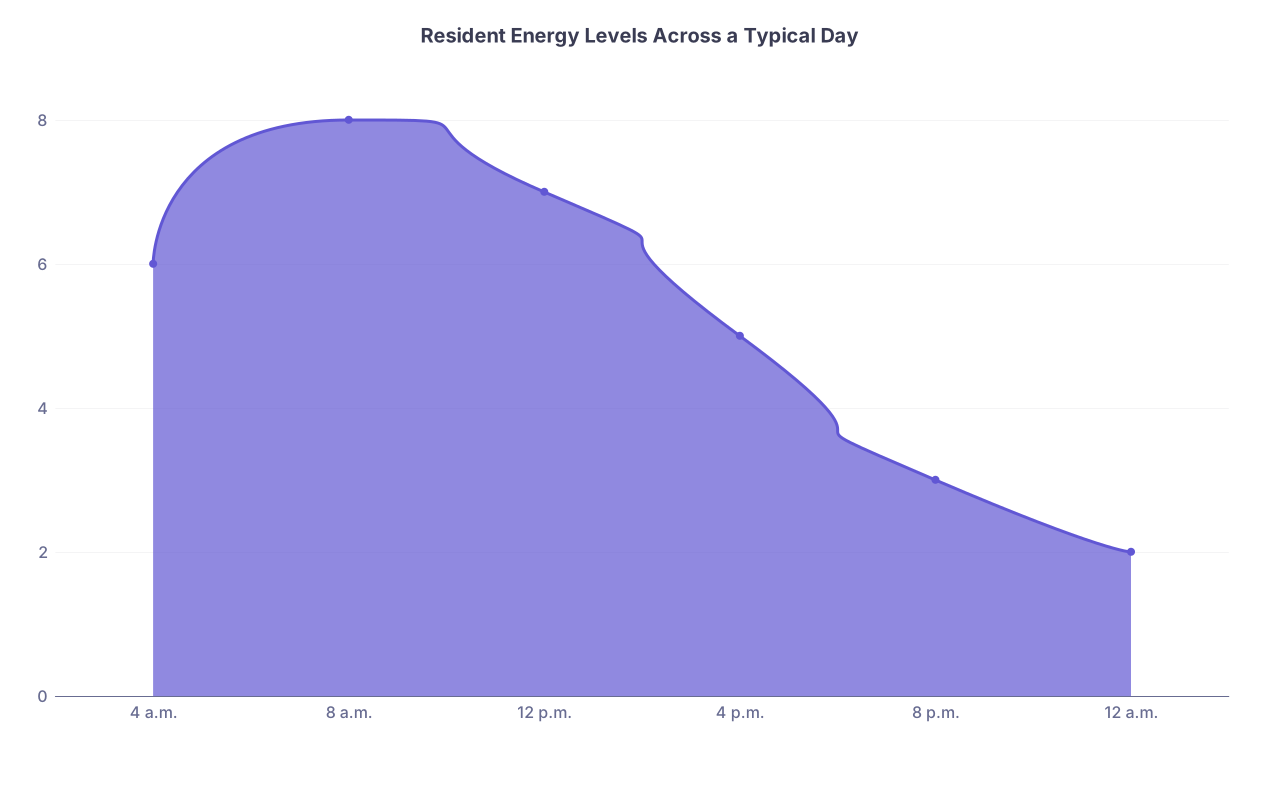
| Category | Value |
|---|---|
| 4 a.m. | 6 |
| 8 a.m. | 8 |
| 12 p.m. | 7 |
| 4 p.m. | 5 |
| 8 p.m. | 3 |
| 12 a.m. | 2 |
General pattern many residents follow (adjust to your reality):
- Morning pre-work: small but decent focus (6/10)
- Midday: sharpest brain (7–8/10)
- After shift: low-cognitive, high-emotion (3–4/10)
Use this:
- High-energy blocks → harder tasks: study, research, planning
- Medium energy → workouts, errands
- Low energy → low-friction social time, passive relaxation, very simple tasks
The mistake is trying to brute-force high-cog tasks at 9 p.m. after a 14-hour shift, then deciding you are “lazy” when it does not work.
You are not lazy. You are misallocating tasks.
Step 10: Install Micro-Safeguards Against Total Burnout
You can build the perfect system and still have weeks that absolutely destroy you: codes, deaths, staffing disasters, abusive attendings.
You need emergency rules for those weeks.
1. Define a “red zone week” protocol
Decide in advance:
- What gets temporarily dropped
- What absolutely stays
Example red zone rules:
- Drop: all optional blocks, non-essential social events, extra research hours
- Maintain at all costs:
- Sleep anchor (even if sleep duration shrinks)
- One 10–15-minute decompression ritual per day
- One check-in text or 5-minute call with your closest person at least twice a week
If you feel yourself thinking, “I do not care about anything, I just want it to end,” that is a red flag. That is when red zone rules kick in.
2. Know your personal early warning signs
Write down 3–5 of your own.
Common early signs:
- You start fantasizing about getting mildly injured so you can skip work
- You stop responding to messages from people you actually like
- You are more irritable with nurses / co-residents than usual
- You are relying on caffeine and sugar just to feel baseline human
When you see two or more of your personal warning signs, you do not negotiate with yourself. You:
- Shorten your task list for 48–72 hours
- Use your red zone protocol
- Schedule a quick check-in (trusted friend, mentor, therapist, program wellness person—anyone that is not your own brain alone)
Step 11: Example Schedules That Actually Work
Let me show you what this looks like in practice for different rotations.
A. Wards: 6 a.m.–6:30 p.m., Q4 call
Core protected blocks
- Sleep anchor: 8:30–4:30
- Keystone habit: 2 × 25-minute strength workouts (Tue/Thu morning)
- Relationships: Wed night 30-minute video call with parents, Sun brunch with partner (post-call permitting)
- Admin: Sat afternoon 30-minute admin block
Typical week sketch
Mon:
- 4:45–5:15: light bodyweight workout
- 6–18:30: work
- 19: quick dinner + 15-min mindless TV
- 20:30: bed
Tue: same work, plus 20 minutes of Anki after dinner
Wed: work → 30-min call with parents, bed
Thu: early workout again
Fri: call
Sat: post-call, mostly sleep + one 15-minute walk and 30-minute admin
This is not glamorous. It is sustainable.
B. Nights: 7 p.m.–7 a.m., 6 nights on
Protected:
- Sleep anchor: 9:30 a.m.–3:30 p.m.
- Keystone: 20-minute walk after “breakfast” before first night and after day 3
- Relationships: 2 × 15-minute calls during commutes, 1 video call on day off
- Admin: only on post-nights day, never on work days
Example
Pre-night:
- Sleep a bit later, light exercise mid-day
- 17:30–18:00: commute and 10-minute check-in call with partner
During block:
- Off at 7:30 a.m. → home → sleep 9:30–15:30
- 16:00–16:20: walk outside
- 16:20–17:30: food, shower, get ready
- 17:30–18:00: commute + quick admin call if brain permits
No “I will study 3 hours before my shift.” That is fantasy. You are building something that a real human with a fried circadian rhythm can handle.
Step 12: Treat This Like QI: Iterate Every Month
You are in medicine. You already know how to do quality improvement: Plan–Do–Study–Act. Apply that to your life.
1. Once a month, ask three questions
- What parts of my system actually worked this month?
- What consistently failed or felt unrealistic?
- What one change will I test next month?
Maybe you realize:
- Early-morning workouts are impossible on ICU? Move them to post-call afternoons.
- You scheduled 5 study blocks and only made 2 happen? Officially reduce to 2, and stop beating yourself up about the fantasy 5.
This is not about discipline Olympics. It is about fitting reality.
A Visual of How This Ties Together
Here is a simple flow of how you turn chaos into protected blocks.

| Step | Description |
|---|---|
| Step 1 | One Week Time Audit |
| Step 2 | Define Rotation Archetypes |
| Step 3 | Set Life Domains and Baselines |
| Step 4 | Create Rotation Templates |
| Step 5 | Pre Commitment Monday |
| Step 6 | Protect Sleep Anchor and Keystone Habit |
| Step 7 | Use Micro Blocks and Admin System |
| Step 8 | Monitor Energy and Red Zone Signs |
| Step 9 | Monthly Review and Adjust |
This is a loop. Not a one-time setup.
The Point
You are not going to make residency “balanced.” The hours and emotional burden are too heavy for that fantasy.
What you can do—what I have watched residents actually do—is:
- Stop letting the job consume every inch of unscheduled time
- Convert scattered, exhausted scraps of a day into something coherent
- Protect a few core parts of your life so you do not finish training burned out, divorced, and wondering who you are outside your badge
You do that with structure, not vibes.

Your Next Step Today
Do not try to build the entire system tonight. That is how people quit.
Do this instead:
Tonight, before you crash, spend 10 minutes on one task:
- Open your calendar and your current rotation schedule.
- Pick one thing to protect this coming week:
- Either your sleep anchor
- Or one keystone habit (e.g., 2 short workouts, 2 calls with family, 3 short study blocks)
Then:
- Physically block that time on your calendar for the next 7 days.
- Treat those blocks like they are mandatory conferences.
- When something tries to invade them, practice one boundary phrase from above.
That is it. Not a life overhaul. Just one protected thing.
Next week, you can add a second block. Then a third.
Open your calendar right now and mark that first protected block. If it is not on the schedule, it is not protected.