
The worst part about toxic program culture isn’t the workload. It’s how quickly it can convince you that you are the problem.
You know that sinking feeling? The one where you’re walking into the hospital at 4:30 am thinking: “If I complain, I’m weak. If I stay, I’ll break. If I leave, I’ve ruined my career.” That loop. That’s what keeps people trapped.
Let me be blunt: residents do get out of toxic programs. They also sometimes stay and quietly survive them. Both paths exist. Neither is easy. But you’re not as stuck as your 3 am brain keeps insisting.
This isn’t going to be some fake-positive “just practice self-care and talk to your PD” nonsense. You already tried smiling more. You already tried working harder. You’re not reading an article like this unless something feels fundamentally wrong.
Let’s talk about what people actually do. The stuff they whisper about in call rooms and group chats. The plans they don’t admit to faculty until after they match somewhere else.
Step One: Admit It Might Actually Be Toxic (Not Just You Being “Soft”)

Toxic culture is sneaky because it makes you doubt your own instincts.
Here’s the internal monologue I see over and over: “Everyone else seems to be coping. Maybe I’m just not built for this. Maybe this is just residency.”
Residency is supposed to be hard. It’s not supposed to be soul-destroying.
A program culture is drifting into “this is actually unsafe/unhealthy” territory when things like this are normal, not occasional:
- Being humiliated or yelled at in front of patients or staff.
- Retaliation or punishment when someone brings up concerns.
- Systematic duty hour violations that are “don’t report that” level, not once-in-a-while emergencies.
- Bullying or targeting of specific residents (the “problem resident” changes every year).
- Chronic understaffing with zero attempt to fix it, only pressure to “just get it done.”
- Being told directly or indirectly that seeking mental health care is “a bad look.”
If you’re telling yourself, “Yeah, but if I just tough it out…” stop. Toughness doesn’t fix structural dysfunction. It only hides how bad it is until something cracks—your health, your marriage, your ability to care about patients.
I’ve watched good people go from compassionate, engaged interns to hollow-eyed PGY-3s who cry in the car after every shift and still insist, “It’s fine. I’m just tired.” That’s the frog-in-boiling-water thing. You don’t notice how far you’ve bent until you can’t unbend.
You don’t have to wait until full burnout to call it what it is: this culture might be bad for you. Maybe bad, period.
Step Two: Quiet Reality Check – How Bad Is It, and How Bad Is It Making You?
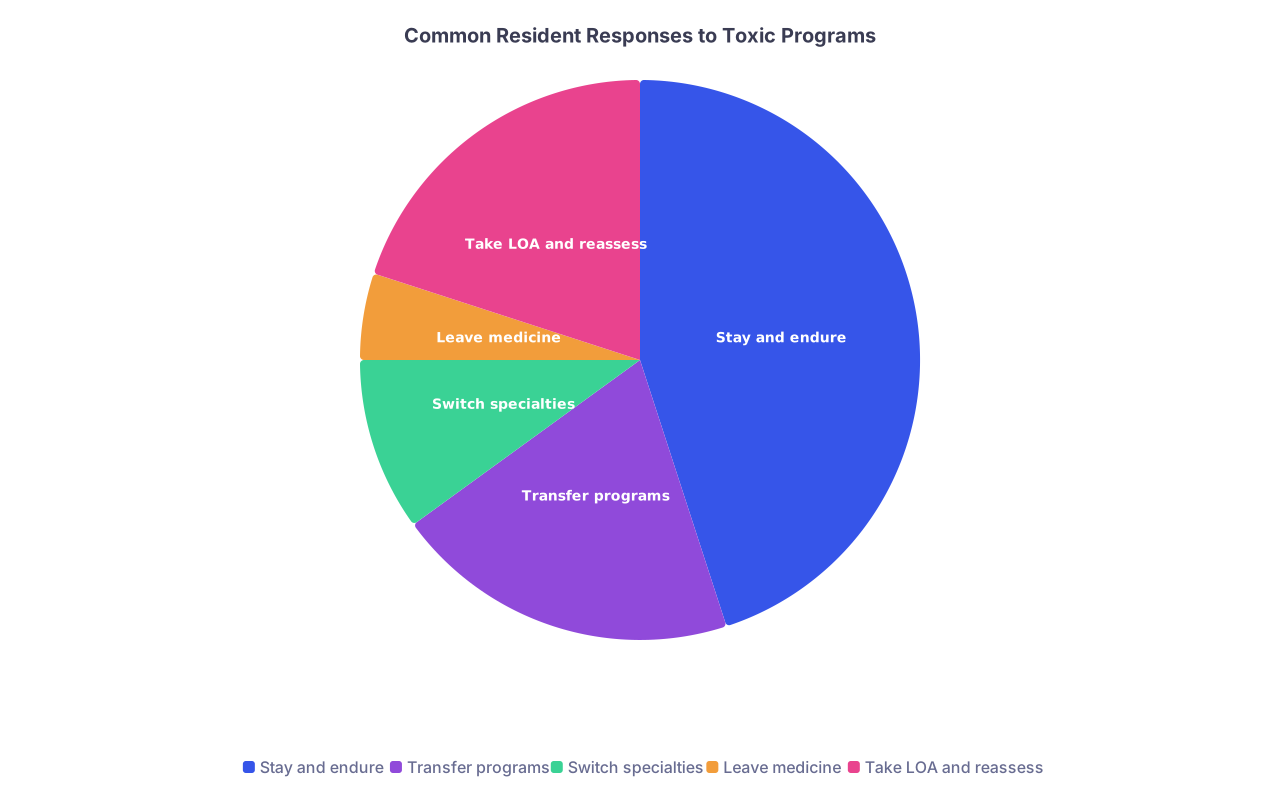
| Category | Value |
|---|---|
| Stay and endure | 45 |
| Transfer programs | 20 |
| Switch specialties | 10 |
| Leave medicine | 5 |
| Take LOA and reassess | 20 |
Before you jump to, “I have to quit,” do a quiet, honest inventory. Not for your PD. Not for your co-residents. Just for you.
Ask yourself three questions:
- Is this culture merely miserable, or is it harming my health/safety?
- Is this getting better, staying the same, or getting worse over time?
- If nothing changes here, can I realistically function for the rest of residency?
If your answers look like: “Yes, it’s harming me; it’s not improving; no, I can’t do this for 2–3 more years,” then you are not being dramatic. You’re recognizing a problem that residents either address early… or pay for later.
Look at concrete evidence, not just feelings:
- Are you losing weight unintentionally? Having chest pain, panic attacks, or insomnia more nights than not?
- Has someone credible (partner, friend, therapist, even a nurse you trust) said, “You don’t seem okay”?
- Are attendings or seniors normalizing clearly unsafe patient care as “how we do things here”?
- Do you dread specific people or rotations not because they’re rigorous, but because they feel cruel?
This is the stage where a lot of people gaslight themselves. “Everyone is tired. Everyone cries sometimes. Everyone hates intern year.” True. But not everyone is fantasizing about car accidents just to get a week off. I’ve heard residents say that out loud. More than once.
If you’re at that level, you’re far past “this is just residency.”
Step Three: The Quiet Backchannel – What Residents Actually Do First
Nobody starts with, “Hello PD, I think your culture is toxic.” That’s suicide-by-honesty in many places.
What people really do when they’re testing whether they’re trapped:
They find one safer person and start talking. Not venting in the workroom. Not a group text meltdown. A targeted, guarded conversation.
That might be:
- A chief resident who has quietly advocated before.
- A faculty member with a reputation for being “actually human.”
- A program coordinator who’s seen five classes rotate through and knows the patterns.
- A therapist outside the institution.
- GME/Resident wellness office (some are useless, some are shockingly helpful—you won’t know until you try).
You don’t lead with, “The program is abusive.” You lead with something like, “I’m struggling with the culture here and I’m worried about how I’m doing. I need honest perspective and to understand my options.”
I’ve seen this go two ways:
- The person leans in and says, “You’re not crazy. This has been a problem. Here are some ways others have handled it.”
- They basically dismiss you, suggest you “work on resilience,” and you get that gut feeling of, “Okay, they’re not safe.”
Both answers are useful. If they’re validating, you might have an ally. If they’re defensive, you’ve learned you need to be even more careful.
Document things. I know that sounds paranoid, but a notes app with dates, times, and a couple bullet points of bad incidents can make a huge difference if you ever need to talk to GME, a union, or a lawyer. Residents who transfer or file complaints almost always end up wishing they had started that earlier.
Step Four: The Actual Options People Use (Not the “Ideal World” Ones)
This is what you came for: what residents actually do when the program feels toxic.
Option 1: Stay, But Change How You Survive It
Not my favorite, but it’s the most common.
People decide, “I can’t blow this up. I just have to get through.”
So they stop trying to fix the program and start focusing on controlled damage:
- Strict boundary setting outside work. Saying no to extra committees, research, non-mandatory “social” events that feel fake.
- Therapy. Medication if needed. No shame. Lots of quietly functional residents are only functional because they got help and never told the program.
- Finding micro-communities: the 2–3 co-residents you can be real with, the one attending who will say, “Yeah, that was not okay,” the nurse who has your back.
- Minimizing exposure to the worst people. Pre-round earlier, ask to switch patients, avoid being alone with a known bully when possible.
- Planning your exit after graduation: different institution for fellowship, different region, even a different career track.
This option works if the culture is bad but not annihilating. You’re unhappy, but you’re not being actively destroyed. You can white-knuckle it with support.
If your health or safety is on the line, though, this “just push through” strategy is how residents end up in crisis.
Option 2: Internal Escalation – PD, GME, Ombuds

| Step | Description |
|---|---|
| Step 1 | Resident Concern |
| Step 2 | Seek Therapy and Support |
| Step 3 | Consider Informal Talk |
| Step 4 | Speak to Chiefs or PD |
| Step 5 | Go to GME or Ombuds |
| Step 6 | Document Conversation |
| Step 7 | Reassess and Continue |
| Step 8 | Consider Transfer or LOA |
| Step 9 | Need to Protect Self First |
| Step 10 | Trust PD or Chiefs? |
| Step 11 | Change Happens? |
Sometimes, against all odds, internal reporting actually improves things. New PDs come in. A bully attending gets “coached” or quietly removed. Duty hours get enforced when GME realizes the liability risk.
Residents who go this route usually:
- Have at least one ally in leadership.
- Present their concerns calmly, with patterns and examples, not just “everyone is miserable.”
- Frame things in language institutions care about: patient safety, accreditation risk, liability, recruitment.
But the fear is real: retaliation. I’ve heard residents say, “If I report this, my evals will tank and I’ll never get a fellowship.” This is why documentation and allies matter. So does knowing your formal pathways: institutional ombuds, GME office, HR, sometimes a union.
This path is higher risk but can lead to real change if leadership is actually open to seeing what’s happening. In a truly toxic culture, they often aren’t. So don’t bet your mental health on an internal fix unless you see some sign of good faith.
Option 3: Take a Leave of Absence (LOA) to Breathe and Decide
This one doesn’t get talked about enough.
Residents disappear for “medical reasons” all the time. Sometimes it’s a physical condition. A lot of the time, it’s mental health and burnout from a bad environment.
LOA is what people use when they’re right on the edge and genuinely don’t know: “Do I stay? Do I transfer? Do I quit?” They just know they can’t keep going as-is.
During an LOA, residents:
- Get intensive therapy and/or psychiatric care.
- Get out of the 80-hour hamster wheel long enough to think clearly.
- Sometimes talk to mentors at other institutions about transfer options.
- Rebuild some sense of self outside the identity of “drowning intern.”
Programs can be supportive about this. Some are. Others are passive-aggressively annoyed and will try to rush you back.
An LOA doesn’t magically fix toxic culture. But it gives you time and distance to make a decision that isn’t coming from sleep deprivation and panic. I’ve seen people come back with a plan: either “I can finish this if I protect myself” or “I need to get out and here’s how.”
Step Five: Transfers, Switches, and Leaving – The Nuclear Options People Really Use
| Option | Time Impact | Risk to Career | Used When |
|---|---|---|---|
| Stay and endure | None | Low | Culture bad but survivable |
| LOA then return | +3–12 months | Low–Medium | Personal crisis, need reset |
| Transfer same specialty | +0–12 months | Medium–High | Culture intolerable, same field |
| Switch specialties | +1–3 years | Medium | Wrong field + bad culture |
| Leave medicine | Permanent | High | Health at stake, no path forward |
And here’s where all your worst-case spirals live.
Transferring Programs (Same Specialty)
Yes, people do this. IM to IM. Surgery to surgery. Psych to psych. It’s not common, and it’s not straightforward, but it happens every year.
What it actually looks like:
- Quietly reaching out to PDs at other programs (often where you rotated as a student, or where friends are).
- Being honest-but-careful in your story: “My current program and I are not a good fit. I’m looking for a healthier training environment,” not “My PD is a monster and my coresidents are trash.”
- Having someone vouch for you: a former attending, medical school dean, faculty mentor.
- Accepting you may have to repeat a year or lose some credit for prior training.
Residency programs know some environments are bad. If your evaluations are solid and you’re not asking them to rescue you from every minor inconvenience, they will at least consider you.
The risk? Your current program might find out you’re looking and get weird. That’s why people usually explore options during an LOA, on vacation, or after quietly talking to a neutral mentor.
Switching Specialties
Sometimes the culture is bad and you’re in the wrong field. It’s a brutal combo.
I’ve watched surgical interns in malignant programs convince themselves they’re just not “tough enough for surgery” when actually the culture is simply abusive. Then they go to anesthesia, psych, or radiology and suddenly flourish. Night and day.
Switching specialties means:
- Likely restarting as a PGY-1 somewhere else.
- Explaining to future PDs why you’re leaving without sounding like you’ll bail again.
- Accepting the time loss for the sake of not hating the next 30 years of your life.
Honestly? I’ve never seen someone who truly switched into a better-fit specialty regret it long-term. They usually say some version of, “I wish I’d left sooner.”
Leaving Medicine Altogether
This is the doomsday scenario your brain plays on loop at 2 am.
“Maybe I’m not cut out for this. Maybe I’ve wasted a decade. Maybe I should just walk away.”
Here’s the uncomfortable truth: some residents do leave. Not many. But some.
They go into industry, consulting, tech, writing, business, public health, anything that lets them stop trading their body and sanity for prestige. And after the initial identity crisis, a lot of them end up… okay. Sometimes better than okay.
You don’t have to decide that now. But knowing it’s there as a last-resort option can actually make it easier to consider less drastic steps like LOA or transfer. You’re not choosing between “stay and die inside” and “quit and live under a bridge.” That’s what the toxic culture wants you to believe.
Step Six: Protecting Yourself While You Decide

While you’re figuring all this out, you still have to show up for patients and not implode. That’s the horrifying part.
So you quietly do things that help you survive this season without broadcasting that you’re struggling to everyone in leadership.
This is what residents who get through it intact tend to do:
They get outside support. Therapy is not a luxury item at this point; it’s protective gear. A therapist who understands medical training can help you untangle: “What’s me” vs “what’s the system” vs “what can actually change.” They can also help document functional impairments if you later need an LOA.
They ruthlessly prioritize sleep like it’s medication. Not because sleep solves culture, but because your brain cannot make big life decisions when it’s running on fumes and cortisol. You start by clawing back minutes wherever you can.
They lower the bar on non-essential performance. You don’t need to be the superstar on every rotation while you’re in crisis. Competent and safe is enough. This isn’t the season to volunteer for extra QI projects to impress fellowship directors who don’t even know you exist yet.
They talk to one or two trusted people with full honesty. Not a whole group chat. Not your PD. The friend who won’t minimize your experience or catastrophize it further.
And they quietly gather information: program policies, transfer timelines, GME contacts, stories from seniors who “barely made it.”
The goal is not to figure out your entire career. The goal is to survive this month without locking yourself into a decision you’d regret if you weren’t exhausted and scared.
Step Seven: You’re Not Weak for Wanting Out
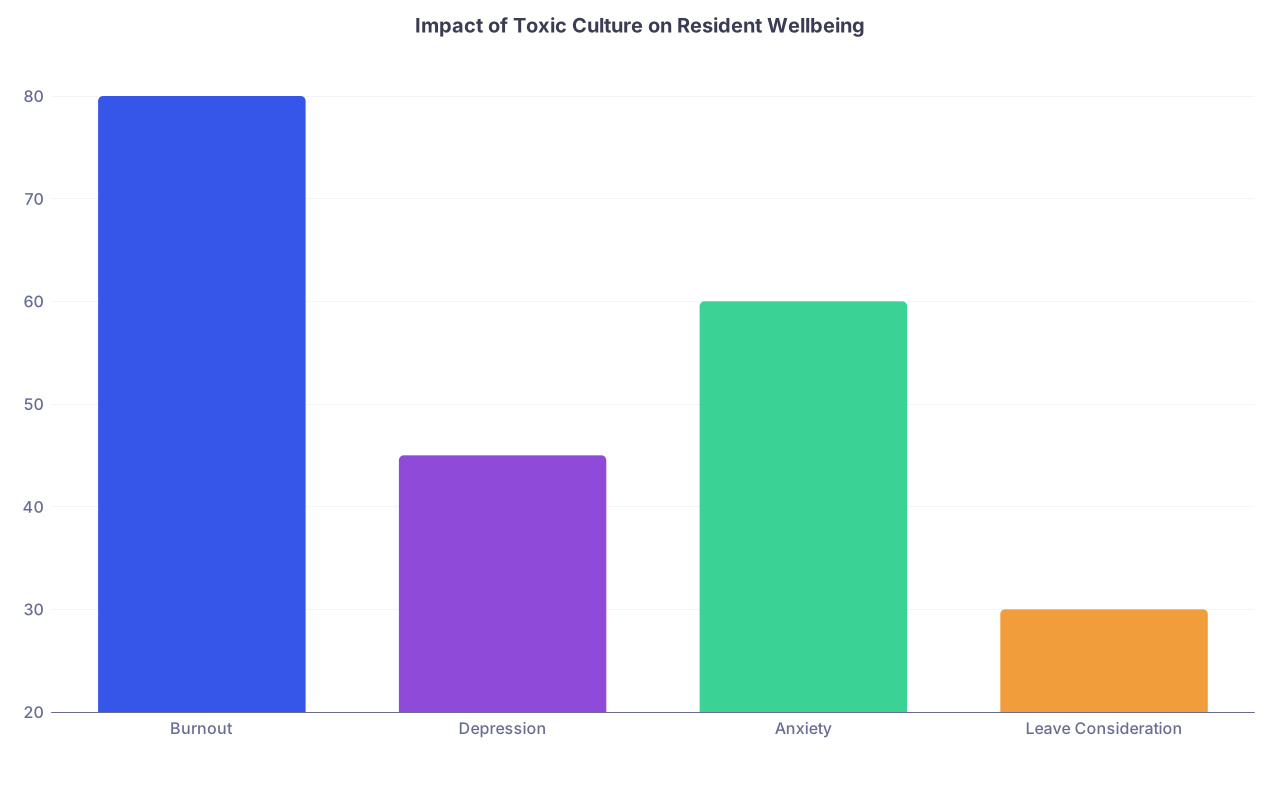
| Category | Value |
|---|---|
| Burnout | 80 |
| Depression | 45 |
| Anxiety | 60 |
| Leave Consideration | 30 |
Toxic programs thrive on this lie: “If you were stronger, you’d be fine here.”
It’s garbage.
I have seen absolute machines of residents—perfect Step scores, nonstop work ethic, terrifyingly smart—get crushed in malignant environments. And I’ve watched “average” residents blossom in supportive ones.
Your reaction to being treated badly is not a character flaw. It’s a nervous system doing exactly what it’s supposed to do when it’s under sustained threat.
Wanting a humane training environment doesn’t mean you’re not cut out for medicine. It means you’re still sane enough to know that basic respect and safety are not luxury requests.
You’re allowed to look at your program and think, “This is not okay for me.” You’re allowed to explore every option: staying with boundaries, reporting, LOA, transfer, switch, or—if it comes to it—leaving.
You’re not trapped as much as your fear says you are. The path out may be messy, slower than you want, and emotionally brutal. But there are paths.

Here’s what I want you to walk away with:
- If your program culture feels toxic, that’s not you being weak. That’s a valid signal something is wrong.
- Residents in your position use real options: quiet allies, documentation, LOAs, transfers, even specialty switches. You are not the first.
- You don’t have to decide everything today. Your job right now is to protect your health, get some outside perspective, and remember this: you are allowed to want a life outside constant fear and humiliation.