
Work-Life Balance Myths That Quietly Sabotage Young Physicians
What if the “work‑life balance” advice you keep hearing in residency is actually making your burnout worse?
Let me be blunt: a lot of what residents trade in as wisdom about balance is complete nonsense. Not just harmless nonsense. Actively harmful. It pushes you toward coping strategies that feel good in the moment and wreck you over 6, 12, 24 months.
I’ve heard these lines on call rooms, wellness retreats, and residency town halls more times than I can count:
“Just survive residency; you can fix balance later.”
“You should treat wellness days like sacred time off.”
“If you just schedule better, you’ll be fine.”
No. That’s not how this works. And the data backs that up.
Let’s dismantle the biggest myths that are quietly sabotaging young physicians—and replace them with what actually holds up under evidence.
Myth #1: “Work‑Life Balance is About Working Less”
This is the most popular bad idea.
The assumption: if you can just reduce hours, things will magically feel sustainable. So people chase “lighter” rotations, negotiate for marginal schedule tweaks, or dream about less demanding specialties as the cure.
Reality: hours matter, but they’re not the whole story—and for residents they’re often not even the main story.
Look at the literature:
- Studies repeatedly show that workload plus control predicts burnout far better than workload alone.
- The National Academy of Medicine’s work on burnout highlights autonomy, culture, and efficiency of practice as major drivers—not just raw hours.
- Post‑duty‑hour reforms, resident work hours dropped on paper, but burnout levels did not drop proportionally. In many programs, they barely budged.
Why? Because if you’re still:
- Charting endlessly in a broken EMR
- Getting undermined or yelled at
- Working in a system where you’re responsible without being empowered
…then 60 hours can feel more soul‑crushing than someone else’s 80.
Work‑life balance for a resident is not “less work.” It’s:
- More control over how and when you do critical tasks
- Less friction (useless bureaucracy, bad workflows, constant paging)
- Better alignment between your work and your values (actual patient care vs. checkbox clicking)
You can work a 75‑hour ICU week and feel strangely okay if the team is supportive, the work is meaningful, and the system isn’t sabotaging you every step. You can work a 50‑hour “cush” elective and feel dead inside if you’re spending 30 of those hours fighting the EMR and the other 20 wondering why you went into medicine.
So if your main “balance” strategy is to shave 3–5 hours a week off your schedule without touching how you work, you’re rearranging deck chairs.
Myth #2: “You Can Fix Burnout with Self‑Care and ‘Wellness’ Activities”
You know the routine:
- Mandatory wellness lecture
- Guided meditation in grand rounds
- A yoga session in the conference room
- Pizza night “for morale”
Residents roll their eyes not because they hate yoga, but because the message is insulting: “If you’re burning out, you probably just need to breathe more and journal.”
The data couldn’t be clearer:
- A 2019 meta‑analysis in JAMA found that system‑level interventions (changing schedules, staffing, or workflows) had larger and more durable effects on burnout than individual‑level interventions (mindfulness, resilience training).
- Mindfulness and exercise help with stress, yes. But they don’t compensate for chronic moral injury, toxic culture, or unsafe staffing.
Self‑care is not bad. It’s just wildly oversold as a solution to a structural problem.
Here’s the correct hierarchy:
- Fix the system: workflow, staffing, supervision, culture.
- Protect your non‑negotiables: sleep minimums, health basics, key relationships.
- Add self‑care as a supplement, not as a primary therapy.
When leadership pushes “resilience” while refusing to address:
- Malignant attendings
- Perpetually unsafe cross‑cover loads
- EMRs designed like torture devices
…they’re gaslighting you. They’re telling you the problem is your inability to meditate your way through a dumpster fire.
If you feel resentful at “wellness” emails in your inbox while you’re post‑call and still finishing notes at 2 p.m., your instincts are correct.
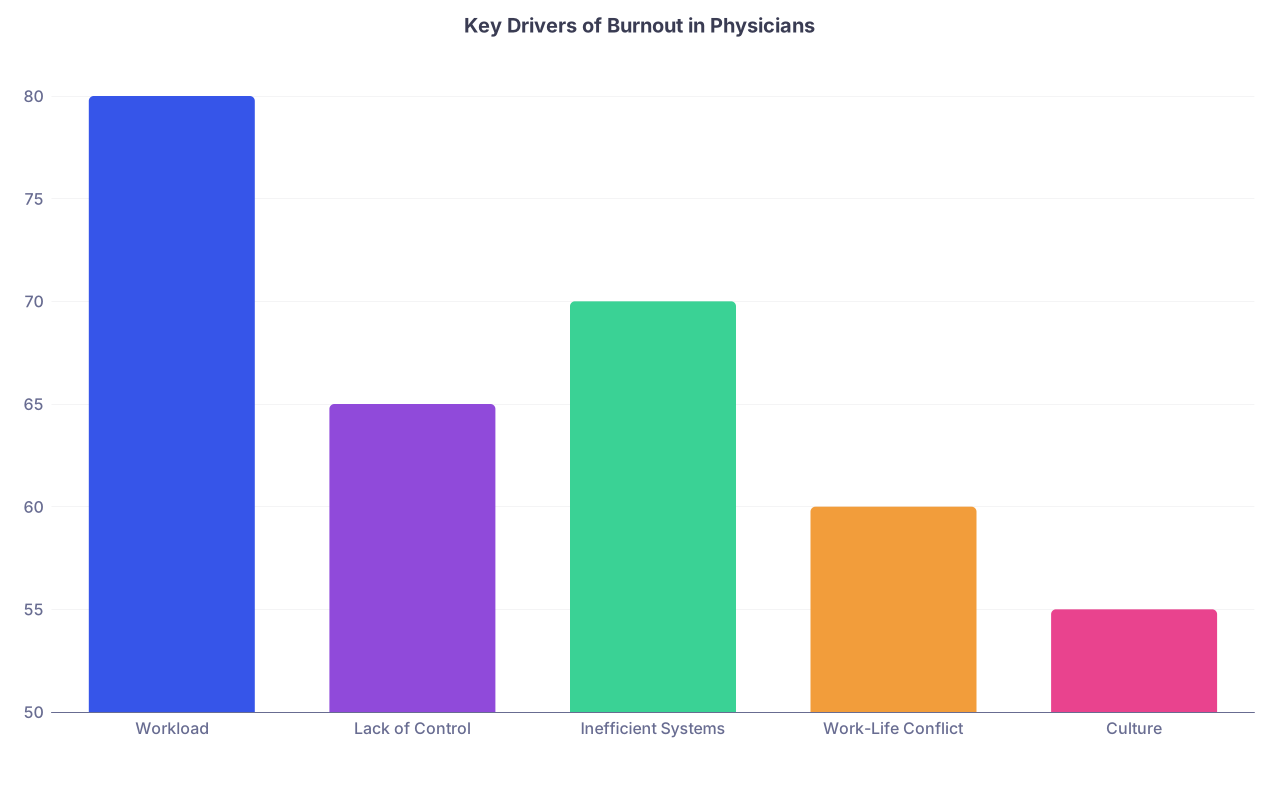
| Category | Value |
|---|---|
| Workload | 80 |
| Lack of Control | 65 |
| Inefficient Systems | 70 |
| Work-Life Conflict | 60 |
| Culture | 55 |
Myth #3: “Balance Will Magically Appear After Residency”
This one is dangerous because it justifies misery now with promises of future relief.
You hear it from older attendings: “Just get through it. Once you’re an attending, you can set your own schedule.”
Some can. Many can’t. A big set of them don’t, even when they technically could.
Look at real numbers:
- Surveys of practicing physicians show burnout prevalence around 40–60%, depending on specialty. That’s after residency.
- Early‑career physicians (first 5 years out) often have some of the highest burnout rates. Why? Debt, new responsibility, weak boundaries carried over from training, and often worse productivity pressure.
The unpleasant truth: you don’t magically develop boundaries and priorities at fellowship graduation. You import whatever habits you normalized in residency.
If your pattern now is:
- Saying “yes” to everything
- Equating worth with productivity
- Ignoring your own limits until your body forces you to stop
…you will keep doing that with a bigger paycheck and more administrative pressure. That’s not balance. That’s just a more expensive version of the same trap.
So no, balance doesn’t “start later.” You are practicing your future career style right now. You’re wiring in what feels normal. That’s why you care about this during residency, not “someday.”
Myth #4: “Work‑Life Balance Means Rigid Boundaries”
Another trap: overcorrecting.
You read about boundaries, you hear “learn to say no,” and suddenly you’re trying to run residency like a 9‑to‑5 corporate job. Hard stop time every day. No staying late ever. No flexibility. Everything that touches personal time is an attack.
Reality: medicine is not predictable. If your model of balance requires predictability, you picked the wrong field.
The issue isn’t whether work sometimes spills over. It’s:
- How often
- For what reasons
- And whether it’s balanced by real recovery and real meaning
If a sick patient is crashing at 4:45 p.m. and you’re supposed to leave at 5, nobody respects, “Sorry, my boundaries.” You wouldn’t respect that in yourself either. That’s not balance, that’s disengagement.
What actually works is flexible boundaries:
- You stay late on Tuesday because a case ran over. Fine. You deliberately protect your post‑call Wednesday and actually say no to optional stuff.
- You pick 1–2 things that almost never get sacrificed (e.g., weekly therapy, standing call with partner, religious observance, or your long run) and treat those as near‑sacred.
- You’re honest with yourself about voluntary overwork vs. required overwork. There’s a big difference between “I had to stay late for a code” and “I chose to stay 90 extra minutes rewriting my note for the third time because I can’t tolerate imperfection.”
Residents get trapped in two extremes:
- No boundaries at all—everything is fair game for work.
- Weaponized boundaries—treating any intrusion as abuse.
Both backfire. The middle path takes more judgment but actually works.
Myth #5: “If You Just Organize and Time‑Manage Better, You’ll Be Fine”
This one’s seductive for high achievers. You’ve always solved problems by working harder, planning more, optimizing.
Lots of residents assume: if I get the right app, the right calendar, the right to‑do list system, this will feel manageable.
But time management does not fix time theft.
If your days are full of:
- Waiting on hold
- Re‑entering the same orders
- Prior auth battles
- Rotations designed with zero protected documentation time
…no planner is going to save you. That’s a systems problem dressed up as a personal failing.
Time‑management helps in exactly three ways:
- Preventing dumb self‑sabotage (scrolling your phone for 40 minutes post‑call and then complaining you “had no time”).
- Making small windows of free time actually restorative instead of wasted.
- Clarifying tradeoffs—consciously deciding, “I’ll skip the optional lecture so I can go home 30 minutes earlier and sleep.”
But if your schedule is structurally unreasonable, you can be the most efficient resident in the program and still be exhausted.
You’re not burned out because you didn’t color‑code your Google Calendar.
Use productivity tools to reduce self‑inflicted chaos. Don’t use them to gaslight yourself into thinking you’re the problem when the system is broken.

Myth #6: “Saying Yes to Everything is How You Keep Doors Open”
Early in training, the pressure to say yes is intense.
“Yes” to every research idea.
“Yes” to every committee.
“Yes” to covering “just one more” shift.
“Yes” to unpaid ‘opportunities’ that help the department more than they help you.
The fear is understandable: you don’t know yet what will matter for fellowship, jobs, or letters, so you default to hoarding options.
But the evidence around burnout and career satisfaction is brutal here:
- Overcommitment and role overload are strongly associated with burnout and attrition.
- People who “keep all doors open” often end up walking through none of them—they’re too tired to actually pursue the opportunities that would have mattered.
Residents who thrive long‑term do something counterintuitive: they intentionally disappoint people.
- They say no to projects that don’t clearly advance their goals.
- They drop committees that aren’t worth the time.
- They choose one or two meaningful non‑clinical commitments and treat those seriously.
Does this mean you should never stretch? No. It means you should stretch strategically.
The tough rule: if you say “yes” to something new, you should know what you are saying “no” to instead. Sleep? Time with your partner? An existing obligation? Be explicit. Otherwise you’re writing checks with your future self’s energy.
And no, you’re not going to “make up” rest later. That’s not how physiology works.
Myth #7: “Good Residents Put Work Above Everything”
You’ve heard the subtext, even if nobody says it outright:
- The resident who never complains and always stays late is “dedicated.”
- The one who leaves on time for a kid’s recital is “less committed.”
- The person who speaks up about insane cross‑cover ratios is “not a team player.”
This culture is not just toxic. It’s also clinically unsafe long‑term.
The research is dull but clear:
- Sleep deprivation impairs cognition, psychomotor performance, and decision‑making to a degree comparable to alcohol intoxication.
- Chronically burned‑out physicians are more likely to make medical errors, less likely to show empathy, and more likely to leave the profession entirely.
So the story that “sacrificing everything makes you a better doctor” is not just wrong, it’s backwards. Past a point, your martyrdom makes you a worse clinician.
You are not a better doctor if:
- You mis‑dose a medication because you’ve been awake 28 hours.
- You snap at a nurse and destroy the team’s willingness to speak up about concerns.
- You become so emotionally blunted that every patient becomes a task to finish, not a person to care for.
Residents who quietly protect their humanity—sleep, family, friendships, basic hobbies—are not selfish. They’re trying to remain capable of caring. For decades, not just until graduation.
| Factor Type | Strong Burnout Link? |
|---|---|
| Workload intensity | Yes |
| Lack of schedule control | Yes |
| EMR inefficiency | Yes |
| Personal resilience | Weak |
| Individual coping style | Weak |
Myth #8: “You’re Stuck—Nothing You Do as a Resident Matters”
This is the most demoralizing myth, and it’s common in malignant or just apathetic programs.
The story: “You’re a cog. You can’t change anything. Suck it up.”
You’re right that you don’t control the entire system. But you control more than zero. And more than most residents think.
Things that do move the needle more than you’d expect:
- Collective complaints, not solo rants. When multiple residents document specific safety or workload concerns and present them in a unified way (to program leadership, GME, or even ACGME during site visits), change happens a lot more often.
- Targeted asks. “We need to fix burnout” gets you a pizza party. “We need two hours of protected documentation time on ICU days” has a better shot.
- Aligning your request with patient safety or accreditation. Programs listen more when you frame issues as safety problems or ACGME compliance issues—because they are.
On the personal level, you also control:
- Who you spend time with (energy‑givers vs chronic complainers).
- How much you medicalize your life (“I’m just a resident” vs “I’m a person who is currently a resident”).
- Whether you invest in one meaningful non‑work identity (parent, musician, runner, faith community member—whatever).
You’re not going to rebuild American healthcare from your night float station. But you’re also not powerless. Learned helplessness is its own kind of trap.

| Step | Description |
|---|---|
| Step 1 | Recognize burnout signs |
| Step 2 | Document specific problems |
| Step 3 | Discuss with co residents |
| Step 4 | Escalate concrete asks to leadership |
| Step 5 | Adjust boundaries and commitments |
| Step 6 | Protect sleep and key relationships |
| Step 7 | Monitor for real change |
| Step 8 | Source mainly system or self? |

So What Actually Works?
Here’s what tends to correlate with residents who don’t implode:
They think in seasons, not days. Some months will be brutal (ICU, nights), some will be lighter (electives). They don’t expect perfect daily balance; they aim for adequate recovery across weeks.
They have one or two non‑negotiables that almost always win. Therapy. Sunday dinner with family. A weekly long run. Something that keeps them tethered to who they are outside the hospital.
They treat overwork as a cost, not a badge. Staying late is sometimes necessary, sometimes a choice. They don’t romanticize it either way.
They invest in good colleagues. The difference between a malignant‑feeling month and a bearable one is often not the hours, but the team. Micro‑community beats generic “institutional wellness” every time.
And they drop the fantasy that balance is a finish line they’ll cross “once residency is over.” They start building a sustainable career style now, with the little control they have.
The Bottom Line
Three key points to walk away with:
- Work‑life balance in residency is not about working less; it’s about having more control, less pointless friction, and some protected parts of your life that training doesn’t devour.
- Self‑care and time‑management help, but they don’t fix structural problems. If you’re burning out, it’s not because you failed to journal.
- The habits you normalize now—boundaries, priorities, what you say yes to—are the ones you’ll carry into attending life. You’re not waiting for balance later; you’re practicing it, or eroding it, every single week.