
The Toxic Myth That Burnout Is a Personal Weakness, Not a System Issue
Why do we keep telling exhausted residents to download a mindfulness app instead of fixing the fact that they’re covering 20 patients, doing 3 people’s jobs, and documenting like a full-time scribe?
Let me be blunt: the idea that burnout is mainly about your “resilience,” “mindset,” or “self-care habits” is garbage. Harmful garbage. It lets systems off the hook and quietly blames you for reacting like a human being to an inhuman setup.
Burnout in residency is not primarily a character flaw. It is a predictable outcome of specific structural conditions. We have data on this. We’ve had data for years. Hospital leadership has seen the same numbers you have. They just prefer the “wellness talk + pizza” solution because it is cheaper and does not threaten the way the machine runs.
Let’s pull this apart.
What the Data Actually Shows About Burnout
Start with some numbers, not vibes.
Multiple large studies – not just one-off surveys – show burnout rates among residents routinely above 50%. Depending on specialty and year of training, some cohorts approach 70%. You don’t get >50% of any reasonably selected population showing “personal weakness.” You get a system that’s miscalibrated.
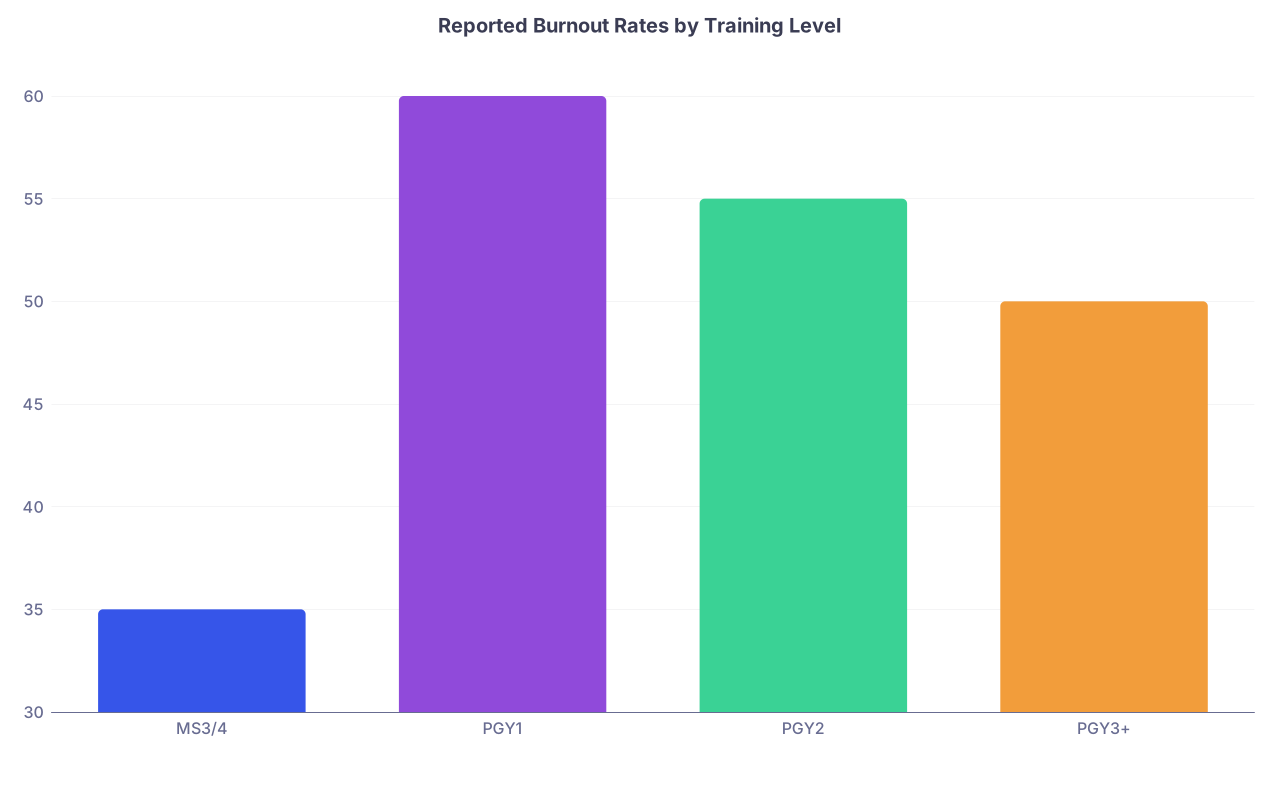
| Category | Value |
|---|---|
| MS3/4 | 35 |
| PGY1 | 60 |
| PGY2 | 55 |
| PGY3+ | 50 |
Those numbers match what you see every day:
- The intern crying in the stairwell at 4 a.m. after back-to-back cross-cover nights.
- The senior who stopped caring whether the ED is “inappropriate admitting” because they’re too numb to be mad anymore.
- The chief resident joking, “My coping strategy is emotional detachment,” and everyone laughs because it is too on the nose.
Now look at predictors. Studies consistently tie burnout to:
- Excessive workload and hours
- Loss of autonomy
- Clerical burden and EMR chaos
- Misalignment between stated values (“patient-centered care”) and actual incentives (RVUs, throughput, metrics)
- Poor leadership and toxic local culture
What doesn’t predict burnout very well? Individual “resilience scores” or personality traits. Yes, there are small effects. But they’re dwarfed by system-level drivers.
If this was any other safety issue – say, 60% of machines in your plant exploding – nobody would say, “We need more explosion resilience training.” Yet somehow in medicine that has become the dominant narrative.
The Convenient Lie: “You Just Need Better Coping Skills”
The personal-weakness myth is not a random misunderstanding. It’s convenient for institutions.
You’ve probably heard some version of this talk:
“Residency is hard. You need to protect your wellness. Make sure you’re doing yoga, gratitude journaling, and using our mindfulness app. Remember, burnout is about how you respond to stress.”
Translation: the problem is you. Not our staffing ratios, not how we schedule, not how many times you’re forced to chart-shop in the EMR for billing requirements that have nothing to do with patient care.
I have literally sat through a noon conference where, right after announcing another round of “productivity targets” and a new documentation requirement, the same administrator talked about a “resilience initiative” involving coloring books and meditation sessions at 7 p.m. (After sign-out, of course. On your own time.)
Let’s be clear here:
- If you’re sleeping 4–5 hours a night for weeks.
- Getting paged constantly for non-urgent nonsense.
- Covering 20–30+ complex patients on a “capped” service that routinely exceeds its cap.
- Spending more time fighting the EMR than examining patients.
You are not burned out because you lack grit. You are burned out because the workload exceeds human capacity over a sustained period.
This is not my opinion. This is how the Maslach Burnout Inventory and decades of occupational health research define burnout: a mismatch between job demands and available resources over time, especially under conditions of low control and low support.
Burnout Is a System Problem Wearing a “You Problem” Mask
Let’s dissect the core myth: that burnout is mainly about “fragile” individuals, not broken systems.
Workload vs. “Resilience”
Studies from multiple institutions show a near-linear relationship between number of work hours, night shifts, and perception of workload intensity with burnout scores. You don’t see that kind of clean signal if this is all about internal mindset.
There’s a classic occupational health framework here: demand–control–support.
- High demand + low control + low support = burnout factory
- Moderate demand + some control + reasonable support = challenging but sustainable
Residency often delivers the first combination. High demand is obvious. Control? You have very little. You can’t change the schedule, the coverage model, the EMR, the call burden, or the care pathways set by people who don’t carry a pager anymore. Support? Depends heavily on your local attendings and seniors, but systemically, it’s patchy at best.
| Factor Type | Example Driver |
|---|---|
| System-level | Patient load per resident |
| System-level | EMR documentation burden |
| System-level | Shift scheduling and nights |
| Personal-level | Sleep hygiene habits |
| Personal-level | Baseline anxiety/depression |
Guess which column has the strongest effect size in large studies? Not the one with “sleep hygiene.”
The EMR and the Clerical Trap
If you want a concrete example of system failure masquerading as personal inadequacy, look at documentation.
Time-motion studies have shown residents and attendings spending 40–60% of their work time in the EMR. Not “thinking,” not talking to patients, not learning. Clicking. Copy-pasting. Box-checking.
You’ll hear leadership say “use smart phrases,” “optimize your workflow,” “improve efficiency.” Again, the subtext: fix yourself.
But the interface is badly designed for clinical reasoning. The billing and compliance requirements are intentionally convoluted. Every time a new regulatory or “quality” demand surfaces, they bolt on another click-path. The system is wired to generate charges and defensible documentation, not sanity.
You’re not burned out because you haven’t discovered the right SmartPhrase. You’re burned out because you’re being used as the cheapest data-entry workforce the system will ever find.
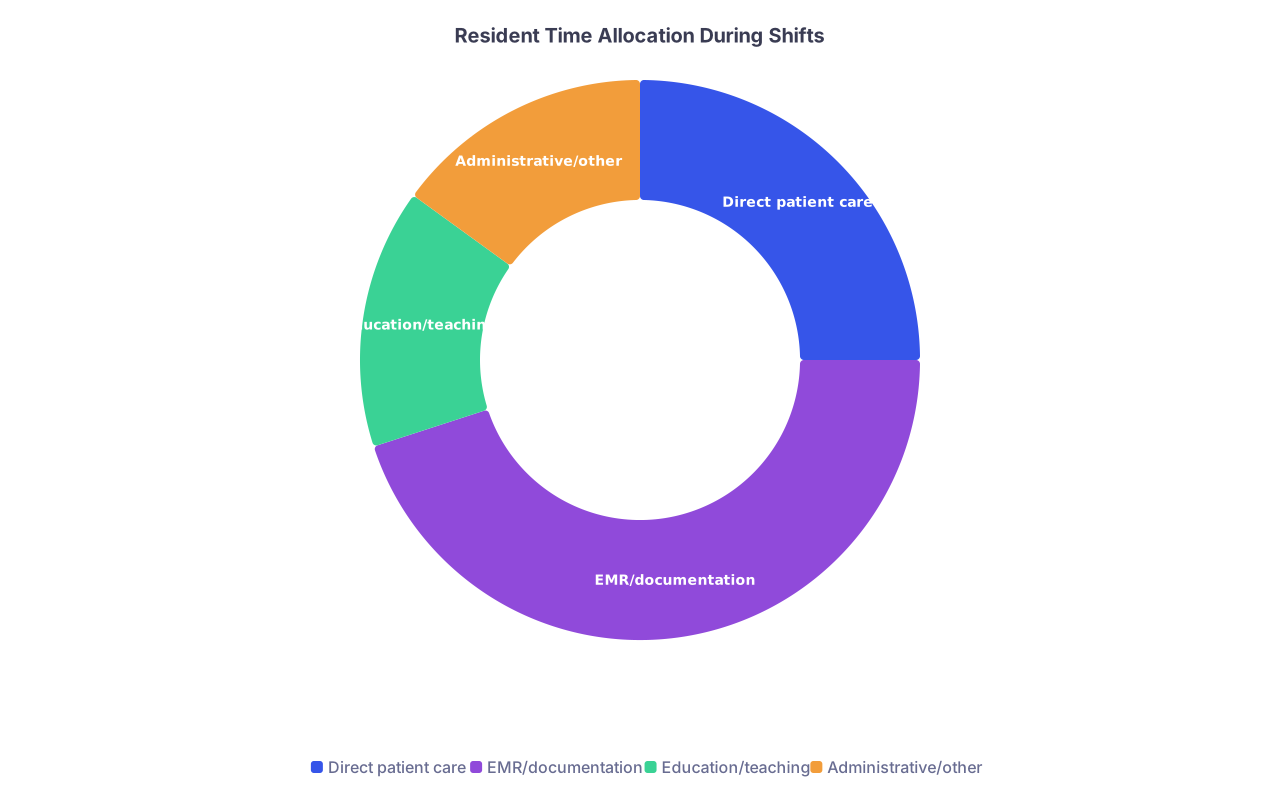
| Category | Value |
|---|---|
| Direct patient care | 25 |
| EMR/documentation | 45 |
| Education/teaching | 15 |
| Administrative/other | 15 |
The Gaslighting Component
Here’s where it gets truly toxic: you’re told the problem is your “wellness” while being punished – directly or indirectly – for acting in ways that would actually protect your wellness.
Call out unsafe volumes? You’re “not a team player.”
Say no to extra shifts because you’re at your limit? You’re “not committed.”
Ask about mental health leave? Whispers about “fitness for duty” and future credentialing.
That’s gaslighting. The message is: you should be well, but do not you dare do what it actually takes to be well. Also, if you’re not well, it must be something wrong with you.
What Actually Changes Burnout Rates (Spoiler: Not Yoga Alone)
Do stress-reduction tools help individuals survive in a bad system? Yes. They can. I’m not mocking meditation or therapy. Use whatever keeps you afloat.
But when you zoom out to the population level, individual coping strategies barely move the needle compared to system reforms.
We have data from multiple interventions:
- Cutting shift lengths and capping hours reduced burnout and medical errors in some settings. Not perfectly – because implementation was inconsistent and often offset by “work compression” – but the trend is very clear.
- Protected sleep periods during call – actual protected time, not “you can sleep if your pager is quiet,” which it never is – led to lower fatigue and better performance.
- Reducing clerical burden with scribes, better EMR tools, or delegating non-physician tasks decreases burnout scores.
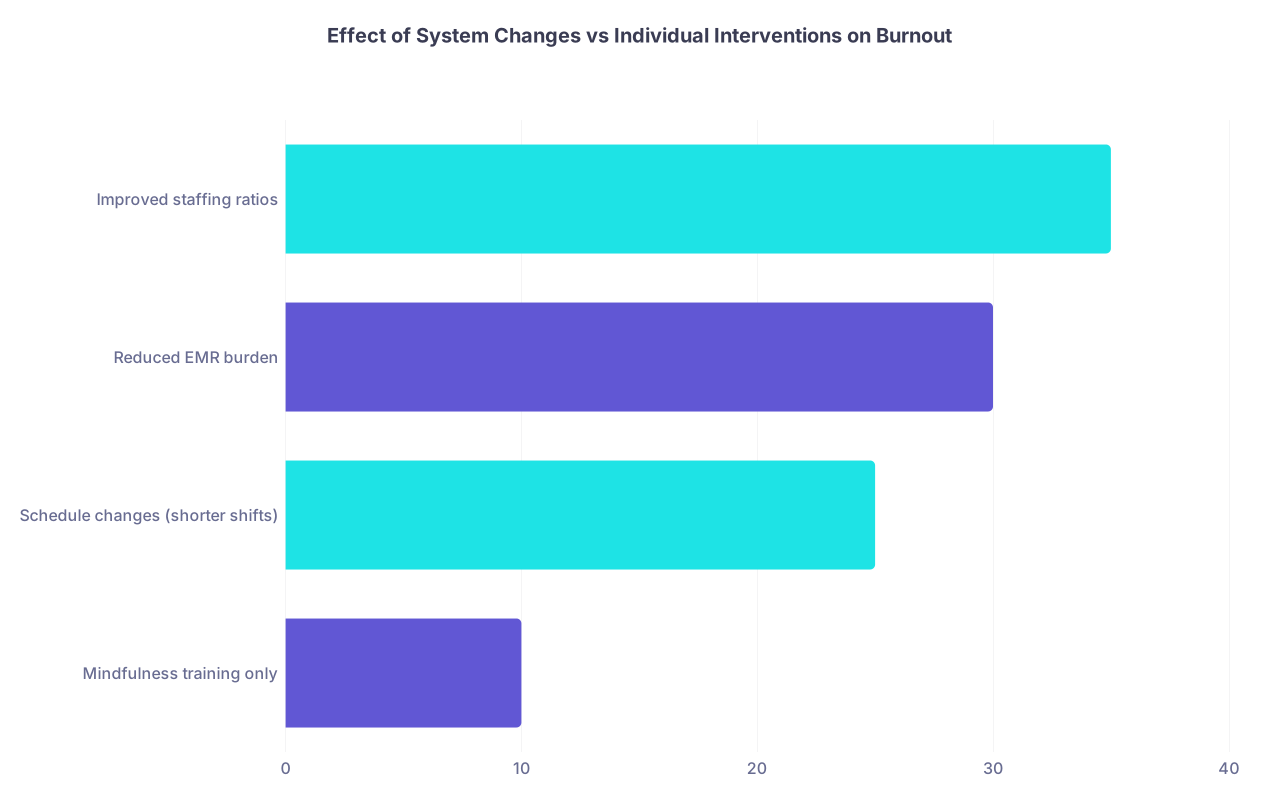
| Category | Value |
|---|---|
| Mindfulness training only | 10 |
| Schedule changes (shorter shifts) | 25 |
| Reduced EMR burden | 30 |
| Improved staffing ratios | 35 |
These numbers are approximate summaries from multiple studies, but the pattern is consistent: system-level interventions produce bigger and more durable reductions in burnout than “teach everyone to breathe more deeply.”
If a residency program is serious about burnout – not cosmetically, not for a slide in the ACGME site visit – you see concrete moves:
- Cohort-based scheduling that respects circadian rhythms.
- Real protected education time, not “protected unless the ED is slammed.”
- Reasonable patient caps that are actually enforced.
- Time and support for residents to go to therapy without playing scheduling Twister.
- Fewer pointless metrics, fewer non-clinical tasks dumped on trainees.
If you never see any of this, but you do see “wellness lectures” and resilience emails, that’s your answer about where the problem lives.
“But Some Residents Cope Fine – Doesn’t That Prove It’s Personal?”
This is the classic counterargument: “If it’s the system, why aren’t all residents burned out? Some seem fine.”
Right. And some people can smoke a pack a day and never get lung cancer. That doesn’t mean cigarettes aren’t carcinogenic.
Human beings have different baselines: genetics, family support, prior trauma, mental health history, personality traits. Sure, those modify how you react to a bad environment.
But here’s the key: variation in vulnerability doesn’t mean the stressor isn’t real or systemic. In fact, in occupational medicine, that’s the norm. Some people tolerate solvents, noise, night shift, or heavy lifting better. We still call those things occupational hazards.
The system-level question is not “Can a minority survive this?” It’s “What happens to the average reasonably healthy trainee over time?”
And the data says: they get more cynical, more exhausted, and more detached from the reasons they went into medicine. Those are the three classic dimensions of burnout – emotional exhaustion, depersonalization, and reduced sense of personal accomplishment – and they track with training year startlingly well.
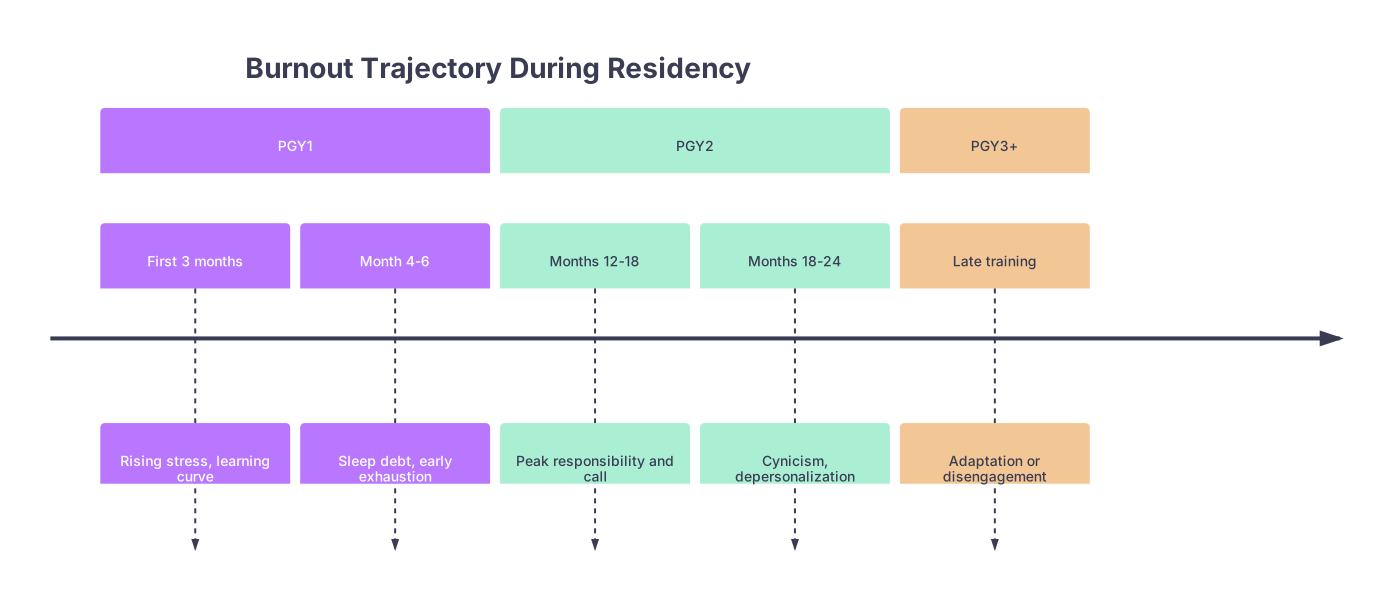
| Period | Event |
|---|---|
| PGY1 - First 3 months | Rising stress, learning curve |
| PGY1 - Month 4-6 | Sleep debt, early exhaustion |
| PGY2 - Months 12-18 | Peak responsibility and call |
| PGY2 - Months 18-24 | Cynicism, depersonalization |
| PGY3+ - Late training | Adaptation or disengagement |
If the environment was fundamentally healthy, burnout would cluster in individuals with clear pre-existing vulnerabilities. Instead, it spreads across entire cohorts, spikes in predictable rotations (ICU, wards, night float), and correlates with predictable system pressures (understaffing, high census, chaotic leadership).
That’s not a personality issue. That’s exposure.
What You Can Control – Without Swallowing the Myth
Here’s the tension: burnout is a system problem, but you’re stuck in the system right now. You can’t rewrite the ACGME rules or fix your hospital’s EMR this week. So what can you do that doesn’t reinforce the “this is all on me” lie?
A few hard truths and equally hard boundaries.
First: stop interpreting your struggle as evidence that you’re lesser. If you’re exhausted, angry, numb, or dreading every sign-out, that’s not a signal that you picked the wrong career or that you’re uniquely weak. It’s a very normal human reaction to sustained overload and moral distress.
Second: use personal strategies as survival tools, not solutions. Sleep discipline, therapy, exercise, saying no when you genuinely can – those are not admissions of failure. They’re how you reduce the damage the system is doing to you. But don’t confuse them with fixing the root cause.
Third: find your lines. You need internal red lines for what you will not sacrifice indefinitely – sleep below a certain threshold, safety corners cut, personal health ignored. The system will not draw these lines for you. In fact, it will quietly reward you for crossing them until something breaks.
Fourth: document, don’t just vent. When things are unsafe – absurd patient loads, impossible call demands, no supervision – write down dates, numbers, specifics. Not because it will magically transform tomorrow, but because data carries more weight when residents push for change, and memory under fatigue is unreliable.

Finally: participate in collective pressure when you can. Resident unions, housestaff councils, collective feedback to the CCC or program director – these are imperfect and sometimes political, but they’re how system problems eventually move from “wellness slide” to actual money and staffing decisions.
What Needs to Change (And Why You Are Not the Problem)
Let me lay it out cleanly: if an institution truly believes burnout is an individual weakness, they will invest in optics. Wellness weeks. Yoga sessions in the conference room. Posters about “grit.”
If an institution accepts that burnout is a system issue, you’ll see painful, expensive, sometimes politically unpopular changes:
- Hiring more staff, not just squeezing more work out of residents.
- Redesigning rotations that are known meat grinders.
- Enforcing caps even when census is brutal and the ED is overflowing.
- Cutting back on low-value documentation and box-checking.
- Giving residents a real voice – not performative surveys that vanish into a black box.
Those are the moves that cost something. Time, money, political capital. That’s why the personal-weakness myth survives: it’s cheaper. It externalizes the cost onto you.
You’re not burned out because you failed some secret internal test. You’re burned out because residency is often designed around historical norms and institutional convenience, not human physiology, psychology, or safety science.
The system will always try to reinterpret your exhaustion as an individual problem. Because if it admitted the truth, it would have to change.
Years from now, you won’t remember the wording of that wellness email or the forced meditation session in the dark conference room. You’ll remember who tried to convince you that your suffering was a personal flaw—and whether you believed them or decided, quietly but firmly, to stop taking the blame for a system that was never built with your well-being in mind.