
The culture of “tough it out” in residency is not just outdated. It is objectively dangerous.
Not metaphorically dangerous. Statistically, clinically, legally dangerous. We have years of data now, across specialties and countries, showing that the macho endurance model of training produces burned-out doctors, more medical errors, worse patient outcomes, and higher turnover. And it does not make better clinicians.
Yet you still hear the same lines in workrooms at 2 a.m.:
“Everyone before you survived this.”
“This is just what residency is.”
“If you can’t handle it, you’re in the wrong field.”
Those are not pearls of wisdom. They are rationalizations for a system that refuses to update itself despite clear evidence.
Let’s walk through what the data actually shows.
The “Tough It Out” Myth: What People Think It Does
The unspoken promise of “tough it out” is simple: if you grind through miserable conditions now, you’ll emerge stronger, sharper, more resilient. Like some twisted rite of passage.
The myth rests on a few assumptions:
- Suffering builds resilience.
- Longer hours → more experience → better training.
- Residents who ask for limits or support are less committed.
- Protecting wellbeing means lowering standards.
Problem: all four of those are contradicted by actual evidence from residency programs, burnout research, and patient safety data.
And not subtly contradicted. More like “180-degrees wrong.”
What the Data Actually Shows About Overwork
Start with the basics: hours and performance.
There’s a large body of research on sleep deprivation, cognitive performance, and medical errors. It all says the same thing: beyond a certain threshold, you are not a gritty hero; you’re an impaired provider.
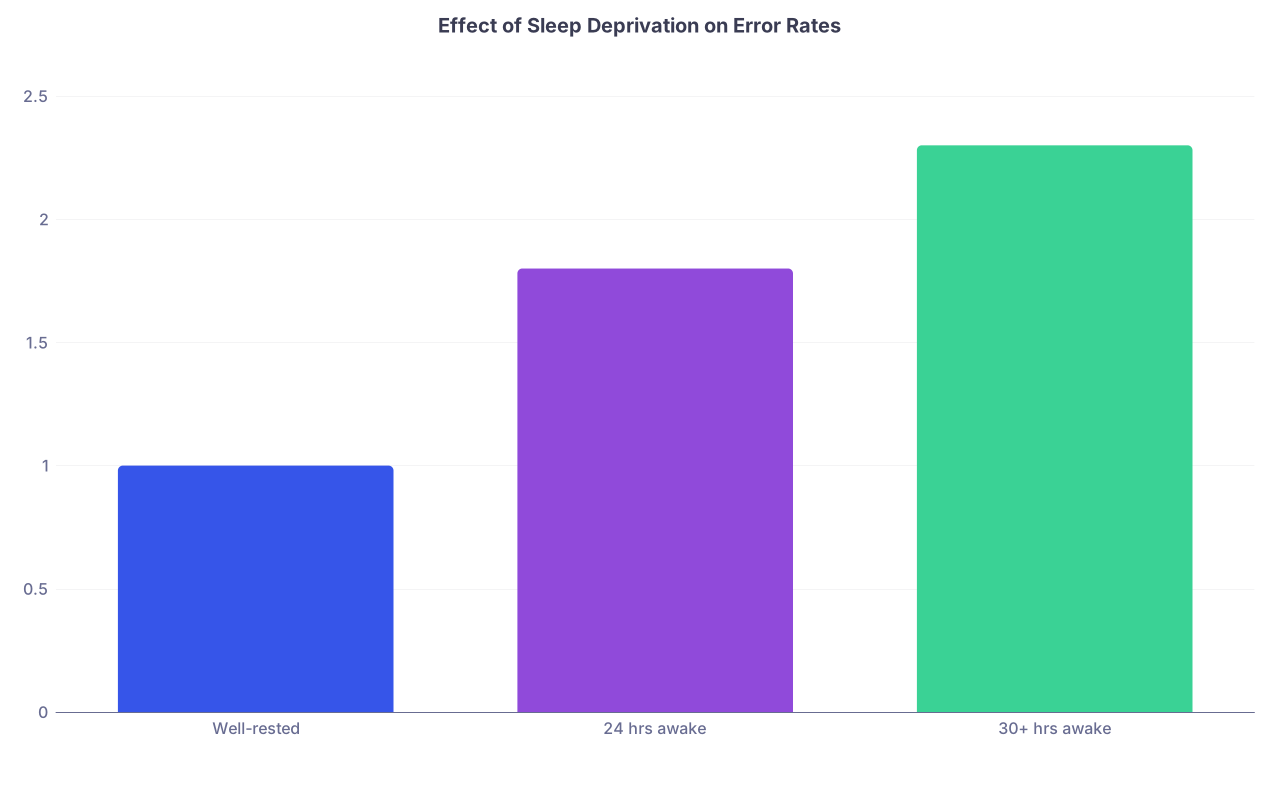
| Category | Value |
|---|---|
| Well-rested | 1 |
| 24 hrs awake | 1.8 |
| 30+ hrs awake | 2.3 |
Those numbers are representative of what multiple studies show: error rates climb dramatically with prolonged wakefulness.
The landmark 2004 NEJM study on interns in intensive care units found that traditional shifts (24+ hours) led to:
- 36% more serious medical errors
- 5.6 times more serious diagnostic errors
That is not “character building.” That is unsafe.
Later work has replicated the basic pattern: more hours, more sleep debt, more errors. And no, seniority does not magically immunize you. A fatigued PGY-3 is still a fatigued brain.
We also have data on personal risk. Residents working extended shifts have significantly higher rates of:
- Motor vehicle crashes after call
- Needlestick injuries
- Self-reported near-miss mistakes they caught “just in time”
So when an attending shrugs and says, “We all drove home post-24s; you’ll be fine,” what they’re really saying is, “We normalized a known, preventable injury risk and we’re still okay with that.”
Burnout: This Isn’t Just People Feeling “Tired”
Burnout is not a vibe. It’s a syndrome with measurable consequences.
Across specialties, resident burnout rates commonly hover in the 40–70% range, depending on the study and the year. High emotional exhaustion, depersonalization, and a sense of reduced effectiveness are not just “everyone complains sometimes.” They correlate with:
- Increased medical error reporting
- Lower patient satisfaction
- Earlier career attrition
- Higher depression and suicidal ideation
This is not theoretical. Residents die. Over and over. The data on physician suicide is ugly: physicians have higher suicide completion rates than the general population, and trainees are at particular risk.
The “tough it out” culture blocks the one thing that helps: early, non-punitive access to support and structural change.
I’ve watched residents whisper to each other, “Don’t say burnout in front of leadership; they’ll think you can’t hack it.” That fear is exactly what keeps the system stable. You suffer, you stay quiet, you get through. Then you become faculty, and unless you’ve deliberately broken the cycle, you shrug and say the same thing to the next cohort.
Does Suffering Actually Make Better Doctors?
This is where the myth really falls apart.
If the harsh, endurance-based training model worked, you’d expect doctors who trained under it to be:
- Clinically sharper
- More resilient long-term
- Less likely to leave clinical practice
That is not what we see.
Programs and countries that have implemented real duty hour protections and more humane schedules (not the fake kind where you “leave” at 6 p.m. and chart for 3 hours from home) do not produce noticeably worse physicians. There’s no credible data showing that cutting 80-hour weeks to 60–70 produces inferior attendings.
We do see the opposite: sustained burnout predicts early retirement, specialty switching, reductions in FTE, and higher intention to leave medicine entirely. You cannot build resilience by repeatedly injuring the system you’re trying to strengthen.
Resilience grows from:
- Supported exposure to challenge
- Predictable recovery time
- Psychological safety to ask for help and feedback
- Workload that is hard but not physically or cognitively impossible
“Here’s 28 patients, no senior backup after midnight, and by the way, don’t complain” is not resilience training. It’s institutional negligence decorated as tradition.
The False Trade-Off: Patient Care vs Resident Wellbeing
One of the laziest claims in this space is: “If we prioritize wellness, patient care will suffer.”
Evidence says the opposite.
When residents are:
- Less sleep-deprived
- Less burned out
- Less cynically detached
…they make fewer errors, communicate better, and catch subtle changes earlier.
Studies have demonstrated direct links between burnout and self-reported medical errors. No surprise. A resident who can barely keep their eyes open is not catching that slight mental status change on a 3 a.m. check-in.

The real trade-off isn’t “patients vs residents.” It’s “short-term staffing convenience vs long-term safety and sustainability.”
Hospitals that lean on “tough it out” are usually doing it for one reason: residents are cheap labor. If they fully acknowledged what the data says, they would have to restructure service coverage, hire more staff, and accept that maybe 3 residents can’t safely cover what they’ve been covering for years.
So they cling to the myth that this is about “training rigor” instead of economics.
What Actually Helps: Evidence-Based Alternatives to “Just Tough It Out”
Let’s be concrete. If “tough it out” is garbage, what does the data support?
1. Realistic Duty Hours and Sleep Protection
Not the performative variety. Actual protected limits with enforcement that doesn’t punish residents for reporting violations.
Programs that adopt:
- No more 24+ hr in-house call for most services
- Faster turnarounds from night to day schedules
- Mandatory protected days off that aren’t constantly “jeopardy-flexed”
…see reductions in burnout and no collapse in educational outcomes.
Are there trade-offs? Of course. More handoffs, sometimes less continuity. But you can mitigate that with structured sign-out and clear ownership systems. That’s solvable. Chronic sleep deprivation is not.
2. Workload Caps That Reflect Reality, Not Fantasy
A cap of “10 new patients per call” means nothing if each one is critically ill and you have two interns out sick. Programs that actually assess cognitive load—not just raw numbers—see better outcomes.
This is where you, as a resident, feel the greatest tension. You’re told it’s a “great learning night” because you admitted 14 patients. No one counts the notes you still have to finish at 11 a.m. post-call, or the orders you placed at 4 a.m. in a fog.
3. On-Call Supervision That’s Truly Available
One of the ugliest flavors of “tough it out” is the absentee senior or attending. The unspoken rule is: only call if the patient is literally coding.
So juniors sit on borderline cases, anxious, Googling doses at 3 a.m., afraid they’ll be seen as weak or incompetent for asking for help.
The data on psychological safety in teams is very clear: environments where trainees can speak up without ridicule or retaliation have fewer serious complications and better team performance. That requires seniors who say explicitly: “Call me. That’s my job. You are not burdening me.”
4. Mental Health Access Without Professional Suicide
Residents avoid help because they’ve learned, correctly in many states, that seeking formal treatment can haunt them in licensure and credentialing. This isn’t paranoia; it’s supported by those “Have you ever had…” questions on licensing forms.
Institutions that take this seriously:
- Provide confidential counseling decoupled from evaluation
- Advocate to change licensure questions to focus on current impairment, not history of treatment
- Normalize using these resources without labeling people as “fragile”
You cannot tell residents “Use wellness resources” while your credentialing committee quietly blacklists anyone who needed more than one therapy visit.
What You Can Do as a Resident (Without Playing Martyr)
You are not going to overthrow GME culture single-handedly between now and your next night float. But you’re not powerless either.
A few concrete things that don’t rely on magical thinking:
- Stop repeating the myth to juniors. When an intern apologizes for being tired, don’t say, “This is just residency.” Say, “Yeah, this system is brutal; let’s figure out how to make tonight safer.”
- Use your program’s data. Most ACGME surveys and internal climate surveys show the same problems year after year. Quote their own numbers back to them in program meetings. “Fifty-eight percent of us report burnout; what’s the plan besides pizza?”
- Normalize calling for help. If you’re a senior, state out loud: “If you’re not sure, wake me up. I will never be mad you called. I will be mad you didn’t.” And then back that up when they actually call.
- Document true safety issues. Not vague complaints. Concrete: “Two residents covering 40+ acute patients overnight; rapid response delayed because both were tied up.” Hospitals listen more when risk management starts to care.

| Step | Description |
|---|---|
| Step 1 | Notice unsafe workload |
| Step 2 | Escalate to senior or attending |
| Step 3 | Document specifics after shift |
| Step 4 | Bring up at resident forum or CCC |
| Step 5 | Report through safety or GME channels |
| Step 6 | Monitor and support co-residents |
| Step 7 | Immediate danger? |
| Step 8 | Pattern over time? |
None of this is as cathartic as fantasizing about blowing up the whole system. But it chips away at the mythology that keeps it frozen.
The Bottom Line
The culture of “tough it out” in residency isn’t noble. It’s lazy and unsafe, and we have the data to prove it.
It doesn’t make better doctors. It makes more errors, more burnout, and more early exits from medicine. What actually builds strong clinicians is challenging work paired with real support, sane limits, and environments where asking for help is a sign of professionalism, not weakness.
You are not less committed because you refuse to treat your brain like a disposable resource. You’re just refusing to maintain a myth that never deserved the authority it claimed.