
What if I pick a specialty and only then realize I can’t handle nights?
Let me say the thing you’re probably not saying out loud: you’re not just “curious” about call. You’re scared you’re going to end up sobbing in a stairwell at 3 am, clinically useless, while someone codes in the next room and your senior asks, “Where were you?”
You’re worried you’ll choose the wrong specialty…and that the real price won’t be Step scores or prestige, it’ll be your sleep, your sanity, your relationships.
You’re also probably hearing totally conflicting stuff:
- “EM doesn’t have call, it’s great!”
- “Surgery is brutal, never go into surgery.”
- “Psych is chill, you barely work.”
Most of that is…half-truths at best. Flat-out lies at worst.
Let’s walk through what night float and call actually look like across specialties, so you’re not choosing based on random Reddit posts and one chill attending who graduated in 2004.
First: what the hell is “night float” vs “call”?
Quick definitions so your brain stops spinning:
- Traditional call:
You work a normal day, stay overnight covering patients, then usually work the next morning too. So like 28 hours. Some places still do this. - Night float:
You have a series of shifts that are only nights (e.g., 5–7 nights in a row, or q2/q3 nights) and that’s your job that week. You usually go home post-call and don’t come back in the same “day.” - Home call:
You’re at home, but you’re on the hook to answer pages/calls and maybe come in. Sounds better than it often is. Your sleep is…fragile. - Shift work:
You’re assigned specific, discrete shifts (e.g., 7a–3p, 3p–11p, 11p–7a). Common in EM, anesthesia (call-ish), some ICU setups.
Why this matters: your experience of nights is wildly different depending on which of these dominates your specialty.
The “heavy night” specialties they warn you about
Let’s start with the ones that spike your cortisol just hearing about them.
| Specialty | Nights/Call Intensity | Common Structure |
|---|---|---|
| General Surgery | Very High | 24-hr call, night float |
| Internal Med | High | Night float + call |
| OB/GYN | Very High | 24-hr call, nights |
| EM | High (but shifts) | Rotating shifts |
| Pediatrics | Moderate–High | Night float + call |
| Psych | Low–Moderate | Home call + nights |
Is this exact for every program? No. Is it directionally honest? Yes.
General Surgery (and most surgical subs)
If your nightmare is being paged every 90 seconds for 24 hours straight while feeling borderline incompetent, surgery is where that becomes…less nightmare, more normal.
Typical patterns I’ve seen:
- Intern and junior years:
- q3 or q4 24-hour in-house call on some services
- Some programs moving to night float, but “night float” can still feel like a war zone
- Nights mean:
- Cross-covering tons of post-ops
- Admits from ED
- Trauma pages
- Emergency OR cases at 2 am
It’s not “you’ll never sleep.” You might sleep. For 30–90 minutes at random. But you can’t count on it.
Here’s the part people don’t say out loud:
A lot of surgical residents adapt. Their bodies adjust, they get more efficient, they learn to catnap.
But there’s a subset who quietly implode. Mood crashes, weight changes, constant dread. They’re fine at 10 am but a disaster at 3 am. And they start wondering if they made a permanent mistake.
If you already know you’re fragile with sleep, surgery isn’t automatically off-limits, but you can’t pretend nights are minor. They’re central.
OB/GYN
In some ways, worse than surgery for sleep. Because babies don’t care. Inductions don’t care. Labor doesn’t care that you worked 13 days in a row.
Typical setups:
- q3 or q4 24-hour labor & delivery call
- Night float blocks where you’re on L&D all night several nights in a row
- Gyn-onc and high-risk services that blow up unpredictably
The worst-case scenario that people actually live: you’re on a 24-hr L&D shift, there are 5 active labors, a crash C-section, and a preeclampsia train wreck. You’re managing lacs in triage while your senior is in the OR. You forget when you last ate. You leave post-call and sleep until it’s time to come back and do it again.
Some residents absolutely love it. The adrenaline, the procedures, the births. Others quietly feel like their nervous system is under constant attack.
If uninterrupted sleep and predictable evenings are core non-negotiables for you, this specialty is going to test every limit you have.
Emergency Medicine
The big misconception: “No call, so it’s chill.”
No. EM isn’t chill. EM is shift work with serious circadian violence.
You don’t stay 28 hours, but you do:
- Rotate between days, evenings, and nights
- Work a series of night shifts (e.g., 5–7 in a row)
- Flip your sleep schedule repeatedly
And unlike floor call, at 3 am in EM…stuff is still happening. You’re still seeing a full load of patients. You don’t get “overnight lull” the way some ward services do. The department stays on.
The bad version of this looks like:
- Constant flip-flop between mornings and nights
- Feeling jet-lagged in your own life
- Missing every normal social schedule your friends have
The good version:
You know you like intensity, you like shifts, you like handing off and going home with no pager. For some people who hate the idea of staying over 24 hours, EM is actually much healthier mentally.
Just don’t pick it thinking “no nights.” EM is built on nights.
The specialties where nights are still real, but less soul-crushing
Internal Medicine
This one’s all over the map. Some IM programs are humane. Others are basically low-key surgical.
Common patterns:
- Night float blocks: 5–7 nights in a row, sometimes 2 weeks at a time
- Some 24-hr calls: especially on ICU or certain wards (though less common than before)
- Cross-cover: you’re covering multiple teams’ patients at night
What nights feel like:
- Intern year: tons of cross-cover pages, new admits, re-writing orders at 2 am
- Senior: triaging admits, managing deteriorating patients, calling codes
The “worst case” here is usually exhaustion plus constant low-level anxiety that you’re missing something important on a sick patient. Not as many OR-level crises, but more mental load and decision making.
If your brain spirals when you’re tired (“Did I miss that potassium? Did I ignore a subtle sepsis?”) IM nights can feed your anxiety. That said, many IM programs are more thoughtful about schedules than surgical ones, and the culture can be more open to talking about burnout.
Pediatrics
Think IM, but littler bodies and more emotional weight if kids scare you.
Peds often uses:
- Night float on wards and NICU/PICU
- Some 24-hour calls on subspecialty services
- Mix of in-house and home call depending on hospital size
Nights can be gentler in terms of raw volume at some community programs, or absolutely vicious in tertiary PICU/NICU. Admission spikes, RSV seasons, winter viruses — they all hit nights hard.
The extra anxiety tax in peds:
You’re making decisions on patients who can’t talk, whose parents are watching you like a hawk, and whose deterioration feels morally heavier. If you’re already someone who catastrophizes, that can be rough.
The specialties that often look better for nights (with caveats)
This is where a lot of anxious, night-averse people start to look: psych, radiology, pathology, derm, some anesthesia.
Let’s be honest about what’s actually better and what’s just “better compared to surgery.”
Psychiatry
The stereotype: psych has no nights, cush lifestyle, everyone is vibing.
Reality:
- Many programs have in-house call as interns/juniors
- Psych ED / crisis services can be 24/7
- Night float blocks exist in some places
- Later years often move toward home call for inpatient/CL
But the raw intensity per night is usually lower than medicine/surgery. You’re not running to emergent intubations every hour.
The trade-off:
Nights might be quieter, but:
- You’re dealing with agitated, suicidal, psychotic patients at 3 am
- Sleep can be disrupted on home call by constant calls from ED or floor
- Safety concerns and burnout from emotional stress are real
If your anxiety is mostly about physical exhaustion and running around, psych might feel more manageable. If your anxiety is more cognitive/emotional (ruminating about dangerous decisions, fear of missing risk), nights still stress you out, just in a different flavor.
Radiology
Good news:
You’re not doing surgery at 3 am. You’re not physically running bed to bed.
Less good news:
Night call in radiology can be brutal in a different way.
Common setups:
- Night float blocks where you’re reading ED and inpatient studies all night
- Home call for some subspecialties (e.g., neuro, IR)
- In-house night coverage at large centers reading nonstop CTs, MRIs, X-rays
The pressure: reading fast, accurately, with no one else double-checking in real time. You miss an epidural hematoma? That’s on you. And yes, people feel that weight.
For some anxious folks this is better (quiet room, no yelling, no codes). For others, it feeds perfectionism and fear of catastrophic error.
Pathology & Derm
Everyone’s favorite “lifestyle” specialties.
Derm:
- Residency: usually minimal nights, maybe some home call for derm inpatients/consults
- You’re not living in the hospital
- Worst “nightmare” scenario is mostly busy clinic + occasional inpt consult frustrations, not being awake all night
Pathology:
- Nights are rare and often limited to specific services (e.g., transfusion medicine, frozen sections, autopsies)
- Call is often home call
- Hours can still be long in big academic places, but nights won’t dominate your life the way surgery does
If your absolute #1 fear is night float and sleep deprivation, yes, these are rationally “safer” choices. The trade-off is they’re competitive and require actually liking the core work (staring at slides, skin rashes, etc.).
Anesthesia
Sneaky one. At first glance, shift-like and procedural, with good lifestyle at many private practices after residency.
In residency:
- OR call: in-house overnight, covering emergent cases, codes, trauma
- ICU rotations: full-on nights similar to IM/surg
- Home call later for some services
Nights can be variable: some dead, some full of emergent cases. The stress is high-stakes — airways, hemodynamics, critical events.
It’s not the worst specialty for nights, but definitely not “night-free.”
What night float actually feels like to your brain
Forget schedules for a second. This is the part that haunts people: what if I just…fall apart?
Here’s what I’ve actually watched residents go through across specialties:
- Week 1 of nights: you’re wired. It’s new. You’re tired but sort of proud.
- Week 2: your baseline anxiety is higher. You second-guess more. You eat garbage. Your fuse is shorter.
- By the end of a brutal block: you’re either in “I survived, I’m weirdly fine” mode…or you’re crying at minor things, dreading coming in, and wondering if everyone else is built stronger than you.
The truth that nobody told me when I was in your shoes:
There is a huge range of how people tolerate nights. Some never fully adjust. Some find ways to cope (blackout curtains, strict sleep routines, therapy, meds). Some switch specialties or choose very specific fellowships/jobs to reduce nights.
The question isn’t “Can I handle any nights?”
It’s “How much of my identity and happiness am I willing to sacrifice to be in a specialty whose lifestyle might always fight my body?”
How to factor call into choosing a specialty (without panicking)
You can’t eliminate nights completely unless you’re laser-targeting certain fields and jobs. But you can be smart and honest about risk.
Here’s a blunt framework:
- If nights destroy you mentally and physically (you’ve done night shifts, or even just all-nighters, and it wrecked you for days):
Be very cautious with surgery, OB/GYN, EM, and high-intensity ICU-heavy paths. - If you can tolerate some nights but hate unpredictability:
Shift-based work (EM, maybe some anesthesia models) can actually be better than random 24-hour calls. - If your anxiety is more about “what if I make a deadly mistake at 3 am?” than about sleep itself:
Psych, path, derm, and some outpatient-heavy specialties may be kinder to your nervous system. - If you love a “bad” lifestyle specialty intellectually:
Be honest: are you willing to accept years of rough nights and some ongoing call for the trade-off? Some people are. Some are not. There’s no moral high ground either way.
A quick specialty-by-night-summary you actually want
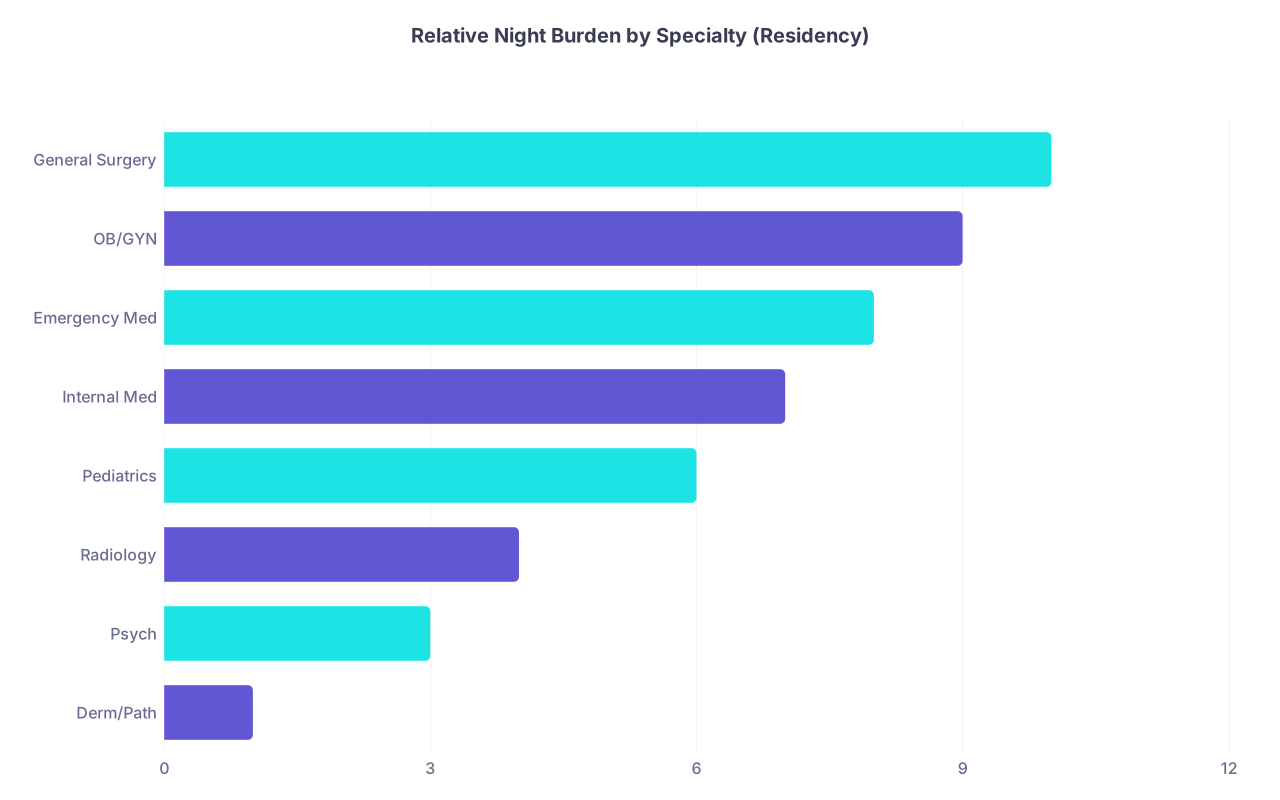
| Category | Value |
|---|---|
| Derm/Path | 1 |
| Psych | 3 |
| Radiology | 4 |
| Pediatrics | 6 |
| Internal Med | 7 |
| Emergency Med | 8 |
| OB/GYN | 9 |
| General Surgery | 10 |
Scale 1–10. Is it perfect? No. Is it roughly reflective of how residents describe their lives? Yeah.
How often does this actually ruin someone’s career?
More people than programs admit quietly adjust their path because of call and nights:
- Surgery → anesthesia/PM&R/rads after prelim year
- OB/GYN → psych or FM
- EM → outpatient IM or urgent care after residency, avoiding nights entirely
But it’s not like half of each class is fleeing. It’s more like a noticeable minority who realize: “I can do this, but it’s eroding too much of me.”
That’s not failure. That’s course-correction.
You are allowed to prioritize not being destroyed by your job. Residency is finite, but your nervous system has to last another 40–50 years.
What you can do now so you’re not guessing
Two practical moves:
Ask brutally specific questions on interviews and rotations.
Not “How’s the lifestyle?” but:- “How many 24-hour calls does an intern actually take in a typical month?”
- “What’s your night float schedule? Consecutive nights? For how many weeks?”
- “Do residents usually get to sleep on call? Realistically, how many hours?”
- “What percentage of graduates go into jobs with heavy in-house call vs outpatient/clinic-heavy?”
Pay attention to how your body reacts during your current night experiences.
Step back from the “I must be hardcore” mindset. Ask:- Did you feel dangerous behind the wheel post-call?
- Did a week of nights tank your mood into the floor?
- Did you start resenting medicine itself, not just the schedule?
If every night block leaves you thinking “I hate my life,” that’s data. Don’t throw it away because you feel weak or dramatic.

| Step | Description |
|---|---|
| Step 1 | Know nights wreck you? |
| Step 2 | Prioritize low call fields like derm, path |
| Step 3 | Track reactions on current nights |
| Step 4 | Adjust specialty rank list |
| Step 5 | Consider broader range including surg, EM |
| Step 6 | Yes |
| Step 7 | Not sure |
| Step 8 | Tolerate nights |
FAQs
1. What if I love a high-call specialty but I’m terrified I’ll burn out?
Then you do a brutally honest risk–benefit analysis instead of fantasy-planning. Ask yourself: if you end up exhausted, crying in your car sometimes, but you love the cases and patients, is that a trade you’d accept for a few years? Some people say yes and mean it. Others realize they’re romanticizing and would actually rather be a little less “hardcore” and a lot more stable. There’s no prize for suffering the most.
2. Do call schedules get better after residency?
Usually. But not automatically. Surgery, OB, EM, anesthesia, and hospitalist jobs can still involve nights and weekends for many years, depending on the practice. Outpatient-heavy fields (derm, psych outpatient, some IM subspecialties, allergy, rheum) are far likelier to have minimal nights. You can often shape your attending life toward fewer nights, but you can’t magically erase them from every job market.
3. Is choosing a specialty mainly for lifestyle “wrong”?
No. Choosing a specialty only because someone said it’s “chill” without caring about the work is a bad idea. But factoring in your mental health, sleep, and relationships is not shallow. It’s self-preservation. The people who smugly say “just pick what you love, lifestyle doesn’t matter” either have unusual resilience, short memories, or a stay-at-home partner absorbing 90% of real-life logistics.
4. How can I tell if I’m just scared vs actually not built for nights?
Look at evidence, not vibes. Think about times you were sleep-deprived: exam cramming, overnight shifts, long flights. Did you recover quickly or were you wrecked for days? Do you become emotionally unstable on little sleep, or just cranky? Can you function with 5–6 hours for a few nights, or do you fully crash? Past patterns won’t predict perfectly, but they’re more honest than “future me will be stronger” fantasies.
5. What if I pick a specialty and then realize the call is killing me?
You are not locked in a burning building. People change plans. You can talk to your program director about modifying rotations, seeking support, or even transferring specialties. You can aim for fellowships and jobs that minimize nights. Worst case, you finish and then deliberately choose a cushier attending job. The fear that “one wrong choice ruins everything forever” is loud in your head, but reality has more exits than you think.
Open a note on your phone right now and write this at the top: “What kind of nights can I realistically live with?” Under it, list three specialties that feel possible given that answer—not your dream PR version, but the honest one. Use that as your filter going forward, not whatever random hierarchy your classmates are panicking about.