
It’s late. You’re on your couch, laptop open to FREIDA, 17 tabs of program websites, a text from your mom saying “I always saw you as a pediatrician ❤️,” and your advisor’s email literally saying “Have you considered Med‑Peds?”
Your brain is doing that awful ping‑pong thing:
“I love kids.” “But I also like complex adult medicine.” “But I don’t want to give up OB.” “But what if I hate clinic?” “But what if I pick wrong and I’m miserable for the rest of my life?”
You’re scrolling Reddit threads about “Do I regret Med‑Peds?” and “Is Family Medicine dying?” and “Peds market is terrible,” as if some random anonymous PGY‑2 is going to hand you certainty.
Let me be blunt: you’re not confused because you’re clueless. You’re confused because these three specialties genuinely overlap and the internet is a mess of half‑truths and worst‑case stories.
So let’s go through this like someone who’s actually heard all the panicked MS4 hallway conversations, watched people switch, and watched others stay stuck because they were too scared to choose.
First: No, You’re Not Ruining Your Life
Before we dissect Peds vs FM vs Med‑Peds, you need this upfront reality check:
You are not picking between “happy, meaningful life” and “eternal regret.”
You’re picking between three good options with different flavors of pain and joy.
Also true:
There are ways to land in a job you hate. Usually because people lied to themselves about what they actually enjoy day‑to‑day.
So your job right now isn’t to find “the perfect specialty” (that doesn’t exist).
It’s to be brutally honest about:
- What kind of patient mix actually gives you energy, not just what sounds noble
- What pace and complexity your brain likes
- What you’re willing to give up
The giving up part is what’s making you anxious. Because every choice means losing something.
Core Identities: What Each Specialty Is Really Built For
Forget the brochure language. Let’s talk about what these actually feel like.
Pediatrics: “I want to live in kid world”
Peds residency is basically: you live and breathe kids. Newborns, toddlers, teens, the whole developmental spectrum.
You’ll still get adolescent medicine, chronic disease, NICU time, PICU time, enough complexity to keep you on your toes. It’s not “easy” medicine. But the center of gravity is clear: children and teens.
After residency, most general pediatric jobs are outpatient clinic with:
- Preventive care and vaccines
- Development, behavior, school issues
- Asthma, obesity, ADHD, mental health, chronic kid stuff
- Parenting guidance (and sometimes parenting therapy, let’s be honest)
Adults will not be part of your practice. At all. If you love the idea of being the “kid doctor” and you don’t mind handing parents off to other people, that’s normal. That’s literally what pediatrics is.
The anxiety trap:
“What if I miss adult medicine? What if I get bored? What if the market for peds is terrible where I want to live?”
I’ve seen people go Peds who realized they actually loved adult chronic disease management more. They struggled. Some did extra training (like adolescent med or PICU) to scratch that complexity itch. Some wished they’d chosen Med‑Peds.
I’ve also seen people in FM who clearly belonged in Peds. You know them: they light up with toddlers and look mildly dead inside when doing Medicare wellness visits.
Family Medicine: “I want to do everything…ish”
Family Med includes kids and adults, sometimes OB, sometimes procedures, sometimes inpatient, sometimes all clinic. But the core identity is continuity across ages, often with entire families.
You might see:
- A pregnant mom in the morning, her newborn in the afternoon, and her 70‑year‑old dad the next day
- Chronic disease: diabetes, HTN, COPD, obesity, chronic pain
- Behavioral health, depression, anxiety
- Some kids, but less complex pediatric pathology than Peds or Med‑Peds in many settings
Reality you won’t see on glossy brochures: a lot of FM in the US has trended toward heavy adult chronic disease, 15‑minute visits, productivity pressure. You can carve out heavy peds or OB or procedural niches, but you have to be intentional and often pick practice settings that explicitly support that.
The anxiety trap:
“What if I think I’ll do OB/peds but end up in a job that’s 90% diabetes and statins and I resent my life?”
That can happen. Especially in large systems where business‑minded administrators just want more RVUs and fewer hospitalizations. I’ve seen FM grads who wanted robust OB completely shut out of L&D in certain markets.
But I’ve also seen FM attendings who have dream lives: heavy OB in rural settings, or mostly peds in a community clinic, or full‑scope FM with procedures and inpatient.
FM is flexible. Flexibility is good. But also chaotic if you don’t know how to protect what you care about.
Med‑Peds: “I want maximum medical complexity & both age groups”
Med‑Peds is a 4‑year combined residency in Internal Medicine and Pediatrics. You graduate board‑eligible in both.
The feel of Med‑Peds in training:
- Half your life is like IM residency: older adults, complex chronic disease, ICU, hospitalist blocks
- Half is like Peds: NICU/PICU, wards, clinic with kids, adolescents, kids with special healthcare needs
- Very little OB
- Stronger emphasis on complexity, transitions of care, multi‑morbid patients, especially those with childhood‑onset conditions that persist into adulthood (CF, congenital heart disease, sickle cell, etc.)
Post‑residency, Med‑Peds docs most commonly:
- Do primary care for both adults and kids, with a heavier load of complex patients
- Work as hospitalists (adult, peds, or both, depending on hospital)
- Do fellowships (cards, ID, heme/onc, etc. — adult, peds, or occasionally combined)
The anxiety trap:
“What if I’m too niche and can’t find a good job? What if I love OB and Med‑Peds kills that dream? What if I actually don’t like the hospital as much as I thought?”
Most Med‑Peds grads don’t have trouble finding jobs. But the type of job in some markets might require more negotiation: some places don’t fully “get” Med‑Peds and will try to fit you into a mold (like “you’re our adult hospitalist who sometimes sees peds”).
If you’re obsessed with OB, Med‑Peds is the wrong choice. It just is.
The Big Question You’re Afraid to Answer
Here’s the ugly core of your anxiety:
You want to keep everything on the table. Kids, adults, maybe OB, some inpatient, hospitalist potential, continuity clinic, maybe procedures, maybe fellowship. You want optionality.
But residency is literally about narrowing and deepening.
So ask yourself a few painful but clarifying questions:
- If you had to give up OB forever, would you be okay?
- If you had to give up adults forever and only see kids, would you be okay?
- If you had to give up kids and only see adults with complex internal medicine, would you be okay?
- Do you enjoy thinking through long problem lists and complex physiology, or does that make you want to close the chart and cry?
- Did you like your inpatient rotations (IM and peds wards, ICU)? Or did you mostly like “finishing them and going home”?
Your honest answers point more strongly than any Reddit thread.
How These Three Actually Play Out Day‑to‑Day
Here’s the part no one tells you clearly enough: the average feel of each path in practice.
| Specialty | Usual Patient Mix | OB Involvement | Complexity Style |
|---|---|---|---|
| Pediatrics | Kids/teens only | None | Kid-specific, developmental, chronic pediatric |
| Family Med | Mostly adults, some kids | Variable by job | Breadth, less super-complex |
| Med-Peds | Mix of adults/kids, often complex | None | High complexity, both age groups |
If you choose Pediatrics
Your world becomes:
- Kid‑friendly offices, tiny blood pressures, growth charts everywhere
- Counseling worried parents, dealing with vaccine hesitancy, school forms
- Fewer med lists of 18+ drugs, more focus on development, genetics, congenital issues
- A very “team” culture, usually more touchy‑feely, which some people love and others quietly hate
The fear: “Will I be challenged enough?”
You will. Kids get sick. PICU and NICU are no joke. But if the idea of never managing heart failure, complicated renal failure, or multi‑morbid elderly patients makes you sad, that’s a signal.
If you choose Family Medicine
Your world might look like:
- 70–80% adults, 20–30% kids in many general FM clinics (varies, but that’s common)
- Managing diabetes, HTN, depression, chronic pain, preventive care, plus some kid visits
- Possible OB and deliveries if you choose a practice that allows and supports it
- A constant tug‑of‑war between what you want your practice to be and what your employer wants it to be (RVUs, short visits, limited OB, etc.)
The fear: “What if I thought I’d see a ton of kids and I end up seeing mostly 55‑year‑olds on statins?”
That’s a real risk. You’d have to intentionally seek jobs with a high pediatric volume or underserved populations with lots of young families.
If you choose Med‑Peds
Your world in training:
- Switching back and forth between services: wards adult → wards peds → ICU adult → NICU → clinic, etc.
- Keeping up with two bodies of guidelines, two exam styles, two board certifications
- Often hanging with IM folks and Peds folks and feeling slightly like an outsider in both
Your world later on could be:
- A mixed panel: adults with diabetes/CKD/CHF, plus adults with congenital heart disease, plus kids with CF or complex genetics, plus “regular” kids
- Hospitalist work that allows both adult and peds coverage at some hospitals
- Stronger options for subspecialty if you care about that route
The fear: “Am I just doing double the work to be a ‘jack of all trades’ and master of none?”
Reality: Med‑Peds docs are usually extremely solid clinicians. But yes, you probably won’t be the hyper‑niche adult cardiologist or the super‑subspecialized neonatologist unless you pick a fellowship and commit.
The Job Market & “Will I Be Employable?” Panic
You’ve probably seen a lot of doomposts about:
- Peds jobs being saturated in desirable cities
- FM being “mid‑level replaceable”
- Med‑Peds being “too weird” for some systems
Here’s the unsugarcoated version:
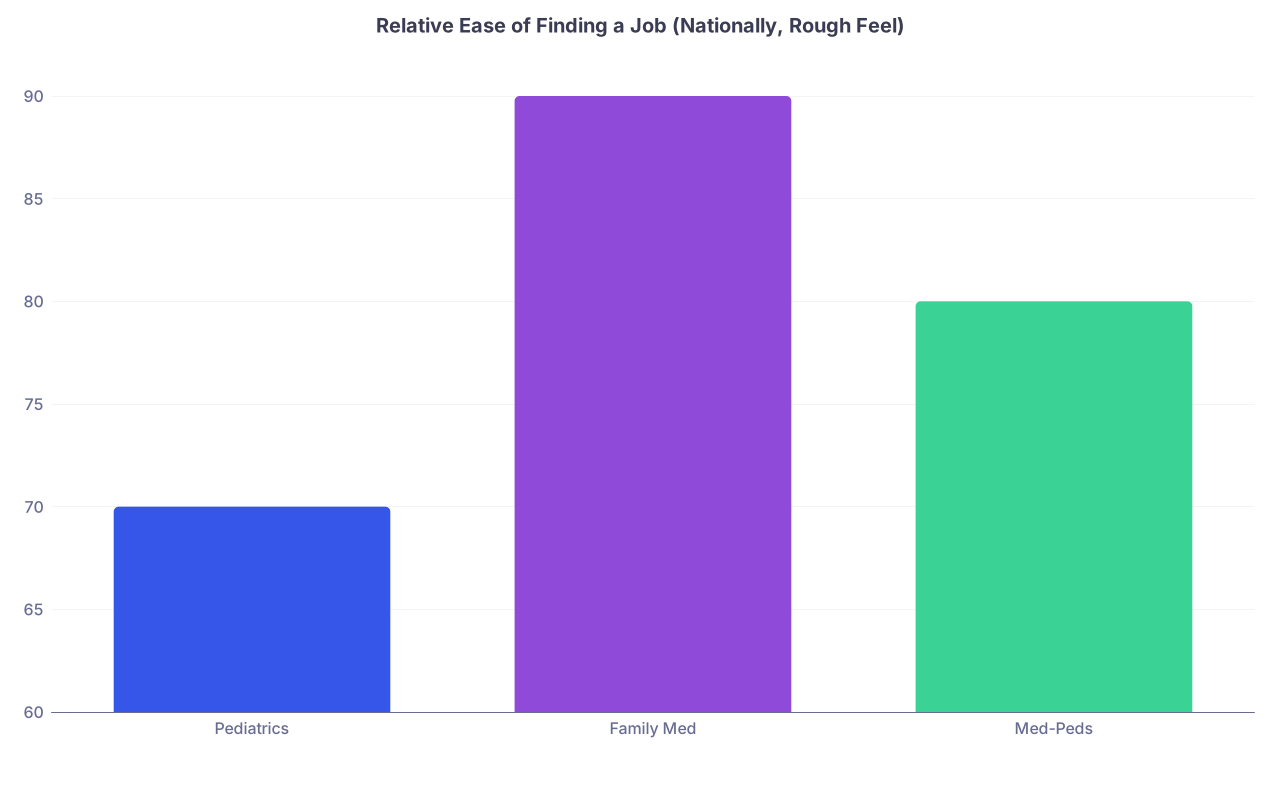
Pediatrics: Urban/suburban general peds spots can be tight, especially if you want part‑time, no weekends, high pay, in a coastal city. But people get jobs. Often, you may need to compromise on location, schedule, or salary if you want “cute clinic only” in a saturated city.
Family Medicine: Extremely employable. But that comes with a catch: you can absolutely land in a soul‑sucking job doing 20‑minute adult chronic care visits, endless inbox messages, and metrics pressure. The risk isn’t unemployment; it’s burning out in a high‑volume setting that doesn’t match your values.
Med‑Peds: You’re employable. Primary care shortages + hospitalist needs + complex care needs means systems generally find ways to use you. But you might have to advocate harder for the type of practice you want (“I want both adults and kids, not just adult hospitalist shifts forever”).
If your brain is screaming “I need to see numbers,” here’s a rough simplified feel:
| Category | Value |
|---|---|
| Pediatrics | 70 |
| Family Med | 90 |
| Med-Peds | 80 |
(Think of those numbers as “ease of finding a job,” not necessarily the exact job you fantasize about.)
What Actually Predicts Regret
I’ve watched this play out with real people. The ones who regret their choice often had one or more of these patterns:
- They chose FM telling themselves “I’ll do lots of OB and peds,” then took a generic outpatient job with zero OB and limited peds. They didn’t protect what they cared about.
- They chose Peds because “I love kids,” but actually they loved developmental stuff and identity formation and complex psychosocial medicine — and ended up craving adult psych/behavioral medicine variety.
- They chose Med‑Peds because they were terrified of closing doors and then realized: they don’t actually like hospital medicine or complex adult wards that much.
On the flip side, people who end up content usually:
- Are honest about what patient interactions leave them energized instead of drained
- Accept that they can’t do everything and grieve that loss early
- Pick a residency whose day‑to‑day life matches their temperament, not just their abstract interests
A Simple (But Brutally Honest) Mini‑Algorithm
Here’s a quick mental flow. Not perfect, but better than spiraling.

| Step | Description |
|---|---|
| Step 1 | Start |
| Step 2 | Leaning Family Med |
| Step 3 | Leaning Pediatrics |
| Step 4 | Leaning Med-Peds |
| Step 5 | Leaning Family Med |
| Step 6 | Reassess - maybe wrong three options |
| Step 7 | Need OB to be happy long term |
| Step 8 | Okay never seeing adults |
| Step 9 | Enjoy complex adult inpatient medicine |
| Step 10 | Prefer outpatient continuity and breadth |
Then ask yourself: did that “leaning” option feel like relief or like dread?
If you think “Ugh, but what if…” — that’s fine. But note which one you’d be most upset to lose.
How to Test Yourself Right Now (Even Late in the Game)
Even if you’re already in application season, you can still pressure‑test your gut.
- Look at your past rotations. Which days did you come home tired but satisfied? IM wards? Peds clinic? OB call?
- Think about your favorite patients. Not the ones that look good on your personal statement. The ones you still think about. Were they kids? Complicated adults? Pregnant patients? 20‑somethings with psych overlay?
- Imagine 5 clinic slots in a row:
- Slot 1: 4‑year‑old well‑child
- Slot 2: 16‑year‑old with depression
- Slot 3: 28‑year‑old prenatal visit
- Slot 4: 58‑year‑old with diabetes, CKD, CAD
- Slot 5: 32‑year‑old CF patient transitioning from peds to adult care
Which visits make you go “oh that’d be a fun half‑day” vs “please no”?
If the thought of never seeing a 4‑year‑old well‑child again makes you sad, that’s real.
If the thought of never managing adult complex pathophysiology again makes you more sad, that’s real too.
You’re not overreacting. These preferences matter more than Step scores and fellowship fantasies.
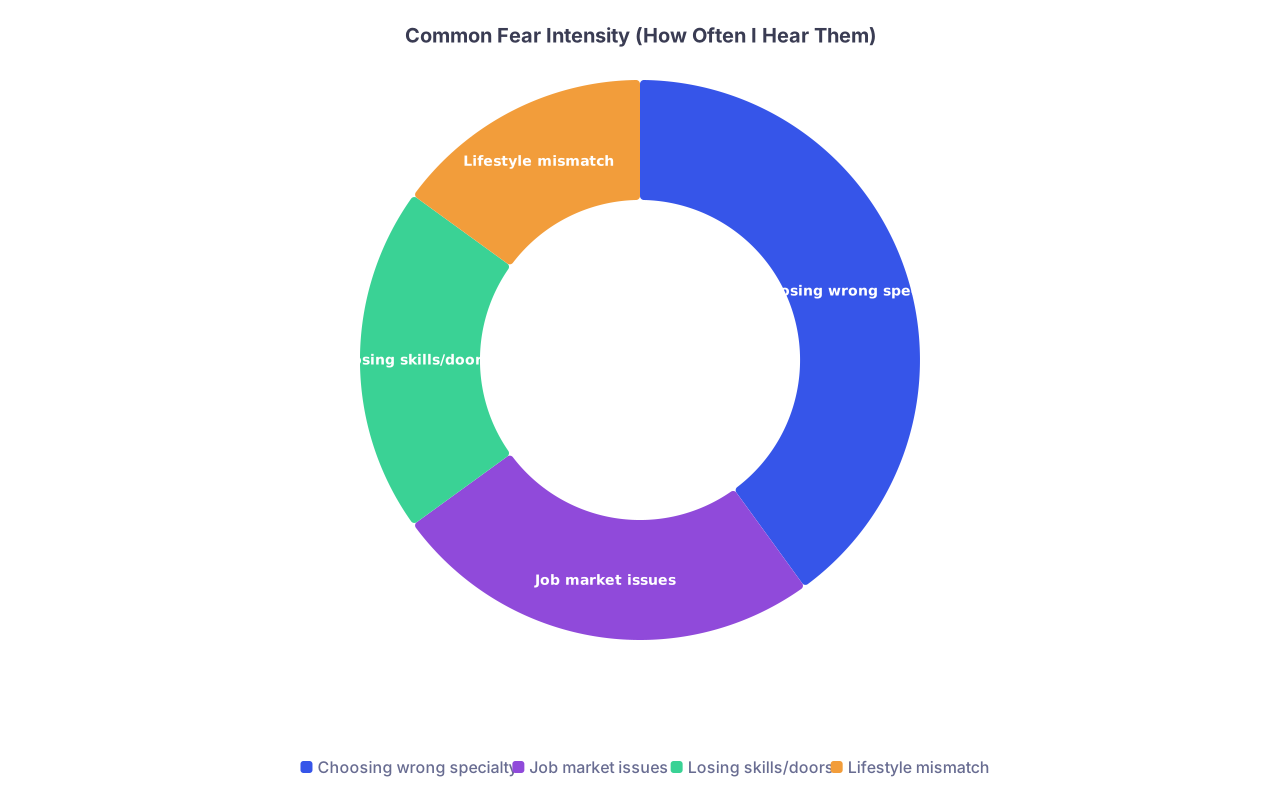
Quick Reality Checks for Specific Fears
Let’s hit a few big ones I hear all the time.
| Category | Value |
|---|---|
| Choosing wrong specialty | 40 |
| Job market issues | 25 |
| Losing skills/doors | 20 |
| Lifestyle mismatch | 15 |
“If I pick wrong, switching is impossible.”
Switching is painful, politically awkward, and sometimes financially rough. But it is not impossible. I’ve seen:
- Peds → Med‑Peds (restart)
- FM → Peds (rare, but it happens)
- Med‑Peds → straight IM or straight Peds tracks
You don’t want to rely on switching as your plan, but stop acting like this decision is a one‑time irreversible cosmic lock. It’s not.
“Med‑Peds is too niche, no one will know what to do with me.”
Some smaller hospitals won’t “get it” immediately, sure. But academic centers, large systems, and complex care clinics absolutely do. Med‑Peds is well‑established at this point.
You might have to explain your training slightly more often. That’s annoyance, not career death.
“FM is getting replaced by NPs/PEs; I’ll be obsolete.”
A lot of FM anxiety comes from admin and reimbursement nonsense, not from FM being clinically useless. Primary care is not disappearing. It is, however, being stretched and abused in some systems.
If you choose FM, you need to be extra intentional about job selection and boundaries. But there will be jobs.
“Peds is low‑paid, I’ll regret it financially.”
Peds does tend to pay less on average than FM or IM in many markets. That’s real. But you’re not going to starve. You can still pay your loans and live a normal physician life. If money is a top‑tier priority for you, you probably wouldn’t even be seriously considering peds.
A Few Very Human Scenarios
Just to ground this in reality:
MS4 A: Loved IM wards, loved peds wards, didn’t care about OB, got genuinely excited by complicated physiology. Went Med‑Peds. Now a Med‑Peds hospitalist doing both adult and peds; tired but very happy.
MS4 B: Loved kids, hated adult medicine clinics, but chose FM because they were scared of “narrowing” too soon. Ended up in a job seeing 80% adults, 20% kids, no OB. Three years later, burned out and actively trying to switch more toward pediatric urgent care.
MS4 C: Liked both kids and adults, but absolutely loved being in L&D and prenatal care. Chose FM deliberately with heavy OB‑focused residency. Now doing full‑scope FM with OB in a rural area, delivering babies, seeing their kids, and their grandparents. Very tired, but feels like life makes sense.
Those aren’t hypotheticals. I’ve watched versions of these people.
Where You Go From Here
You don’t need a perfect 10‑year plan. You do need enough self‑honesty to say:
- “I could be happy in more than one of these, but I’d be most myself in ___.”
- “I’m willing to give up ___ to protect ___.”
If your brain is still screaming, do this:
- Write down: “If I secretly had to choose today with no one watching, I’d pick ___.”
- Notice your immediate reaction: relief, sadness, anger, panic. That reaction is data.
Then, build your rank list to reflect that priority. Yes, even if your mom wants you to be a pediatrician. Yes, even if your advisor thinks Med‑Peds is “overkill.”
You’re the one who has to live these clinic days. Not them.

FAQ (Exactly 5 Questions)
1. If I really, truly like both kids and adults equally, is Med‑Peds automatically the best choice?
Not automatically. Med‑Peds is best if you like both age ranges and the style of internal medicine and hospital‑level complexity. If you love outpatient continuity and maybe OB, FM may still fit better. If you’re more emotionally drawn to kid and teen development and don’t care much about adults long‑term, straight Peds may still be right, even if you “like” adults.
2. Can I do a lot of pediatrics as a Family Medicine doctor?
Yes, but only if you deliberately structure your training and job toward that. That usually means an FM residency with strong peds exposure and then choosing a practice where there’s demand for kid visits (community clinics, underserved populations, certain group practices). If you take a generic suburban FM job, expect more adults than kids.
3. Does Med‑Peds really hurt my ability to get a fellowship compared to straight IM or Peds?
Generally, no. Med‑Peds grads match into competitive fellowships regularly (cards, heme/onc, ID, etc.). Program directors know Med‑Peds is rigorous training. You may even be more attractive for some fields that deal with transitions of care or congenital diseases. The bigger factor in fellowship is your performance, research, and letters—same as everyone else.
4. What if I pick Pediatrics and later miss adults, or pick FM and later miss complex kids?
There are ways to shift your practice focus, but it’s harder to fully cross back. A Peds doc missing adults might gravitate toward adolescent medicine, complex peds, or work settings that feel more “medicine‑heavy.” An FM doc missing kids might look for clinics with lots of young families or urgent care shifts heavy in pediatric cases. You can’t fully erase the boundaries, but you can angle your practice.
5. Is it a red flag that I’m this anxious about choosing? Does that mean none of these are right?
No. It means you actually care and you understand that this choice has consequences. Most thoughtful people get spun up about this. The red flag isn’t anxiety; it’s ignoring what your gut has been quietly saying for years. If all three are truly plausible, you’re not on the verge of a disaster—you're choosing between three viable, slightly different flavors of “good enough.” Pick the one you’d be most sad to lose, and move forward.
Key takeaways, so you can close the laptop:
- You’re not choosing between “right” and “ruined”; you’re choosing which trade‑offs you’re willing to live with.
- Peds = kids only, FM = breadth with adults dominating many jobs, Med‑Peds = both ages with high complexity and no OB.
- Protect what you actually love in your day‑to‑day, not what sounds impressive or keeps the most theoretical doors open.