
You’re on call in the peds workroom at 2:15 a.m., halfway through another bronchiolitis admission, and it hits you — this isn’t where you want to spend your career. You don’t hate it. But you’re not energized by it either. You keep finding yourself reading UpToDate on adult CHF and diabetes instead of Kawasaki. Or you’re realizing you like continuity and systems more than sick kids.
And now the real question:
Can you actually switch from pediatrics to internal medicine (IM) or family medicine (FM) during residency — and what does that process really look like?
Here’s the straight answer: yes, you can switch from peds to IM or FM. People do it every year. But it’s not a simple “flip a form and transfer your year” situation. It’s paperwork, timing, politics, and risk. Done right, it’s survivable and often absolutely the right move. Done carelessly, it can leave you without a spot or scrambling.
Let’s walk through the practical realities.
1. Big Picture: Is Switching from Peds to IM/FM Actually Possible?
Short version: Yes, it’s possible. It’s also relatively common compared to people switching between highly competitive subspecialty tracks.
You’re in a better position than someone trying to go:
- From pathology to derm
- Or from peds to neurosurgery
Why? Because:
- IM and FM are generally more flexible and have more spots nationally.
- Your peds training overlaps a lot with IM/FM in structure: wards, clinic, continuity, systems, on-call, multi-disciplinary care.
- Program directors (PDs) for IM and FM understand that people’s interests evolve during training.
But you need to understand 3 hard truths:
There’s no automatic “credit transfer.” ACGME doesn’t run this like college credits. Each new PD decides how much of your peds time counts toward IM or FM training.
There is real risk of a gap. You may end up with time between programs (unmatched year, research, prelim time, etc.) if you don’t plan carefully.
Your current PD’s support matters a lot. A positive letter from your peds PD opens doors. A hostile PD makes your life much harder (but doesn’t make it impossible).
If you’re reading this during PGY-1, you’re early enough that your options are wide open. PGY-2? Still doable, but more logistics. PGY-3? You’re basically starting another residency — possible, but you need to know what you’re signing up for.
2. How Training Credit Works: What Carries Over from Peds?
Let’s tackle the “will my year count?” question, because everyone gets this wrong.
There’s no universal rule like “1 year of peds = 1 year of IM.” What actually happens:
- The receiving program director (IM or FM) reviews your previous training.
- They may consult their GME office and sometimes their RRC / ACGME guidelines.
- They decide how much credit they’ll give you toward their program graduation.
Typical patterns:
Going from Peds → IM
- Many IM programs will give up to 1 year of credit if your rotations were broad and well-documented.
- If you switch early PGY-1, expect to repeat most of year 1.
- If you switch after PGY-2 or PGY-3, you might get 1–2 years of partial credit, but most people still end up doing at least 2 full years of IM.
Going from Peds → FM
- FM is often more flexible — I’ve seen PDs grant 1 full year of credit pretty routinely and occasionally more, depending on your rotation mix (especially if you had NICU, newborn, outpatient, ED, some OB exposure).
- You’ll still need to meet FM-specific requirements: adult inpatient, maternity care, behavioral health, geriatrics, etc.
The key:
You should assume you’ll “lose” at least 6–12 months of training time. If the new PD gives you more credit, that’s a bonus.
| Original Training | New Specialty | Common Credit Range |
|---|---|---|
| Peds PGY-1 | IM | 0–12 months |
| Peds PGY-2 | IM | 6–18 months |
| Peds PGY-3 | IM | 12–24 months |
| Peds PGY-1 | FM | 6–12 months |
| Peds PGY-2–3 | FM | 12–24 months |
Bottom line: Switching is rarely a time-saver. It’s a career fix. If you’re hoping to switch and finish faster — that combo almost never happens.
3. Timing: When to Decide and When to Apply
This is where people get burned — they realize late and miss key windows.
Ideal timeline if you’re PGY-1
By late fall (Oct–Dec):
You’re noticing the misfit is persistent. Not just “I’m tired” but “this type of work doesn’t feel like mine.”By early winter (Dec–Jan):
Start discreet exploratory conversations:- Trusted faculty or mentors (maybe not your PD yet).
- IM or FM residents at your institution.
- College of Medicine advisors if local.
By winter–early spring (Jan–Mar):
You should:- Decide if you’re serious about switching.
- Talk to your PD (earlier is better if you want their support).
- Start reaching out to IM/FM PDs about off-cycle or PGY-2 spots.
Match vs off-cycle:
- You can re-enter the Match for IM/FM as a PGY-1 in peds.
- But often, people pick up off-cycle PGY-2 positions when someone resigns, transfers, or a program expands.
If you’re already PGY-2 or PGY-3
You have two main paths:
Cut now and switch:
- Look for immediate or next-year PGY-1/2 spots in IM/FM (off cycle or Match).
- Expect to redo at least 1 year.
Finish peds, then re-train:
- Complete peds, become board-eligible.
- Apply for IM or FM as a “second residency.”
- This can make sense if:
- You’re relatively close to finishing.
- Your current PD is not supportive and you’d rather graduate cleanly and then move.
Either way, you need to give yourself 6–12 months lead time before the start date you want.
4. Politics and People: Your PD, Letters, and Reputation
Let me be blunt: how you handle your relationship with your current PD can make or break this.
Step 1: Get clear personally before you go public
Before you say anything:
- List why you want IM or FM instead of peds.
- Be specific and honest:
- “I find myself more drawn to adult chronic disease and system-level management.”
- “I want full-spectrum + OB; FM fits that better.”
- “I realize I don’t want to subspecialize in peds; I’d rather manage a broader panel.”
Program directors hate vague “I’m not happy” with no direction. They’ll respect a thoughtful, clear story.
Step 2: Talk to your PD the right way
When you’re ready, schedule a meeting instead of dropping a bomb in the hallway.
Key points to hit:
Own your decision:
“I’ve been reflecting for months, talking to mentors, and I’m convinced my long-term fit is better in internal medicine / family medicine.”Avoid trashing peds or your program:
You can say it’s not the right fit for you without saying it’s a bad specialty.Ask for partnership, not permission:
“I’d really value your support in making a thoughtful transition — letters, guidance on timing, and constructive feedback on what I need to improve.”
Best-case scenario: they’re disappointed but mature; they help you find contacts, write a strong letter, and coordinate with GME.
Worst-case: they’re defensive, cold, or obstructive. If you get that vibe:
- Stay calm, professional, and document everything.
- Loop in:
- Your institution’s GME office.
- A trusted faculty mentor in another department.
- Possibly your dean’s office (if you’re at a big academic center).
Don’t start bad-mouthing your PD to everyone. That follows you.
(See also: How Residency Rank Meetings Actually Work Behind Closed Doors for more.)
5. The Mechanics: How You Actually Switch
Let’s talk nuts and bolts, because “just apply again” is vague and unhelpful.
Path A: Off-cycle transfer into IM or FM
This is the most common practical route.
How to do it:
Update your CV and personal statement to reflect:
- Your current training.
- Why you’re changing.
- What you’ve learned in peds that will make you a strong IM/FM resident.
Email program directors directly:
- Target IM and FM programs in regions you’d actually move to.
- Subject line example: “Current PGY-1 Pediatrics Resident Seeking PGY-2 IM Position – July 202X”
- Attach: CV, brief personal statement, and summary of rotations.
- Ask if they anticipate any upcoming PGY-2 openings (due to expansion, attrition, etc.).
Tap the hidden network:
- Ask your PD (if supportive) to reach out to PDs they know in IM/FM.
- Ask senior residents you trust if they know of programs losing a resident.
Interview like a normal applicant:
- You’ll be grilled on: “Why are you leaving peds?”
- Have a mature, non-dramatic answer that shows insight and growth, not chaos.
Once you have an offer:
- Coordinate start/end dates with both programs and GME.
- Confirm training credit in writing (email is fine, but be explicit).
Path B: Re-entering the Match (ERAS)
This is more structured but slower.
- Register for ERAS again.
- Build a new application that:
- Clearly explains your prior training and your switch.
- Has updated LORs: at least one from your peds PD, plus any IM/FM faculty you’ve worked with (even elective time helps).
- Apply broadly: community and academic; don’t be fancy.
- You’ll start as PGY-1 again unless the program explicitly agrees to give you advanced standing.
6. IM vs FM: Which Switch Makes More Sense from Peds?
Both IM and FM are realistic paths from peds. Which one fits depends on what you want your day-to-day to look like.
Think about IM if:
- You’re drawn to:
- Complex adult inpatient medicine
- ICU, subspecialty work, or hospitalist life
- You’d consider fellowship later:
- Cards, GI, pulm/crit, ID, heme/onc, etc.
- You don’t care about OB or full-spectrum outpatient peds.
Your peds skills that translate well:
- Comfort with physiology.
- Systems-based thinking.
- Communication with families — this actually helps a lot with complex adult families and goals-of-care talks.
Think about FM if:
- You want:
- Continuity with whole families, including kids.
- OB/maternity care.
- Procedures in a clinic/community setting.
- Versatility: outpatient-heavy, rural practice, urgent care, etc.
Your peds background is actually a massive asset in FM:
- You already know vaccine schedules, developmental milestones, and common childhood issues.
- Many FM programs will love that you bring strong peds comfort — that’s a known weak spot for some FM grads.
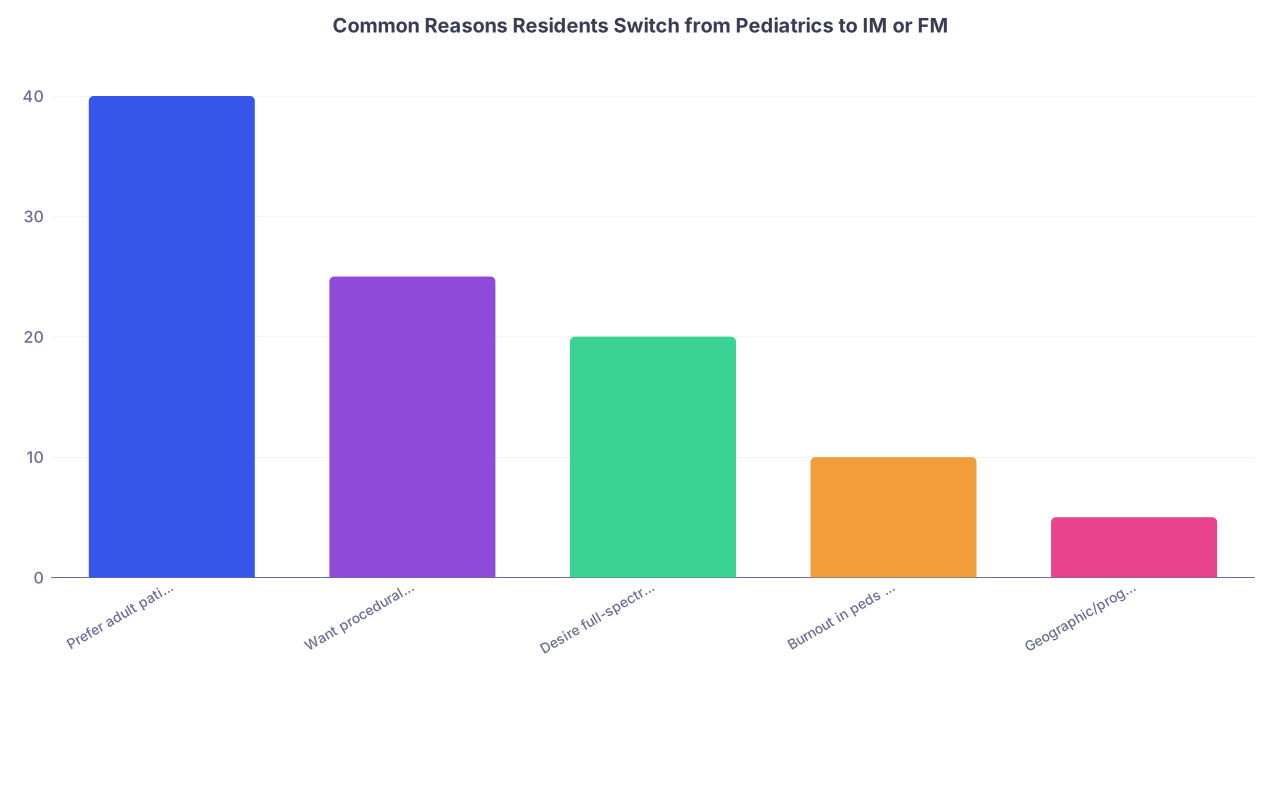
| Category | Value |
|---|---|
| Prefer adult patients | 40 |
| Want procedural/subspecialty options | 25 |
| Desire full-spectrum FM | 20 |
| Burnout in peds environment | 10 |
| Geographic/program issues | 5 |
(The numbers are illustrative, but that’s roughly the pattern I've seen.)
7. Financial and Emotional Realities: Not Just Paperwork
You need to be honest with yourself about the cost — not just the logistics.
Financial
- Extra years = extra salary delay.
Every extra year in training delays attending income by one year. That’s not small. - If you end up:
- Doing 1 year peds + 3 years IM
- Versus 3 years peds and done
You’ve added a full extra year of resident salary instead of attending salary. That’s easily a six-figure opportunity cost.
But here’s the counterpoint:
If you’re going to spend 30+ years in a specialty, an extra year or two to correct course is a rounding error compared to decades in the wrong career.
Emotional
- You will feel:
- Guilt about “abandoning” peds or your co-residents.
- Fear of program director backlash.
- Impostor syndrome in the new specialty.
None of that means you’re making the wrong choice. It means you’re human.
Switching is not a failure. It’s you taking responsibility for the actual career you want rather than passively drifting into the one you started at 24 years old.
8. Red Flags: When Switching Might Not Fix the Problem
One uncomfortable thing you need to check in yourself:
Are you switching because peds is wrong — or because residency is hard?
If any of this rings true:
- You’re constantly overwhelmed but can’t point to a specific mismatch with peds.
- You dislike call, notes, prior auths, and EHR — which are identical in IM and FM.
- You’re battling untreated depression, anxiety, or burnout.
Then switching specialties may change the wallpaper but not the house.
If you suspect this might be the case:
- Talk to a therapist, not just a mentor.
- Be brutally honest: would IM/FM actually be better? Or does every specialty sound equally bad right now?
Switching can be powerful, but it shouldn’t be used to outrun problems that will follow you anywhere.
9. Concrete Next Step: What You Should Do Today
Don’t “think about this more” in a vague way. Do something specific.
Here’s your next move — today:
Sit down and write two short paragraphs:
Why pediatrics is not the right long-term fit for you. Be specific: which aspects of the day-to-day work drain you, which patients or problems you don’t want to see for 30 years.
Why internal medicine or family medicine is a better fit. Again, specific: what kinds of patient stories, pathophysiology, continuity, or roles actually sound energizing.
If you can’t write those clearly, you’re not ready to talk to your PD or apply. If you can write them, send them (or the core ideas, cleaned up) to one trusted mentor and ask for a 30-minute call to sanity-check your thinking.
That’s how you turn “late-night doom scroll about switching specialties” into an actual, controlled transition plan.