
Combined neuro‑psych programs are brilliant for the right person and absolutely miserable for the wrong one. Most students over‑romanticize them and under‑analyze the reality: call structure, board exams, and the job market. Let me be blunt—those three things will decide whether this path feels like a dream or a trap.
You are not choosing a vibe. You are choosing specific schedules, exams, and employment lanes for the next decade. So let’s go through this like an adult, not like an M2 watching brain dissection videos on YouTube.
What “Combined Neuro‑Psych” Actually Means
“Combined” sounds unified. In practice, you are doing two residencies sewn together with some credit sharing. There is no magical third board in “Neuropsychiatry.” There are:
- Categorical Neurology (usually 4 years; 1 year prelim/IM + 3 years neuro)
- Categorical Psychiatry (4 years)
- Combined Neuro‑Psych (5 years total, accredited, with ABPN approval pathways)
The big combined programs (examples, not exhaustive):
- Brown Neuropsychiatry
- Columbia/Cornell Neuro‑Psych
- University of Pittsburgh
- Baylor
- UC Davis
- Medical University of South Carolina (MUSC)
- Others come and go, so you always check the current ERAS list
You still end up board‑eligible in both neurology and psychiatry through ABPN pathways. That sounds great on paper. The cost is time, complexity, and some identity chaos. Hold that thought; it matters for boards and career planning.
Call Structure: How Your Life Actually Feels
This is where people get blindsided. Combined programs are not gentle; they are just…different.
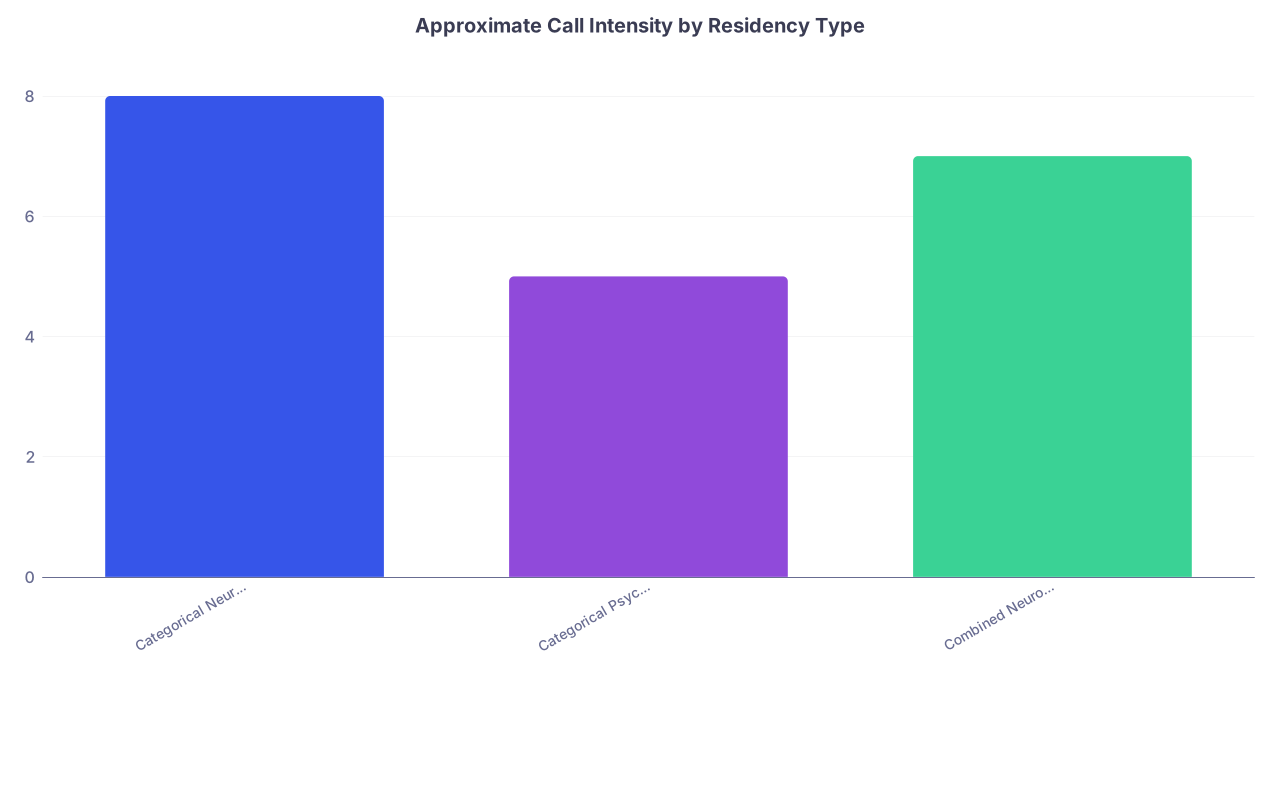
| Category | Value |
|---|---|
| Categorical Neurology | 8 |
| Categorical Psychiatry | 5 |
| Combined Neuro-Psych | 7 |
Scale: 1 = very light, 10 = brutal (think surgical prelim in 2005).
Combined programs typically land between pure neurology and pure psychiatry in total call burden, but more fragmented.
The Rotation Pattern
Typical structure over 5 years (schematic, varies by program):
- About 30 months Neurology
- About 30 months Psychiatry
- Sprinkle of electives and research in there
- Intern year often counts toward both sides (if structured correctly)
Your call depends heavily on current block:
- On neurology months → You are a neurology resident (stroke codes, status epilepticus, ICU consults).
- On psychiatry months → You are a psychiatry resident (ED psych consults, inpatient unit admissions, safety evaluations).
Nobody cares that you are “combined” at 2 a.m. The system uses you as whatever service you are on.
Common Call Models You Actually Face
Let me break it down by service type. This is where the lifestyle reality lives.
Neurology Call
Typical patterns I have seen in combined tracks:
- PGY‑1/2: Mostly in‑house night float or q4–q6 neurology call, depending on how malignant the place is.
- Code stroke coverage: You will answer stroke pages. CT at 3 a.m., tPA or thrombectomy calls, family counseling, NIHSS on patients who arrived 15 minutes ago and speak a language nobody in the room speaks.
Neurology on‑call responsibilities usually include:
- New admissions: acute stroke, GBS, meningitis/encephalitis, new seizure, myasthenic crises.
- Cross‑cover: ventilated ICU neuro patients, long lists of complex inpatients with 5 subspecialty attendings.
- Consults: ICU “altered mental status,” medicine floor “confusion,” trauma “possible spinal cord,” ED “weakness.”
At many combined programs, you will:
- Take essentially the same neuro call burden as categorical neurology.
- Or only slightly reduced (e.g., 75–80% of what categorical neurology residents do).
No free lunch. If a program says “our combined residents have much lighter call than categorical neuro,” you ask very specific questions. Because something is being offloaded on you somewhere else.
Psychiatry Call
Psychiatry call looks and feels very different:
- Night psych consults: suicidal ideation evaluation, psychosis, agitation, restraints decisions.
- Inpatient: admission H&P, meds, capacity evaluations, legal paperwork.
- Cross‑cover: multiple inpatient psych units, plus ED psych boards.
Psych call is:
- More cognitive/behavioral, less procedures.
- High emotional intensity; you might spend 3 hours with one patient.
- More tied to safety, law, and documentation than neurology.
Combined residents usually:
- Take comparable psych call to categorical residents on the same year level.
- Sometimes get slightly fewer total psych nights over 5 years, but not dramatically.
So across five years, your brain and circadian rhythm are constantly flipping between neurology nights and psychiatry nights. That mental context switching is something most M4s underestimate.
How A Real Month Might Look
Here is a composite of what a PGY‑3 combined neuro‑psych month at a reasonably busy academic center might feel like:
Week example:
- Monday–Friday days: Inpatient neurology consults
- Two nights that week: 5 p.m.–7 a.m. neurology night float
- One weekend: 24‑hour psych ED call (Saturday), post‑call Sunday
You spend Monday night handling stroke alerts, seizures, ICU patients. Four days later, you are deciding whether a patient meets criteria for involuntary admission and writing court paperwork.
Is it doable? Yes. Plenty of residents finish and function well. But you must actually like both styles of clinical work under pressure, at night, with very little hand‑holding.
How Combined Call Compares to Categorical Programs
Let’s put them side by side.
| Feature | Categorical Neuro | Categorical Psych | Combined Neuro‑Psych |
|---|---|---|---|
| Total years | 4 | 4 | 5 |
| Night intensity | High | Moderate | High‑Moderate |
| Stroke/ICU nights | Many | None | Many |
| ED psych consult nights | None | Many | Many |
| Fragmentation of roles | Low | Low | High |
The key trade‑off: combined training does not massively reduce your exposure to hard neurology call. It adds psychiatry nights on top of that, while stretching the whole experience over five years.
You get longer training and more cognitive switching, not a magically cushioned lifestyle.
Boards: You Are Signing Up for Two
If you do a combined neuro‑psych residency, you are not escaping anything. You are doubling it.
You will deal with:
- USMLE Step/COMLEX (obviously)
- Neurology board certification (ABPN Neurology)
- Psychiatry board certification (ABPN Psychiatry)
Same board (ABPN), different certification pathways.
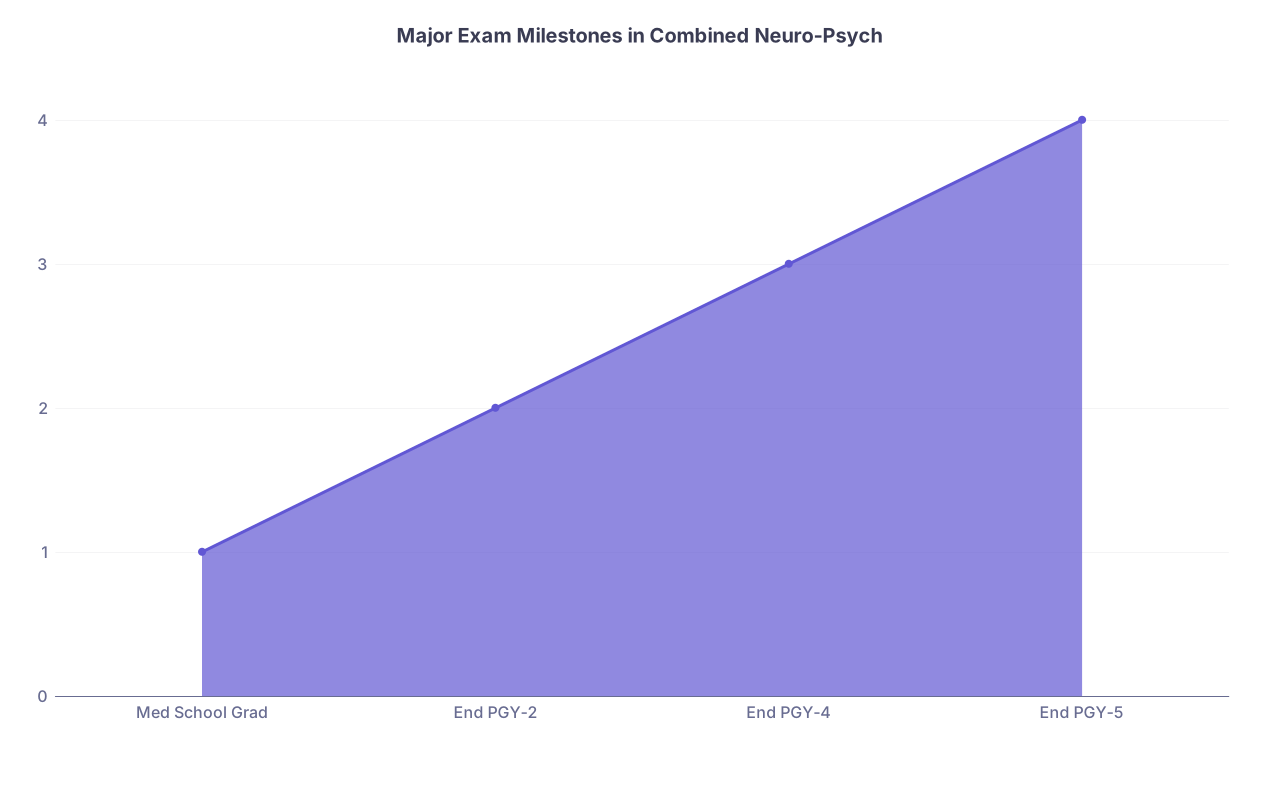
| Category | Value |
|---|---|
| Med School Grad | 1 |
| End PGY-2 | 2 |
| End PGY-4 | 3 |
| End PGY-5 | 4 |
Scale: 1 = just taking Step 3, 4 = both specialties board‑eligible.
Timeline Reality
Rough sketch for a typical combined program:
PGY‑1: Internship. Study for and pass Step 3 if not already done.
PGY‑2–4: Heavy service time in both neurology and psychiatry. Your “other specialty” will always feel slightly rusty.
PGY‑5: Higher‑level rotations, electives, maybe chief duties. You are also trying to:
- Apply for jobs or fellowships.
- Prepare for two separate board exams, usually taken within a 1–3 year window after finishing.
Most combined grads end up:
- Taking one board exam soon after residency (often psychiatry first, sometimes neurology, depends on what they are practicing more heavily out of the gate).
- Then taking the other after a year of practice or fellowship.
Board fatigue is real. You do not want to be doing this in a chaotic first attending year without a study plan.
Exam Content vs Training: The Rust Problem
Your training time in each field is not continuous. That matters.
Example:
- You do 8–12 months of neurology upfront (stroke, general neuro, ICU).
- You swing into 10–12 months of psychiatry (inpatient, consults, outpatient).
- You come back to neuro a year later and suddenly need to remember fine‑grained EEG patterns, neuromuscular junction disorders, neuroimmunology.
Same on the psych side:
- You might do a lot of inpatient psych early.
- Then you get stuck in neuro land for a while.
- You reappear in outpatient psych and feel rusty with therapy frameworks and obscure DSM‑5‑TR specifiers.
Boards do not care about your rotation schedule. They expect full‑scope, categorical‑equivalent knowledge.
So you have to maintain two knowledge trees in parallel:
- Neurology: stroke, epilepsy, movement, neuromuscular, neuroimmunology, neuro‑oncology, headache, dementia.
- Psychiatry: mood, psychosis, anxiety, substance use, child, geriatric, forensics, consultation‑liaison, psychotherapy basics, cultural psychiatry.
If you are the kind of person who needs forced structure to keep up, you will need to design that structure yourself: yearly question banks for both, regular reading in both, not just cramming in PGY‑5.
Fellowship Options: Does Combined Open or Close Doors?
Combined programs do not block you from fellowships. But your choices and branding matter.
Common paths I have seen from combined grads:
- Neurology fellowships:
- Epilepsy/EEG
- Neurocritical care
- Movement disorders
- Behavioral neurology/dementia
- Neuroimmunology (MS, NMOSD, etc.)
- Psychiatry fellowships:
- Consultation‑liaison psychiatry
- Addiction psychiatry
- Geriatric psychiatry
- Forensic psychiatry
- Child & adolescent (less common but doable)
And the specifically “bridging” ones:
- Behavioral neurology and neuropsychiatry (BNNP)
- Psychosomatic medicine (now consultation‑liaison psychiatry)
- Some research tracks in cognitive neuroscience, translational neuropsychiatry
If you sell your combined training correctly, you are very attractive to:
- BNNP programs
- CL psychiatry programs at major academic centers
- Research groups doing mood disorders, psychosis, cognition, neuroimaging, etc.
If you do it wrong—no clear focus, no depth—you become “that combined person who is okay at both, expert in neither.”
Job Market: Where Combined Neuro‑Psych Actually Pays Off
Here is the part almost nobody explains concretely. Let me.
Overall market:
- Neurology: High demand, especially stroke, general neuro, community practices. Lifestyle variable; call is heavy in many places.
- Psychiatry: Extremely high demand almost everywhere. Outpatient psych jobs are everywhere with better pay and better lifestyle than almost any other cognitive field.
You will be dual‑eligible. That does not mean employers automatically understand how to use you.
| Practice Type | Fit for Combined Grad | Comment |
|---|---|---|
| Pure outpatient psychiatry | Excellent | Slight neuro skills underused |
| Pure outpatient neurology | Very good | Psych skills underused |
| Academic neuropsychiatry clinic | Ideal | Uses full training |
| Community hospital neuro only | Good | Marketable as neuro generalist |
| Inpatient psych unit only | Good | Boarded psychiatrist is enough |
| Neuroscience research center | Excellent | Dual background = asset |
Realistic Practice Patterns
Most combined neuro‑psych grads do one of three things:
Practice mostly psychiatry with a neuro‑flavor
Example: 80% outpatient psych, 20% “difficult neuropsychiatric cases” (PNES, functional disorders, psychosis in epilepsy, mood disorders after stroke, etc.).
Why? Because:
- Psychiatry has better flexibility and high demand.
- Easier to avoid nights/weekends.
- You can still bill well and be extremely in‑demand for complex cases.
Practice mostly neurology with a psych‑flavor
Example: General neuro job where you are the go‑to for FND (functional neurological disorder), non‑epileptic events, “mystery symptoms,” and mood/cognitive overlays.
Pros:
- You differentiate yourself in a crowded neuro market.
- Stroke or general neuro groups like having someone who is not terrified of SSRIs and antipsychotics.
Cons:
- You are back in heavier call environments.
- You may underuse your psychiatry board fully.
Full combined niche practice (true neuropsychiatry)
Usually at:
- Academic medical centers
- VA systems with neuropsychiatry clinics
- Brain injury, dementia, or epilepsy centers
- Movement disorders centers with heavy psychiatric comorbidity
You run clinics like:
- FND/PNES clinic
- Cognitive disorders with prominent behavioral disturbance
- TBI neuropsychiatry
- Epilepsy + psychiatric comorbidity
This is the idealized combined practice. It exists, but not in every city, and almost never in purely private practice settings without academic connection.
Geographic Flexibility: The Hidden Constraint
Being dual‑trained is useful. But neuropsychiatry‑style jobs are concentrated in:
- University hospitals
- VAs
- Large multi‑specialty systems
If your personal life requires:
- Living in a small town
- Being near a spouse’s non‑mobile career
- Returning to a specific geographic region with limited academic footprint
You will likely end up practicing mostly one specialty anyway. Usually psychiatry, because of demand and the ability to craft outpatient‑heavy jobs.
So ask yourself a harsh question now:
If I had to practice only neurology or only psychiatry for 30 years, which would I rather do?
If you do not have a clear answer, combined may sound attractive. In reality, it increases the odds you will be pulled toward psychiatry by market demand and lifestyle even if you loved neurology more in training.
Money and Lifestyle: What Changes With Combined Training?
Short version: You are adding an extra year of residency. That is a real financial cost.
Let’s do some simple comparisons on timing.
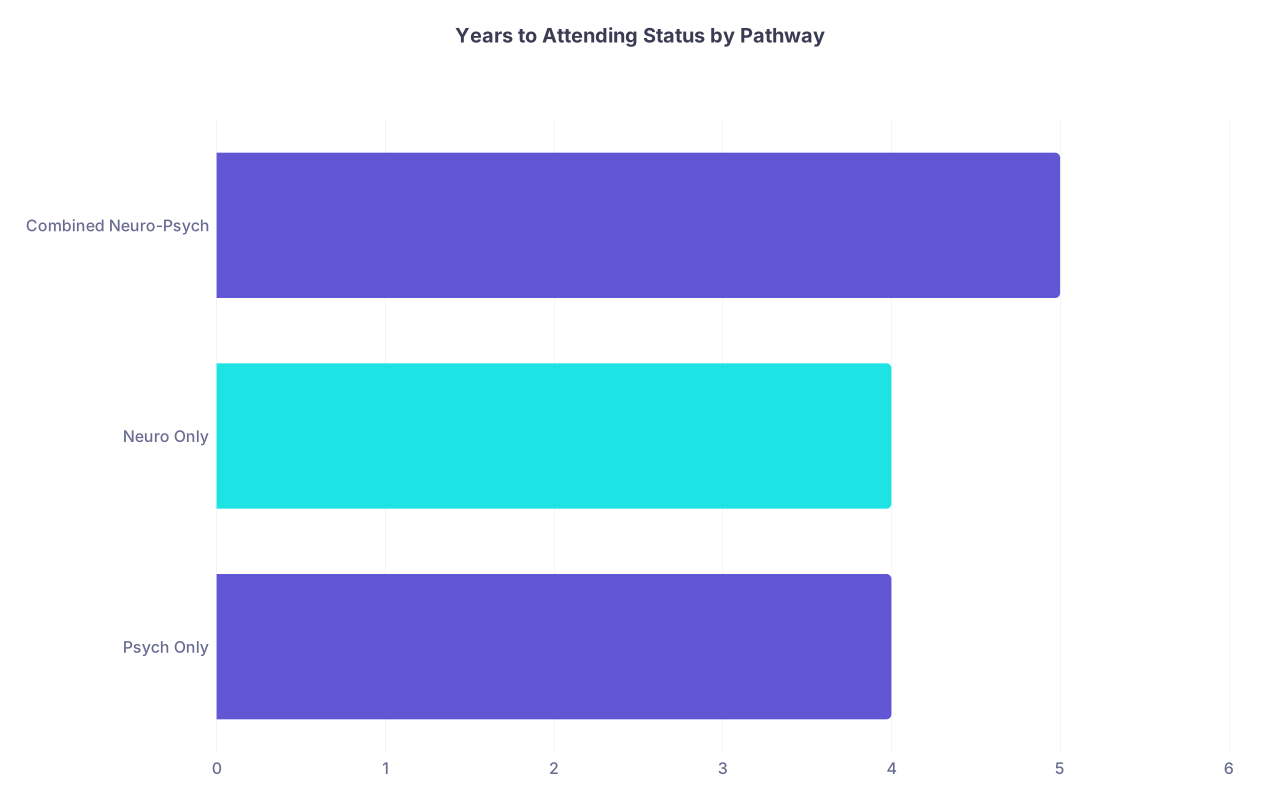
| Category | Value |
|---|---|
| Psych Only | 4 |
| Neuro Only | 4 |
| Combined Neuro-Psych | 5 |
Assume you would otherwise have chosen one specialty. You lose:
- 1 year of attending income
- 1 year of retirement contributions and investment compounding
- 1 year of ability to shape your own practice and location
Average psychiatry and neurology attending salaries (ballpark, vary by region/time):
- Psychiatry: ~ $270–350k+ depending on setting
- Neurology: ~ $260–350k+; stroke and procedure‑heavy roles may be higher
That extra residency year is easily a $300k+ opportunity cost, conservatively. If you end up practicing 95% psychiatry anyway, the math looks worse.
Lifestyle wise:
- During residency: Slightly longer training, high fragmentation, substantial call exposure.
- After residency:
- If you choose mostly psychiatry: You can have a very good lifestyle and may feel “overtrained but grateful.”
- If you choose mostly neurology: Lifestyle will depend entirely on local call structures and your subspecialty.
So the financial and lifestyle upside of combined training is not automatic. It is highly contingent on how you actually practice after graduation.
Who Combined Neuro‑Psych Is Actually Right For
Let me be very direct about this.
Combined neuro‑psych is a great fit if:
- You are genuinely fascinated by the interface: FND, PNES, dementia with behavioral issues, TBI, epilepsy + psychosis, movement disorders with mood disturbances, etc.
- You see yourself in an academic or large system environment long‑term.
- You are comfortable with high cognitive load and long training.
- You are willing to actively maintain competence in two distinct but overlapping knowledge domains.
- You can tolerate the idea of possibly practicing mostly one specialty anyway, but want that deeper dual framework.
Combined neuro‑psych is a bad idea if:
- You are mostly using it as a hedge because you cannot decide between neurology and psychiatry.
- You secretly dislike ICU settings, rapid decisions, or acute neurologic codes.
- You secretly dislike lengthy emotional encounters and complex psychosocial work.
- You are seeking an “easier” or lighter residency.
- You are strongly geographically constrained and aim for small community practice.
If you cannot imagine yourself doing stroke codes at 3 a.m. and suicide risk evaluations at 3 a.m. and not hating both, do not do a combined program.
How To Vet Individual Programs (Not All Are Equal)
You do not pick “combined neuro‑psych” generically. You pick a specific program with a specific institutional culture.

| Step | Description |
|---|---|
| Step 1 | Identify Programs |
| Step 2 | Review Curriculum |
| Step 3 | Ask About Call Structure |
| Step 4 | Talk to Current Residents |
| Step 5 | Clarify Board Pass Rates |
| Step 6 | Assess Job Outcomes |
| Step 7 | Decide Fit |
Concrete questions to ask on interviews:
Call:
- “How does neurology call differ for combined vs categorical residents?”
- “How many nights per month are typical on neurology? On psychiatry?”
- “Do combined residents ever have to cover both neuro and psych on the same night?”
Identity and support:
- “Who is your main mentor—neurology or psychiatry?” (Watch for confusion.)
- “Do you have dedicated neuropsychiatry clinics?”
- “Do combined residents feel like they belong in both departments, or neither?”
Boards and outcomes:
- “What are your neurology and psychiatry board pass rates for combined residents?”
- “What kinds of jobs have your last five graduates taken?”
- “Have any graduates struggled to get jobs in either field?”
The answers will tell you quickly whether the program sees you as an asset or a scheduling patch.
How To Prepare As a Student If You’re Serious
If you are leaning hard toward combined neuro‑psych, do something more disciplined than just vibing with the idea.
Do one strong neurology rotation and one strong psychiatry rotation at home.
- No shortcuts. Take the hardest inpatient neuro month you can tolerate.
- Take a real inpatient psych month with heavy consult or ED exposure.
If possible, do a dedicated neuropsychiatry elective.
- Movement disorders clinic with a focus on psych comorbidities.
- Epilepsy clinic with PNES.
- FND/neurobehavior outpatient.
Talk to at least two current combined residents.
Ask them what actually sucks. They will tell you:
- Being pulled to cover holes in both departments.
- Feeling behind compared to categorical co‑residents in either camp at certain times.
- The constant juggling of two service cultures, two email lists, two expectations.
If you hear that and still feel very drawn to it, you are probably a good fit.
Two Final Sanity Checks
Before ranking combined neuro‑psych programs high:
Ask yourself: “If combined residencies vanished tomorrow and I had to pick only neurology or only psychiatry, which would I honestly choose?”
If your answer toggles daily, you are probably masking indecision with complexity.
Picture your ideal week as an attending at age 40:
- Where do you work—academic center, VA, community hospital, private practice office?
- Are you taking neuro call? Running an inpatient psych service? Doing clinics only?
- What percentage of your time is neurology vs psychiatry vs research?
If you cannot sketch at least a plausible week that uses your combined training in a real job market, be cautious.
Key Takeaways
- Combined neuro‑psych gives you two real specialties, not a soft hybrid. That means heavier call variety, longer training, and double board obligations.
- The job market rewards combined grads who carve out a clear neuropsychiatric niche, usually in academic or large system settings; everyone else tends to drift into practicing mostly one specialty.
- It is a great path for people obsessed with brain‑mind interface work and comfortable with complexity, and a terrible path for anyone using it as a hedge because they cannot choose between neurology and psychiatry.