
You’re not “too sensitive” for pediatrics. You’re exactly the kind of person pediatrics tries very hard not to burn out.
Let me say the quiet part out loud: a lot of people who go into peds are very sensitive. That’s partly why they’re good at it. The fear you have — that you’ll be crying in every room, wrecked by every code, unable to function around sick kids — is way more nuanced than anyone tells you on those shiny residency program websites.
Let’s pull it apart properly, because the Instagram version of “peds = sunshine and stickers” is a straight-up lie. But so is the “peds will emotionally destroy you if you feel things deeply” myth.
What “Too Sensitive” Usually Means (And What It Doesn’t)
When people say “I’m too sensitive for pediatrics,” they usually mean one (or more) of these:
- “I get attached to patients and think about them after I leave.”
- “I cry easily or feel emotions very intensely.”
- “Bad outcomes haunt me for days, not minutes.”
- “I feel responsible for everyone’s pain.”
- “If a parent is upset with me, I’m wrecked.”
That’s not pathology. That’s actually… normal. Especially in peds.
Where it can become a problem is when sensitivity mixes with a few specific patterns:
- You can’t make decisions because you’re scared of causing discomfort.
- You’re so flooded with emotion that you freeze in emergencies.
- You can’t separate your self-worth from outcomes you don’t control.
- You never “turn off,” so you’re in emotional overdrive 24/7.
Notice the difference? Feeling deeply isn’t the issue. Getting stuck in feelings to the point of impairing your functioning — that’s where you need tools, not a different specialty.
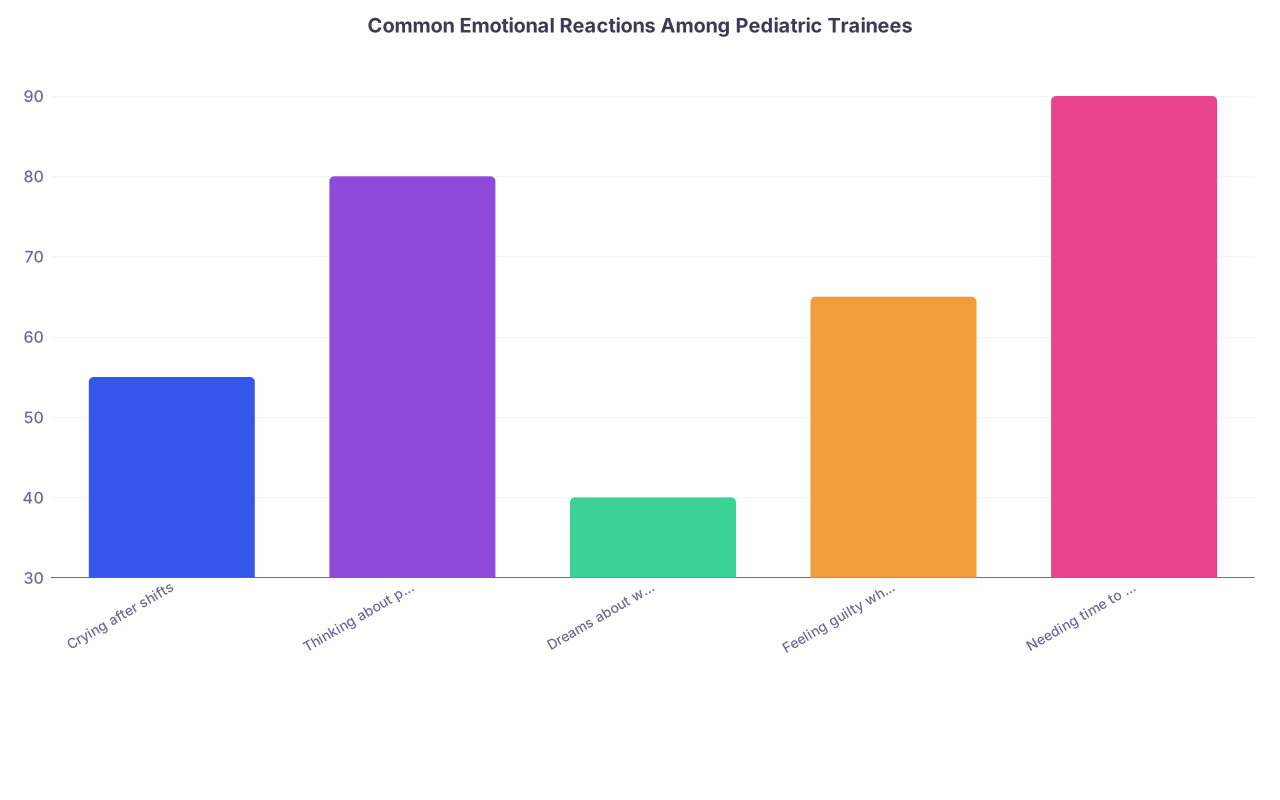
| Category | Value |
|---|---|
| Crying after shifts | 55 |
| Thinking about patients at home | 80 |
| Dreams about work | 40 |
| Feeling guilty when leaving | 65 |
| Needing time to decompress | 90 |
These percentages aren’t from a specific study; they’re roughly what I’ve seen in conversation after conversation with peds residents. You’re not the outlier you think you are.
The Real Emotional Demands of Pediatrics (Not the Brochure Version)
Let’s be honest about what can mess you up. Not to scare you — you’re already scared — but because knowing the terrain actually calms that buzzing “what if” brain a bit.
1. Chronic kids you don’t fix
The big lie: “Kids are resilient, they bounce back!”
The reality: On any peds rotation, you’ll meet children who won’t “get better” in the way you want.
- The ex-24-weeker with severe disabilities who’s in and out of the PICU.
- The oncology kid whose counts just won’t recover.
- The teen with cystic fibrosis who knows, better than most adults, exactly what their prognosis is.
If your internal script is “I must fix this, or I failed,” pediatrics will chew you up. Because you won’t “fix” most chronic children. You’ll improve, support, relieve, stabilize. You’ll rarely get the tidy movie ending.
Being sensitive here doesn’t hurt you. The all-or-nothing perfectionism does.
2. Parents who are drowning (and sometimes take you with them)
People love to say, “I could never deal with parents.” They mean:
- Parents who are terrified and asking question #17 after you already answered 16.
- Parents who are angry because the last doctor said something different.
- Parents who are grieving and taking it out on whoever walks in the door in a white coat.
If you’re sensitive, you’ll feel this like a punch. You’ll walk out wondering, “Did I ruin that interaction? Did I make it worse?”
Here’s the annoying truth: peds is as much about parents as kids. You’re managing family fear constantly.
But that’s also where being sensitive is an advantage. The least “sensitive” residents I’ve seen get defensive and authoritarian when parents are upset. The better ones feel the discomfort, don’t love it, but can stay curious instead of reactive.
3. “Small bodies, big emotions”
This is the one everyone is secretly scared of: codes and bad outcomes with tiny patients.
- The blue newborn who isn’t crying right away.
- The toddler in septic shock.
- The trauma you can’t unsee.
If you’re already picturing worst-case scenarios, of course your brain says, “Nope. Not safe. Run.” That’s what anxiety does — it shows you the hardest 1% of days, over and over, as if that’s every day.
The actual ratio? Most days are:
- Fevers
- Asthma
- New diabetes
- RSV
- Development questions
- Feeding issues
The really awful days happen, and yes, they stick with you. But they are not the majority.
What matters is not “Do I cry when a kid dies?” (most people do) but “Can I function during the crisis, and fall apart after in a safe place?” You can learn that. People do it all the time.

| Step | Description |
|---|---|
| Step 1 | Bad news or emergency |
| Step 2 | Initial emotional hit |
| Step 3 | Focus on tasks and team |
| Step 4 | Ask for help or step back briefly |
| Step 5 | Case ends |
| Step 6 | Debrief with team or mentor |
| Step 7 | Private processing - cry, journal, talk |
| Step 8 | Return next day with slightly more resilience |
| Step 9 | Can I still do the next step? |
That branch at E — “ask for help / step back” — is what “too sensitive” people are terrified they’ll need. But good teams expect that, and they function just fine with it.
(See also: What If I Like Both Kids and Adults? Anxiety Guide to Peds vs FM vs Med‑Peds for more details.)
How Sensitive People Actually Do in Pediatrics
Here’s the weird contradiction: the people most worried they’re too fragile for peds often turn out to be some of the most solid pediatricians.
Why?
They see kids as whole humans, not “cute cases”
The sensitive med student is the one who:
- Notices the teen who seems “fine” but hasn’t eaten much in days.
- Remembers the sibling in the corner who’s being ignored.
- Picks up the parent’s body language when they say “We’re okay” but look anything but.
You can teach protocols. You can’t easily teach this level of attunement. It’s the secret sauce.
They’re not desensitized, just better regulated (eventually)
You’re probably scared of “hardening” or becoming numb. Most peds people don’t. They get compartmentalized, not cold.
It looks like:
- Holding it together during the family meeting.
- Letting yourself have a 5-minute bathroom cry after.
- Going home, letting yourself feel sad, then still being able to eat dinner and watch TV.
That’s not being a robot. That’s emotional regulation, and it’s a learned skill, not a personality trait you either have or don’t.
They’re good at boundaries — or they’re forced to get good
Some of the most sensitive residents I’ve seen in peds came in:
- Answering MyChart messages at midnight.
- Obsessing over every lab result from home.
- Reading obits for former patients months later and spiraling.
Most of them didn’t quit. They hit a wall, then learned: “I ■actually■ have to draw a line.”
They got therapy. They found mentors. They stopped following old patients on social media. They built rituals: taking off the badge before leaving the hospital, listening to the same playlist on the drive home, doing a “mental sign-out” to themselves.
Sensitivity didn’t go away. The constant rawness did.

Concrete Red Flags vs Normal Worry
Let’s separate “I’m anxious and care a lot” from “I probably shouldn’t choose a career that keeps me this triggered all the time.”
Normal (even if uncomfortable):
- You cried on your pediatric rotation after a bad case.
- You think about certain patients years later.
- You dread telling families bad news, but you can still do it.
- You feel emotionally tired after a run of hard cases, but you recover with rest.
- You worry before starting peds that you’ll be overwhelmed.
Bigger red flags (worth taking very seriously):
- You dissociate or completely shut down during emergencies.
- You’re already having panic attacks on your pediatric rotation.
- You’re so triggered by any sick child that you can’t sleep or eat.
- You have unresolved personal trauma involving kids/hospitals that gets reactivated every time.
- You can’t be around crying or distressed kids without feeling overwhelmed, even in low-stakes situations.
Those don’t automatically mean “no peds ever,” but they do mean you shouldn’t white-knuckle your way through. You’d need:
- Honest conversations with a therapist.
- Trying shorter or outpatient peds experiences first.
- Very clear coping mechanisms and support.
If your brain right now is trying to put you in the “worst” category automatically — check it. Anxiety loves catastrophizing. But if some of those big red flags are actually true, that’s not failure; that’s data.
Trying Pediatrics Without Committing Your Entire Life
You don’t have to decide your existential emotional capacity right now from your couch. You can test this.
1. Look at your actual experiences, not just your fears
Think back to:
- Core peds clerkship
- Peds sub-I
- NICU/PICU elective
- Camp for kids with chronic illness
- Any time you’ve worked with kids long-term (tutoring, coaching, etc.)
Ask yourself:
- Did I function during harder moments?
- How long did it take me to reset afterward — hours? days? weeks?
- Did I feel drained and dreading the next shift, or tired-but-still-wanting-to-show-up?
Your brain will want to highlight the absolute worst shifts and pretend that was every day. Don’t let it.
| Question | What to Look For in Your Answer |
|---|---|
| How did I handle my sickest peds patient? | Could you still think and do tasks, even if emotional later? |
| How did I feel *before* peds shifts? | Dread vs nervous-but-also-meaningfully-drawn |
| How long did emotional cases stick with me? | Days and processable vs weeks with major impairment |
| Did I ever feel energized by peds days? | Any sense of “this is hard but right for me”? |
| How do I feel after adult vs peds patients? | Notice where you feel more “yourself” afterward |
2. Different flavors of peds have different emotional weights
If you hear “pediatrics” and immediately picture PICU codes and oncology deaths, your brain is skipping like 90% of the menu.
There’s:
- General inpatient peds
- Outpatient clinic
- NICU
- PICU
- Heme/Onc
- Adolescent medicine
- Developmental-behavioral
- Palliative care
- Emergency peds
- Hospitalist roles in community settings
Some are very high intensity for shorter stretches. Some are lower-intensity but emotionally slow-burn (e.g., long-term chronic kids). Some are mostly reassurance and vaccines and watching kids grow up.
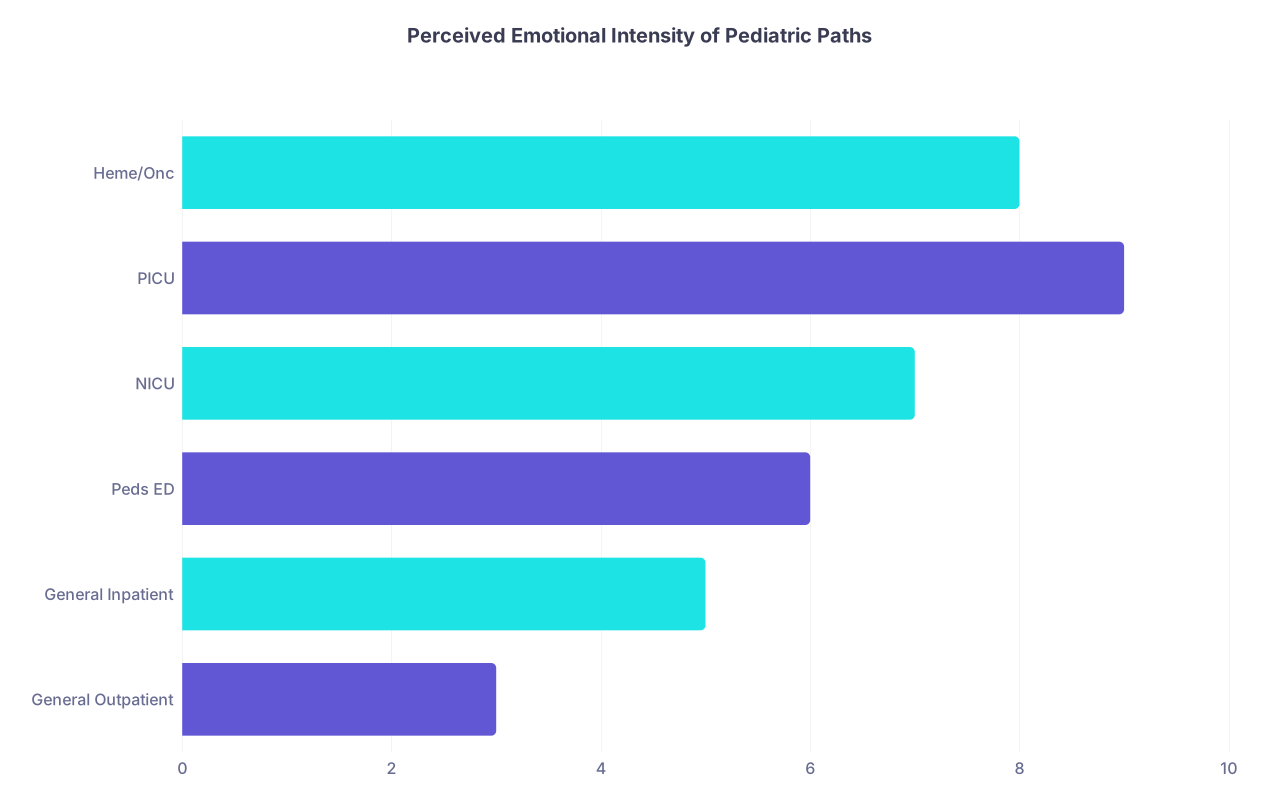
| Category | Value |
|---|---|
| General Outpatient | 3 |
| General Inpatient | 5 |
| Peds ED | 6 |
| NICU | 7 |
| PICU | 9 |
| Heme/Onc | 8 |
Scale 1–10, very rough, based on what trainees commonly report. Point is: if you’re not wired for the PICU, that doesn’t mean you’re not wired for peds.
(Related: Scared to Commit: How to Handle Indecision Between IM and Psych)
What You Can Do Now If You’re Still Freaked Out
1. Talk to the right people (not just the loud ones)
Find:
- A peds resident who is openly emotional/sensitive.
- A faculty member in peds who seems empathic, not hardened.
- Someone who has switched into or out of peds and will be blunt.
Ask them:
- “Did you ever worry you were too sensitive?”
- “What has actually been hardest emotionally?”
- “What do you wish you had known before choosing this?”
The stoic ICU person who “never thinks about patients at home” is not your reference point. They’re a data point, not the standard.
2. Do one more intentional experience
If you can, before locking in your rank list or specialty choice:
- Another peds elective (even outpatient).
- Shadow in a subspecialty you’re scared of (NICU, PICU, oncology) for a few days.
- Actually watch a goals-of-care conversation if you haven’t already.
You’re trying to gather data, not to “prove” you can muscle through everything. If you leave those days thinking, “That was brutal, but these are my people,” that’s meaningful.
If you leave thinking, “I’m already at my limit and it’s only day 2,” also meaningful.

3. Get proactive about your mental health, not reactive
If you suspect peds will hit your emotional buttons (it probably will), you don’t wait until PGY-2 collapse.
You can:
- Start therapy now and explicitly say “I’m considering pediatrics; I’m scared about the emotional load.”
- Learn basic grounding techniques for when you feel overwhelmed on the floor.
- Figure out: who would I call after a terrible shift? Do I have that person?
Sensitive doesn’t mean doomed. Sensitive without tools and support? That’s where people break.
The Ugly Truth: Every Specialty Hurts, Just in Different Ways
There’s this fantasy hiding under your question: that there’s some specialty where you’ll never feel gutted.
Not real.
- Internal med: watching chronic adults decline slowly, patients dying alone.
- Surgery: catastrophic complications and “I did this with my own hands” guilt.
- OB: fetal demises, maternal deaths, shoulder dystocia nightmares.
- EM: trauma that walks in off the street, child abuse, suicides.
The pain just… looks different. If kids in pain are your personal kryptonite because of specific history, then yeah, maybe peds is too loaded. But if you’re “just” generally sensitive? You’re going to feel a lot no matter where you go.
So the better question isn’t “Am I too sensitive for peds?”
It’s “Where does my heart break in a way that still feels meaningful to me?”
If, in your gut, you keep circling back to pediatrics — even while terrified — that matters.
FAQs
1. What if I cry in front of families — is that unprofessional?
Crying with a family isn’t inherently unprofessional. Totally losing it and making them comfort you is the problem. A few tears, a caught breath, a quiet “I’m so sorry, this is really hard” — that’s human. Most families appreciate it. Programs know this. You’re not going to be dismissed from peds because your eyes watered in a family meeting.
2. I had a really traumatic pediatric case as a student and I still think about it. Is that a sign I shouldn’t do peds?
Not automatically. It’s a sign that the case mattered a lot to you and probably hit some deep fear. What you do with that matters: have you ever actually processed it with someone (attending, therapist, mentor), or have you just let it fester in your own head? If every time you’re around a sick kid you re-experience that same intensity, that’s a flag to get help unpacking it before committing. But one unforgettable case doesn’t automatically rule out pediatrics.
3. Are pediatric residents really more “nice” and supportive, or is that just a stereotype?
The stereotype exists because there’s some truth to it — peds tends to attract people who are collaborative and patient-focused. But there are still toxic programs, burned-out attendings, and co-residents who cope badly and snap. Don’t romanticize it. You still have to choose programs carefully, talk to current residents, and ask how they handle debriefing, wellness, and support after bad cases.
4. I’m torn between peds and a “less emotional” field because I’m scared of burnout. Is choosing the safer-feeling option the smart move?
“Less emotional” on paper doesn’t always feel less emotional in real life. If you pick a specialty you’re lukewarm about just because it seems safer, you risk a different kind of burnout: apathy, resentment, feeling stuck. If peds is the thing that keeps tugging at you, your job is to take your burnout risk seriously inside pediatrics — not necessarily to run from the field entirely. That might mean choosing more outpatient-heavy paths, avoiding the ICU if it’s too much, and building support systems early, rather than abandoning the specialty that actually feels meaningful.
Key takeaways:
- Being sensitive doesn’t disqualify you from pediatrics; it’s often why you’d be good at it.
- The real problem isn’t feeling deeply — it’s having no tools or support to handle those feelings.
- Test your assumptions with real experiences and honest conversations, then choose the specialty where the emotional cost feels painful but still worth it to you.