
What if you match into a “non‑procedural” specialty and still end up doing procedures every single day?
If that thought makes your stomach flip, you’re my people.
You’re not just “not that into” procedures. You’re dreading them. The idea of placing central lines, intubating, doing LPs, cutting into someone’s skin… it’s not exciting, it’s panic‑inducing. And every time someone says, “Oh you’ll get used to it,” your brain screams, “I don’t want to get used to it.”
So you’re trying to game the system: which residencies actually minimize hands‑on procedures? Like really minimize them, not the fake “we don’t do that many” while the resident clinic is full of biopsies and injections.
Let’s go through this honestly. No sugarcoating.
You deserve to know where the real low‑procedure paths are — and where people are lying to you.
Step 1: Reality Check – You Cannot Escape Procedures Completely
Let me just rip the Band‑Aid off.
If you want an MD/DO career that involves zero procedures, you’re basically looking at:
- Non‑clinical careers (industry, consulting, pharma, informatics, etc.)
- Certain very niche academic/admin roles after training
- Maybe some psych or path jobs with essentially no procedures (but residency still has some)
Residency itself is hard to fully escape procedures because:
- You’ll do at least some inpatient rotations in almost every specialty.
- Programs are accredited based on procedural exposure in many fields.
- Even “soft” specialties have the occasional needle, biopsy, or scope lurking in the background.
Now the good news: some residencies are dramatically lighter on procedures and patient contact than others. Like, different universe levels of invasive.
Let’s sort them into tiers.
Step 2: The True Low‑Procedure Residencies (Your Best Bets)
These are where your odds are best if you’re seriously procedure‑avoidant.
1. Psychiatry
Psych is the classic “I hate procedures” refuge. And honestly? That reputation is mostly accurate.
What you actually do in psych residency:
- Interview patients — a lot.
- Manage meds.
- Team meetings, family meetings, documentation.
- Occasionally restraints, seclusion decisions (emotionally intense, but not procedural).
- Rarely, ECT if you’re at an academic center — but in many places, attendings handle the technical part.
Typical procedure burden:
- Needles? Basically just when you’re doing something like IM injections in emergencies (usually nursing does that).
- No central lines, no intubations, no chest tubes, no suturing clinics every Thursday.
Caveats:
- You’ll still do some medicine rotations intern year (especially if you’re in a 4‑year categorical program). That might mean:
- A couple months on wards
- Maybe nights
- Basic procedures if the team expects interns to do them (IVs, ABGs, maybe a paracentesis if the culture is aggressive)
If you can tolerate “temporary pain” during PGY‑1, psych is probably the safest long‑term low‑procedure path.
2. Pathology
If you’re OK with anatomy, tissue, and being more behind‑the‑scenes, path is very low on live‑patient procedures.
What you actually do:
- Look at slides.
- Gross specimens.
- Autopsies (not always, depends on the program, but commonly included).
- Call clinicians with results.
- Maybe supervise lab processes.
Procedures:
- Not on live, awake patients. Almost never.
- You might do some bone marrow biopsies in some programs, but often this is optional or heavily supervised early on.
- Autopsies are technically procedures, but not the “I’m going to hurt someone if I mess this up” variety.
The catch:
- You have to be OK with:
- Seeing organs, internal anatomy up close.
- Sometimes deceased bodies.
- If your anxiety is “I don’t want to harm someone,” path might actually feel easier.
- If your anxiety is “I can’t handle bodily stuff at all,” then this might still be too much.
Long‑term practice:
- Many practicing pathologists do no procedures whatsoever in their day‑to‑day, just diagnostics.
3. Radiology (especially Diagnostic Radiology)
This one surprises a lot of people. “But don’t rads people do biopsies?” Yes — interventional radiology does. Regular diagnostic radiology? Way less.
Diagnostic radiology residency:
- You mostly:
- Read imaging.
- Dictate reports.
- Occasionally consult with clinical teams.
- Procedures vary by program:
- Some expect all residents to do basic image‑guided biopsies, paracenteses, thoracenteses, LPs.
- Others push most hands‑on work to interventional radiology.
But: It’s not a “no procedure” field. It’s a “few controlled procedures with lots of imaging guidance and backup” field.
If your anxiety is more about chaotic bedside situations and less about controlled, image‑guided pokes, you might tolerate this. If any needle in a human body makes your heart race? You might still be miserable for parts of residency.
4. Neurology (borderline for true procedure‑avoidant)
Neurology is less procedural than internal medicine, but not procedure‑free.
Common neuro procedures:
- Lumbar punctures (LPs). This is the big one.
- EMG/NCS (some people consider these minor, other people hate them).
- Occasionally botox injections for spasticity or migraine.
You can’t really claim “I’m not doing LPs” as a neurology resident at most programs — it’s kind of core. Same for stroke codes, ICU consults, etc.
So I’d call neuro: “lighter” but not safe for someone with a deep, visceral needle/procedure phobia.
Unless you’re willing to grind through the procedures as “the price of admission.”
Step 3: The Sneaky “Non‑Procedural” Specialties That Actually Aren’t
This is where people get burned.
These are the specialties that sound like they’d be low on procedures, but reality is uglier.
1. Internal Medicine
People think: “I’ll just be a cognitive diagnostician. No scalpels.”
Reality:
- Residency:
- You’ll be expected to do:
- Paracenteses
- Thoracenteses
- Central lines at some programs
- ABGs
- Maybe even intubations in some community places
- ICU and night rotations can be very procedure heavy.
- You’ll be expected to do:
- Long‑term:
- Outpatient primary care is mostly non‑procedural, yes.
- But you can’t skip what’s required for training and board eligibility.
If the idea of holding a needle to someone’s neck for a line makes you want to quit medicine, IM residency can feel like torture at the wrong program.
2. Family Medicine
Same trap as internal medicine, plus OB and pediatrics.
Reality:
- Many FM residencies proudly advertise:
- “Full spectrum training”
- “Lots of procedural experience”
- “OB, inpatient, ICU, clinic procedures”
- That means:
- I&Ds
- Laceration repairs
- Joint injections
- Pap smears
- Possibly vaginal deliveries, circumcisions, etc.
Yes, you can eventually become an outpatient FM doc who barely touches procedures. But residency? Not safe for the truly procedure‑averse.
3. Emergency Medicine
I know you know this, but I still see anxious students saying, “I like talking to patients and the variety, and I can always let others do the big procedures, right?”
No. Just no.
EM is:
- Lines
- Tubes
- Lacs
- Reductions
- Splints
- Central lines
- Intubations
- Chest tubes
- And more… on your patient, right now, with pressure and chaos.
If you have a deep fear of doing something invasive, EM is the actual nightmare rotation.
4. Pediatrics
People think: “Little kids, fewer dangerous procedures.”
Reality:
- Peds wards:
- LPs on babies
- IVs
- Resuscitations
- NICU:
- Um… lots of procedures on tiny fragile preemies.
- Long‑term outpatient peds can be less procedural depending on your practice… but residency still has those rotations where you’re expected to act.
Step 4: Rough Ranking – How Procedural Are These Specialties Really?
Very crude, if we had to rank:
| Specialty | Overall Procedural Load (Residency) |
|---|---|
| Emergency Med | Very High |
| Surgery (all types) | Extremely High |
| Internal Medicine | Moderate to High |
| Family Medicine | Moderate to High |
| Neurology | Moderate |
| Radiology (Diag) | Low to Moderate |
| Pathology | Very Low (live-patient) |
| Psychiatry | Very Low |
If you’re reading this with your heart racing, your safest realistic training bets are:
- Psychiatry
- Pathology
- Radiology (diagnostic, at a low‑procedure program, if you can handle some procedures)
- Maybe neurology if you can grit your teeth through LPs and some ICU work
Step 5: How to Vet Programs If You’re Terrified of Procedures
Programs will absolutely underplay procedure volume if they think it might scare applicants. I’ve heard it. In those forced‑cheerful Q&As:
“We don’t do that many procedures here.”
Translation at some places: “We don’t do as many as a crazy surgical ICU, but you’re still doing stuff regularly.”
You have to dig.
Here’s how.
Ask residents directly (not just the PD)
Questions you can ask without outing yourself as “terrified of procedures”:
- “Who usually does bedside procedures — residents, fellows, or dedicated teams?”
- “Do interns have specific procedure logs or minimums they have to meet?”
- “On ICU rotations, how often would a typical intern do central lines or intubations?”
- “Do residents feel pressure to ‘compete’ for procedures?”
- “Are there residents who tend to do fewer procedures here, and is that OK culturally?”
Watch their faces. If they hesitate, laugh awkwardly, or say “it depends” ten times — that’s a red flag.
Look at the call structure and ICU time
More ICU months = more procedures.
For IM/FM/Neuro especially:
- How many:
- ICU months
- Night float months
- ED or cross‑cover months?
Programs with:
- Long stretches of q4 call in ICU
- Heavy night shifts covering multiple units
…usually mean more “oh, and you’re doing the line.”
For psych specifically
Psych is safest, but still:
- Ask: “How much internal medicine exposure is there in PGY‑1?”
- 6 months? 8 months? All traditional medicine wards?
- Any ICU time? ED months?
- Ask psych residents:
- “Did you feel over your head medically intern year?”
- “Were you expected to do procedures on your medicine months?”
Some psych programs are heavily cushioned. Others dump you into the same harsh intern year as everyone else.
For radiology
- Ask: “What procedures are residents required to become competent in?”
- “Do all residents rotate through IR? How much?”
- “Is there a separate IR track, or are procedures spread throughout the residency?”
At some places, you can quietly gravitate away from procedures. At others, no chance.
For pathology
- Ask: “How much of the workload is autopsies? Bone marrows? Any live‑patient procedures?”
- “Is there any expectation to participate in bone marrow biopsies on live patients?”
- “Do any residents choose to not do those procedures?”
You’re looking for programs where the culture allows opt‑out or delegation.
Step 6: What If You’re Afraid You’ll “Fail” at Procedures?
This is the part no one says out loud:
A lot of us were terrified we’d be the one who just couldn’t do it. Couldn’t get the line. Froze in a code. Shook too hard to hold the needle.
What actually happens for most people:
- You’re bad at first. That’s normal.
- No one trusts you alone early anyway.
- Your first few attempts are heavily supervised.
- Some of the fear becomes familiarity.
But here’s the harsher truth:
If you truly, deeply, fundamentally never want to touch an invasive procedure on a living human, not even once? You have to plan around that now. Because some specialties flat out won’t work.
And that’s not you being weak. That’s you being honest about your limits.
Step 7: Other Paths If Clinical Medicine Feels Like Too Much
Just in case this is you:
If every version of residency that touches real patients feels unbearable — even psych, path, or rads — you’re allowed to consider:
- Research‑heavy careers (MD/PhD or pure research roles)
- Industry: pharma, biotech, med devices
- Public health, policy, informatics
- Non‑clinical consulting
That’s not “giving up.” That’s deciding you don’t want the tradeoffs that come with traditional residency.
Visuals for Your Brain That Needs Structure
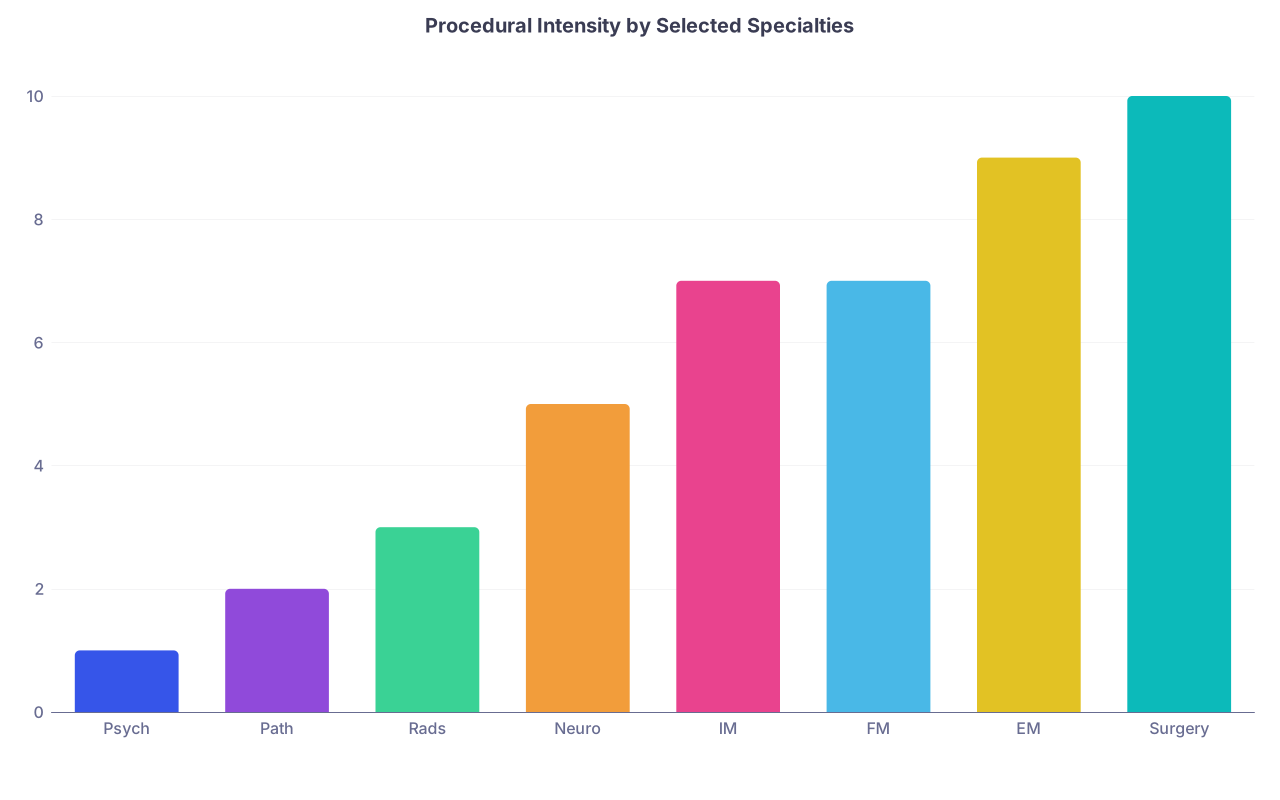
| Category | Value |
|---|---|
| Psych | 1 |
| Path | 2 |
| Rads | 3 |
| Neuro | 5 |
| IM | 7 |
| FM | 7 |
| EM | 9 |
| Surgery | 10 |

| Step | Description |
|---|---|
| Step 1 | Hate procedures? |
| Step 2 | Consider Psych or Path |
| Step 3 | Consider Rads or Neuro |
| Step 4 | Neurology |
| Step 5 | Diagnostic Radiology |
| Step 6 | Research program cultures |
| Step 7 | Able to tolerate some during training? |
| Step 8 | OK with LPs and some ICU? |

FAQ – Exactly 6 Questions
1. Is it “wrong” or unfit for medicine if I hate procedures this much?
No. It just means your risk tolerance and comfort zone are different. There are plenty of excellent psychiatrists, pathologists, and non‑clinical physicians who hate poking people and still contribute massively. The only “wrong” part would be forcing yourself into a heavily procedural field because of ego or pressure, then burning out or panicking every day.
2. Can I tell programs I’m procedure‑averse during interviews?
I wouldn’t walk in saying, “Needles terrify me and I refuse to do procedures,” especially for IM/FM/EM. For psych, path, or rads, you can frame it as: “I’m drawn to more cognitive/diagnostic work and less to invasive procedures.” That’s honest without sounding unsafe. Save the deeper fears for trusted mentors, not the PD in a 20‑minute Zoom.
3. Will my co‑residents hate me if I avoid procedures?
They’ll resent you if they feel you’re dumping work on them. If you truly can’t or don’t want to do procedures, you need to pick a specialty and program where those expectations are low for everyone, not just you. In a surgical ICU, yes, you’d be dead weight. In psych? No one cares that you’re not placing central lines because… no one is.
4. What if I choose psych and still feel overwhelmed by medicine in PGY‑1?
That’s pretty common. A lot of psych residents feel like reluctant interns. If you’re anxious about that, look for psych programs that:
- Have integrated PGY‑1s with more psych and less medicine.
- Limit ICU time.
- Have strong support on medicine floors. You can also mentally frame PGY‑1 as a finite, crappy year you survive to get to the career that actually fits you.
5. Is it possible to switch out of a procedural specialty if I realize I can’t handle it?
Yes, but it’s messy, stressful, and not guaranteed. People do switch from EM, surgery, or IM into psych, path, or rads after miserable intern years. But spots have to be available, and you’ll already be drained. I’d rather you be brutally honest now than bank on a future escape hatch.
6. If I pick a low‑procedure specialty, will I regret “limiting myself” later?
Maybe. Or maybe you’ll be deeply relieved you’re not dreading work every day. You’re not locking yourself into a dark cave — psych, path, and rads have subspecialties, academic roles, leadership opportunities, and non‑clinical side doors. The bigger regret I see isn’t “I chose psych and I miss central lines.” It’s “I chose the ‘prestigious’ procedural field and spent years in a near‑constant state of dread.”
Bottom line:
- True low‑procedure residencies exist, but they’re mostly psych, path, and carefully‑chosen diagnostic radiology (maybe neuro if you can handle LPs).
- Don’t trust generic “we don’t do that many procedures” lines — ask residents specific, concrete questions.
- Your fear of procedures doesn’t disqualify you from medicine, but it absolutely should shape which residencies you consider.