
It’s 11:47 p.m. You’re scrolling through Reddit between consult notes, reading threads where psych residents sound burned out, disillusioned, or talking about “getting stuck” in a specialty they’re not sure they love. You’ve told people you’re going into psychiatry. Maybe you’ve already submitted ERAS. Maybe you’ve matched. And now this little voice keeps whispering:
“What if I regret choosing psychiatry and it’s too late to fix it?”
Let’s say it out loud: you’re not just “thinking it through.” You’re catastrophizing. Imagining waking up at 35, board-certified in psych, hating your job, and realizing you spent a decade walking straight into the wrong life.
You’re not crazy for thinking that. Every halfway self-aware applicant has some version of this panic. Psychiatry just adds an extra layer because it’s:
- Less “procedural”
- More emotionally heavy
- More ambiguous day-to-day
- Still misunderstood (even by other doctors)
So let’s pull this apart. Not with “follow your passion!” nonsense, but with actual early warning signs, realistic safeguards, and what people really do if they end up regretting psych.
First: What You’re Probably Actually Afraid Of
Under the “what if I regret psych?” question, there are a few more specific fears:
- “What if I miss doing ‘real medicine’ and lose my skills?”
- “What if I can’t handle chronic, non-fixable conditions?”
- “What if talking all day drains me and I burn out?”
- “What if I’m picking psych because I’m avoiding harder fields?”
- “What if job options or money end up worse than I thought?”
- “What if psych stigma (from family/colleagues) gets to me?”
You’re not wrong to worry about these. They’re all legitimate. But they’re different problems, and they have different warning signs and fixes.
The real disaster scenario isn’t “I have doubts.” It’s “I ignore all the data, commit blindly, and only realize five years in that the red flags were obvious.”
So let’s talk red flags.
Early Warning Signs You Might Regret Psychiatry
Not “you had a hard day on your psych rotation.” That happens to everyone. I’m talking about patterns. Stuff that keeps happening and doesn’t feel better even when you get rest, support, or a decent supervisor.
1. You Feel Bored or Useless During Psych Rotations
Not “this is slow compared to surgery.” True. It is. I mean:
- You leave clinic feeling like you barely did anything.
- Notes feel like creative writing, not medicine.
- You’re more engaged checking labs and vitals than talking to the patient.
If you consistently think, “I wish I could do something with my hands / procedures / acute interventions,” that’s a genuine signal. Some psych niches are more “medical” (CL psych, neuro-psych, inpatient with lots of med issues), but if talking and thinking about behavior never feels satisfying, that’s not going to magically change PGY-4.
2. You Dread the Emotional Weight – And It Doesn’t Ease With Experience
Everyone is unsettled by suicidal patients, self-harm, and psychosis at first. That’s normal. But here’s when it’s a warning sign:
- You leave shifts emotionally wrecked every time.
- You feel constantly responsible for everyone’s safety in a way you can’t shut off.
- You ruminate for hours or days about every high-risk patient.
- You hate high-risk evals so much you fantasize about “escaping” to another specialty.
Some of this improves with training and supervision. But some people truly don’t want a job where suicide risk assessment and chronic trauma are baked into daily life. If every psych encounter feels like carrying a backpack full of other people’s pain home with you, that’s not trivial.
3. You Don’t Actually Like Talking to Patients for Long Periods
Psych is not, “Quick HPI, physical, move on.” It’s:
- Deep dives into life history.
- Long interviews where you listen more than you talk.
- Repeating yourself. Over and over. With some very disorganized or mistrustful people.
If, during your psych time, you find yourself:
- Clock-watching 10 minutes into every interview
- Mentally checking out halfway through
- Enjoying collateral calls more than the actual patient encounter
- Feeling drained, not “used,” by extended conversations
…that’s a serious compatibility question. This is the core of the job.
4. You’re Only Excited About “Cool Cases,” Not the Day-to-Day Grind
Manic patient who thinks they’re a prophet? Fascinating. Rare psychosis case with catatonia? Interesting.
But most psych is:
- Anxiety, depression, PTSD, substance use. Again. And again.
- Med management follow-ups.
- Resistant people who barely want to be there.
If you enjoy psych in theory but are already bored by bread-and-butter clinic, that boredom will not shrink with time. You’ll know this if you light up when an acute bizarre case appears, but you drag your feet through all the “routine” stuff.
5. You’re Choosing Psych Mainly to Avoid Something Else
This is harsh, but I’ve seen it:
- “I’m bad at procedures, so I’ll just do psych.”
- “I don’t want to work that hard, so psych seems chill.”
- “My scores limit me, so psych is my backup.”
Psych is not a retirement home for tired med students. It’s a real specialty with real difficulty, just a different kind. If your main emotional driver is escape (from call, from sick patients, from ICU-level decisions), you’re at risk of future regret.
Why? Because every specialty has its own brutal side. Psych’s version is risk, uncertainty, chronicity, and systems-level frustration.
6. The Identity Shift Feels Wrong
This one’s subtle but huge.
When you picture introducing yourself as “the psychiatrist,” do you feel:
- Relieved? “Yeah, this fits.”
- Or fake? “I don’t really see myself as that person.”
If you cringe a little, or you feel like you’re stepping down from “doctor” to “therapy person,” you either have internalized stigma (very common and often fixable) or this identity really isn’t you.
Safeguards Before You Commit Fully to Psychiatry
You’re not powerless here. There are several ways to stress-test your choice before you’re locked into a psych residency or a psych career.
1. Get More, Not Less, Psych Exposure – But Be Strategic
If all you’ve seen is one cushy outpatient month, you don’t actually know psych.
Actively seek:
- Inpatient psych (different pace, more acute)
- CL psych (more medically complex, lots of liaison with other services)
- ED psych consults (decision-heavy, triage, safety calls)
And pay attention to your body’s reaction:
- Are you tired but weirdly satisfied?
- Or are you counting down days, fantasizing about other rotations?
If you finish a 4-week psych block and feel neutral-at-best and absolutely not excited to come back, that’s data. Stop telling yourself you’re “overthinking it.” You’re not.
2. Talk to Residents and Attendings About Their Regrets – Directly
You’ll learn more from one honest psych attending than from 50 online threads.
Ask them, straight up:
- “Have you ever regretted psych?”
- “If you could go back, would you do it again?”
- “What’s the part that almost made you quit?”
- “What surprised you in a bad way?”
If everyone you talk to hesitates and gives you vague non-answers, that’s also an answer. The vibe matters. A happy psych department doesn’t mean no one struggles, but it does mean regret is not universal destiny.
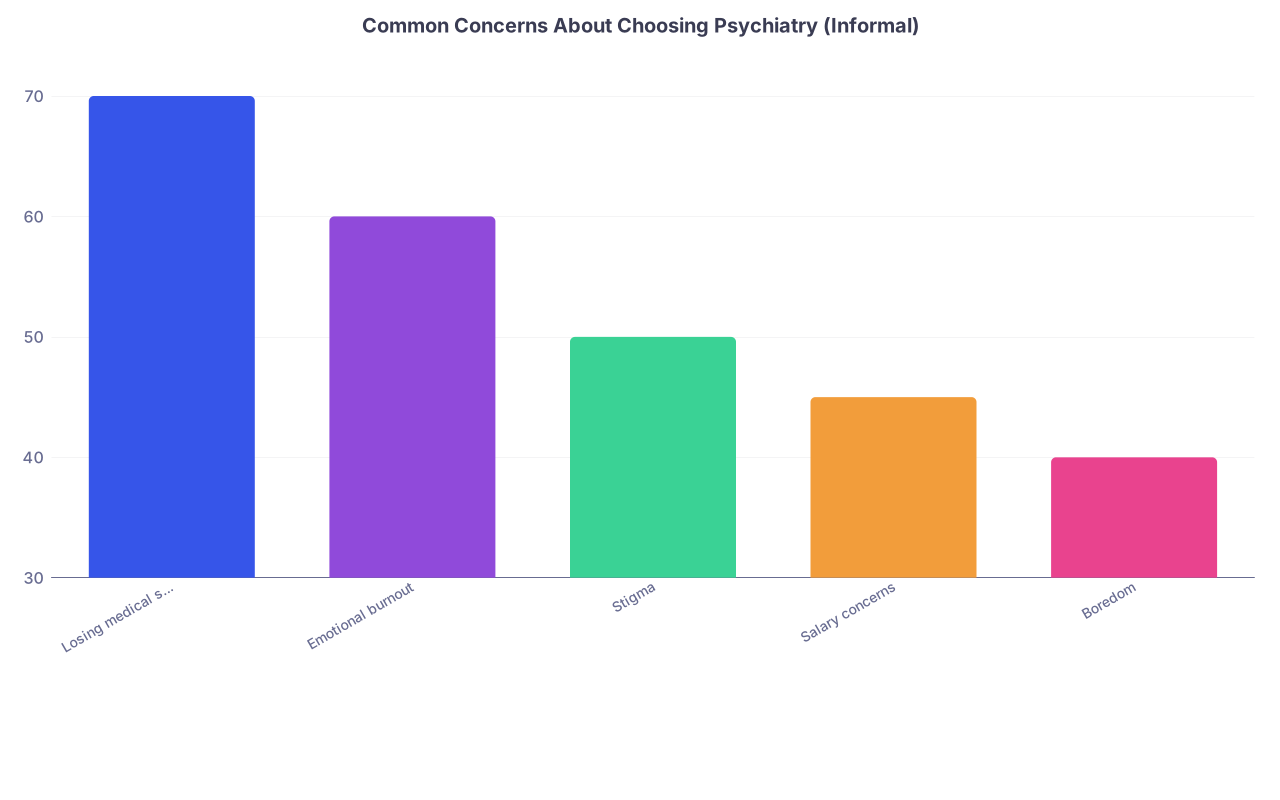
| Category | Value |
|---|---|
| Losing medical skills | 70 |
| Emotional burnout | 60 |
| Stigma | 50 |
| Salary concerns | 45 |
| Boredom | 40 |
3. Protect Optionality in Your Application Strategy
If you’re pre-ERAS or early in the cycle, you can build in fail-safes.
Concrete things you can do:
- Keep up your internal medicine/surgery letters if there’s even a 10% chance you’d pivot.
- Don’t tell every program psych is your “one true calling” if you’re still testing it out. You can be honest about exploring.
- Some people dual-apply (e.g., psych + IM). It’s messy but sometimes rational if your doubt is real, not just anxiety.
You’re not “betraying” psychiatry by protecting your future self.
4. Do a Brutally Honest Values Check
No fluff. Sit down and answer:
- What do I want my day to feel like?
- How much uncertainty can I stand?
- How okay am I with chronic, non-curable illness being a huge part of my career?
- What drains me faster: physical intensity (procedures, codes) or emotional intensity (suicide risk, trauma, conflict)?
If you’re someone who would rather run a code than sit with someone crying for 45 minutes, listen to that. It doesn’t make you a bad person. It means your energy fits somewhere else.
What If I Choose Psychiatry and Then Regret It?
Here’s the part your brain is catastrophizing: the “I picked wrong and now my life is over” narrative.
It’s not over. There are ways this actually plays out.
1. You Might Not Regret Psych Itself – Just Where You’re Doing It
A huge chunk of “I hate psych” is “I hate my program / job / setting.”
I’ve seen:
- People miserable in county inpatient who thrived in outpatient private practice.
- Residents convinced they picked wrong until they switched to CL or addiction focus.
- Folks who just needed to get out of a toxic residency culture.
Psych is wildly flexible compared to many fields. You can shift between:
- Inpatient vs outpatient
- Academic vs private vs locums
- Adults vs child/adolescent vs geriatric
- Medication-heavy vs therapy-heavy vs consult-heavy
So “I regret psych residency at Hospital X” is not the same as “I regret psychiatry as a career.”
2. You Can Pivot Within Medicine – Even After Residency
Is it easy to switch specialties post-residency? No.
Is it impossible? Also no.
Real scenarios I’ve seen or heard about:
- Psych → family med (extra residency, but doable)
- Psych → neurology or PM&R with a second residency
- Psych → addiction medicine / pain / consultation medicine hybrids
You’d likely:
- Take a pay cut for a while
- Do extra training years
- Eat a big hit to sunk time and maybe ego
But if you truly hate being a psychiatrist, a few extra years is not a life sentence. It just feels like it from inside med training culture where everyone is rushing.
3. You Can Build a Psych Career That Minimizes What You Hate
Hate endless med checks? You can lean into:
- CL psychiatry
- Emergency psychiatry
- Inpatient mood/psychotic disorder units
- Forensic psychiatry (more evaluation, less follow-up clinic)
Hate high-acuity risk all day? You can move toward:
- Outpatient mood/anxiety
- Group practice
- Telepsychiatry with screened populations
- Collaborative care with primary care
You don’t have to do the version of psych that terrifies you forever.

The Difference Between Anxiety and a True Misfit
Right now your brain is mixing normal anxiety with actual compatibility questions. You need to separate them.
Signs It’s Mainly Anxiety Talking
- Your worries sound like “what if…?” spirals with no real pattern from actual experiences.
- You have enjoyed psych rotations, but still feel scared.
- You tend to overthink every big decision (college, med school, Step exams) the same way.
- When you’re in the middle of a good psych day, you’re fine. The panic comes late at night or when scrolling.
That’s not “I picked the wrong specialty.” That’s your default brain setting.
Signs You’re Actually a Poor Fit for Psychiatry
- You’ve had multiple psych exposures and consistently feel bored, drained, or resentful.
- The parts psych people love (intricate histories, longitudinal relationships, complex dynamics) don’t light you up at all.
- You actively dislike the patient population. Not just find them hard – lots of psych people love hard patients – but find no meaning in working with them.
- You keep fantasizing about another specialty with actual longing, not just FOMO.
If you’re honest with yourself and you see the second pattern more than the first, you need a real conversation with mentors about whether to pivot now rather than hope it gets better later.
A Quick Reality Check: Psychiatry Pros You May Be Undervaluing
Your anxiety has you laser-focused on the worst possibilities. Let’s not be delusional, but we also don’t have to pretend psych is a trap.
Real upsides:
- Flexibility: Part-time, telehealth, locums, private practice. Much more control over schedule than most fields.
- Lower physical fatigue: You’re not on your feet 14 hours a day in the OR.
- Impact: When it works, it really works. People go from barely functional to stable.
- Job market: Psychs are in demand almost everywhere. That gives you leverage to craft a better job if your first one sucks.
None of that makes psych automatically “right” for you. But it does counter the internal story that picking psych is some irreversible downgrade.

| Step | Description |
|---|---|
| Step 1 | Psych Residency |
| Step 2 | Stay in Specialty |
| Step 3 | Change Job or Focus Area |
| Step 4 | Consider Second Residency |
| Step 5 | Discuss with Mentors |
| Step 6 | New Role Better Fit |
| Step 7 | Plan Transition |
| Step 8 | Happy with Psych? |
| Step 9 | Hate All Psych or Just Setting |
FAQ – Exactly What Your Brain Is Probably Asking
1. What if I already matched into psychiatry and now I’m panicking?
Panic after Match is super common. Give yourself at least a few months of actual residency before deciding it’s a disaster. Keep a private log: what days drain you, what days feel okay or even good. If, after 6–12 months, your dread is consistent and intense, talk early to your PD and mentors about whether a switch or major adjustment is possible. You’re not the first to have that conversation.
2. Will I “lose” my medical skills if I do psych?
Yes, to some extent. You will not be managing ventilators or doing central lines anymore. But many psych jobs – especially inpatient and CL – still require you to be medically sharp: reviewing labs, recognizing delirium, understanding med interactions. If the idea of de-emphasizing physical medicine fills you with grief, listen to that. If it just mildly worries you because of ego or identity, that’s more workable.
3. Does it mean I’m weak if I’m afraid of the emotional burden in psychiatry?
No. It means you’re not numb. That’s actually a good starting point. The key question: can you grow your coping skills with supervision and experience, or do you feel like this kind of work is fundamentally misaligned with your own mental health? If you already have severe burnout, depression, or trauma history that flares badly on psych, you may need to be much more cautious.
4. Is dual-applying psych and another specialty a bad idea?
It’s not automatically bad, but it’s tricky. It can dilute your narrative and make you look non-committal if you’re not careful. But if your doubt is serious – as in, you have real experiences pulling you toward two very different paths – dual applying may be a rational safeguard. Just don’t lie to programs. Frame it as genuinely exploring where you can best serve and thrive.
5. What if my family or other doctors look down on psychiatry and that’s what’s making me doubt?
This is wildly common. Surgeons, internists, even some faculty will say garbage like “psych isn’t real medicine.” If, when you’re alone, without their voices, you actually like psych, then this is a stigma problem, not a specialty problem. You’re allowed to want a career that doesn’t fit someone else’s prestige hierarchy. Their opinion will matter a lot less in 5–10 years than you think.
6. How do I know if I’m just scared of committing to anything, not psych specifically?
Look at your pattern. Did you agonize about picking a college major? Med school? Even which sandwich to order? If yes, your brain melts down at any fork in the road, not just this one. That doesn’t mean you ignore the panic; it means you don’t let “I feel anxious” equal “this must be wrong.” Force yourself to base your decision on actual experiences – specific psych days, patient encounters, your energy levels – not just imagined futures.
If you remember nothing else:
- Doubting psychiatry doesn’t mean you’re doomed; it means you’re awake.
- Watch for patterns in your real experiences, not just late-night spirals.
- Build safeguards now – extra exposures, honest conversations, and some optionality – so your future self has room to adjust if needed.