
A single bad neurology clerkship evaluation does not get you filtered out of ERAS. How you respond to it might.
I have watched students match neurology at excellent programs with one ugly neuro eval in their file. I have also watched students let that same kind of eval poison their application because they handled it passively or defensively.
You are not stuck. You have about 3–6 levers you can still pull before ERAS locks. This is the playbook.
Step 1: Diagnose the Damage Precisely (Not Emotionally)
First you need a cold, unemotional read of what you are actually up against.
Do this in sequence:
Separate components
- Overall clerkship grade (Honors/High Pass/Pass/Low Pass/Fail).
- Narrative comments on the evaluation.
- Any professionalism flags or “concerns”.
- Shelf/NBME score.
- Timing: was this your only neurology-like experience?
Classify the problem
Most “weak neuro evals” fall into one of these buckets:
| Type | Typical Situation |
|---|---|
| Grade-only | Solid comments but just Pass |
| Narrative red flags | Descriptions of attitude or behavior |
| Inconsistent story | Comments do not match the grade |
| Shelf drag-down | Mediocre performance, bad shelf score |
| Timing/recency problem | Only neuro exposure and it is weak |
- Highlight exact phrases
Open the eval and literally copy the phrases that would worry a PD:
- “Required more supervision than peers.”
- “Knowledge base below level.”
- “Passive on the team.”
- “Concerns about reliability/ownership.”
- “Interpersonal challenges with staff.”
Circle or bold these lines in your own notes. These become your targets to fix or dilute.
- Reality check with someone blunt
Do not rely on your own interpretation. Ask:
- A trusted advisor (specialty-agnostic).
- A neurology faculty member who knows you.
- If available, a dean of students or career advisor.
Tell them: “Read this like a PD who does not know me. What conclusions would you draw?”
You want the unsanitized version.
This step hurts. Do it anyway. You cannot build a repair plan on a fake version of events.
Step 2: Decide: Are You Explaining, Compensating, or Both?
There are only two ways to neutralize a weak evaluation:
- Make it look like an outlier, or
- Make it look accurate but old, and clearly corrected.
You decide your route based on what went wrong.
A. When to explain it
You consider explanation (in your PS or Dean’s letter addendum) if:
- There was a clear, documentable event:
- Family emergency.
- Illness.
- Rotation chaos (new site, absent attending, etc.).
- Or a significant mismatch of expectations:
- You were placed in a primarily consult service with minimal autonomy.
- You had multiple attendings and one very negative one drove the final grade.
You do not explain:
- “I was tired during that block.”
- “I did not like neurology at that time.”
- “I did not gel with the resident because of personality differences.”
Those are not explanations. Those are red flags with extra steps.
B. When to compensate it
You compensate when:
- The eval is probably…mostly fair.
- Or it is marginally unfair, but there is no clean external explanation.
- Or you have limited political capital at your school to challenge it.
Compensation means you:
- Generate stronger, more recent neurology evidence.
- Stack your application with signals of improvement: letters, electives, Step 2 score, research, leadership, etc.
- Make the trend line unmistakable: weak → good → strong.
Almost everyone reading this falls in the “compensate” bucket. Explanation is used surgically, not as the default.
Step 3: Repair Through Action: Get a Strong Neuro Experience on the Record
If you are serious about neurology, you need a second datapoint that is clearly stronger than the first.
3.1. Schedule a senior neuro elective or sub-I — strategically
You want:
- Timing: Before ERAS submission or at least before MSPE release.
- Location: Your home institution if possible. An away rotation if:
- Your home neuro department is small or unsupportive.
- You need a new environment to show who you are now.
- Structure: A team where:
- You work directly with 1–2 attendings who actually write letters.
- You have real patient ownership: pre-rounds, notes, follow-ups.
If you cannot get a formal “Neuro Sub-I”, any of these can work:
- Inpatient neurology consults.
- Epilepsy/EEG service with inpatient exposure.
- Stroke/neuro-ICU elective where students can function at near-sub-I level.
Your ask when scheduling should be explicit:
“I am strongly considering neurology and would like an elective where I can function at a sub-intern level and be evaluated closely.”
3.2. Perform like someone rewriting their narrative
On this neuro elective, every attending and resident needs to see a different version of you than the first eval describes. Focus on the exact domains that were criticized.
If your eval said “passive,” then on the elective:
- Show up with pre-written plans before rounds.
- Offer to call consults, follow up on imaging, call families.
- Ask residents, “What else can I take off your plate?” at least once per day.
If it said “weak knowledge base”:
- Have a pocket study plan:
- One core neurology text or resource (e.g., Clinical Neurology by Lange, or the clerkship-level chapters of Biller’s Practical Neurology).
- 20–40 UWorld/AMBOSS neurology questions nightly.
- At the end of the day, pick 1–2 patients and read specifically about their issue. Come back the next day with one concise teaching point per patient.
If it hinted at “attitude / professionalism”:
- Do the boring basics perfectly:
- On time. Every day.
- Answer pages.
- Respond to emails.
- Be nice to nursing staff and PT/OT.
- Minimize complaining. About anything. Especially to residents.
You are trying to create a situation where the attending later writes:
“I am aware of a prior mid-level evaluation in neurology. I did not see that student on this rotation. They functioned at or above the level of an incoming intern.”
I have read letters like that. They are gold.
3.3. Secure a deliberately corrective letter of recommendation
Do not just passively hope you get a good letter. Engineer it.
Near the end of your elective:
Ask for feedback first
“Can I get your honest feedback on how I have done this month, and if you have seen growth compared to other students at my level?”If that feedback is genuinely positive, say this directly:
“I had a weaker neurology clerkship evaluation earlier in third year that I am concerned may not reflect where I am now. Based on your experience working with me, would you feel comfortable writing a strong letter of recommendation that speaks specifically to my current performance and growth?”Offer specifics:
- Provide a short bullet list of:
- Key patients you followed.
- Times you presented independently.
- Teaching you did for the team.
- Include your CV and personal statement draft.
- Provide a short bullet list of:
You are not asking them to lie or “fix” the old eval. You are asking them to give PDs a newer, more accurate window into who you are.
Step 4: Control the Narrative in Your Application Documents
You cannot delete the old eval. But you can decide how PDs interpret it.
4.1. Personal Statement: Hint at the arc, do not write a confession
Should you mention the weak eval? Usually: no, not explicitly.
Use the PS to:
- Emphasize:
- Why neurology now makes sense for you.
- What you have done to deepen your commitment (research, electives, longitudinal clinic).
- Subtly show:
- You grew during clinical rotations.
- Early experiences challenged you but pushed you to develop.
An example of a subtle signal without self-sabotage:
“Early in my clinical years I struggled to translate pre-clinical knowledge into efficient clinical reasoning on busy inpatient services. Neurology forced me to slow down, structure my thinking, and seek out feedback aggressively. Through subsequent rotations, a sub-internship on the stroke service, and focused work with my mentors, I have developed a more organized approach that I now enjoy using to teach junior students.”
No mention of “bad eval.” But any PD reading between the lines understands: there was growth, there were bumps, you learned.
4.2. MSPE / Dean’s letter: Push for accurate context
This is where you have a small window to actively shape the story.
Schedule a meeting with:
- Your student affairs dean, or
- Whoever drafts your MSPE.
Go in prepared:
- Bring:
- The weak neuro eval.
- A clearly stronger neuro evaluation (from your elective/sub-I).
- Any neurology-related achievements: case report, poster, QI project, etc.
- Your ask:
“I understand the original evaluation needs to stay in my record. Could we include in the MSPE a brief comment emphasizing my later neurology performance and improvement over time? I want programs to see that this evaluation does not represent my current level.”
Most schools are receptive to this…if you show them new data. Not just feelings.
You are trying to get something like this written in the MSPE:
“While early neurology clerkship performance was mid-range, the student’s later neurology sub-internship evaluations described them as functioning at the level of an incoming intern, with particular strength in ownership and communication.”
That sentence alone can defuse a marginal evaluation.
Step 5: Use Numbers and Non-Neuro Rotations to Stabilize the Picture
PDs are pattern-recognition machines. Your job is to make the pattern obvious: this was a blip, not a trend.
5.1. Crush Step 2 CK (if still pending)
If your neuro eval flagged knowledge or reasoning, a strong Step 2 score is your fastest partial antidote.
If you already took Step 2 and it is solidly above your school’s and neurology’s average, you are fine.
If you have not taken it yet:
- Build a targeted plan:
- Focus especially on neuro questions and neuroanatomy.
- Track your neurology percentages on UWorld and NBME practice exams.
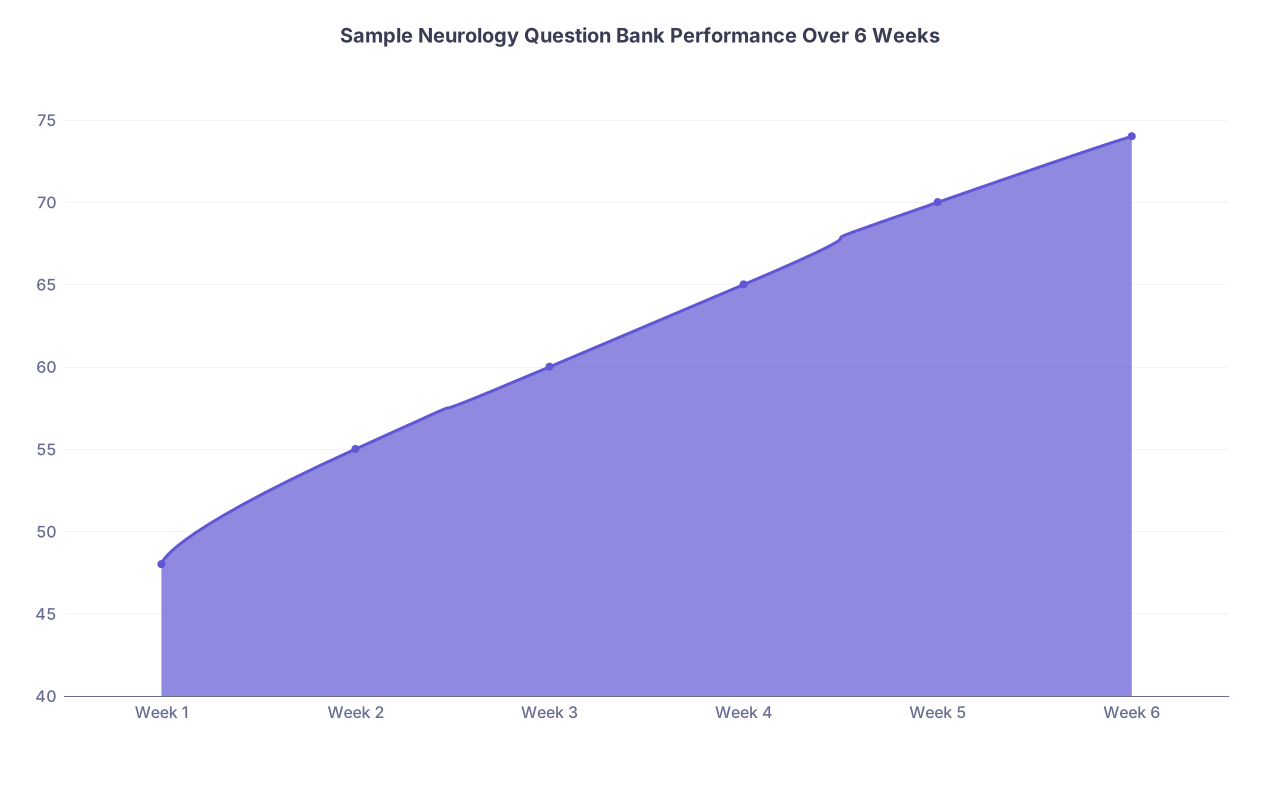
| Category | Value |
|---|---|
| Week 1 | 48 |
| Week 2 | 55 |
| Week 3 | 60 |
| Week 4 | 65 |
| Week 5 | 70 |
| Week 6 | 74 |
Show that kind of upward curve in your own prep and your confidence on exam day will reflect it.
5.2. Leverage strong non-neuro clerkships with similar skills
If your neuro eval hints at:
- Poor communication → Highlight strong evaluations from:
- Psychiatry.
- Internal medicine.
- Family medicine.
- Weak ownership/initiative → Highlight:
- Surgery or ICU experiences where you clearly took charge.
- Weak reasoning → Highlight:
- IM or EM evals describing strong clinical reasoning and diagnostic workups.
You want a PD to think:
“Huh. Neuro was mediocre. But IM, psych, and sub-I comments are all glowing about reliability and reasoning. I am going to assume the neuro eval is an outlier or early misstep.”
To make this easy for them, you can even mention in your ERAS “Experiences” descriptions brief nods to skills:
- “Functioned with near sub-intern level responsibility on IM wards, independently managing 5–8 patients with daily plans reviewed by residents and attendings.”
- “Led family meetings with attending supervision on psych inpatient service, focusing on clear communication of complex treatment plans.”
That is quiet, indirect damage control.
Step 6: Decide Where to Apply and How Broadly
You cannot “strategy” your way out of a completely noncompetitive application. But a single weak neuro eval, in an otherwise reasonable record, is not a death sentence. It just means you apply smarter.
6.1. Calibrate competitiveness honestly
Look at your whole profile:
- Step 1: Pass (obviously).
- Step 2 CK: actual score.
- Clerkship grades distribution.
- Research: any neurology or general clinical work.
- Letters: strength and number of neurology-specific ones.
| Tier | Typical Step 2 CK | Typical Profile |
|---|---|---|
| Highly competitive | 245+ | Mostly Honors, strong research, strong neuro LORs |
| Mid-tier | 230–245 | Mix of Honors/High Pass, some research |
| Safety / community | 220–235 | More Pass/High Pass, fewer publications |
If you have:
- One weak eval, but:
- Solid Step 2.
- Strong later neuro performance.
- Decent letters.
Then your strategy should be:
- Apply broadly across mid-tier + safety programs.
- Add a few reach programs only if you have a big upside (research, unique background, or a well-known letter writer).
6.2. Use away rotations surgically, not as a Hail Mary
An away rotation can help if:
- Done before ERAS or early in the season.
- At:
- A realistic target program.
- Or a regional “name” program that can vouch for you.
But away rotations cut both ways. If you underperform, now you have 2 weak neurology evals. That is harder to explain.
So:
- Do an away only if:
- You have already proven you can shine on your home neuro elective.
- You have the stamina to go full-throttle during interview season.
If you go:
- Treat it like a month-long audition.
- Explicitly ask at the end whether they would consider supporting your application or writing a letter.
Step 7: Prepare to Address It in Interviews Without Digging a Deeper Hole
Some PDs will never mention the weak eval. Some will stare right at you and ask:
“I noticed your neurology clerkship evaluation was weaker than your other rotations. Can you tell me what happened there?”
You need a rehearsed, short answer that:
- Takes responsibility.
- Describes change.
- Ends on a forward-looking note.
Template to adapt:
Own it plainly (but briefly)
“You are right. My early neurology clerkship was not my best performance.”Identify a specific growth point
“At that point I was still figuring out how to translate pre-clinical neuroanatomy into efficient day-to-day decision making on the wards. I also did not yet understand how proactive I needed to be in asking for feedback and responsibilities.”Show concrete change, with evidence
“I took that feedback seriously. Before my neurology sub-internship I met with my clerkship director to clarify expectations, created a structured neuro study plan, and asked my residents to tell me daily what I could own more fully. On that sub-I I managed my own small patient list, independently developed assessment and plans that were often accepted by the team, and received evaluations describing me as functioning at an intern level.”Tie it to future behavior
“So for me, that early clerkship was a wake-up call about the level of initiative and structure required. I am glad it came when it did because it changed how I approach every rotation now.”
Then stop talking. Do not over-explain.

| Step | Description |
|---|---|
| Step 1 | PD asks about weak eval |
| Step 2 | Briefly acknowledge |
| Step 3 | Identify concrete weakness |
| Step 4 | Describe specific actions taken |
| Step 5 | Point to later evidence of improvement |
| Step 6 | Link to readiness for residency |
Practice this answer out loud until it sounds natural and unemotional.
Step 8: Things You Think You Should Do (But Should Not)
Some common “fixes” students try are actually self-sabotage.
Do not:
Ignore it and hope PDs don’t notice.
They will. Especially for a neuro applicant.Write an emotional email to the original attending challenging the eval, months later, with no new evidence.
If you truly believe there was a serious fairness issue, discuss with your dean first. Do not freelance.Over-explain in your personal statement.
Turning your statement into a 1,000-word justification of one rotation will tank your application.Ask for multiple letters from people who barely know you just because they are “big names.”
A generic letter from a famous neurologist who worked with you for two days is weaker than a detailed, passionate letter from a community neurologist who saw you own patients for a month.Apply only to ultra-competitive academic programs thinking “if I get one interview, I’ll win them over.”
With a visible weak point, you need depth of applications more than reach.
Step 9: Build a Tight, Coherent Neurology Story Anyway
Your weak eval should be a footnote, not the story. The story you want is:
- You discovered neurology.
- You leaned into it.
- You improved measurably.
- People who work with you now want you in their residency.
Practically, that means by ERAS deadline you want to have:
- At least one very strong neurology letter, ideally two.
- A recent neurology rotation with clear, positive evaluation.
- A solid Step 2 score or clear improvement from Step 1 performance.
- A few neurology-related experiences:
- Case report on a stroke patient.
- Poster on epilepsy.
- Volunteer work in a neurology clinic.
- A personal statement that sounds like someone who has actually spent real time with neurologic disease and still wants more.
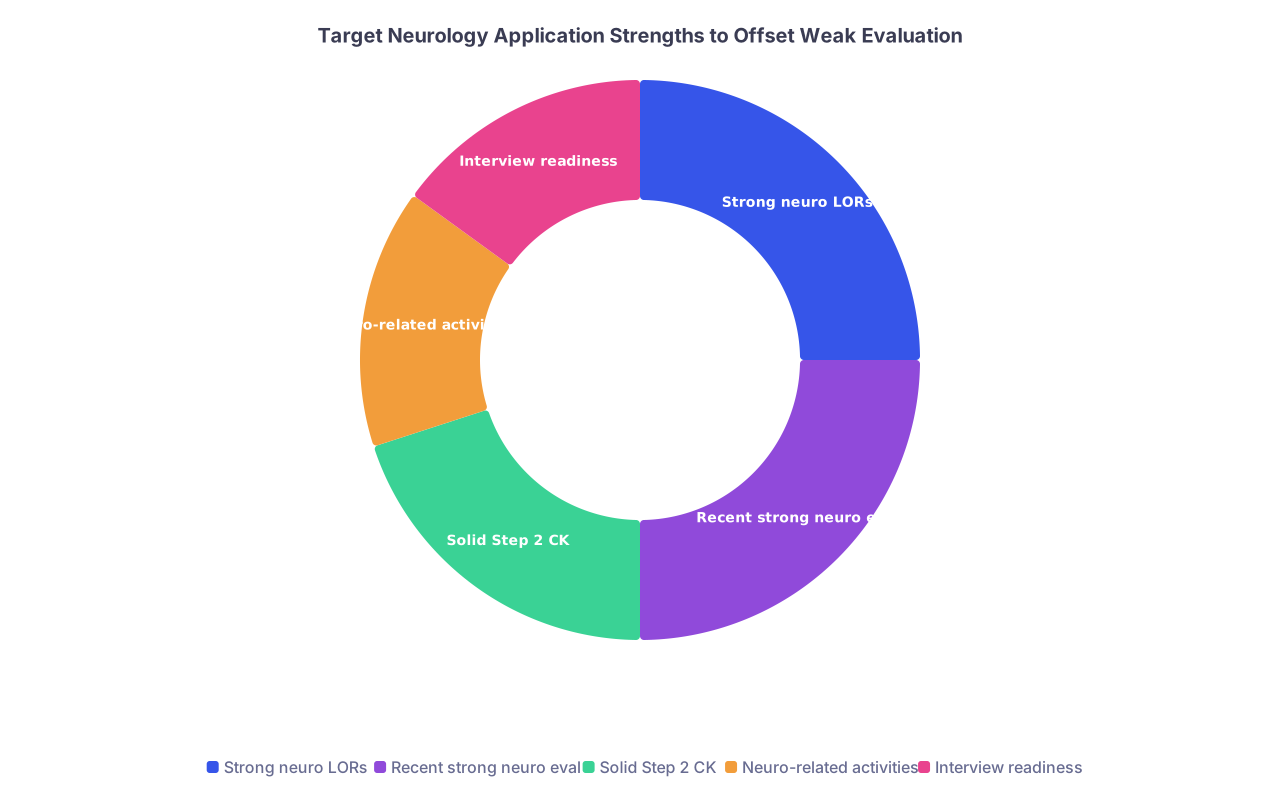
| Category | Value |
|---|---|
| Strong neuro LORs | 25 |
| Recent strong neuro eval | 25 |
| Solid Step 2 CK | 20 |
| Neuro-related activities | 15 |
| Interview readiness | 15 |
If you have those in place, many PDs will glance at the old eval, maybe ask you about it, then move on.
Step 10: Final Checklist Before You Hit Submit
Run through this, item by item:
Do I have at least one high-quality neurology letter that:
- Comes from someone who saw me on an inpatient or busy outpatient service?
- Comments on work ethic, ownership, and reasoning?
Is there a clear upward trajectory visible in:
- Neurology-specific experiences?
- Overall clerkship comments?
- Step scores?
Did I speak with my dean/MSPE author and confirm:
- The weak eval will not be the only neurology note highlighted?
- Any substantial later improvement is mentioned?
Do my ERAS experiences and PS:
- Emphasize neurology interest and maturity?
- Avoid melodramatic explanations of the weak eval?
Have I practiced a 60–90 second answer to:
- “Tell me about your neurology clerkship performance”?
If you can answer yes to most of those, submit. Obsessive tinkering after that point will not change much.
Key Takeaways
- A weak neurology clerkship evaluation is a data point, not a sentence. Your job is to surround it with stronger, newer data that shows growth.
- The most powerful repairs are action-based: a strong neuro elective or sub-I, targeted Step 2 prep, and high-quality neurology letters that explicitly or implicitly correct the earlier impression.
- Control the narrative in your MSPE, ERAS, and interviews: own, improve, demonstrate, and move on. Programs care far more about who you are now than who you were on one rotation eighteen months ago.