
The stuff that determines your future on wards is almost never what ends up in your MSPE.
Faculty write those bland “above expectations” lines. Behind the scenes, attendings are having very direct conversations about who they would and would not want as their resident. Those conversations are based on things you will never see in a Dean’s letter.
Let me walk you through what actually gets noticed on ward months—what makes you “ranked to match” versus “hard no”—even when your MSPE still looks identical to your classmates’.
The Silent Scorecard Attendings Keep in Their Heads
There’s a running evaluation in every attending’s mind, whether they admit it or not. It’s not the clerkship form. It’s a mental scoreboard that starts the minute you introduce yourself.
It usually has five big buckets:
- Can I trust this person with my pager at 2 a.m. in July?
- Will they make the team better or more miserable?
- How do they react when they’re tired, wrong, or behind?
- Are they learning the right things, not just memorizing buzzwords?
- Would I fight for this person at a rank meeting?
Your MSPE talks about “professionalism” and “clinical reasoning.” On wards, those words are code for very specific behaviors that people whisper about in workrooms and never document.
Let’s get concrete.
1. Micro‑behaviors with Nurses and Staff (This Is Where You Rise or Die)
Every attending I know in IM, surgery, EM, OB, peds—does the same thing on ward months: they ask the nurses.
Not formally. Casually. In passing. In between notes.
“How’s that student doing?”
“Would you want them here as an intern?”
“Do they help or just disappear?”
I’ve watched a student with a 260+ and honors on everything get quietly blacklisted by three separate services. Why? Two nurses on different months said the same thing to different attendings: “They’re polite, but they vanish when we actually need something.”
Here’s what attendings are really clocking:
- Do you introduce yourself to the nurse when you pick up a new patient?
- When a nurse looks stressed, do you ask, “Anything I can do to help with 18B?”
- When a nurse calls you about vitals or pain, do you blow it off, or do you show up?
No one writes that on an MSPE. But I’ve seen this sentence more times than I can count in selection meetings: “Strong student, some concerns from nursing staff about reliability.” That’s usually the death sentence line.
The “Disappearing Act” Pattern
Mid‑afternoon, floor’s getting crushed, admissions coming in, discharges stuck, everyone’s drowning.
Two types of students:
- Student A is suddenly “in the bathroom,” “finishing notes,” “checking something,” basically anywhere but where the work is.
- Student B shows up at the pod desk and says: “Hey, I have a bit of bandwidth. Anyone need help calling families, updating med lists, doing discharge education?”
No one logs this in a formal eval. But the chief will tell the PD later: “That student carried themselves like a PGY1 already.” That single sentence often matters more than your pre‑clinical grades.
2. How You Handle Being Wrong (The Moment Attendings Really Decide)
The MSPE will say: “Accepts feedback well.” Meaningless.
On wards, we’re watching exactly three things when you’re wrong:
- Do you get defensive or curious?
- Do you fix the thing immediately?
- Does it change your behavior the next day?
I remember a student who confidently told the team, “The patient doesn’t need DVT prophylaxis; they’re ambulatory.” Attending asked, calmly, “What’s their Padua or Caprini score?” Student froze. Guesswork, no framework.
Two types of reactions I’ve seen:
- Weak reaction: “Oh, okay, I’ll look it up,” with visible annoyance, then nothing changes.
- Strong reaction: Next day, the student shows up with: “I read up on VTE risk scores; I made a one-page quick reference for the team—want to see if I’m thinking about this right?”
Same mistake. Very different trajectory. The second student gets talked about when letters are written: “Rapidly incorporates feedback at a level closer to a resident than a student.” That line makes PDs lean in.
The Red‑Flag Behavior That Never Reaches Your MSPE
Attending suggests a different management approach in rounds. Student nods. Later, the resident discovers the student kept the original plan anyway. Either out of ego or inattention.
Nobody writes, “This student ignores guidance and double-documents their own plan.” But trust me: that story will get told when someone asks, “Anyone have strong feelings about this applicant?”
3. Your Relationship with Uncertainty (And How You Talk About It)
Nobody expects you to know everything. What they’re looking for is how you think when you don’t know.
Students destroy themselves by trying to mask uncertainty with scripted nonsense. The classic: “The exam is unremarkable” when you obviously did a 20‑second cursory check.
Attendings notice:
- Do you say, “I’m not sure, but here’s how I’m thinking about it”?
- Do you try to present with fake confidence and get caught in shallow reasoning?
- Do you ever admit: “I read about X last night but I’m still not confident applying it here”?
The MSPE phrases it gently: “Shows developing clinical reasoning.” What we’re actually saying in private: “They memorize, but they don’t synthesize,” or “They’re humble and intellectually honest; I’d trust them to call for help.”
That last one matters more than your Step score once you hit a certain bar.
4. Time Management Under Real Pressure (Not Your Study Schedule—Your Clinical One)
Programs are not worried about whether you can handle UWorld blocks. They’re worried about whether you collapse the first time you have 8 patients, a cross-cover pager, and two angry families.
On wards, they try to simulate that in small ways.
They pay attention to:
- How long you take to preround on 2–4 patients. Does that expand to fill all available time?
- Do you still get flustered by 10:00 a.m. when you had a simple day?
- When something urgent pops up, can you drop what you’re doing and reprioritize?
Here’s the part no one tells you: when attendings are picking who to give the “heavy” patients to, they’re testing who will sink and who will grow.
If they deliberately give you the trainwreck patient and you:
- Get there early,
- Make a clean, prioritized one‑liner,
- Admit where you’re out of your depth,
- And still have your notes done by late afternoon,
You just moved from “strong student” to “I’d be very comfortable with them as an intern.” That’s a non‑documented but very real upgrade.
5. How You Talk About Patients When You Think No One’s Listening
Locker room talk on wards travels. Fast. You think you’re venting to another student. The pharmacist in the corner? The nurse charting? The RT by the printer? They heard you.
I’ve seen it play out like this: brilliant student, beloved by attendings in the room. Then a senior nurse pulls the attending aside.
“Just so you know, that student called the patient in 14 ‘crazy’ and was mocking them after you left.”
That does not hit the MSPE. What it does hit is your informal reputation, especially locally.
Attendings, especially in psych, IM, peds, OB, will notice:
- Do you roll your eyes at “noncompliant” patients?
- Do you use dismissive language—“trainwreck,” “frequent flyer,” “drug seeker”?
- Do you treat patients differently when they’re difficult, demanding, or poor historians?
There’s a very simple mental split attendings make:
- “This student is stressed but still respects patients.”
- “This student becomes cruel when tired or frustrated.”
The second category doesn’t get their name floated when someone asks, “Any students from our school we should recruit this year?”
6. Whether You Make the Team More Efficient or More Work
Residents are ruthless—but usually fair—judges of this. They’re the ones whose shoulders you’re sitting on.
Behind closed doors, here’s how they categorize students:
- Net negative: slows everything down, needs constant re‑explaining, loses data.
- Net neutral: fine, does their own tasks, does not actively help the team.
- Net positive: anticipates, closes loops, does real work correctly.
Your MSPE comment “a valued member of the team” could apply to any of those. In real life, there’s a massive difference.
| Type | What They Say in Workroom |
|---|---|
| Net Negative | "Nice, but I can't give them much." |
| Net Neutral | "Fine. Didn't hurt us." |
| Net Positive | "Felt like having an extra intern." |
Attendings listen closely when residents say that last sentence.
The “extra intern” students are the ones we will call the PD about. That conversation never touches the MSPE, but it absolutely changes how your name lands later when your ERAS file pops up.
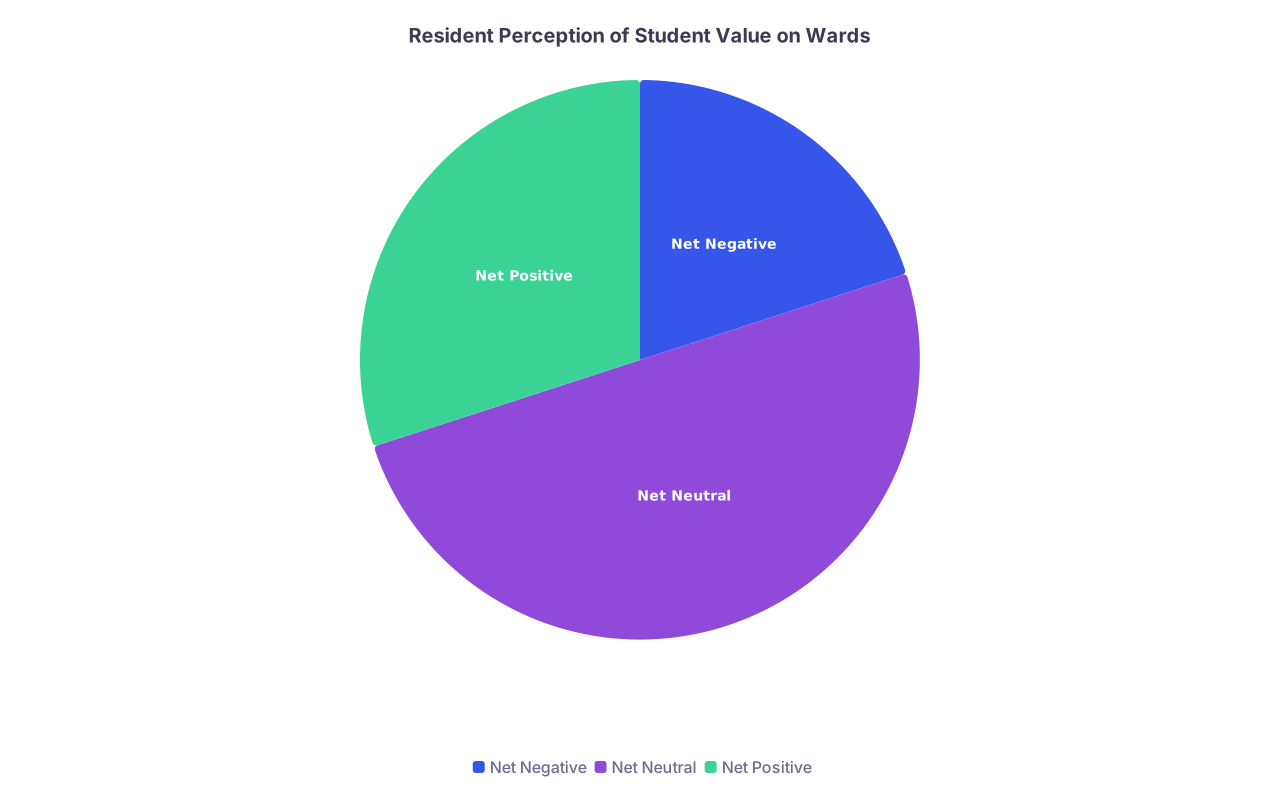
| Category | Value |
|---|---|
| Net Negative | 20 |
| Net Neutral | 50 |
| Net Positive | 30 |
How Students Accidentally Become Net Negative
I’ve seen it over and over:
- Rewriting the entire med list without verifying, introducing errors.
- Promising families you’ll “update them this afternoon” then forgetting.
- Starting five tasks, finishing none, because they keep chasing “interesting” things.
None of that ever appears in your formal evaluation. But residents remember exactly who created more cross‑cover headaches.
7. Specialty‑Specific Things Attendings Clock That Never Hit Paper
Different specialties watch for different tells.
Internal Medicine
IM attendings are obsessed with how you think on the third layer of a problem.
They watch:
- Do you connect today’s issue to chronic disease trajectory?
- Can you distinguish “data I have” from “data I’m assuming”?
- When you read a note, do you just summarize or do you critique?
The MSPE might say “demonstrates sophisticated reasoning,” but the real signal is this: the attending finds themselves asking your opinion not as a test, but because they’re genuinely curious what you think. That only happens when you’re processing like a junior resident.
Surgery
Surgical attendings are less impressed by your textbook knowledge and more by whether you show up the way they did as trainees.
They clock:
- Do you show up before the residents or exactly at start time?
- Are your dressings straight, your drains labeled, your post‑op checks done without prompting?
- How do you react when you get cut from a case? Sulk, or quietly ask, “Can I see the imaging and review the steps anyway?”
No one writes: “Student showed up at 4:45 daily and had every patient scoped out before rounds.” But in the call room that’s exactly what gets said—and that’s the student who later gets the “you should apply here” corridor invitation.
Pediatrics
Peds attendings watch your patience and your ability to communicate at multiple levels at once.
They pay attention to:
- How you talk to a scared kid versus a frustrated parent versus an anxious resident.
- Whether you default to compassion when families are irrational or demanding.
- Whether you make nursing’s life easier or harder with orders, timing, and expectations.
Again, your MSPE might just say “connects well with children and families.” The real distinction: nurses on the peds floor ask, “Is that student coming back as a resident? We’d love to have them.”
Emergency Medicine
EM cares a lot about how you function in chaos and how you prioritize.
They notice:
- Do you freeze when three patients roll in, or do you start doing something appropriate?
- Can you give a tight, 20‑second verbal handoff without wandering?
- When someone’s sick, do you physically move toward them or stay anchored to a computer?
EM attendings talk bluntly at their rank meetings. “This student felt like dead weight in a busy pod” versus “I could throw them in any zone and know they’d hustle and call for help early.”
OB/GYN
OB is watching two big things: can you handle intense emotions, and can you function when the room turns on a dime?
They’re looking for:
- Your face when a delivery goes sideways or there’s a fetal heart rate decel.
- How you talk about laboring patients outside the room.
- Whether you disappear to “read” right when triage gets crazy.
Your MSPE won’t say: “Student went pale and shrank into the wall every time something urgent happened.” But every attending and senior on L&D remembers that.
8. The “Would I Want Them in My Call Room at 2 a.m.?” Test
This is the real question.
After all the eval forms, all the mini‑CEX, all the shelf scores, it boils down to a gut check: do I want to share a small, sticky call room, a brutal sign‑out, and a 2 a.m. code with this person?
You pass that test when:
- You do not melt down when things go off script.
- You maintain basic decency to everyone—nurses, consults, transport, housekeeping—even when you’re exhausted.
- You show up on time, do what you say you’ll do, and own your misses.
Those things almost never appear explicitly in your MSPE. But that’s what attendings are thinking about when they tell a PD, “If they train here, I’ll be glad. If they match somewhere else, that program will get a good one.”
9. How This Actually Filters Into Your Residency Application
You might be thinking: if none of this hits the MSPE, why does it matter for choosing a residency?
Because the MSPE is not the only information PDs get. Here’s what you do not see:
- Backchannel emails from faculty to PDs: “Heads up, this student is exceptional—you should look for their application.”
- Informal texts from chiefs: “Our students X and Y are the ones you want, avoid Z.”
- Phone calls from your home program director to another program: “If you only interview two from our school, make it these two.”
Those backchannel nudges are built on ward months. On the stuff nobody documents but everyone remembers.

| Step | Description |
|---|---|
| Step 1 | Ward Month Performance |
| Step 2 | Resident Impressions |
| Step 3 | Nursing Feedback |
| Step 4 | Attending Opinion |
| Step 5 | Chief Resident Input |
| Step 6 | Letters and Emails |
| Step 7 | Home PD Perspective |
| Step 8 | External PD View |
You want to be the student whose name keeps surfacing in those informal conversations.
10. How to Actually Use This Knowledge Without Becoming Fake
There’s a trap here. Students read this kind of thing and start play‑acting: over‑the‑top helpful, performative humility, forced “I love feedback” speeches. Attendings see right through that.
You do not need to be perfect. You do not need to know everything. You do need to be three things consistently:
- Reliable – When you say you’ll do something, it gets done, or you tell someone early that you’re stuck.
- Coachable – When someone points out a gap, you change something visible the next day.
- Decent under strain – When you’re stressed, your worst behavior is still something the team can tolerate.
If you focus on those three, the rest sorts itself out. You’ll naturally be the student who helps rather than hides, listens rather than defends, and grows rather than postures.
And that, not the polished sentences in your MSPE, is what attendings remember when they have a quiet word with the people who will decide where you spend the next three to seven years.

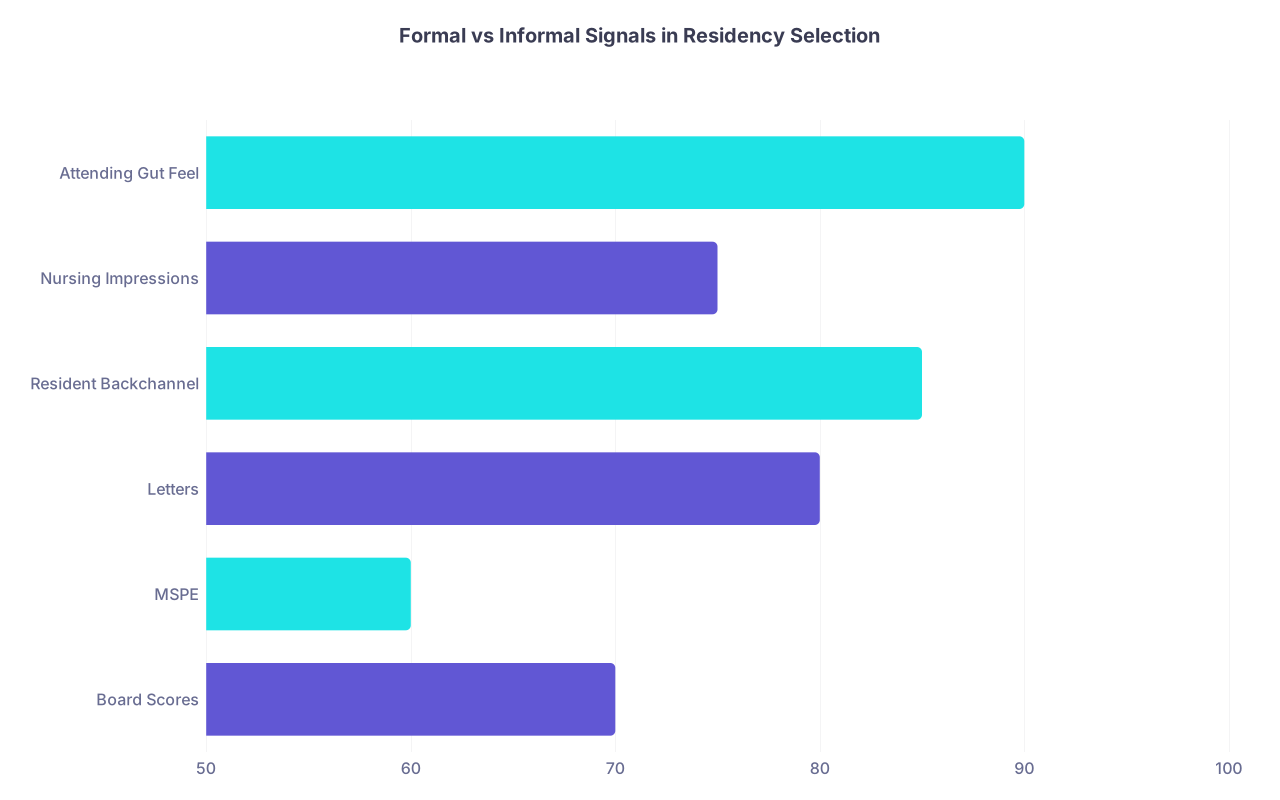
| Category | Value |
|---|---|
| Board Scores | 70 |
| MSPE | 60 |
| Letters | 80 |
| Resident Backchannel | 85 |
| Nursing Impressions | 75 |
| Attending Gut Feel | 90 |