
The rank meeting that decides your future is far less rational than anyone admits—and far more predictable if you understand how it really runs.
Let me walk you into that room.
I’m talking about the closed-door residency rank meeting where a handful of attendings, a PD, maybe an APD or two, and a few residents sit down and literally decide your fate. By name. Out loud. With your photo on a slide.
Not the sanitized version you hear on premed forums. The real one.
How the Room Is Set Up Before You Ever Walk In To Interview
By the time interview season starts, programs already have a rough hierarchy of applicants in their heads, even if they pretend they do not. The rank meeting doesn’t begin on “rank night.” It begins months earlier.
Most programs do some version of this, regardless of specialty:
Initial screen
Staff or a junior faculty member runs through ERAS. People get sorted into three very blunt piles: “strong,” “maybe,” “no.” Step scores (yes, even with Step 1 pass/fail, they still look at Step 2), class rank, school reputation, and any obvious red flags drive this. The PD only sees the “strong” and the top “maybe” pile.Pre-interview scoring
A lot of places in IM, EM, gen surg, anesthesia, peds use a pre-interview composite score. Something like:- USMLE/COMLEX score band
- School tier (they’ll never admit this on the record)
- AOA or class decile
- Home vs away rotator vs total stranger
- Research / leadership flags
- Obvious connections (alumni, faculty email, chair letter)
They swear holistic review. They still run a spreadsheet.
Protected insiders already exist
Before anyone talks about fairness, there is a short hidden list of “we will rank to match” or “we will rank somewhere no matter what.” These are:- Internal students loved by the department
- Away rotators who crushed it
- Offspring of faculty or important alumni
- A couple of “mission fit” candidates (rural, diversity, military, etc.) the institution cares about
Those people are starting the race 50 yards ahead. The rank meeting is not where they earn their spot; it’s where everyone else fights over what’s left.
The Anatomy of a Rank Meeting: Who’s In the Room and Who Has Real Power
Let me be clear: not everyone’s vote is equal. Not even close.
A typical final rank meeting in a mid-to-large program might have:
- Program Director (PD) – de facto king/queen
- 1–3 Associate PDs
- A handful of core faculty (sometimes section chiefs)
- 2–5 residents (often chiefs plus 1–2 handpicked juniors)
- Program coordinator sitting quietly, tracking changes
Heads of department or chair sometimes drop in for 10 minutes to “bless” the list, but they’re rarely in the trenches.
Here’s the part applicants never get: the social dynamics in that room matter more than your last publication. Who speaks freely, who stays quiet, who the PD defers to—that’s the real game.
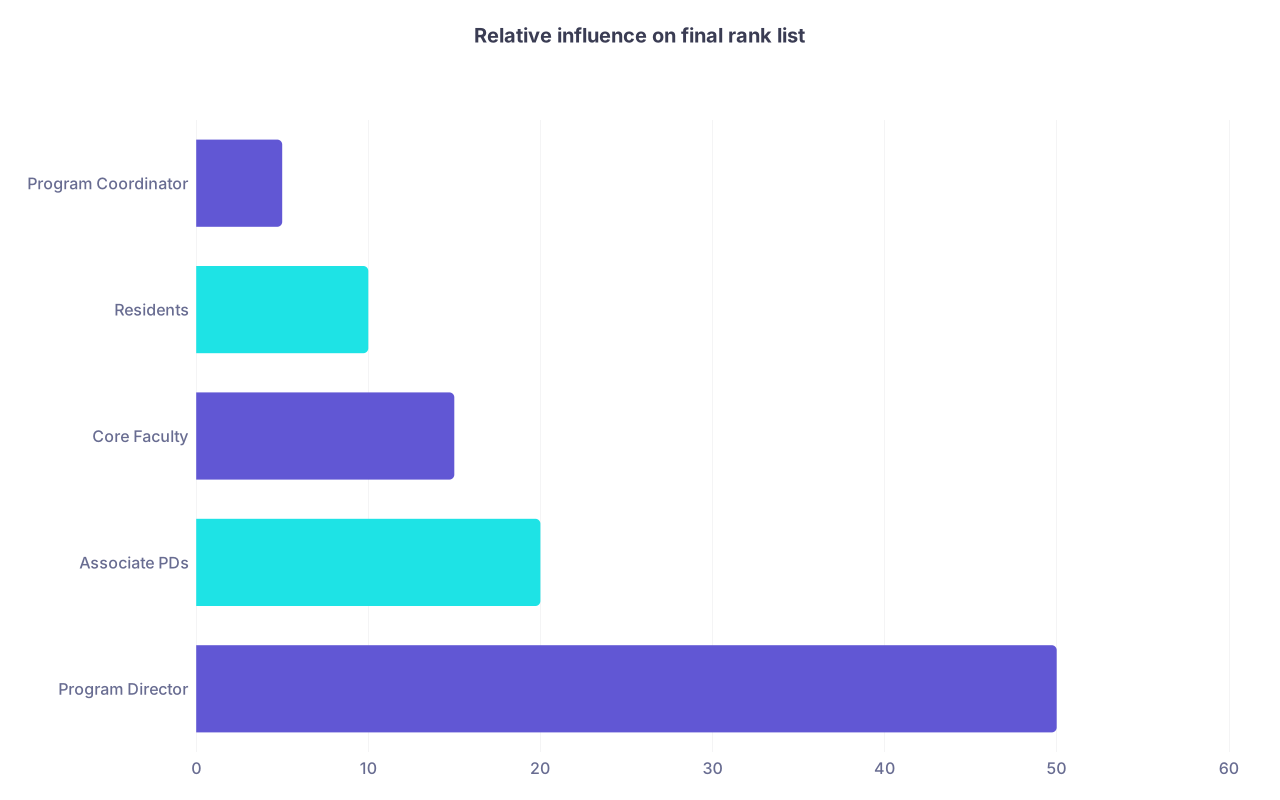
| Category | Value |
|---|---|
| Program Director | 50 |
| Associate PDs | 20 |
| Core Faculty | 15 |
| Residents | 10 |
| Program Coordinator | 5 |
Residents have a voice, yes. They are not driving the bus. A beloved chief might save someone or sink someone, but they’re not rewriting the top 10 alone.
A PD at a strong academic IM program once said, half-joking and half not:
“Everyone gets to talk. I get to decide how much I care.”
That’s the reality.
How Candidates Are Actually Scored Before the Big Night
Most programs don’t start from a blank whiteboard on rank night. They start with a provisional list generated from some kind of scoring system. Then they fight over it.
For a lot of specialties (IM, peds, EM, anesthesia, psych), this looks roughly like:
| Component | Approx Weight (%) |
|---|---|
| Interview Performance | 30–40 |
| Letters & MSPE | 20–25 |
| USMLE/COMLEX | 15–20 |
| Clinical Grades | 10–15 |
| Research/Scholarly | 5–15 |
| “Fit” / Gut Feel | 10–20 |
Interview days generate:
- Faculty interview scores or categories (top third, middle third, etc.)
- Resident feedback forms (“would you want to work with this person?”)
- Notes on concerns: “quiet but solid,” “talked over others,” “seems rigid,” “stellar, would absolutely work with”
The “fit / gut” category is where the dirty little secret lives. That’s code for:
How much did this person make the interviewer feel that they’d be easy to staff at 3 a.m. on a bad call night?
What Actually Happens in the Meeting: Step by Step
Here’s how it runs in most places, whether they admit this or not.
1. The “no brainers” get locked in early
The PD usually starts with: “Let’s look at our clear top group.”
These are the candidates that:
- Everyone liked
- Have no red flags
- Hit whatever the program values (strong academics, good clinical letters, pleasant personality, etc.)
They’re discussed briefly. Someone will say, “Any concerns if we keep them in the top tier?” Silence or a couple of enthusiastic endorsements. They stay at the top.
You aren’t debated. You’re just quietly accepted into the promised land.
2. Then come the “projects” and “favorites”
Now it gets interesting. Because this is where humans start bending the system.
Faculty will advocate for their favorites:
- “This applicant doesn’t look as shiny on paper, but on the wards they were the best student I’ve had in years.”
- “Her Step score is low, but we need more people interested in global health and she’s the real deal.”
- “He’s from our state, first-gen, super hard working. I’d rather have him than another Ivy grad who’s going to do a fellowship and leave.”
This advocacy matters. A lot. One respected faculty champion can drag you up 10+ spots.
On the flip side, someone will quietly (or not so quietly) flag a concern:
- “He was great in my interview, but his sub-I evals are full of ‘needs to work on communication.’ That’s a pattern.”
- “Residents said she seemed condescending to the staff on interview day.”
- “He seemed burned out already. I’m worried he’ll struggle here.”
Those comments stick. And people remember them later when they’re tired and the list is long.
3. The internal / rotator advantage gets cashed in
This is where home students and away rotators cash their chips.
I’ve watched this exact conversation in a surgery program:
Faculty A: “Look, we know Candidate X. We’ve seen him on trauma and night float. He shows up, he owns the patients, and the nurses like him. I would rather have him than some random 260 who we met for 30 minutes.”
Candidate X’s USMLE wasn’t impressive. But they’d spent 8 weeks showing exactly who they’d be at 2 a.m. That wins.
And yes, I’ve seen an away rotator with average scores leapfrog 15 “better” applications in EM/ortho/IM because the residents basically said, “This person makes our lives easier. Rank them high.”
If you rotate somewhere and they remain lukewarm about you, that’s almost worse than never rotating there at all. No one says that publicly, but it’s how people think.
Where Programs Argue and Where They Don’t
The fighting tends to cluster around 3 parts of the list: the very top, the middle, and the “maybe we’ll get them if we’re lucky” tier.
The very top (Rank #1–5 or so)
Everyone wants their superstar in the top three. The PD is thinking about:
- Their board pass rates
- Fellowship match bragging rights
- “Faces of the program” for the next several years
Here’s the irony: a lot of the true superstars have multiple similar offers and may not match there anyway. But programs still obsess over these names.
There will be debate:
- “She’s incredible but I think she’s going to go to [Big Name Program]. Do we burn our #1 spot on her?”
- “If we don’t put him #1, and he ranks us #1, we blow it.”
So they guess. Everyone is gaming everyone.
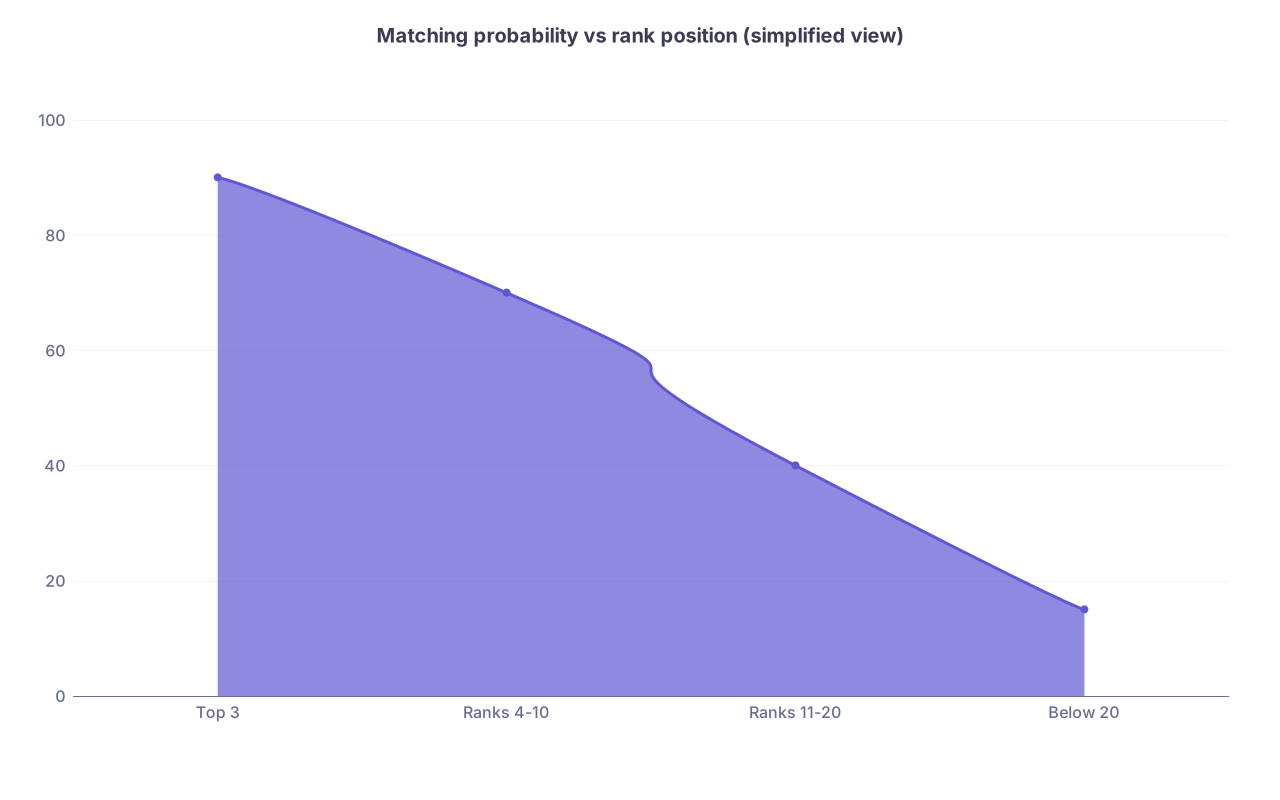
| Category | Value |
|---|---|
| Top 3 | 90 |
| Ranks 4-10 | 70 |
| Ranks 11-20 | 40 |
| Below 20 | 15 |
No, these aren’t exact numbers. But this is how programs think psychologically: top 3 feels “safe,” 4–10 feels “likely,” past that is “we’ll see.”
The mid-tier (where most people actually land)
This is where you live if you’re a solid applicant without a dramatic hook.
At this stage, conversations are fast and sometimes disturbingly superficial. People are tired. There are 100 names left.
The PD will display 8–10 names at a time on a screen:
- Quick comments: “Great interview, no issues,” “seemed quiet,” “strong research, not sure about fit,” “residents loved her”
- Someone might say, “I remember this guy; he really connected with the intern during the social.”
Then decisions like: “OK, bump her up 5 spots. Drop him a few. Anyone object?”
Silence is consent.
If no one remembers you, you fall back on your paper stats. If your file is “fine but forgettable,” you’ll be treated like a moveable number.
The “lottery” tier (bottom half to third of the list)
Now they’re past the number they realistically think they’ll match. This is where they rank people they like enough not to offend, just in case, but don’t expect to ever see again.
Candidates here might be:
- Very strong on paper but clearly going for more competitive or geographically preferred programs
- Couples match wildcards
- People someone liked “okay” but didn’t fight to move up
You don’t want to be here if that program is truly high on your list. Because yes, programs absolutely game the odds and deprioritize people they think are unlikely to match there.
They are not supposed to use your overt signals of interest (“I’m ranking you #1!”) in any official way. Offline? They absolutely do.
How Much Residents Really Matter
Let’s kill a myth: “Residents decide the rank list.” No. They don’t.
But if the residents collectively dislike you? You’re in trouble.
Resident feedback almost always comes in one of three categories:
- “Absolutely yes, I’d love to work with them”
- “Fine / neutral”
- “No, thanks”
If you end up in group 3 with multiple comments, you will slide down. I’ve watched PDs say, “Residents really didn’t click with this one; let’s move them down 10–15 spots.”
Common reasons residents tank someone:
- Condescending or weird with support staff at dinner
- Constant flexing or name-dropping
- Seemed uninterested or bored
- Said something tone-deaf about work hours, wellness, or patient population
- Gave off “I’m just here because I didn’t get interviews at the cool places” vibe
Contrast that with the person who made interns laugh, asked about call, was normal about the flaws of the program, and didn’t pretend every place was their dream. Those applicants get bumped up.
Specialty-Specific Quirks You Won’t Hear on Tours
Every specialty has its behind-the-scenes priorities that change the rank conversation.
Internal Medicine
Academic IM obsesses over:
- Fellowship potential (especially cards, GI, heme/onc)
- Research productivity
- Letters from big names they recognize
Community IM obsesses over:
- Reliability
- Good communication with nurses and staff
- Long-term retention in the area
In rank meetings, academic IM faculty will argue for the future cardiologist with posters at ACC. Community IM will fight for the grounded, “would stay in our town” candidate even with less sparkle.
Emergency Medicine
EM is brutally personality-driven at rank time.
Everyone is asking: “Do I want this person next to me at 3 a.m. with 20 people in the waiting room?”
Red flags in the EM rank room:
- Arrogant, can’t take feedback
- Seems too tightly wound or rigid
- Poor teamwork vibes on the interview day
Huge pluses:
- Easy rapport with residents
- History of thriving in chaotic environments
- Strong SLOEs with “top 10%” language
General Surgery
Surgery rank meetings tend to be more hierarchical and blunt.
They care about:
- Work ethic and resilience
- Operating potential (based on letters and sub-I evaluations)
- Grit. They might not call it that, but that’s what it is.
In the room, a respected surgeon saying, “I want this person in my OR” carries enormous weight.
Someone saying, “He folded on a busy call—complained a lot” can sink you.
Psychiatry
Psych programs will talk more explicitly about:
- Interpersonal style
- Insight and emotional intelligence
- Flexibility with complex patient populations
A PD once said in a meeting: “I don’t care if his Step score is 20 points higher; I would not send my family member to him as a psychiatrist. That’s a no.”
And that was it. Moved down.
The Stuff That Moves You Quietly Up or Down
Here’s what really shifts your position at 10 p.m. when they’re on candidate #147 and no one wants to argue.
Things that quietly push you up
- A faculty advocate who keeps bringing your name up positively
- Residents saying some version of “I’d be happy on nights with them”
- A clear, believable interest in that geographic area (spouse job, family nearby, etc.)
- A strong away rotation where “we’ve actually seen them work”
- Being memorable for the right reasons (something specific, not “nice applicant #47”)
Things that quietly push you down
- Lukewarm or vague letters: “pleasant to work with” with no specifics
- Any whiff of ego, entitlement, or rigidity
- Mild but consistent concerns on evals/MSPE about communication or professionalism
- A sense that you’re “using” the program as a backup and will be unhappy there
- Being completely forgettable
I’ve watched PDs scan a page and literally say, “Who remembers this person?”
Silence.
“OK, let’s leave them where they are and move on.”
That’s how some careers get decided.
How the Final List Actually Gets Locked
Once they’re “done,” they’re not actually done.
There’s often a second shorter meeting or at least email chain where:
- PD revisits the top 10–15 and bottom 10–15
- Someone notices a gap: “We have 3 couples in our top 12; if they don’t match here, this whole section shifts”
- Chair or GME person glances at the top group for optics (diversity, institutional priorities, whatever the hospital is pushing that year)
Some programs also run “what if” scenarios, especially in smaller or more competitive specialties:
- “If we don’t get our top 3, are we OK with this next group being the core of our class?”
- “Do we have enough people who want to do academics vs community?”
By the time the list is certified, it is not some purely meritocratic ordering.
It’s a compromise: personality, politics, faculty ego, resident input, institutional needs, and your actual qualifications all mixed into one.

| Step | Description |
|---|---|
| Step 1 | ERAS Applications |
| Step 2 | Initial Screen |
| Step 3 | Interview Invitations |
| Step 4 | Interviews Completed |
| Step 5 | Preliminary Scores |
| Step 6 | Rank Meeting Debate |
| Step 7 | Adjust for Priorities |
| Step 8 | Finalize Rank List |
| Step 9 | Certify in NRMP |
What This Means For You: How to Play the Game Without Selling Your Soul
You cannot control the entire room. But you have more influence than you think over what gets said about you when you’re not there.
Focus on three things:
Be someone residents genuinely want next to them
The resident social, the way you talk to staff, the questions you ask about real life there—those matter more than you think.Give at least one person a reason to advocate for you
This could be a sub-I attending, an interview faculty, or a PD. Show depth about something (geographic tie, academic interest, a clear narrative) so they remember you as “the one who…”Avoid being forgettable
Not by being loud or performative. By being specific, prepared, and present. Bland applicants slide down lists at 11 p.m. because no one has energy to defend them.