
It is mid‑July of your PGY‑2 year. You are sitting in the workroom between pages, scrolling through your inbox. One co-resident forwards a glowing fellowship letter draft their mentor shared with them “for your records.” It is ridiculous. Two full pages of specific cases, superlatives, and the kind of lines you see in people who match at Hopkins, MGH, Stanford.
You look at your own emails. You have… one polite “happy to help—remind me in the spring” from an attending who barely remembers your name. Another faculty member has not replied at all.
This is the fork in the road nobody explains to you in intern orientation: by the time ERAS opens for fellowship, some residents will have three weapons‑grade letters essentially locked in, and others will be hustling for generic paragraphs written 48 hours before the deadline. The difference is not random. It is built over 18–24 months of specific, often invisible behaviors.
Let me walk you through how this really works behind the scenes.
How Program Directors Actually Read Fellowship Letters
Before we talk about getting great letters, you need to understand how they’re read. Because that informs what you should be aiming for.
Picture a fellowship selection meeting. Stack of applications. Everyone exhausted. They’re flipping through PDFs at alarming speed.
What happens with letters? They do not read every word for every applicant. They scan first. Their brains are trained for certain signals.
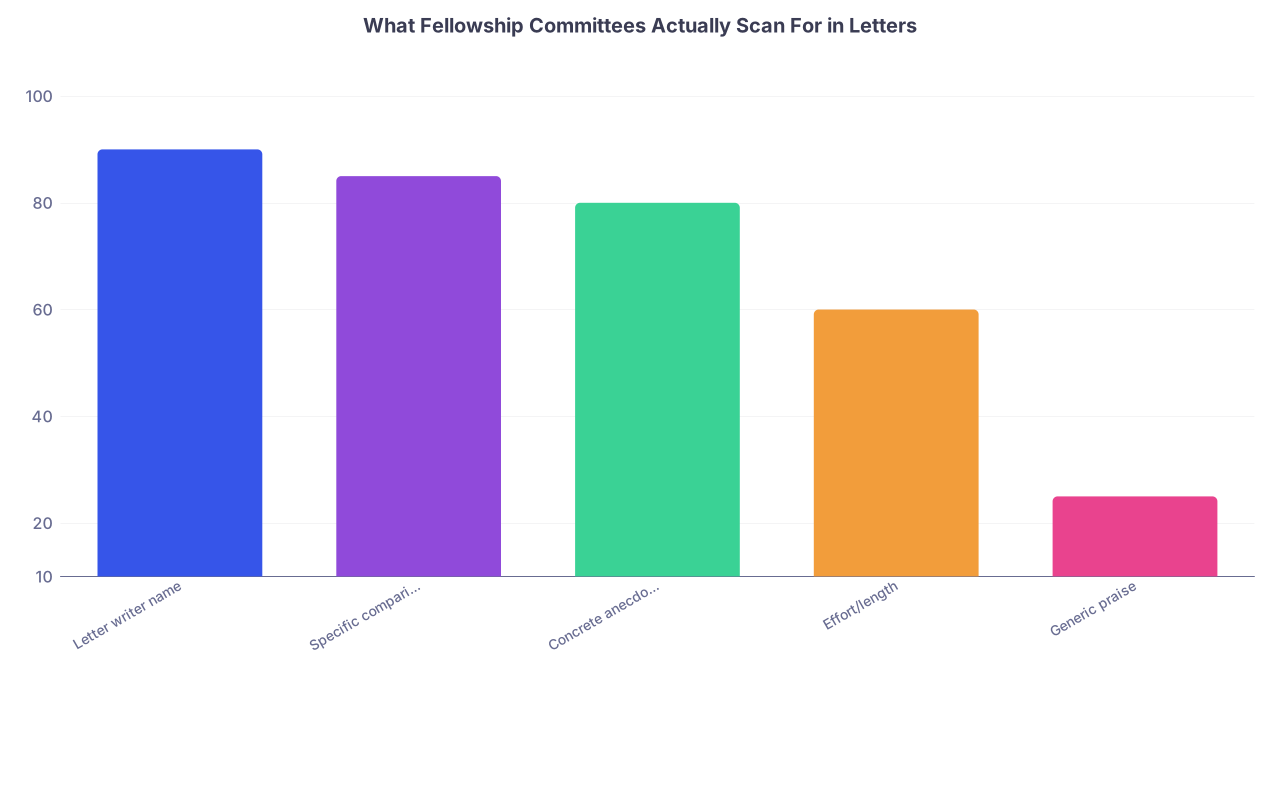
| Category | Value |
|---|---|
| Letter writer name | 90 |
| Specific comparisons | 85 |
| Concrete anecdotes | 80 |
| Effort/length | 60 |
| Generic praise | 25 |
Here is what carries weight:
They look at who wrote it. A letter from “Program Director, University of X Internal Medicine” or “Chief of Cardiology, Big Name Hospital” gets their attention instantly. Certain names are essentially brands. If they know the writer is stingy with praise, that letter gets triple the weight.
They look for comparisons. “Top 5% resident I have worked with in the last 10 years.” “Among the strongest procedural trainees I have supervised in my career.” Those are currency. If your letter doesn’t have any rank or comparison, it is already less powerful.
They look for specificity. Fellowship committees are allergic to fluff. “Hard-working, compassionate, team player” is background noise. What they stop for is: “On a complex shock case with multi-organ failure, she independently identified…”, followed by a concrete behavior.
They look at effort. Not everyone admits this, but they judge the length and effort of the letter. A one‑page, template‑looking note with obvious cut‑and‑paste is judged harshly. A well‑structured, detailed 1.5–2 page letter implies the writer actually cares about you. That matters.
They mentally account for writer generosity. They know which PD writes “outstanding” for literally every average person, and which attending only uses “outstanding” once every five years. Context is everything.
And here is the hardest truth: by the time you are thinking “I should get a letter from Dr. X,” most of what will appear in that letter has already been determined by how you behaved in front of them over months.
The Residents Who Get Elite Letters: What They Actually Do Differently
The residents who end up with the kind of letters that move rank lists are not always the smartest or the nicest. They are the ones who understand how faculty think. Let me show you what they actually do on the inside.
They choose letter writers strategically—and early
Strong letter writers are not the same as “attendings I liked.”
There are three categories that consistently generate high‑impact letters:
- Program leadership: PD, APD, chair, chiefs. Their titles give built-in authority.
- Subspecialty leaders: Fellowship directors or division chiefs in your target field.
- Faculty with national reputations, heavy involvement in education, or known connections to your desired programs.
Residents with great letters do something most of you do not: they identify these people in PGY‑1.
They look around: Who’s the PD that’s deeply involved? Which cardiology attending is constantly getting invited to give grand rounds elsewhere? Who is the fellowship director whose residents keep matching to top‑tier places?
Then they deliberately put themselves in front of those people on rotations that matter. Not just for two days on a consult service while that attending is at a conference, but for a solid block where their work is visible.
Let me be explicit: if you want a big‑name cards letter, and you know Dr. S is the cardiology fellowship director, you should be on their service PGY‑1 or early PGY‑2, not scrambling to meet them in March of your application year.

They build a narrative in front of the writer
Faculty do not write letters from thin air. They repackage a story they have personally witnessed.
Residents who get memorable letters understand that “the story” is built by:
- Being predictably excellent on the basics: showing up early, knowing patients cold, anticipating routine tasks.
- Having a handful of standout moments the attending will remember. The day you handled a crashing patient at 3 a.m. The complex family meeting you led. The impossible discharge you pulled off.
- Showing visible growth over time.
Attendings remember contrast. If you start rotation a little unsure, then by week three you are running the list, making independent plans, and calmly managing cross‑cover calls, that arc is gold. The letter almost writes itself: “Over the course of the rotation, I watched her develop from a strong intern into the de facto team leader.”
They make themselves easy to advocate for
Here’s a dirty little secret: attendings are more likely to go to bat for residents who make their lives easier.
If every time Dr. K staffs the ICU you have the notes done, the labs checked, the imaging pre‑reviewed, and a reasonable plan proposed, they feel safe with you. That sense of psychological safety matters. It is what transforms “Yeah, they were fine” into “I would trust them with my own family.”
Residents with great letters also communicate their goals clearly and early. “I’m really interested in GI. I’d like to be the kind of fellow who can handle the sickest patients in the unit.”
Now the attending knows what lens to view you through. Every time you handle a variceal bleed, that gets filed into the “GI fellow material” box in their head.
By the time you ask for a letter, they already have an internal monologue about you. Your job in PGY‑1 and early PGY‑2 is to shape that monologue.
Why Some Residents End Up With Weak, Generic Letters
Nobody tells you this directly, but most mediocre letters come from predictable mistakes residents make over and over.
They wait too long—and end up forgettable
If your first meaningful interaction with a potential letter writer is three months before ERAS opens, you are already behind. You might still get a letter, but it will be thin.
Faculty memory is not archival. They remember:
- Outliers (brilliant or terrible)
- People they see repeatedly
- Residents who made a strong impression, often tied to one or two specific cases
If you rotated with Dr. L as an intern for two weeks, were fine but not remarkable, then never saw them again, and now you email asking for a letter as a PGY‑3? They will say yes if they are polite. Then they will open your CV, stare at a blank document, and force themselves to type “X was a pleasure to work with…”
That’s not a letter that will get you anywhere special.
They confuse “nice” with “strong”
A lot of residents ask the wrong people because they feel emotionally comfortable with them.
The warm, nurturing ward attending who was very kind to you as a struggling intern might write a sweet letter full of “hard‑working, eager to learn, cares deeply about patients.” That reads as “solid but unremarkable” on the fellowship side.
Meanwhile, the more demanding subspecialist who pushed you, challenged your plans, and intimidated you a bit? That’s often the person who, if you impressed them, will write, “This resident is operating at the level of our current fellows.”
One sounds nicer to your parents. The other moves your application.
They never showed something distinctive
Here is the blunt truth: if your daily behavior screams “average,” there is nothing for an attending to write about.
You don’t need to be a genius. You do need at least one lane where you clearly stand out: clinical reasoning, procedural skill, ownership of patient care, teaching interns, calm under pressure, or scholarship.
The worst letters I have seen as a faculty reviewer all sound the same:
“Resident X is reliable, gets along with team members, is compassionate with patients, and will be a solid fellow.”
That is code for: there was nothing wrong with them, and also nothing special.
The residents who get the best letters create moments faculty cannot ignore:
- Calling the attending overnight because you caught a subtle EKG change and actually being right.
- Leading a chaotic code with composure while the attending watches.
- Turning around a dysfunctional team dynamic by quietly mentoring a floundering intern.
Those things stick.
What Faculty Actually Do When Writing Your Letter
You need to see this from the other side of the keyboard.
Imagine: I’m the cardiology attending you rotated with for four weeks.
You email me mid‑PGY‑2, subject line: “Fellowship letter of recommendation request.” You attach your CV, personal statement, and a list of programs. You remind me of a couple of patients we co‑managed.
What happens next?
First, I do a gut check. My internal questions:
- Did I like working with you?
- Would I want you in our fellowship program?
- Am I willing to have my name attached to you?
If the answer to that is a strong yes, your letter is already in a different category.
Then I open your CV. I’m looking for alignment. You said you want to do advanced heart failure? I look for ICU experience, QI projects, case reports, anything that shows this is not a whim you woke up with last week.
Now I open a template or an old letter. No one starts from absolute scratch; we all have scaffolds. But here is the key distinction:
For residents I barely remember, I’m plugging in generic descriptions. I might even ask the chief resident for bullets. The letter will be structurally sound but soulless.
For residents who impressed me, I slow down. I think about memorable cases. I comb through the EMR for a day or two, pull patient MRNs, remind myself of what happened. I write lines like:
“On our CCU service, we cared for a young patient with fulminant myocarditis who rapidly progressed to cardiogenic shock. Dr. R independently recognized the subtle early signs of decompensation on morning rounds, escalated care appropriately, and coordinated with the ICU team for timely mechanical circulatory support. This level of situational awareness is rare in residents at his stage.”
That level of detail is what selection committees trust. Because you cannot fake it without sounding vague.
The other piece you do not see: many of us informally rank you in the letter. PDs notice phrases like:
- “Top 5%” vs “Top third”
- “One of the best” vs “Among the many”
- “Extraordinary” vs “Very strong”
We are choosing our adjectives deliberately. A resident may never know their true rank; fellowship directors reading dozens of letters from the same writer absolutely do.
The Quiet Politics: PD Letters vs Specialty Letters
One more layer: who your letters come from sends as strong a signal as what’s in them.
There is an unofficial “must have” structure for most competitive fellowships:
- One letter from your residency PD (or APD in a large program).
- One or two letters from subspecialty faculty in the field you are applying to.
- Optional additional letter from someone who knows your academic or research strengths.
| Fellowship Type | PD Letter | Specialty Letters | Research/Other Letter |
|---|---|---|---|
| Cardiology | Required | 2 | Optional |
| GI | Required | 2 | Optional |
| Heme/Onc | Required | 1–2 | Strongly preferred |
| Pulm/CCM | Required | 2 | Optional |
| Endocrinology | Required | 1–2 | Optional |
Residents with top‑tier letters are very deliberate about this distribution.
They do not skip the PD letter, even if they worry the PD doesn’t “know them that well.” PDs talk to each other. A missing PD letter, when everyone else has one, raises questions. Instead, strong residents make sure the PD does know them by:
- Taking leadership roles (chief resident, committee work, curriculum projects).
- Being the one the PD hears about from multiple attendings (“Have you seen how good J has become?”).
- Meeting with the PD periodically to discuss career goals, not just when there’s a problem.
On the subspecialty side, the best letters come from people whose word carries weight in that specific field. A generic cards attending at a community site isn’t equal to the division chief in terms of impact, even if the latter is scarier to you.
And then there’s the research letter. In oncology, for example, I have watched mediocre PD letters get overridden by a stunning letter from a PI at a major cancer center describing real, sustained research productivity and clinical potential. That’s the exception, not the rule—but it happens.
How to Turn a Normal Rotation Into Letter Material
So what do you actually do during a rotation with a potential letter writer?
Think of it as an audition, but not in the fake “try-hard” sense. You’re building a three‑part impression: baseline reliability, standout strengths, and character.

| Step | Description |
|---|---|
| Step 1 | Week 1 - Show Reliability |
| Step 2 | Week 2 - Demonstrate Growth |
| Step 3 | Week 3 - Create Standout Moments |
| Step 4 | Week 4 - Clarify Goals and Close Strong |
Week 1: You prove you are not a liability. You are on time. You know your patients. You don’t disappear. You ask good, contained questions. You read at night and it shows in your plans.
Week 2: You show growth. You need fewer prompts; you start anticipating next steps. You volunteer for the tough admissions instead of avoiding them. The attending notices the trend.
Week 3: You deliberately create at least one standout moment. Volunteer to lead a family meeting—then prepare meticulously. Ask to present a mini‑teaching session to the team. Offer to write up an interesting case with the attending if something comes in that’s worth reporting.
Week 4: You connect the dots. You say something like, “This month really confirmed for me that I want to pursue nephrology; I’d like to develop into the kind of consultant who can manage complex ICU patients the way you do.” You are not asking for a letter yet. You’re setting up the story.
Residents who do this consistently walk out of rotations with attendings already thinking: “That’s a future fellow. I could write them a great letter.”
The Ask: How Strong Residents Actually Request Letters
Another behind‑the‑scenes truth: how you ask for a letter influences how much effort goes into it.
The residents who get the best letters do not send a one‑liner: “Dear Dr. X, I was wondering if you could write me a letter for fellowship. Thanks.”
They send something closer to this:
- A short, respectful email reminding the attending who they are, what rotation they shared, and any memorable shared cases.
- A clear statement of goals: what fellowship, what kind of career they’re aiming for.
- An honest line inviting the attending to decline if they cannot write a strong letter.
Something like: “If you do not feel you can write a strong letter on my behalf, I completely understand and would appreciate your honesty.”
What does that do? It gives the attending an easy out. If I was lukewarm on you, I will politely decline, and you’ve just avoided a mediocre letter that would quietly sink your application.
Strong residents also attach a “letter packet”: updated CV, personal statement draft, list of programs, and sometimes a one‑page “brag sheet” with bullet points of specific things they did on that rotation. Not to brag but to remind the writer of concrete material.
The best letters I have written were for residents who made my job simple. I still did the thinking and wrote from scratch, but I did not spend half my time digging through the chart to remember what actually happened.
The Intangible Factor: Reputation Drift
One last insider concept you won’t hear in official talks: reputation drift.
By PGY‑3, every resident has a “whisper reputation” among faculty:
- “Incredibly smart, a little intense, but I’d want them as my doctor.”
- “Super nice, but I wouldn’t trust them alone in the unit.”
- “Slow start as an intern, but has improved massively. I’m impressed.”
- “Great on days, disappears on nights.”
This reputation quietly colors your letters—even from people who never directly supervised you.
PDs and fellowship directors talk. They ask each other, “What’s the story on this one?” before they rank you to match.
Residents who end up with elite fellowship letters have reputations that match those letters. You cannot fake it with three documents in ERAS if everyone in your home institution knows you cut corners, misrepresent your work, or crumble under pressure.
On the flip side, if you had a rough PGY‑1 but clearly put in the work to turn things around, some of the most powerful letters you can get are from faculty who saw that arc. “I have rarely seen a resident grow as much as A did over three years. They took feedback seriously and transformed from struggling intern to one of our most reliable seniors.”
Fellowship directors love that story. It signals resilience and humility, not just raw talent.
What You Should Be Doing Now—Depending on Your PGY Level
Where you are in training changes your moves.
If you are a PGY‑1: your job is exposure and reputation. Get on the radar of potential letter writers in your specialty at least once this year. Do not be the intern they have to constantly chase. Avoid drama. You’re building a floor.
If you are early PGY‑2: this is prime time. Identify 3–4 target letter writers and get serious rotations with them in the next 6–9 months. On those services, treat every day like you’re already auditioning for fellowship. Ask for feedback mid‑rotation and act on it. Start small scholarly projects with one or two of them if you can.
If you are late PGY‑2 / early PGY‑3 and feel behind: you do not have the luxury of randomness. You need to:
- Sit down with your PD or APD and get a brutally honest read on your competitiveness and who might write for you.
- Stack your remaining elective time with the most credible letter writers in your field.
- Over‑communicate your goals with those attendings and deliver at a very high level while you’re with them.
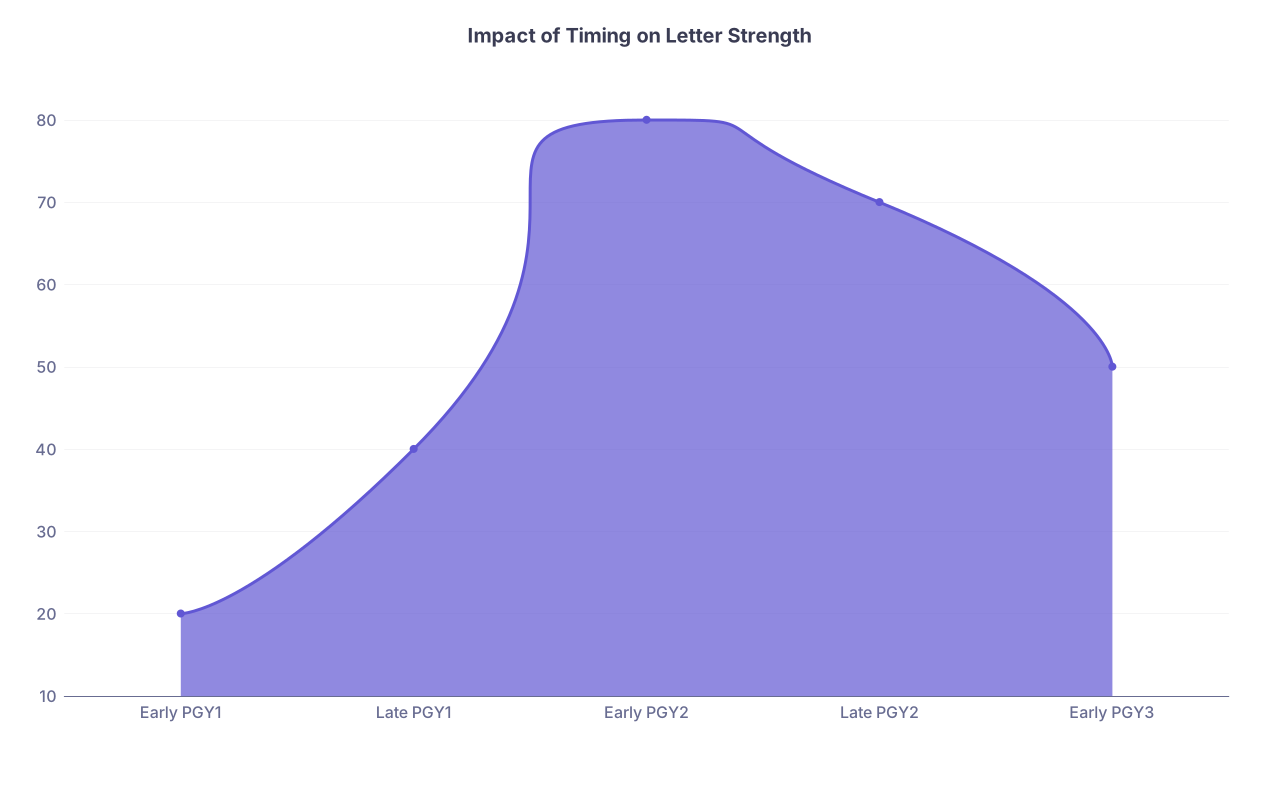
| Category | Value |
|---|---|
| Early PGY1 | 20 |
| Late PGY1 | 40 |
| Early PGY2 | 80 |
| Late PGY2 | 70 |
| Early PGY3 | 50 |
The further left you start building these relationships, the more powerful the letters end up. Residents who wait until the right side of that graph are betting on short‑term impressions. It can work, but it is risky.
What Comes Next
Fellowship letters don’t appear out of nowhere in August of your application year. They are the written record of how you’ve practiced, behaved, and grown since the first day you put on your resident badge.
The residents who get the best letters are not always the ones born brilliant. They’re the ones who consciously curate who sees their best work, who understand how attendings think, and who give faculty something real to write about.
You can start doing that tomorrow on your next shift.
From here, your next step is simple and uncomfortable: sit down with your schedule, identify your realistic letter writers, and be honest about what they’ve actually seen from you so far. If that picture is not as strong as you’d like, you still have time to change the story—if you start now.
Once you’ve lined up people willing to write truly strong letters, then we get into the next layer: crafting your personal statement, coordinating your letters with your PD, and building an application that tells one coherent story instead of three disconnected ones. That’s the next move in this game—but you cannot play it well without the right letters in your corner.