
Last recruitment season, I watched an IM PD at a big-name East Coast program skim a stack of fifty files in under an hour. Step scores, transcripts, CVs flew by. Then she hit a chair letter that made her actually stop, lean back, and say out loud: “Okay… who is this kid?” That’s the reaction you’re trying to generate. Most of you do not.
Let me walk you through what really happens to your chair letter when it lands inside a competitive internal medicine or neurology program. Not what the dean’s office brochure says. What actually happens in the workroom, on Zoom rank meetings, and in the side conversations between PDs and chiefs.
First truth: The chair letter is not read the way you think it is
You imagine some solemn, line-by-line reading, highlighter in hand, weighing every adjective.
Reality: in competitive IM and Neuro programs, especially academic ones, the chair letter is scanned first for three things, and three things only:
- Who wrote it
- How strong the signal is
- Whether there are any red flags or weird hedges
The actual “story” content is secondary. Polite fluff is background noise.
Here’s how it typically goes in a committee room or on a PD’s screen:
They open your file. They already know your scores, grades, maybe your personal statement. They click the chair letter and their eyes go straight to the letterhead, signature block, and last paragraph.
No one is starting at paragraph one and lovingly absorbing the narrative.
They’re asking themselves:
- Do I know this chair?
- Do I trust their judgment?
- Are they sending a clear signal, or is this generic template nonsense?
- Is there any faint whiff of “do not rank high”?
If the answer to those questions is “known and trusted, strong signal, no hedges,” the chair letter has already done its real job. The details just need to not screw that up.
If it’s from an unknown or weak chair, pure template language, or hedgy… you’re fighting uphill, especially in the upper-tier IM/Neuro programs.
How IM and Neuro programs actually use chair letters
Internal medicine and neurology handle chair letters similarly, but with slightly different priorities.
Broad strokes: IM leans heavily on chair letters for global professionalism and “will they function on a busy inpatient service” reassurance; Neuro leans more on them for “is this person actually interested in neurology and not using us as a backup” plus cognitive/behavioral fit.
Let’s split them for a second.
In competitive Internal Medicine programs
Think places like BIDMC, Northwestern, Michigan, UCSF, Mayo, Baylor. At these places, the chair letter is:
- A trust check: “If Dr. X says they’re in our top 10%, I believe it.”
- A behavioral filter: “Will this person be a problem at 2 a.m. in the MICU?”
- A prestige signal: Not fair, but yes—some chairs’ names carry weight nationally. Their praise moves the needle.
What they look for:
- Explicit ranking phrases (“among the top residents I’ve worked with in the last 5–10 years” — yes, they notice the time window).
- Evidence you can handle autonomy, volume, and complexity.
- Comments about work ethic that are specific, not “hard-working and dedicated.” Everyone is “hard-working and dedicated” on paper.
Where it hurts you:
- Vague, tepid language like “I fully expect them to become a competent internist” — that word, “competent,” is death at top places.
- Short letters that read obviously templated, with your name swapped in.
- Any subtle mention of “with support,” “benefited from direct supervision,” or “improves with feedback” as the central praise.
In competitive Neurology programs
Think MGH/Brigham, Columbia, Penn, UCLA, WashU, Hopkins. Here, the chair letter is a bit different:
- A commitment check: “Is this actually a neuro person or just someone with decent scores fishing for an interview?”
- A cognitive/behavioral assurance: Neurology cares deeply about reliability, detail orientation, and emotional steadiness.
- A fit filter: Are they the kind of person we can mold into a subspecialist/fellow?
They’re scanning for:
- Direct mentions of neurology-specific interest, rotations, and impact on neuro faculty.
- Phrases like “He has already functioned at the level of a junior neurology resident” or “She was among our best students on the neurology service in recent memory.”
- Comments about analytical thinking, communication with families, patience, and persistence.
Red flags in Neuro-chair letters that will quietly kill you:
- Anything hinting at interpersonal friction with staff or families.
- Comments about being “easily overwhelmed,” “still developing confidence,” or “requires encouragement.”
- No mention of neurology exposure at all, or obviously generic text that could’ve been written for someone applying to anesthesia or IM.
The hierarchy: which letters actually matter
You probably have a stack of letters: mentor, subspecialty attending, research PI, and the chair. Let me be blunt: not all letters are created equal.
Here’s the hierarchy as it is applied in real discussions, not as publicly stated:
| Letter Type | Typical Weight |
|---|---|
| Big-name, specific chair letter | Very high |
| Subspecialty IM/Neuro attending | High |
| Research PI in same specialty | Moderate–High |
| Generic home institution chair | Moderate |
| Non-specialty or vague faculty letter | Low |
Program directors will never say this out loud, but they treat:
- A powerful subspecialty attending letter (e.g., from a well-known cardiologist or epileptologist) as more useful for clinical detail.
- A strong chair letter as more politically important and reassuring.
In a lot of IM and Neuro programs, the chair letter is more of a gatekeeper than a detailed evaluation. It signals, “No hidden landmines,” or, “Proceed with caution.”
When it’s written by a nationally known figure, it becomes a currency. PDs remember who those chairs vouched for, and they track whether those residents turned out as advertised.
How the letters are actually read in committee
Let me walk you through an actual internal scene.
PD has your file open during a pre-interview or ranking meeting. There are 30–40 applicants up for serious discussion. No one is reading letters from scratch. They are confirming impressions.
The PD glances at the chair letter and does this:
- Skims the end for the summary paragraph.
- Looks for ranking language: “top 5%,” “one of the best in the last decade,” etc.
- Checks for any coded language that suggests problems.
- Looks at 1–2 concrete examples if time allows, usually earlier in the letter.
The residents or faculty on the committee? Most of them never read the chair letter in full. At best, one faculty member who previewed your file might summarize:
“Chair says she’s among their best students in several years, excellent on wards, no concerns.”
Or:
“Chair letter is fine, but nothing standout. Mostly generic.”
That 10-second summary carries more weight than any finely crafted anecdote buried in paragraph three.
In IM and Neuro specifically, I’ve watched PDs say:
- “What does the chair say?” as the tie-breaker between two similar applicants.
- “Anything weird in the chair letter?” as a quick risk screen.
Your chair letter often does not get you the interview. It can, however, quietly cost you one. Or it can move you from “maybe” to “yes” when everything else looks similar.
What “strong,” “medium,” and “weak” chair letters really look like
You’re not good at distinguishing strength levels because all of them sound flattering to an untrained ear. The language is coded. Let’s decode it.
Strong chair letter (what PDs perk up for)
Features:
- Clear, explicit ranking: “top 5–10% of students I’ve worked with in the last decade”
- Concrete, specialty-relevant examples
- Unambiguous endorsement: “I give my highest recommendation without reservation”
Example phrases that carry real weight:
- “I would be thrilled to have him as a resident in our own program.”
- “She stands out not only for her fund of knowledge but for her clinical judgment, already functioning at the level of a first-year resident.”
- “Among the neurology-bound students in recent years, he is the one I would expect to lead in academic contribution.”
Medium chair letter (most people fall here)
Features:
- Pleasant adjectives, but no strong ranking language
- 1–2 generic examples
- Safe but lukewarm closing: “I recommend her for your residency program.”
Phrases that signal “fine, but not special”:
- “She will make a fine resident.”
- “I expect him to be a solid contributor to your program.”
- “She performed well on her rotations and worked well with the team.”
These letters do not rescue mediocre metrics, and they do not separate you from the crowd at high-tier programs. They’re neutral.
Weak or “concern” chair letter (even if it sounds polite)
Features:
- Very short length, very generic, no specifics
- No ranking, no comparison to peers
- Odd qualifiers or hedging
Phrases that quietly torpedo you:
- “With appropriate supervision, he will grow into a competent resident.”
- “She had some early challenges but responded to feedback.”
- “He has the potential to succeed with the right environment and support.”
Nobody’s going to write “Do not rank.” They don’t need to. That kind of language is enough. PDs read this, mark you as risky, and move on.
IM vs Neuro: subtle differences in what they read for
There’s overlap, but the emphasis is different. Here’s how it tends to break down.
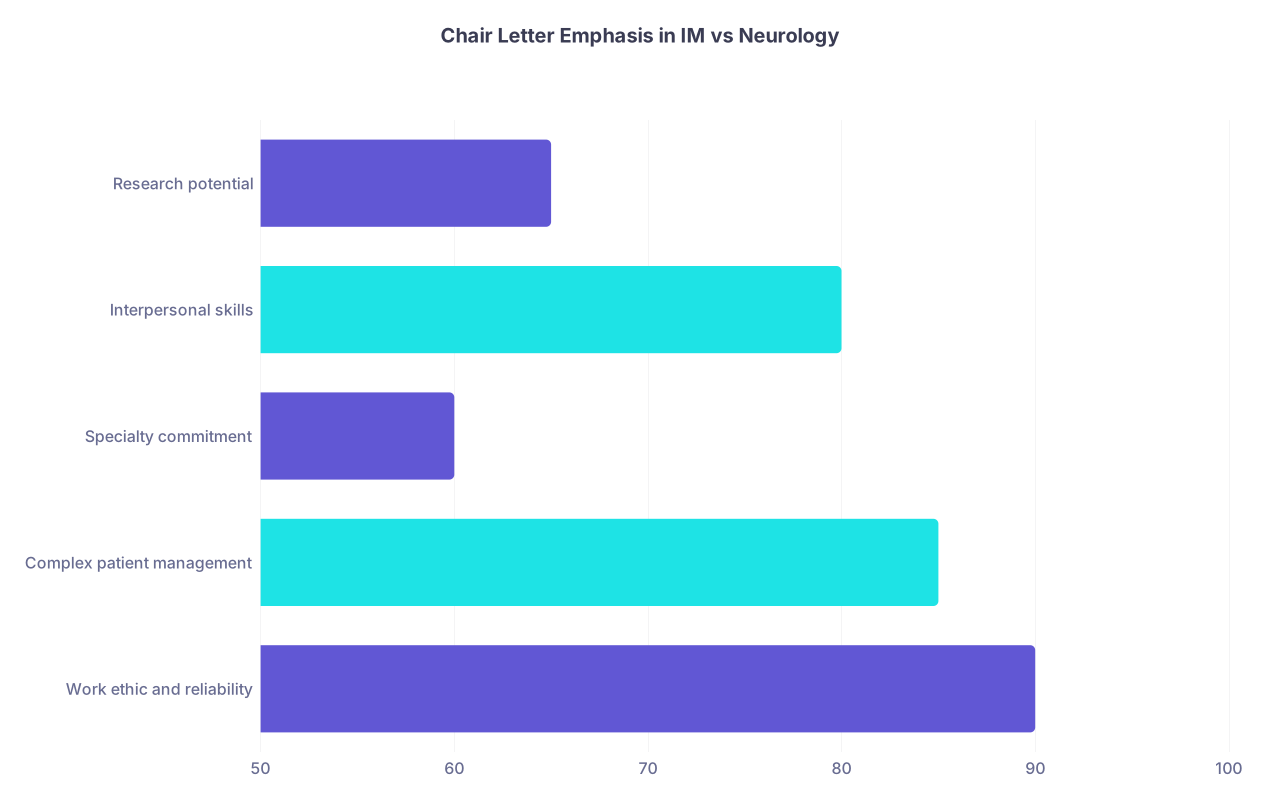
| Category | Value |
|---|---|
| Work ethic and reliability | 90 |
| Complex patient management | 85 |
| Specialty commitment | 60 |
| Interpersonal skills | 80 |
| Research potential | 65 |
For Neurology, swap those emphasis levels in your head: specialty commitment jumps way up; complex patient management drops slightly; research potential often matters more at academic heavy-hitters.
In practice:
- IM programs read carefully for team functioning and multi-comorbidity management potential. Phrases like “took ownership of complex patients, coordinated with multiple services, and never dropped the ball” land very well.
- Neuro programs read more carefully for attention to detail, communication, and steadiness. Phrases like “showed remarkable patience interpreting subtle neurologic findings and explaining complex diagnoses to families” hit exactly where they’re aiming.
If your chair letter subtly reads like you’re a medicine person applying to neuro as an afterthought, top neuro programs will notice. And vice versa.
How connections and politics creep in
Another behind-the-scenes reality: the identity and reputation of the chair matters. A lot more than schools will admit.
If you’re from a smaller or less-known school and your chair is not a national figure, you’re already starting with weaker signal strength. That doesn’t mean you’re doomed, but you’re not getting the same instantaneous “oh, I know this person’s judgment” reaction as someone coming from UCSF IM or Columbia Neuro with a letter from a nationally visible chair.
PDs absolutely say things like:
- “Oh, that’s a So-and-So letter? They’re pretty reliable. If they say top 10%, I believe it.”
- Or the opposite: “Yeah, that chair calls everyone ‘excellent.’ I discount those a little.”
Is that fair? Not really. Is it real? Yes.
Your buffer against a less-known chair is:
- Rock-solid subspecialty letters
- Clearly documented performance on rotations at big-name away sites
- Chair letter that at least sounds individually written, with specific examples, not just recycled praise.
The hidden timing and reading order game
There’s also a structural piece most students never think about: when the chair letter is read and in what order.
Typical pattern for many IM and Neuro programs:
- Initial screen: board scores, school, transcript, MSPE, maybe personal statement.
- Secondary screen: subspecialty letters (for Neuro, especially neuro faculty letters) and research.
- Chair letter: checked closer to invite decision or after deciding you’re serious.
In other words, your chair letter is often not what gets you on the short list. It’s what gets you safely through the short list and avoids surprises later.
When does the chair letter suddenly become very important?
- Borderline candidates: strong story but maybe a softer metric. The PD reads the chair letter to decide whether to take a chance.
- Top stack candidates: everyone agrees you’re strong; the chair letter is checked for landmines before ranking you highly.
- Mixed-signal files: one great attending letter, one lukewarm; the chair letter serves as tie-breaker.
What you should actually care about as an applicant
You can’t write your own chair letter. You also can’t turn your chair into a national name by September. So what can you control?
You can:
- Make sure the right people are feeding information to your chair. If your chair doesn’t know you, those subspecialty attendings and mentors have to send them concrete bullets.
- Ensure you’ve done at least one rotation where your clinical behavior is fully “chair-letter safe.” No professionalism dings. No disappearing acts. No staff complaints. Chairs do hear those things.
- Clarify your specialty commitment with actions, not just talk. Particularly for neurology. Published case reports, neuro electives, presentations at local neuro meetings—those details should find their way into the chair’s narrative.
For IM: make your record show that you can function on a real ward. For Neuro: make your record show you’re not just there because you liked your stroke rotation once.
A quick internal flow of how chair letters shape the final rank list
Here’s what the PD’s actual mental flowchart looks like when everything’s on the table:

| Step | Description |
|---|---|
| Step 1 | Applicant on short list |
| Step 2 | Low rank or no rank |
| Step 3 | Check subspecialty letters |
| Step 4 | Read chair letter carefully |
| Step 5 | Scan chair letter for red flags |
| Step 6 | Moderate to high rank |
| Step 7 | Lower rank or remove |
| Step 8 | Keep at projected rank |
| Step 9 | Metrics and rotation reviews strong |
| Step 10 | Letters consistent and strong |
| Step 11 | Chair strongly positive |
| Step 12 | Any hedging or concerns |
Nobody is going to announce, “We’re bumping you down 30 spots because the chair used the word ‘competent’ instead of ‘outstanding.’” But the aggregate effect of that hedging is exactly that.
FAQs
1. If my chair barely knows me, am I screwed in IM or Neuro?
Not automatically, but you’re at risk of getting a generic, medium-strength letter. That will not sink you by itself, but it also will not rescue you if your application is borderline. Your job is to make sure your subspecialty letters are excellent and that your key attendings actively communicate with the chair—many schools have an internal process for that, but you may need to politely nudge it along. A generic chair letter plus generic attending letters? That combination absolutely will hurt in competitive IM and Neuro.
2. Does a famous chair’s letter really matter that much?
Yes. At the upper-tier IM and Neuro programs, a letter from a nationally known, trusted chair is a force multiplier. PDs have mental maps of which chairs “over-rate” and which are brutally honest, and they adjust for that. But a strong ranking statement from a respected name can be the difference between “solid candidate” and “we should push them up.” It doesn’t override terrible metrics, but among strong applicants it can move you up the pile.
3. Can a single weak phrase in my chair letter tank my application?
Not in isolation, but it can be the deciding negative when the file is already on shaky ground. One hedgy sentence about “needing support” or “still developing confidence” won’t kill you if everything else screams “star.” But if your scores are average for that program and other letters are just “good,” the cautious tone of the chair letter will push you into the “not worth the risk” category. The letter is interpreted in context, but PDs are very sensitive to even mild concern language.
4. Is the chair letter more important in IM or Neurology?
They’re both important, but in slightly different ways. Internal medicine uses the chair letter more as a global “safety and reliability” check and sometimes as a prestige signal. Neurology uses it more as a commitment and fit check—especially for applicants where the program is not yet sure they’re truly neuro-focused. In both, a truly strong chair letter helps; a generic one is neutral; a hedged one is dangerous. You won’t win a match purely on a chair letter, but you can absolutely lose one because of it.
Years from now, you will not remember the exact adjectives your chair used in that letter. What will stick with you is whether you’d built a track record that made it easy for them to say, without hesitation, “Yes, this is someone I would trust with my own patients.” That’s the part you control, long before anyone ever hits “open” on your file.