
You’re sitting at your laptop with fifteen psychiatry programs bookmarked. Your advisor just said, “Honestly, psych is less hierarchical than surgery. You’ll be fine anywhere.” Then a co‑MS4 pulls you aside and whispers, “No, there’s like… the real psych programs. The ones that open every door.”
Now you’re trying to figure out which list is real.
Let me be blunt: there absolutely is a prestige hierarchy in psychiatry. It’s just more subtle, more political, and more heavily disguised behind “fit” and “interest alignment” than in something like ortho. Program directors will never write this on their websites. Faculty talk about it over beers at APA, not in official meetings.
But they all know it. And they act on it.
I’ll walk you through how the tiers really shake out, what they mean for fellowships and jobs, and where people routinely delude themselves.
How Psych Hierarchy Actually Works (Not How People Pretend It Works)
The first lie you’ll hear: “Psych is so short-staffed, prestige doesn’t matter.”
Wrong. Clinical jobs are plentiful. Plum jobs are not. Elite fellowships are not. Fast-track academic careers are not.
Here’s what really drives prestige in psychiatry:
- Historical academic clout (decades of NIH money, landmark trials, named chairs)
- Faculty names that show up on the papers you actually see in JAMA Psych or AJP
- The reputation of their graduates among chairs and PDs who hire
- Perception of resident quality (and yes, Step scores and med school pedigree still feed that)
- Depth of subspecialty training and research infrastructure
But psych is weird compared to, say, derm. A mid‑tier overall program with a legendary addiction service can outrank a “top 5” place within that niche. Same with forensics, CL, women’s mental health, neuropsychiatry.
So there are really two overlapping hierarchies:
- Overall residency prestige
- Subspecialty/fellowship-specific prestige
Smart applicants understand both.
To ground this, here’s how PDs and faculty informally sort things when they’re being honest.
| Tier | General Reputation |
|---|---|
| 1A | National elite, opens any door |
| 1B | Strong national academic, highly competitive |
| 2 | Solid academic / hybrid, regional powerhouses |
| 3 | Decent training, regional recognition |
| 4 | Service-heavy, less academic visibility |
Do people argue at the margins? Sure. But this is the skeleton most insiders use.
Tier 1A: The “You Can Do Anything” Psych Programs
These are the names that stop conversations. If you match here and don’t burn it down, doors open almost automatically. Chairs assume you’re well trained. Fellowship directors assume your letters carry weight. Academic departments assume you know what an R01 is.
Think: MGH/McLean (Harvard), Columbia, UCSF, Stanford, Yale, maybe Penn when it flexes.
I’ve sat in ranking meetings where someone literally said, “She’s from MGH, just interview her.” No CV in front of them yet. That’s how baked in this is.
What defines Tier 1A psych:
- Massive research infrastructure. Multiple R01-funded labs, imaging, genetics, digital mental health, early psychosis programs.
- Subspecialty depth. Not just a CL fellowship. A CL brand. A psychosis program that other programs send their toughest cases to. Autistic spectrum clinics with big grants. Cutting edge neuromodulation.
- Name‑brand faculty. People on guideline panels. Names you recognize from your Step resources. People who get invited to give grand rounds everywhere.
- Residents who match into any fellowship they want, often at the same or equivalent tier. Not “one superstar got into Stanford CL.” More like every year, several go to top fellowships, or just stay and do theirs in-house because it’s already elite.
This doesn’t mean every graduate becomes a superstar academic. Many head straight to private practice, outpatient groups, telepsych, or boutique concierge practice. But the difference is: if they want to pivot into research or highly selective subspecialty work, people assume they can.
The downside no one tells you
Life in Tier 1A is not all cozy psychotherapy and “protected time.”
You trade:
- More scut disguised as “research opportunities”
- Heavier pressure to produce posters, abstracts, actual manuscripts
- Being surrounded by extremely driven (and sometimes performatively anxious) co-residents
- Attendings who expect you to think like a junior faculty member by PGY‑3
I’ve watched residents at UCSF and MGH flame out because they really just wanted a clean 9‑5 outpatient life and ended up in a culture where everyone compares CVs.
If you’re not at least open to academic work, this tier can be overkill.
Tier 1B: Real Academics, Slightly Less Hype, Still Powerful
These programs could sit next to Tier 1A at any national meeting and nobody would bat an eye. The difference is degree, not kind.
Think: Brown, Michigan, UCLA, Washington University in St. Louis, Mayo, Northwestern, some of the stronger NYU / Sinai tracks, Emory, Duke, Hopkins psych (yes, the brand is big but psych-specific hype is more nuanced than students think).
What distinguishes 1B from 1A usually isn’t quality of training. It’s:
- Slightly less sheer research volume or narrower research focus
- Less of an automatic “halo” to non‑psych folks (outside psych, some of these are seen as “strong but not Harvard”)
- Geography — places like St. Louis or Providence do not have the same casual applicant magnetism as San Francisco or Boston
Inside the field, though, PDs and fellowship directors know exactly how strong these programs are. If you’re aiming for CL at Michigan, mood disorders at UCLA, or neuropsych tracks at WashU, nobody will question your pedigree.
The hierarchy between 1A and 1B matters more for ego and certain ultra‑competitive academic niches than for 95% of psych careers. Someone from Brown vs Stanford Psych? No one in a real hiring meeting is drawing that line like premed forums do.
Tier 2: Strong Regionals and Hybrid Workhorses
This is where most well-trained psychiatrists actually come from.
Tier 2 includes:
- State flagships with solid departments: UNC, Colorado, Wisconsin, Minnesota, Iowa, OHSU.
- Mid‑to‑upper academic centers in big cities: Rush, Baylor, some UC programs like UCSD depending on faculty cycle, VCU, UAB, etc.
- Some very strong county/university hybrids: places like UT Southwestern, etc.
These programs:
- Have credible research, but maybe in a couple focused areas rather than across the map.
- Send residents into good fellowships regionally and occasionally to Tier 1A/B places when the resident is motivated and supported.
- Give you heavy, diverse clinical exposure: inpatient, county systems, VA, outpatient clinics with real pathology, not just “worried well tech workers.”
From the inside, many of these programs train better clinicians than the elites. You see more severe SMI, more systems issues, more actual psychiatry instead of residents getting peeled off for research half the time.
The tradeoff is name recognition.
If you walk into an academic job search with “University of Iowa Psychiatry” versus “MGH Psychiatry” on your CV, you may need to prove a little more. People will respect the training, but it won’t short‑circuit the conversation.
You can still absolutely get elite CL, addictions, forensics, child, or research positions out of Tier 2. I’ve seen it repeatedly. The difference is: you need the CV to back it up. The program brand alone won’t carry you.
Tier 3 and 4: Service Programs, Safety Schools, and “We Just Need Bodies”
Here’s the part no one says out loud.
There is a long tail of psych programs that exist primarily to staff hospitals and meet workforce demand. They are not trying to build the next generation of department chairs. They are trying to keep the inpatient unit open.
These are the community-based, low‑research, often newly accredited or rapidly expanding programs. Some older university-affiliated programs sit here too, coasting on a name that used to mean something before the department hollowed out.
Red flags that you’re in Tier 3/4 territory:
- Faculty pages with mostly hospitalists and a couple “directors” but nobody with real publications in the last decade.
- “Research opportunities available” that translate to: you can maybe do a QI poster if you beg.
- No in-house fellowships except maybe a token child slot. Or fellowships that are basically just extra service years with a different title.
- Residents who overwhelmingly go straight into general outpatient or inpatient jobs, not by choice but because they weren’t competitive for much else.
Does that mean the training is automatically bad? Not necessarily. You can become an excellent bread-and-butter psychiatrist at many Tier 3 programs. Especially if they serve a high-need, high-volume population.
But you will not get the same mentorship, networking, or reputation halo. And if you later decide you want a prestigious fellowship or academic position, you’re swimming upstream.
Faculty gossip is brutal here. I’ve sat in committees where someone said, “We don’t usually take people from that program; they don’t get much exposure to X.” It’s not fair. But it’s real.
Subspecialty Hierarchies: When a “Mid‑Tier” Beats the Ivies
Here’s where med students often miss the plot.
They obsess over overall USNWR‑style prestige and ignore the fact that some programs are world‑class in one slice of psychiatry and forgettable in others.
If you already have a strong pull toward a subspecialty, you need to know these “micro‑hierarchies.”
A few examples (not exhaustive, but this is how faculty talk):
- Addiction: Places like MUSC, Brown, some VA-heavy programs, and a few big urban centers can have addiction divisions that out-muscle their overall rank.
- Forensics: Programs attached to major state forensic hospitals or with historic forensic units often outrank “shiny coastal” names for forensic-specific training. Think places like UC Davis, some state-oriented programs, etc.
- Consult-Liaison (CL): Here, the academic heavyweights matter, but certain mid-tier hospitals with monster transplant centers or complex medical populations produce incredibly strong CL psychiatrists.
- Child & Adolescent: Some otherwise mid-prestige adult programs have powerhouse child fellowships that are nationally respected.
- Neuropsychiatry / Neuroimaging: This cluster is tightly tied to specific labs and PIs more than programs per se. If the person doing the imaging work you admire is at a “Tier 2” place, going there may be more useful than sitting at Harvard without access to that mentor.
Where people mess this up is chasing the biggest brand without looking at the subspecialty landscape. They match into a “top 5” psych program that barely cares about, say, women’s mental health, while turning down a “Tier 2” with a nationally known perinatal clinic.
For subspecialties, the name on your mentor’s CV can matter more than the name on your badge.
What Prestige Actually Buys You (And What It Doesn’t)
Let me strip the hype away.
Prestige does buy you:
- Easier entry into elite fellowships. A Columbia or UCSF PD email nudging their former co‑fellow who runs a top CL fellowship? That’s weighty.
- Automatic credibility in academic environments. At least at first glance.
- Stronger research infrastructure. Not just “protected time,” but real trials, data, statisticians, and someone who knows how to get you on a paper fast enough that it matters.
- Better networking. National conferences feel different when you’re being introduced as “our PGY‑4 from MGH” versus “our resident from Metro Regional.”
Prestige does not automatically buy you:
- Teaching quality. Some of the “best” places have atrocious bedside teaching and burned‑out faculty.
- Resident happiness. I’ve seen more depressed, disillusioned residents at Tier 1A/1B programs than you’d like to believe.
- Work-life balance. The whole “psych is chill” myth collapses quickly in high‑octane academic environments.
- Guaranteed career success. I’ve seen Harvard psych grads vanish into low‑engagement telepsych roles and never publish again.
There are Tier 2 grads with better careers than Tier 1A grads because they hustled, picked the right mentors, and didn’t hide behind their badge.
The Hidden Variable: Your Med School and Step/COMP Score
Here’s something students rarely hear directly: the hierarchy you come from before residency also shapes how PDs perceive your training.
They won’t tell you this explicitly. But when a PD sees:
- Applicant A: Mid‑US MD, Tier 1 psych residency
- Applicant B: Top 10 MD, Tier 2 psych residency
They do a double-take. The med school brand plus a solid psych residency can sometimes neutralize or even outweigh a slightly lower residency tier, especially for early academic jobs.
On the other hand, if you come from a low‑prestige med school and a Tier 3 residency, you’ll need an absolutely bulletproof fellowship or research track record to climb academically. It’s not impossible. But it’s an uphill climb.
Faculty Gossip vs Official Messaging
Let me tell you how this really plays out in rooms you’re not in.
At APA, at AADPRT, at regional meetings, program leadership talks. They share impressions. They trade trainees. They remember the last two residents they got from Program X and whether they were stars or disasters.
A sample of things I’ve personally heard:
- “We’ve had three fellows from that place in the last five years; they’re solid clinically but no research skills.”
- “Their PD writes amazing letters; if she says the resident is strong, I believe her.”
- “Honestly, that program has expanded so fast they can’t possibly be training them well.”
None of that is written down. None of it shows up on Doximity. But it massively shapes downstream opportunities.
And yes, some programs are overrated on paper and underwhelming in reality. Others are quiet workhorses that savvy insiders respect more than the USNWR list suggests.
Choosing Where You Fit in This Hierarchy
So what do you actually do with all this, beyond anxiety spiral?
First, stop pretending prestige does not matter. It does. The question is how much for you.
Ask yourself, bluntly:
- Do I see myself doing academic work, publishing, teaching, maybe being faculty?
- Do I care about getting a very competitive fellowship (top CL, top child, big‑name addictions, forensics)?
- Am I the kind of person who will actually use a massive research machine? Or will I just feel guilty for not caring?
If the answer to those first two is a strong yes, you should aim as high on the hierarchy as you realistically can tolerate geographically and personally.
If you mostly want to be a strong clinician with a stable life, and prestige is an ego thing more than a tool, then a well‑run Tier 2 with good teaching and sane culture will probably serve you better than a burn‑factory top program.
This is where honest intel from current residents matters more than websites.
A Candid Look at Outcomes by Tier
Just to give you a sense of the downstream pattern, here’s how things tend to break out. Not ironclad, but patterns I’ve watched for years.
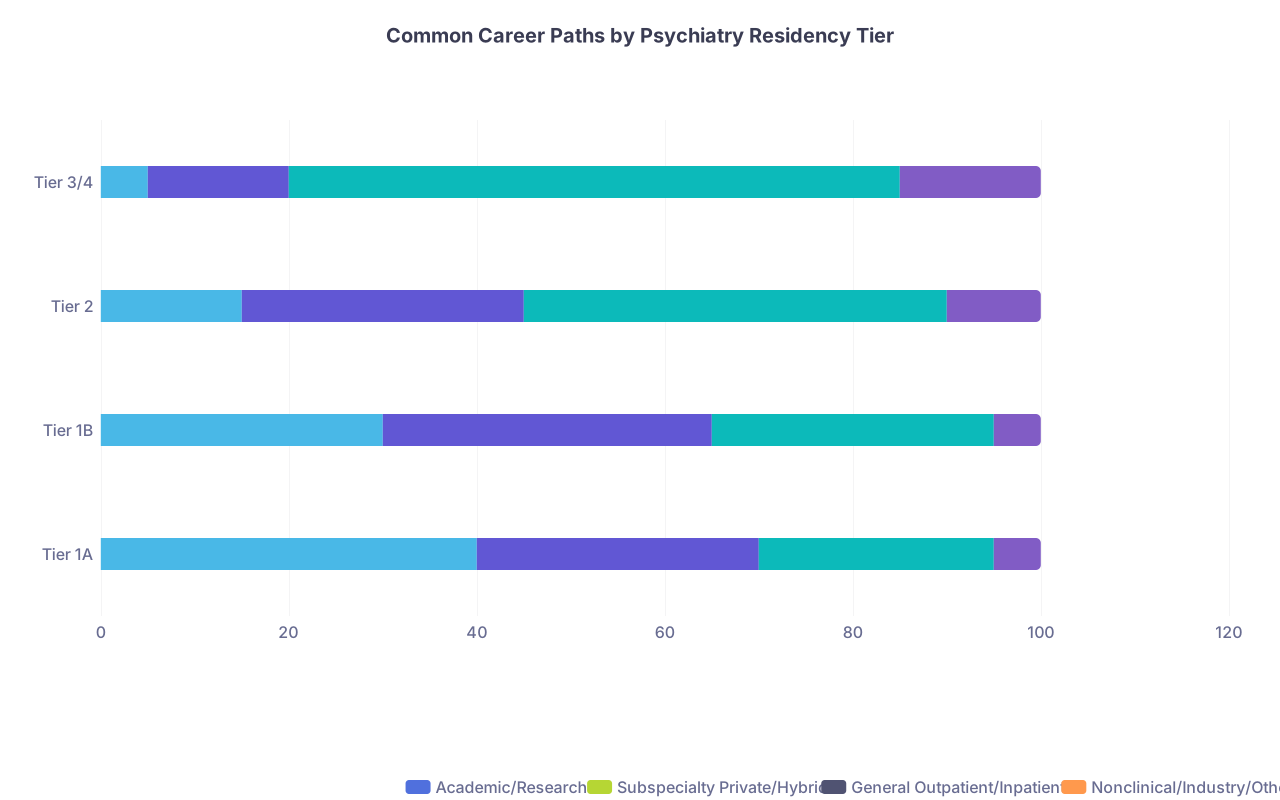
| Category | Academic/Research | Subspecialty Private/Hybrid | General Outpatient/Inpatient | Nonclinical/Industry/Other |
|---|---|---|---|---|
| Tier 1A | 40 | 30 | 25 | 5 |
| Tier 1B | 30 | 35 | 30 | 5 |
| Tier 2 | 15 | 30 | 45 | 10 |
| Tier 3/4 | 5 | 15 | 65 | 15 |
Again, this is directional, not literal data. But it tracks what departments see:
- Tier 1A/1B send a significant slice into academic or mixed academic careers.
- Tier 2 is a workhorse for well-trained clinicians with a peppering of academics.
- Tier 3/4 funnel heavily into general service roles, with smaller academic output.
Nothing wrong with being in any of those buckets – as long as it matches what you want.
How to Read Between the Lines on Programs
When you’re looking at programs, stop fixating only on livability and “good vibes on interview day.” Those matter, yes. But prestige and real training quality are in the quieter details.
Things you should be trying to find out:
- Where did the last 5–10 grads go? If a program can’t show you that clearly, that’s usually because the answer doesn’t impress them.
- Who are the three most active researchers, and are residents actually on their papers?
- How many residents present at APA or subspecialty conferences yearly?
- Is there a clear track record of grads getting fellowships you care about?
- What do faculty at other institutions say when you casually drop that program name? (Your home psych chair or mentors will tell you more over a coffee than any website will.)
And yes, ask current residents, “If you were aiming for a top academic CL or addictions fellowship, would you feel competitive from here?” Watch their faces, not just their words.
The Truth About “You’ll Be Fine Anywhere”
The most common advice I hear faculty give is, “Psych is chill, you’ll be fine anywhere.” That’s lazy. It’s true only if:
- You want a straightforward clinical job
- You don’t care much about subspecialty prestige or academic rank
- You’re flexible on geography later
If you want to keep serious doors open, the hierarchy matters. Not as a dictator of your life, but as a multiplier on your efforts.
A hustler at a Tier 2 with a strong mentor can absolutely outcompete a sleepwalker at a Tier 1A. But a hustler at a Tier 1A with strong mentors? That’s the person who becomes “Dr. So-and-so” whose name gets dropped in every meeting.
Know what you’re signing up for.
You’re at the stage now where all this can still change your trajectory. You haven’t locked in your ERAS list. You haven’t bought your interview flights. You still have room to be strategic instead of just aspirational.
Next comes the uglier part: actually mapping your stats, your school, and your goals onto specific psych programs and deciding where to shoot your shot, where to settle, and where to walk away even if they seem “safe.”
With this hierarchy in your back pocket, you’re ready to look at real programs with clearer eyes. How to build that actual rank list—and what to do when your interview experience doesn’t match the reputation—that’s the next move in your journey.