
Most applicants picking pediatrics programs are looking at the wrong numbers.
They obsess over NICU beds, PICU acuity, and fellowship match lists. Then they barely glance at outpatient clinic volume and structure. That is a serious mistake. One that can quietly wreck your quality of life, your learning, and even your future marketability as a pediatrician.
If you match into a program with poorly designed or extreme outpatient volume, you will feel it every single week. Not just on the occasional ICU month. Every continuity clinic. Every ambulatory block. Every time your schedule flips unpredictably between inpatient and clinic.
Let me be blunt: you can survive a mediocre PICU experience and still be a good pediatrician. You cannot escape your clinic system and clinic volume. It follows you across three years.
Let us go through where people mess this up and what you need to watch for.
The Big Myth: “Peds is Inpatient Heavy, Clinic is an Afterthought”
This misconception is everywhere. Students walk through impressive children’s hospitals, see shiny NICUs, listen to chiefs brag about ECMO cases, and assume that is what will define their training.
Reality: most pediatric graduates practice primarily outpatient medicine. Even many hospitalists end up doing some outpatient follow-up, urgent care, or mixed roles. And your board exam? Heavily outpatient-facing: well child care, common complaints, chronic disease follow-up, developmental and behavioral concerns.
Yet applicants keep doing the same thing:
- Ranking programs high based on how “sick” the inpatient population is
- Ignoring the actual number of half-days in clinic
- Not asking what a typical clinic template looks like
- Never clarifying who is responsible for after-hours calls and refills
They match. Six months later they are drowning in MyChart messages, triple-booked 15-minute visits, and a continuity clinic that teaches them almost nothing beyond how to click faster.
Do not be that person.
Why Outpatient Volume Matters More Than You Think
Outpatient volume is not just “how busy clinic is.” It quietly controls:
- Your cognitive load and burnout risk
- How much genuine teaching happens in clinic
- Whether you can see a patient as a whole person or just a problem-list
- Your comfort with bread‑and‑butter peds when you graduate
- Your ability to manage chronic conditions (asthma, ADHD, obesity, constipation) in the real world
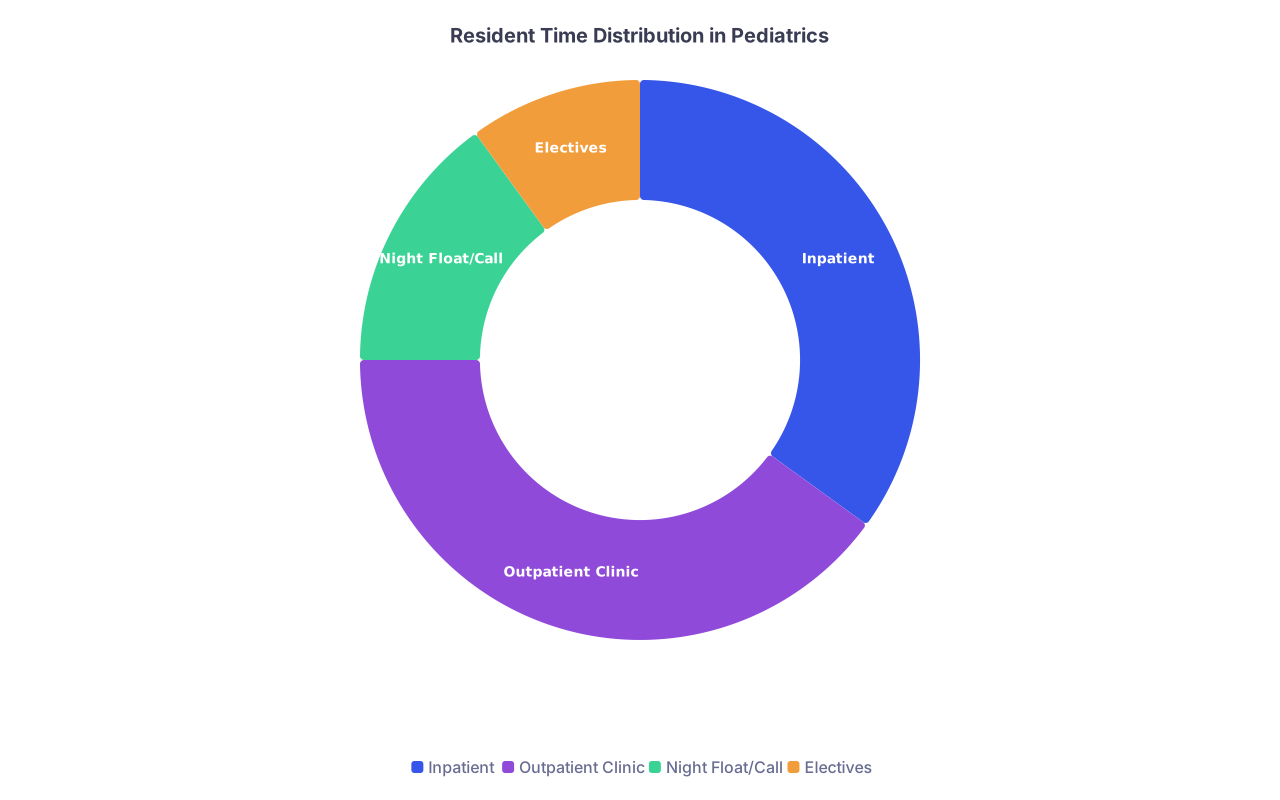
| Category | Value |
|---|---|
| Inpatient | 35 |
| Outpatient Clinic | 40 |
| Night Float/Call | 15 |
| Electives | 10 |
Look at that split. Programs love to sell you on the 35% inpatient piece. But your life and your stress level often live in the 40% outpatient wedge. If you do not interrogate that side, you are walking in blind.
There are three especially dangerous outpatient mistakes:
- Underestimating the sheer number of clinic sessions and visits
- Ignoring how rushed those sessions are
- Overlooking who owns the in-between work (messages, labs, forms)
Let us pull those apart.
Mistake #1: Not Knowing How Many Clinics You Actually Have
Too many applicants only ask, “How many continuity clinics per week?” and stop there. That is superficial. You must understand yearly volume, not just weekly structure.
Programs vary a lot. Here is the kind of comparison you should be forcing yourself to make:
| Program Type | Continuity Clinics / Week | Ambulatory Blocks / Year | Typical Patients / Half-Day |
|---|---|---|---|
| High-Volume County Peds | 2 | 3 | 12–16 |
| Balanced University Peds | 1 | 4 | 8–10 |
| Subspecialty-Heavy Peds | 1 | 2 | 6–8 |
The mistake is thinking more equals better. It does not. Not automatically.
Excessive clinic volume with poor support leads to:
- Rushed visits with no time to learn
- Constant schedule overruns, late notes, and “just finish it at home” creep
- Superficial management: refill, refer, move on
On the flip side, anemic outpatient exposure leaves you under-prepared:
- You will not get enough vaccine counseling reps
- You will not be comfortable with developmental surveillance
- You will graduate shaky on basic follow-up patterns (e.g., returning after bronchiolitis, weight checks, med titration for ADHD)
What you want is not “maximal” exposure. You want deliberate exposure.
Red flags when asking about volume:
- Vague answers like “We are really busy; you see a lot”
- Chiefs saying “You get used to finishing notes at home”
- Faculty proudly mentioning double- or triple-booked slots for residents
Better questions to ask:
- “Across all three years, how many half-days of continuity clinic do residents usually complete?”
- “Do interns ever have more than two clinics in a single week?”
- “How many patients are scheduled on a standard template for a PGY‑2?”
- “Are there dedicated ambulatory blocks, and what does a typical day look like?”
If a program cannot answer those numerically, they have not thought about your workload. That is a bad sign.
Mistake #2: Confusing “High Volume” with “High Value”
High outpatient volume is only good if the conditions around it are sane.
I have watched residents brag on interview day panels: “We see 16–18 patients in a half-day by PGY‑3. You are totally ready for private practice when you leave!” That is not a flex. That is a warning label.
Ask yourself: what is actually happening in that clinic?
- Are you getting time to discuss plans with an attending before walking back in?
- Or are you firing off orders and hoping you did not miss something?
- Do you get feedback on your notes, coding, and anticipatory guidance?
- Or is everyone just trying to survive the schedule?

Warning signs of low‑value high volume:
- No buffer slots for late arrivals or walk-ins
- Residents writing almost all notes and orders solo with minimal review
- Attending “supervision” that is basically just signing notes
- No time blocked for post‑clinic review, teaching, or inbox cleanup
On the other side, there is the under-volume problem. The “fellowship factory” programs that quietly devalue general outpatient peds. Residents rotate through subspecialty clinics that look impressive on paper but give them almost no usable primary care skills. You spend a month in pulmonology doing PFT interpretation and zero asthma action plan counseling.
You want to avoid both extremes:
- Grindhouse continuity clinics that teach you throughput instead of thinking
- “Pretty” academic ambulatory that underexposes you to real-world primary care
The only way you sort this out as an applicant is by pushing for specifics. Vague enthusiasm from residents—“Clinic is fine!”—is meaningless. Ask for numbers, ratios, and structure.
Mistake #3: Ignoring Who Handles Calls, Messages, and Refill Work
You are not just selecting visit volume. You are selecting in-between-visit burden. And most applicants do not even realize that is a variable.
Some programs design outpatient like this:
- Nurses or MAs triage most portal messages
- Call centers shield residents from non-urgent nonsense
- Attending physicians own the bulk of refill management
- Residents are copied only when it is clearly educational or necessary
Other programs dump everything into your lap:
- Every non-urgent cough message → routed to resident
- School forms, camp forms, FMLA forms → resident to complete
- Lab follow-up, imaging, outside records → resident
- Medication prior authorizations → resident and maybe an overwhelmed nurse
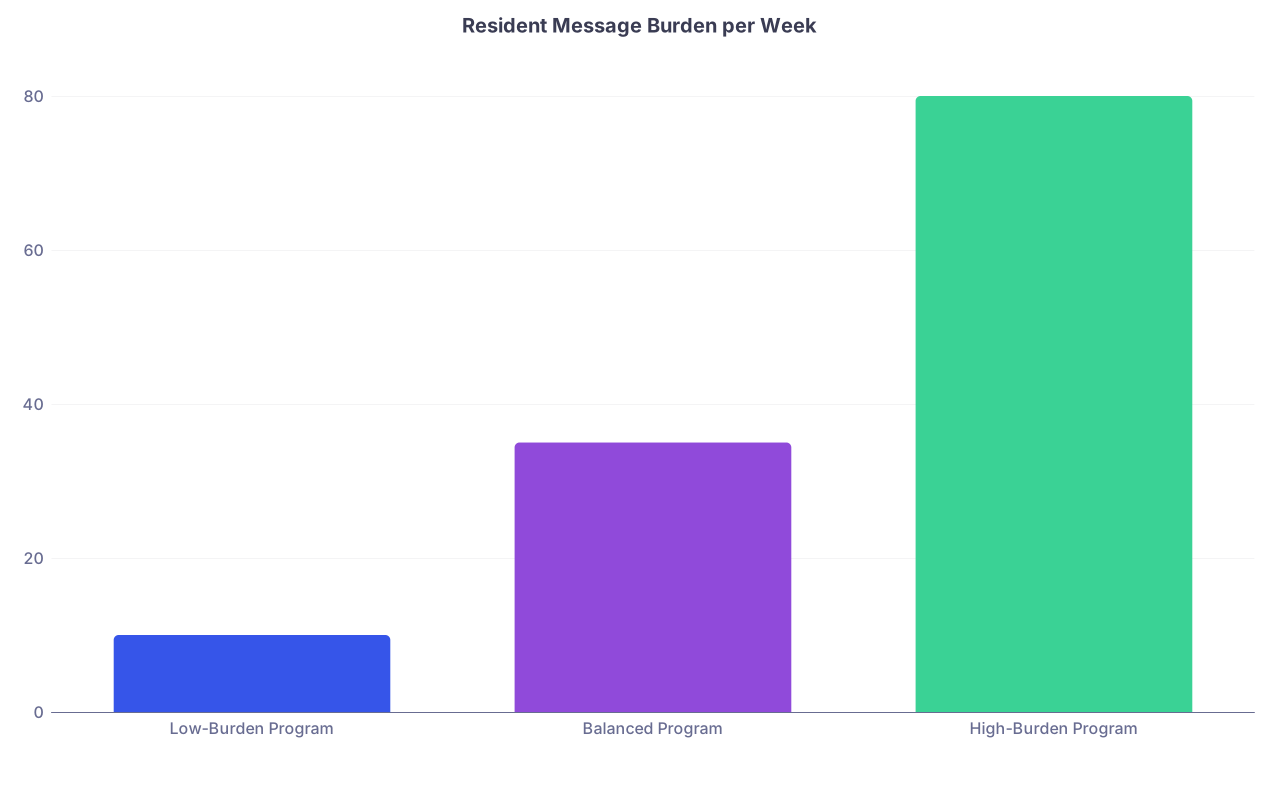
| Category | Value |
|---|---|
| Low-Burden Program | 10 |
| Balanced Program | 35 |
| High-Burden Program | 80 |
That chart is not hypothetical. I have seen 80+ in-basket items in a resident’s queue after a vacation week. They were already doing 10–12 patient half-days. So now they are up late clicking through low-yield portal messages or “FYI” results and hating outpatient medicine by November of intern year.
You need to ask these questions explicitly:
- “Who primarily manages patient messages between visits—nurses, attendings, or residents?”
- “Do residents have a protected time block for in-basket work?”
- “Are clinic ‘no show’ slots converted into inbox/administrative time?”
- “How often are residents responsible for forms (school, camp, etc.)?”
Programs that say “Oh, we are working on that” but cannot tell you what the current system is? They will not fix it before you arrive. Believe their present, not their promises.
Mistake #4: Not Understanding How Clinic Is Integrated with Inpatient
Outpatient volume does not sit in a vacuum. It crashes into your inpatient responsibilities. Badly designed programs make you do both at once. Poorly.
Here is the classic trap:
You are on a brutal inpatient month. High census, sick kids, new admits every day. And you still have your one or two continuity clinics per week. No drop. No adjustment.
So what happens?
- You leave rounds early, scramble to clinic, barely eat
- You come back to the ward after clinic to finish discharges and notes
- You miss teaching rounds or family meetings
- You start resenting clinic and inpatient both
This is not “great exposure.” It is fragmentation. And it breaks people.

| Step | Description |
|---|---|
| Step 1 | Inpatient Rotation Day |
| Step 2 | Full Focus Inpatient |
| Step 3 | Leave Rounds Early |
| Step 4 | Clinic Session |
| Step 5 | Return to Floor Late |
| Step 6 | Finish Notes and Tasks Late |
| Step 7 | Reduced Teaching and Higher Burnout |
| Step 8 | Clinic Today |
Better-designed programs:
- Pull you completely out of inpatient on clinic days
- Cap inpatient workload when someone is at clinic (true “jeopardy” or coverage systems)
- Reserve certain months as “inpatient only” or “outpatient heavy” so you can mentally switch modes
You should ask:
- “On heavy inpatient rotations, do residents still go to continuity clinic?”
- “Who covers my patients while I am in clinic?”
- “Is the inpatient census capped or adjusted on clinic days?”
If the answer is essentially “Everyone just handles it” or “We make it work,” expect chaos. You will pay for that with your sleep and your learning.
Mistake #5: Not Matching Outpatient Volume to Your Career Goals
Here is where applicants really sabotage themselves. They talk vaguely about “keeping options open” yet ignore the most obvious alignment question: Does this program’s outpatient design fit how I actually want to practice?
Some examples:
You are 90% sure you want to be a community general pediatrician.
Matching into a program that minimizes continuity clinic, outsources chronic disease follow-up to subspecialists, and views primary care as an afterthought is a poor choice. You will finish uncomfortable with independent management of obesity, ADHD, and behavioral concerns—the bread and butter of real-world clinic.You think you might want peds emergency medicine or PICU.
You still need outpatient reps. Why? Because you will be the consultant explaining return precautions, follow-up intervals, vaccine catch-up plans. Patients and parents need you to understand what happens after they leave the hospital.You want adolescent medicine or complex care.
You need longitudinal exposure to high‑risk teens, medically complex kids, and fragmented families in clinic. Zero chance you learn that from 15-minute checkouts on the ward.
Do not just ask, “Do your grads get great jobs?” That lumps everyone together. Ask this instead:
- “Where do graduates who go into primary care usually practice?”
- “Do they feel adequately prepared for busy outpatient work?”
- “What do recent grads say they wish they had more of in clinic?”
If a program cannot name real graduates in roles similar to what you want, and what those grads thought of their outpatient preparation, be cautious.
Mistake #6: Failing to Probe Supervision and Teaching Quality in Clinic
Volume without mentorship is just throughput. That is not training.
Here is a rookie error: assuming that because an attending is assigned to your clinic, you are getting high-quality teaching. Not necessarily.
Possible realities:
- Attending bouncing between two residents, double-booked schedule of their own
- Zero pre-clinic huddles; you meet the attending as you are already behind
- Debriefs that last 60 seconds per patient: “That seems fine, send them back”
- Residents writing notes with no phrase-level feedback, just a signature at 10 p.m.
You need to separate three concepts:
- How many patients you see
- How much time you have per patient
- How much actual supervision and teaching you receive
Ask residents pointed questions:
- “Do attendings review your assessments and plans in real time?”
- “How often do attendings directly observe your counseling with families?”
- “Do you ever get structured feedback on your clinic performance?”
Look for programs where residents can say concrete things like:
- “My clinic preceptor watches at least one visit every clinic”
- “We start clinic with a quick huddle about interesting patients”
- “We get dedicated time after clinic to discuss challenging cases”
If all you hear is, “They are really nice,” that is not enough. Niceness does not train you. Structured supervision does.
Mistake #7: Overlooking Logistics That Make Volume Tolerable or Intolerable
Same number of patients. Completely different lived experience. The difference is workflow and support.
Details that matter more than you think:
- Do MAs room patients, check vitals, and do preliminary screenings?
- Is there an on-site social worker or care coordinator?
- How many EMR clicks does it take to order a basic vaccine set?
- Are interpreter services easily available, or do you fight the system every time?

When support is poor, your effective volume feels double. You are doing every tiny piece yourself:
- Calling families into the room
- Logging vaccine lot numbers manually
- Hunting down growth charts
- Manually entering outside lab data
None of this is educational. All of it is exhausting.
On interviews, do not just ask, “Is there good support?” Everyone will say yes. Ask questions that force specifics:
- “Who rooms patients and takes vitals?”
- “Are residents expected to call every family with routine lab results?”
- “How are complex social issues (transportation, insurance, CPS concerns) handled in clinic?”
You are trying to figure out if the clinic system is built around physician learning and patient care—or around squeezing maximum throughput at your expense.
How to Actually Evaluate Outpatient Volume Before You Rank
Here is a simple, ruthless framework to keep you out of trouble. For each pediatrics program you are considering, write down answers to these:
Continuity clinic structure
- Number of half-days per week, each year
- Typical patients per half-day by PGY level
- Whether inpatient rotations are protected from clinic on heavy days
Work between visits
- Average weekly message / in-basket burden
- Who handles routine calls and messages
- Where labs, forms, and prior authorizations land
Learning environment
- How often you get direct observation and feedback
- Whether there is structured didactic time attached to clinic
- How rushed attendings are with their own panels
Support and logistics
- Nursing / MA staffing
- Access to social work, interpreters, case management
- EMR efficiency and typical note expectations
If you cannot get clear data on these, consider that a data point. Programs that have thought deeply about outpatient training can answer these questions cleanly. Programs that see residents as cheap clinic labor will dodge and generalize.
The Bottom Line: Stop Treating Clinic as Background Noise
Ignoring outpatient volume in pediatrics program selection is not a small oversight. It is one of the most common and costly errors I see.
Three points to remember:
- Outpatient volume and structure will shape your daily life and long-term competence far more than one extra ICU or NICU month.
- High volume without support and teaching is not a strength; it is a red flag. Demand specific numbers and workflows, not vague reassurances.
- Align the clinic intensity and design with your actual career goals—and do not believe any program that cannot clearly explain who does the work between visits.
If you respect the outpatient side of pediatrics when building your rank list, you avoid years of preventable burnout and come out actually ready for the job you say you want. Ignore it, and you will learn the hard way—one overbooked half-day at a time.