
You are at your laptop with FREIDA, Reddit, and a half-finished personal statement all open at once. You are 90% sure about your specialty. You are comparing “prestige,” fellowship options, maybe average salaries. Then you glance at the “call schedule” line in the program brochure: “q4–q6, night float system, home call, some weekends.”
You nod and move on.
That is the mistake.
You are treating call schedule language like legal fine print instead of what it is: a blueprint for how exhausted, resentful, or actually functional you will be for the next 3–7 years. And different specialties hide pain in different ways.
Let me walk you through where people get burned. Specialty by specialty. So you do not end up three months into PGY‑1 staring at your pager at 2:47 AM, realizing you picked the wrong life.
The Core Mistakes People Make With Call
There are four big errors I see over and over:
- Believing “home call” means easy call
- Ignoring frequency and post‑call realities
- Assuming “night float” automatically protects lifestyle
- Not realizing different specialties have very different flavors of pain
Let’s get those out of the way.
1. “Home Call” Is Not Automatically Better
The classic trap: “Oh, this program does mostly home call. So more sleep. Great.”
Sometimes true. Very often false.
Home call can be miserable if:
- The pager never stops
- You still have to come in for anything procedural
- There is no real cap on how many calls you can take “from home”
Surgery subspecialties, OB/GYN, and some radiology and anesthesia groups love to sell home call as lifestyle-friendly. Then you discover you are driving in at 2 AM for a stat C‑section or ruptured AAA, then back home at 4:30, then rounding at 6:00.
You were “at home” on paper. You were functionally at the hospital all night.
2. Ignoring Post‑Call Expectations
Do you leave by 11 AM? Or do you “stay till the work is done”? Programs love that second phrase.
If you are not explicitly guaranteed:
- A real post‑call day
- A hard out time (enforced, not mythical) …you will get trapped in sludge.
ICU months. Trauma months. OB months. Call is survivable if you truly leave the next morning. Brutal if you do 28 hours and then “just help with discharges” until 3 PM.
3. Over-trusting “Night Float” As Magic Protection
Night float can be better than 24+4 traditional call.
It can also be:
- Six nights in a row of 14‑hour shifts
- Flipping your sleep schedule every week
- Totally incompatible with child care or any structured life
Programs will say “We eliminated 24‑hour calls!” and fail to mention that the new system is a night float block that destroys your circadian rhythm for 4 weeks straight.
4. Not All Call Pain Is The Same
You cannot compare:
- OB resident: 24 hours of intermittent screaming emergencies
to - Pathology resident: one week of home call where the phone rings three times
to - EM attending: no “call” but 14 shifts this month that end at 1 AM
Different specialties hurt in different ways:
- Constant pager anxiety vs short, intense bursts
- Sleep fragmentation vs just being late every evening
- Weekend domination vs terrible nights but free days
You need to match that pattern with who you are, not with what looks good on a brochure.
How Call Actually Feels by Specialty
I will not cover every field, but I will hit the big categories where people underestimate lifestyle.
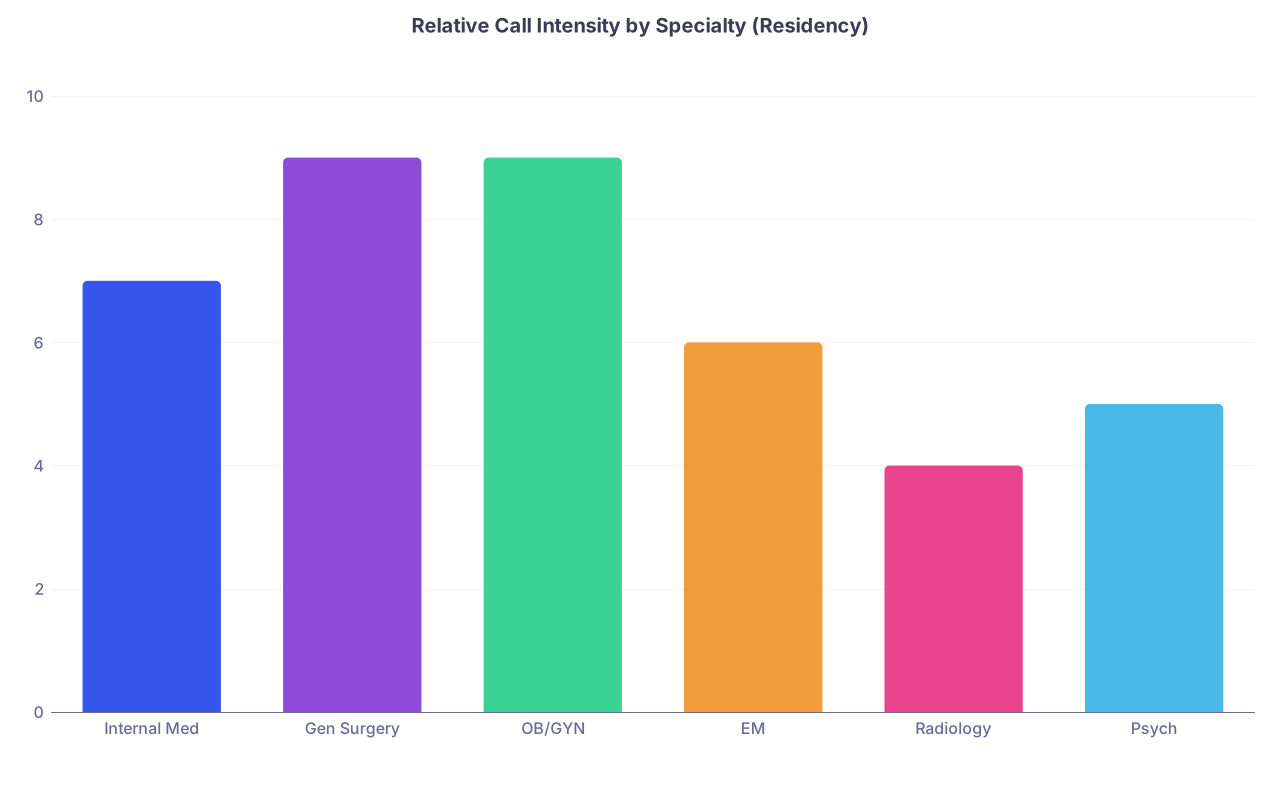
| Category | Value |
|---|---|
| Internal Med | 7 |
| Gen Surgery | 9 |
| OB/GYN | 9 |
| EM | 6 |
| Radiology | 4 |
| Psych | 5 |
Scale 1–10, where 10 = “maximum chaos.” Rough, yes. But directionally about right for most programs.
Internal Medicine: “Not That Bad” Is Still… Not Good
Here is the classic mistake: students think medicine is “lifestyle neutral.” Not malignant like surgery, not chill like derm. Middle of the road.
Reality:
- Inpatient months: night float or q4‑q6 call, constant cross-cover pages
- ICU: some of the worst call you will ever do
- Ambulatory months: sane… if your program actually has them
Hidden pitfalls:
- Cross-cover hell: You are covering 60–80 patients, half of whom you have never met.
- Fake caps: “You cap at 10 new admissions.” But you still manage yesterday’s 12 “old” patients.
- Post‑call creep: Attendings who “just need you for this one family meeting” at noon on your post‑call day.
Biggest underestimation: how much your phone/pager will own your brain. Even when you are “off,” you will obsessively check for missed calls early on. That fades, but not fast.
Where people get misled:
- Program websites that highlight outpatient and electives
- Residents who tell you “call is fine” because they have normalized chronic fatigue
If you are already fragile on sleep, be very cautious with IM-heavy programs that still do traditional 28‑hour calls.
General Surgery: The Quiet Lies Around “Home Call” And “Home by Noon”
General surgery is call-heavy. You know that much. The mistake is underestimating the shape of it.
Common traps:
- “Home by noon post‑call” on paper, 2–4 PM in reality
- “Home call” on some services that function as in‑house because the hospital is always busy
- “Jeopardy” or backup call that ends up activating way more than implied
PGY‑2 and PGY‑3 in surgery can be some of the worst years of call in all of medicine:
- Trauma nights: back‑to‑back activations, no sleep
- ICU: full responsibility for crashing patients
- Floor: endless pages plus ED consults
You will hear: “You get used to it.” Some do. Others drift into permanent exhaustion and become angry, brittle people by PGY‑3.
If you are considering surgery, you must assume:
- Your weekends will frequently vanish
- Vacations will be negotiated around call in ways that will frustrate you endlessly
- “Protected time” is fragile when the OR board is full and the ED is slamming you with consults
Do not tell yourself you will “make it up after residency.” Seven years (if you do a fellowship) is a long time to white‑knuckle your life.
OB/GYN: The “I Didn’t Realize It Was This Intense” Specialty
I have seen more people shocked by OB call than any other.
Reason: students see a handful of deliveries, some clinic, and think, “Busy, but fun.”
What they do not see:
- The relentless unpredictability of L&D
- The constant legal/medico‑legal anxiety
- Simultaneously covering triage, high‑risk, OR, and postpartum at 3 AM
OB call often means:
- Frequent 24‑hour in‑house shifts
- Regular weekend call
- Post‑call days that might be protected, unless labor floor is exploding
Even as an attending, OB call can wreck you: stat C‑sections at 2 AM, shoulder dystocia, hemorrhage. These are not “phone‑in” problems. You have to be physically present, fully awake, and technically sharp within minutes.
Big lifestyle lie: “You can always go to just GYN or clinic later.”
Sometimes true. Often you are in a group that expects you to share L&D call for many years.
If you are not okay with:
- Chronic sleep interruption
- Being awakened out of deep sleep to make surgical decisions
- Holidays and big life events being unpredictably hijacked by deliveries
…you need to be honest with yourself now, not in PGY‑3.
Emergency Medicine: “No Call” Is Not Synonymous With “Lifestyle”
A lot of people think EM = no call = easy lifestyle.
Here is the trick. You will not have traditional call. You will have:
- Nights
- Evenings
- Weekends
- Holidays
- A schedule that rotates your circadian rhythm into trash
Typical pitfalls:
- String of late shifts (15:00–01:00) that bleed into your “days off” because you sleep until noon
- Rapid flip from nights to days
- “Just pick up a few extra shifts for money” — and suddenly you are at 18 shifts / month and exhausted
Residents underestimate:
- How isolating it can be when all your days off are weekdays and your partner/friends work 9–5
- The long-term strain of never having predictable sleep
- How quickly you stop doing anything on post‑shift days except lying in bed scrolling
Yes, EM can be controlled later with smart group choice. But if you already know you hate nights and feel physically ill on them? Be brutal with yourself about whether this pattern is tolerable for decades.
Radiology & Pathology: The Deceptive Quiet
People categorize these as “lifestyle.” Which can be true. But if you ignore the call specifics, you set yourself up for a different type of misery.
Radiology pitfalls:
- Night float with 7‑on/7‑off, 5 PM–7 AM type schedules
- Cross‑section call: endless stat CTs, strokes, trauma reads
- IR home call: pager going off all night for bleeds, drains, emergent cases
As a resident, overnight rotations can be brutal. The work is cognitively heavy, and you may be alone or nearly so. You are not “resting in a call room.” You are reading at speed all night.
Pathology pitfalls:
- Autopsy or frozen section call
- Transfusion medicine / blood bank call: “phone call” sounds easy until you are managing complex, high‑stakes situations at 2 AM (massive transfusion protocols, organ transplant workups)
- Surgical pathology sign‑out backlogs after a heavy call week
Not as physically grinding as surgery or OB. But if your personality hates nights or you crumble when you are the only one awake and responsible? That can still be a poor fit.
The Hidden Dimensions of Call That No One Explains
Programs and attendings will talk about “q4” and “night float.” They rarely talk about these parts. You should.
| Factor | Why It Matters |
|---|---|
| Post-call rules | Determines real recovery time |
| Cross-cover volume | Drives pager fatigue and errors |
| Call room quality | Affects whether you ever actually sleep |
| Weekend frequency | Controls whether you have a real life |
| Home call burden | Predicts sleep fragmentation |
1. Cross-cover Volume
This is the single biggest driver of awful call nights in IM, surgery, psych.
Questions you absolutely should ask residents:
- “On a typical night, how many patients are you cross-covering?”
- “What is the worst‑case number?”
- “Do you routinely get crushed with pages or is it manageable?”
If someone says, “You cover like 80–100, but it’s not that bad,” that is a program where everyone has normalized dysfunction.
2. Call Rooms That Are Actually Unusable
Programs brag about call rooms. Many are:
- Loud (near ED, OR, or elevators)
- Shared with several other services
- Barely have working showers or acceptable bedding
If the call room is a joke, your ability to function the next day goes down significantly. Ask:
- “Do you actually sleep on call?”
- “Do you use the call room or just stay up all night?”
- “Can you shower and leave decently, or is it gross?”
Not glamorous questions. But very predictive of real life.
3. Weekend and Holiday Reality
You must get specific:
- “How often are you on call on weekends during an average month?”
- “On a typical December, how many major holidays will I work?”
- “How much control do you have over requesting specific weekends off?”
Residency will take a chunk of your twenties or thirties. If every meaningful family or social event is a logistical nightmare, you will resent your specialty faster than you think.

| Step | Description |
|---|---|
| Step 1 | Choose Specialty |
| Step 2 | Residency Call Pattern |
| Step 3 | Sleep Disruption |
| Step 4 | More Predictable Routine |
| Step 5 | Relationship Strain |
| Step 6 | Burnout Risk |
| Step 7 | Better Work Life Integration |
| Step 8 | Question Specialty Choice |
| Step 9 | High Nights or Weekends |
How To Evaluate Call Schedules Without Getting Snowed
You have two jobs:
- Decode the brochure language
- Extract the truth from residents and faculty
Step 1: Decode the Language
Some translations for you:
“Night float system”
→ Ask: How many nights in a row? How many blocks? What is the start / end time?“Home call”
→ Ask: How often are you called in? Can you drink alcohol? How often do you get real sleep at home?“Post‑call by noon”
→ Ask: What is the actual average departure time? What makes you stay late?“Complies with 80‑hour work week”
→ Means nothing. Everyone technically complies.“Call varies by rotation”
→ Which rotations are worst? How many months of them?
Step 2: Ask Residents Targeted, Uncomfortable Questions
You are not there to make small talk. You are interviewing them just as much as they are you.
Ask:
- “What is your worst call month? Describe a typical worst‑case day.”
- “How often do you truly feel rested on your days off?”
- “Has anyone ever had to go to the PD because call was unsustainable?”
- “What percentage of residents with kids seem like they are surviving vs drowning?”
Watch their faces. The hesitation before they answer tells you more than the answer.
Step 3: Look at PGY‑2 and PGY‑3 Patterns, Not Just Intern Year
Programs like to talk about PGY‑1, because it is structured.
You want:
- “What is call like as a PGY‑2 on [ICU, trauma, L&D, night float]?”
- “Does call get better or worse after intern year?”
- “Who has the hardest schedule in the program?”
Many people underestimate how much PGY‑2/3 will break them, not PGY‑1.
Personality–Specialty Mismatches Around Call
This is where people really hurt themselves. They pick a good intellectual fit and completely ignore the lifestyle pattern.
If You Are Extremely Sensitive to Sleep Loss
You should be very cautious with:
- OB/GYN
- General surgery and many surgical subspecialties
- Trauma-heavy EM sites
- Any program with tons of 24‑hour+ calls, especially ICU-heavy ones
You will not “train yourself” out of innate sleep fragility. You will just be chronically miserable.
Better fits (if you still want meaningful patient care):
- Outpatient-focused IM (endocrine, rheum path later)
- Psych in a well-structured program
- Radiology or pathology with humane call structure
- PM&R, occ med, some non‑trauma-heavy neurology programs
If You Crave Predictability More Than Free Time
You might tolerate:
- EM (if you can get a group with set block scheduling)
- Radiology with structured shifts
- Hospitalist tracks where you know exactly which 7 days you are on
You will hate:
- OB and L&D with constant unpredictability
- Surgical subspecialties with long cases and endless add‑ons
- Call setups where “just one more” case blows your day apart
If You Need Evenings and Weekends for Family
You must treat:
- Surgery, OB, and some EM jobs as very high risk
- ICU-heavy programs with caution
You should seriously look at:
- FM but in outpatient-heavy programs
- Psych with limited inpatient call
- Radiology/pathology with minimal weekends
- Non-procedural internal medicine subspecialties long term
And no, you cannot fix this just with “good time management.” That is the lie tired residents tell themselves instead of admitting their specialty choice conflicts with their life priorities.

Concrete Things To Do Before You Sign Your Life Away
Track your own response to nights and 24s during MS3–MS4.
Be honest. After a 28‑hour call, were you shaken for 2 days? Or fine after one long nap?On every interview day, ask at least 3 residents about call:
- “What is your worst call rotation and why?”
- “How bad is cross‑cover at night?”
- “How often do you get a real post‑call day?”
On second looks or informal visits, ask specifically about PGY‑2.
That is usually where the skeletons are.Talk to residents at other programs in the same specialty.
Get a sense of what is “normal” call for that field. If a program’s residents look uniquely wrecked compared with peers elsewhere? Red flag.Imagine your actual week.
Do not think “I will be a surgeon.” Think: “It is Wednesday night, I am post‑call, my kids have a school event. Where am I?”
If you cannot picture a realistic, emotionally tolerable answer, reconsider.
FAQ (Exactly 5 Questions)
1. Is it a mistake to rule out a specialty just because of call?
No. It is a mistake to pretend call does not matter. If you truly love a field and can tolerate its call pattern, great. But “I love the OR” does not magically fix being permanently sleep-deprived and absent from your own life. Some people leave their chosen specialty later specifically because they ignored call.
2. Do call schedules usually get better as an attending?
Sometimes. The pain shifts rather than disappears. Surgery and OB attendings still take intense call; EM loses “call” but keeps nights and weekends; radiology/pathology can be relatively light but IR and blood bank can be heavy. You should look at realistic attending schedules in your field now, not a fantasy of “I will choose a chill job later.”
3. Are programs honest about their call schedules on paper?
They are honest in the narrow, technical sense and often misleading in the lived-experience sense. “Post‑call by noon” might happen one out of three times. “Home call” might mean “we page you so often you never sleep.” This is why you must talk to residents without faculty hovering and push for real examples.
4. How much worse is q4 call compared to q6 really?
It compounds. Q4 means more sleep debt, more disruption of your circadian rhythm, and less recovery time. People tolerate short bursts (a month or less). Months of q4 call, especially in ICU/trauma/OB, change your baseline mood, cognition, and general life satisfaction. Do not shrug at the difference.
5. If I already matched into a high‑call specialty and hate call, am I stuck?
You are not automatically trapped, but it will require uncomfortable decisions. Options: transfer programs, switch specialties early, target a fellowship or job with lighter call, or negotiate schedules aggressively as an attending. The worst move is denial—telling yourself to just “power through” while your physical and mental health crater.
Key points:
- Do not treat call schedules like fine print; they are central to what your life will feel like in residency and beyond.
- The pattern of call by specialty matters as much as raw hours—nights, weekends, cross‑cover, and post‑call rules are where the real pain hides.
- Be brutally honest about your own sleep tolerance and life priorities now, not after you are three years into a specialty that was never compatible with you.