
Three‑Year FM vs Three‑Year IM: Training Depth Myths Explained
Why do so many people talk like three years of Internal Medicine creates “real” doctors, while three years of Family Medicine somehow creates half‑trained ones?
Let’s kill that idea properly.
The Core Myth: “Three Years of FM Is Shallower Than Three Years of IM”
The hallway version of this myth goes like this:
- “IM is three years of pure adult medicine. FM is three years split between peds, OB, clinic, psych, etc., so the internal medicine part has to be watered down.”
- “FM residents just do cushy community rotations; IM residents do the real inpatient medicine.”
- “If you want to be good at complex adults, you have to do IM.”
Here’s the inconvenient fact: when you compare accredited, non‑garbage programs, three‑year FM and three‑year IM both produce physicians who are fully trained for their scope of practice. The “shallowness” argument completely ignores:
- Different end goals
- Different patient populations
- Different accreditation standards
They’re not two versions of the same track. They’re two different jobs.
You are not choosing between “3 years at 100% medicine vs 3 years at 70% medicine.” You’re choosing between:
- Depth in complex adult inpatient + consultative medicine (IM)
- Breadth across lifespan + primary care + some procedures (FM)
Those are different skill profiles, not better vs worse.
What the Data Actually Shows: Requirements Side‑by‑Side
Let’s start with what the programs are required to give you – not what your buddy from Step prep Reddit “heard.”
| Feature | Family Medicine (3 yrs) | Internal Medicine (3 yrs) |
|---|---|---|
| Total training length | 36 months | 36 months |
| Minimum continuity clinic | ~165–170 half days over 3 yrs | ~130–150 half days over 3 yrs |
| Minimum inpatient adult time | ~6–8 months (varies by program) | ~12–16 months (often more) |
| Pediatrics required | Yes (inpt + outpt) | No (unless med‑peds) |
| Obstetrics/women’s health | Required, including L&D exposure | Limited clinic gyn, little/no L&D |
| ICU time | Required but shorter blocks | Heavier and more frequent blocks |
Are these exact numbers for every program? No. But this is the pattern:
- IM has more adult inpatient and ICU time
- FM has more continuity clinic and broader age/scope exposure
- Both have enough volume in their focus areas to meet ACGME and board standards
Saying “FM is shallower” because it spends fewer months in the MICU is like saying a trauma surgeon is “shallower” than a nephrologist because they don’t manage chronic CKD—wrong comparison.
Where Training Actually Differs: Inpatient vs Breadth
Here’s where the myth has a partial truth, twisted into nonsense: IM does usually get more exposure to high‑acuity, tertiary‑care medicine. FM does trade some of that intensity for breadth and outpatient depth.
The right question is not “Which is better?” The right question is “Which is aligned with the job I want?”
Internal Medicine: What Three Years Really Build
IM residency is designed to create:
- Hospitalists
- Outpatient internists (less common right out of residency now)
- People heading into subspecialty fellowships (cards, GI, heme/onc, pulm/crit, etc.)
So the training leans hard into:
- Complex adult inpatients: CHF exacerbations, DKA, decompensated cirrhosis, septic shock, weird autoimmune things.
- ICU: vents, pressors, lines. Yes, you put in more central lines.
- Consults: pre‑op risk, co‑management, “Please clear this 78‑year‑old with 10 comorbidities for surgery tomorrow.”
And yes, there’s more emphasis on:
- Reading trials, guidelines, and subspecialty‑adjacent literature
- Working with subspecialists and learning when to escalate care
Is this “deeper” medicine? For adult internal disease in the hospital, absolutely. That’s the point.
But here’s the part people conveniently ignore: a lot of IM residents finish three years having:
- Never delivered a baby
- Seen very little primary care pediatrics
- Minimal behavioral health integration beyond consult psych
- Very limited hands‑on office procedures
That’s not a flaw. That’s design. The job description is different.
Family Medicine: What Three Years Really Build
FM residency is designed to create:
- Comprehensive outpatient primary care physicians across the lifespan
- Generalists who can practice in clinics, community hospitals, rural settings
- People who might still do scopes, OB, inpatient, etc., depending on program
So the training is unapologetically broad:
- Newborn exams, well‑child checks, ADHD, autism workups
- Prenatal care, contraception, common OB complications, sometimes deliveries
- Chronic adult disease: diabetes, hypertension, COPD, depression, anxiety, substance use
- Musculoskeletal complaints, basic procedures (joint injections, skin biopsies, IUDs, lacerations, etc.)
Depth here is different. It’s:
- Managing the whole person over time, across life stages
- Living with diagnostic uncertainty in low‑acuity settings (which is actually harder than following an ICU order set)
- Coordinating care between specialists, social services, mental health, and the patient’s actual life
Does FM spend less time in the MICU than IM? Yes. Because the FM graduate is not primarily being trained to run a tertiary academic ICU in a major center.
Does that mean the FM graduate is “shallow”? Not if you judge depth by what they’re supposed to be good at.
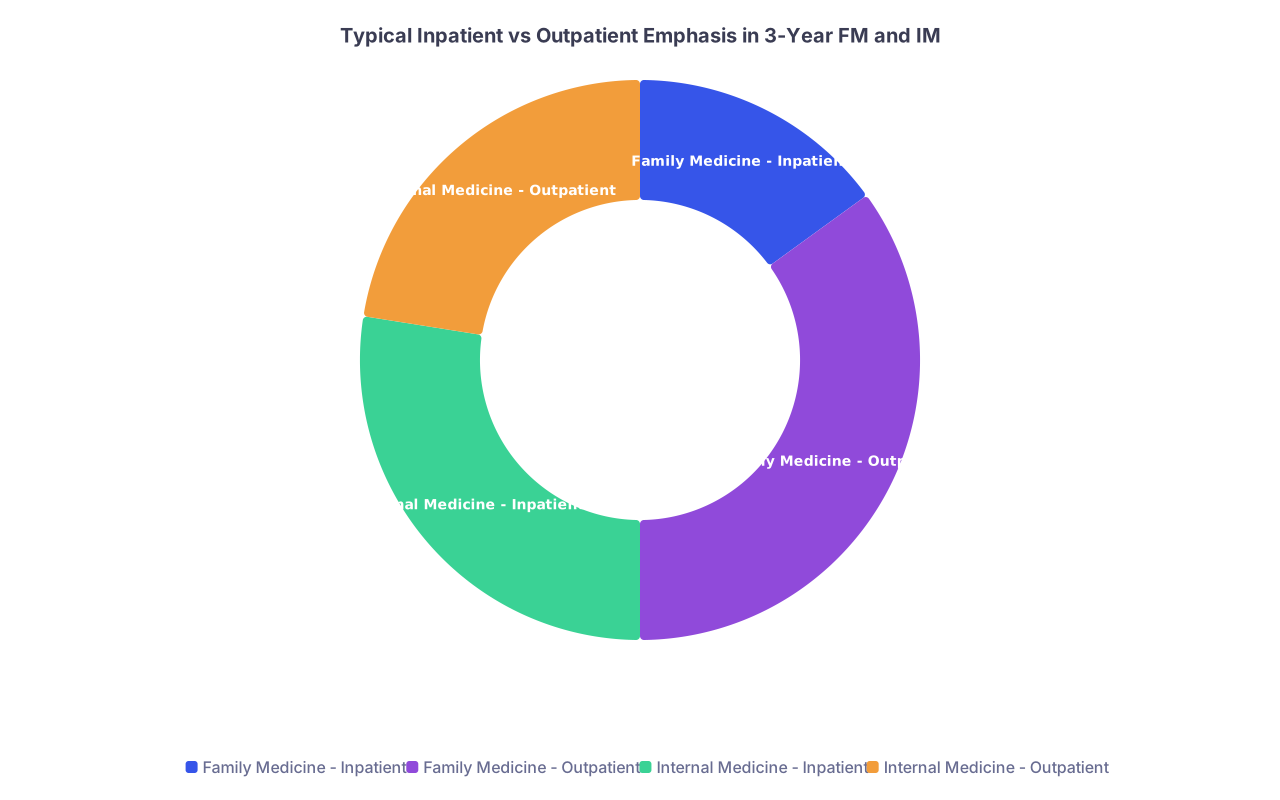
| Category | Value |
|---|---|
| Family Medicine - Inpatient | 30 |
| Family Medicine - Outpatient | 70 |
| Internal Medicine - Inpatient | 55 |
| Internal Medicine - Outpatient | 45 |
No, that’s not exact. But it illustrates the reality: IM pushes more inpatient; FM pushes more outpatient/breadth.
“But IM Residents See Sicker Patients, So They’re Better Doctors”
The number of times I’ve heard some version of this from a brand‑new PGY‑2 who just placed their third central line is…a lot.
Here’s the problem with that logic:
Patient mix is strongly program‑dependent, not just specialty‑dependent.
- A strong FM program at a big academic center (think Swedish, UW‑affiliated, UNC, etc.) will see very sick patients.
- A small community IM program can have relatively simple patients compared with a safety‑net FM program.
Most practicing outpatient physicians do not see MICU‑level cases every day.
For bread‑and‑butter primary care, the question is: Who is better at managing complex chronic issues over years, not days?Acuity ≠ complexity of care over time.
Stabilizing a DKA admission is one type of skill. Managing the same patient’s diabetes, depression, housing instability, and inability to afford insulin over 10 years is another. Different complexity.
The honest breakdown:
- If your career will be heavily inpatient and tertiary‑care oriented → IM training is deeper and more relevant.
- If your career will be mostly outpatient, community‑based, full‑spectrum primary care → FM training is deeper for that role.
There is no universal “better doctor” shield you get at the end. You just get skills that fit—or don’t fit—the job you end up doing.
Fellowship and Subspecialty: The Favorite Fear Tactic
Another popular myth: “If you do FM, you’re shutting the door on everything. FM is the end of the road; IM is where the options are.”
Reality is more nuanced.
IM absolutely has a more established, straightforward pipeline to:
- Cardiology
- Gastroenterology
- Heme/Onc
- Pulm/Crit
- Rheumatology
- Endocrinology
…you know the list.
If you’re dreaming of being a transplant hepatologist or an interventional cardiologist, go IM. This isn’t controversial.
But the FM‑can’t‑do‑any‑fellowship myth is just lazy.
FM grads can and do complete fellowships in:
- Sports medicine
- Geriatrics
- Palliative care
- Addiction medicine
- Sleep medicine
- Maternal‑child health
- Some hospitalist tracks / advanced obstetrics in certain regions
Will FM get you cards or GI in 2026? Realistically, no. That’s an IM lane. But FM gives you actual structured paths to advanced primary‑care‑adjacent fields.
So the decision tree is simple:
- Want classic internal medicine subspecialty? → IM
- Want advanced training closely tied to primary care scope (sports, pall care, geri, addiction, etc.)? → FM or IM both can work, but FM is absolutely not excluded.
The Scope Myth: “FM Shouldn’t Touch Complex Adults”
This one is almost funny when you look at real practice patterns in rural and underserved areas.
Plenty of FM‑trained physicians:
- Admit their own patients
- Run small ICUs with tele‑ICU backup
- Do endoscopy (after extra training)
- Manage ventilators in resource‑limited settings
- Serve as de facto hospitalists in critical access hospitals
Is every FM grad ready to do that on Day 1? Of course not. Same for IM grads taking a first hospitalist job in a tiny 25‑bed hospital with minimal subspecialty support. Everyone has a learning curve.
What matters more than the letters on the diploma:
- How strong was the residency?
- What did their inpatient exposure actually look like?
- Did they intentionally train for that type of practice?

In many rural settings, hospital CEOs would laugh at the idea that FM can’t manage complex adults. They depend on them to do exactly that.
Flip side: if you want to be a high‑volume, pure tertiary‑center hospitalist with Q3 nights in a 60‑bed ICU—IM is better training. No argument there.
What You Should Actually Base the Decision On
Forget the identity politics. Ask five blunt questions:
Do you want your default patient to be adults only—or cradle‑to‑grave?
- Adults only, love inpatient, maybe subspecialty → That’s IM.
- You like kids, OB doesn’t scare you, and you like the idea of treating the entire family → That’s FM.
Do you want your training centered around the hospital or the clinic?
- Want heavy inpatient rotations, long ICU months, and more time in the hospital at 3 a.m.? → IM.
- Want more continuity clinic, more exposure to outpatient mental health, peds, women’s health? → FM.
Is a subspecialty fellowship your primary goal?
- Cards, GI, heme/onc, rheum, pulm/crit → IM.
- Sports, geri, pall care, addiction → Either, but FM is fully viable.
Where do you envision practicing?
- Academic center, big city hospital, classic subspecialty group → IM fits more naturally.
- Community clinic, rural town, FQHC, broad‑scope primary care → FM is built for this.
What kind of day‑to‑day problems do you like solving?
- Diagnostic puzzles, consult questions, rare diseases, high‑acuity physiology → IM.
- Long‑term behavior change, prevention, whole‑family context, broad pattern recognition → FM.
The wrong way to decide is, “IM is more respected” or “FM is easier.” Both of those statements fall apart if you’ve actually stepped foot in strong programs on both sides.

| Step | Description |
|---|---|
| Step 1 | Start - Choosing Residency |
| Step 2 | Consider Family Medicine |
| Step 3 | Choose Internal Medicine |
| Step 4 | Do you want to see kids and do OB? |
| Step 5 | Interested in fellowship like cards or GI? |
| Step 6 | Prefer inpatient or outpatient? |
The Board Exam / “Knowledge Depth” Argument
You’ll hear people say, “Just look at the board exams—IM is obviously deeper.” The reality:
- ABIM is heavily adult internal medicine, with emphasis on inpatient and subspecialty‑adjacent knowledge.
- ABFM includes adult medicine plus pediatrics, OB/women’s health, behavioral health, preventive care, and practice management.
Different test, different emphasis.
Are ABIM questions more granular for rare adult diseases? Often yes. Because that’s the job spec.
Is ABFM broader and more primary‑care oriented? Yes. Also the job spec.
Claiming one is globally “harder” is like arguing whether the surgery or radiology boards are harder. Wrong frame. They’re hard if you haven’t trained for the job they’re testing.
The Real Myth: That There’s One “Best” Track
What’s actually going on underneath most of these FM vs IM arguments is status anxiety and insecurity.
- IM residents worried they’ll hate inpatient work long‑term.
- FM residents worried they’ll be seen as “less than.”
- Students terrified they’ll pick “wrong” and ruin their careers.
Here’s the thing: I’ve seen outstanding, terrifyingly competent physicians from both backgrounds. I’ve also seen weak ones from both. The single biggest predictor has never been the specialty label; it’s:
- How hard they worked in residency
- The quality and intensity of their specific program
- Whether they chose a path aligned with their strengths
Three years of FM is not “IM lite.”
Three years of IM is not “FM but smarter.”
They’re simply optimized for different futures.
FAQ (Exactly 5 Questions)
1. If I want to be a hospitalist, should I do FM or IM?
If your goal is a classic hospitalist job at a mid‑ to large‑size hospital, IM gives you cleaner access and usually stronger inpatient training. That said, plenty of FM‑trained hospitalists exist, especially in community and rural hospitals. If you choose FM and want hospitalist work, you should target FM programs with strong inpatient exposure and possibly do an extra year of hospitalist‑focused training in some markets.
2. Do FM residents get enough ICU experience to safely manage sick adults?
In many programs, yes—for the level of ICU care they’re expected to handle in practice. FM ICU time is usually less than IM, but FM grads planning to work in small hospitals or do inpatient work often supplement with electives, critical care courses, and targeted mentoring. If your dream is to run a big academic MICU, go IM then pulm/crit. If your goal is stabilizing and co‑managing moderately sick patients with backup, FM can be sufficient with the right program.
3. Is it harder to match into a competitive fellowship from FM compared with IM?
For classic IM subspecialties—cards, GI, heme/onc, pulm/crit—yes, it’s dramatically harder from FM; in practice it’s basically off the table at most places. For things like sports med, geriatrics, palliative care, and addiction medicine, FM is a perfectly standard route and in some programs even preferred because of its primary‑care orientation. The “no fellowships from FM” line is just false; but “no cards/GI from FM” is functionally true.
4. Will I be undertrained in adult medicine if I choose FM and then do mostly adult primary care?
If you attend a solid FM program and actually engage with the curriculum, no. You’ll be trained to the scope of outpatient adult primary care, with added skills in peds, women’s health, and behavioral health. You won’t have the same inpatient depth as IM, but for chronic outpatient adult disease management, FM training is absolutely adequate and in many ways more attuned to real primary care needs than pure hospital‑centric IM.
5. Does the prestige difference between FM and IM matter in real life?
On student Reddit and some academic corridors, yes—people act like it does. In actual practice, less than you think. Your competence, communication, and reliability rapidly overshadow your residency title once you’re out. Academics and subspecialty careers skew toward IM, primary‑care‑heavy roles and community leadership roles skew toward FM. Patients mostly care whether you listen, explain things clearly, and help them feel better. The rest is your ego talking.