
What if I told you that “Family docs can’t be real hospitalists” and “Only IM is legit for inpatient” are mostly recycled nonsense from 2008—and that hospital hiring data completely contradicts what a lot of attendings keep telling you?
You are not actually choosing, “Can I be a hospitalist or not?” when you pick FM vs IM.
You are choosing how many doors you might have to knock on to get there—and in which types of hospitals.
Let’s break the biggest myths with what programs and employers are actually doing, not what someone’s salty PGY‑4 told you on rounds.
Myth #1: “Only Internal Medicine Can Be a Hospitalist”
Short version: This is false. Dead false.
Longer version: It depends where and what kind of hospitalist you want to be.
The American Board of Internal Medicine and the American Board of Family Medicine both certify physicians who commonly work as hospitalists. There is no federal law, no CMS rule, and no cosmic residency police saying “IM only” for inpatient.
What actually matters:
- How the hospital credentialing committee is set up
- Whether the employer’s malpractice carrier has specific requirements
- Local culture and precedent (i.e., “We’ve always hired IM only” vs “We’ve had FM hospitalists for years”)
Here’s a quick reality snapshot:
| Hospital Type | IM Residents | FM Residents |
|---|---|---|
| Large academic center | Strongly favored | Rare, sometimes excluded |
| Big tertiary community hospital | Favored | Possible but variable |
| Smaller community hospital | Common | Common |
| Rural critical access hospital | Common | Very common |
| Pediatric hospitalist roles | Med-Peds/IM-Peds | FM with strong peds or peds residency |
You do see some hard “IM only” job descriptions, especially at large academic centers or big tertiary hospitals. But you also see a lot of “FM or IM” postings, particularly in community and rural settings.
This is not theoretical. I’ve seen job ads explicitly say:
“BC/BE in Internal Medicine or Family Medicine. Inpatient only. No procedures required.”
If someone is telling you “Family can’t be a hospitalist,” what they usually mean is:
“At my institution, we’ve decided not to hire FM for hospitalist roles. And I’m extrapolating that to the entire country.”
That’s not a rule. That’s just provincial thinking.
Myth #2: “Family Medicine Hospitalists Are Second-Class or Unsafe”
This one gets repeated a lot—usually by people who have never worked with a solid FM hospitalist in a community shop.
Let’s be blunt: 3-year categorical IM vs 3-year FM are different training experiences. IM is more concentrated inpatient/ICU; FM is broader (peds, OB, outpatient, geriatrics). But the idea that FM residents are inherently unsafe or incompetent on the wards is lazy thinking.
The real questions are:
- Did this FM resident actually spend time on adult inpatient medicine?
- Did they seek out hospitalist-oriented electives, nights, ICU rotations?
- Does their comfort level match the acuity of the hospital where they’re applying?
Most FM hospitalists I’ve seen in community hospitals are absolutely fine. Some are outstanding. In small or rural hospitals, they’re often the backbone of the service.
Here’s what hiring committees actually care about, behind the scenes:
- Can you independently manage bread-and-butter adult inpatient cases?
- Can you recognize when someone is too sick for your facility and transfer appropriately?
- Are you comfortable with the pace, documentation, and communication demands of inpatient care?
That’s not an IM vs FM question. That’s a “how were you trained and how hard did you push yourself” question.
To be fair, if you did an FM residency that barely touched inpatient adult medicine, you may struggle to land a job at a high-acuity tertiary center as a pure hospitalist. But that’s not FM’s “fault” as a field—it's a function of your particular training environment.
Myth #3: “If You Want Inpatient, You Must Choose IM”
This is the most common advice med students get. It’s also incomplete and oversimplified.
Here’s what the data and patterns actually show:
- Plenty of FM-trained physicians are working 100% inpatient as hospitalists, especially in community and rural hospitals.
- Many FM grads do mixed models: clinic + inpatient, or ED + inpatient, depending on the town.
- IM opens more doors at big academic centers, subspecialty fellowships, and ICU-heavy roles.
So the more accurate version is this:
If you are absolutely sure you want a pure hospitalist career, especially at large or academic centers, IM is usually the path of least resistance.
If you want flexibility to do hospitalist work plus clinic, plus maybe rural broad-scope practice, FM is extremely viable.
Let me put some structure to this with a comparison.
| Feature | Internal Medicine (IM) | Family Medicine (FM) |
|---|---|---|
| Adult inpatient volume | High | Moderate, varies by program |
| ICU exposure | Usually stronger | Variable; some strong, some minimal |
| Pediatrics inpatient | Minimal | Stronger in many programs |
| OB/Newborn | Very rare | Common in FM |
| Typical hospitalist hiring edge | Academic + tertiary centers | Community + rural; some community tertiary |
| Outpatient continuity emphasis | Moderate | Strong |
If your mental image of “being a doctor” is living on the wards, teaching residents, maybe doing a pulmonary/critical care fellowship—pick IM. You’re making your life easier.
If your mental image is more like: “I want to be the doctor who can handle clinic, the hospital, maybe some ED, maybe some OB if needed”—FM lines up better with that reality, and hospitalist work is still very much on the table.
What Employers Actually Do: Follow the Money and the Coverage Gaps
Hospitals are not philosophical. They are desperate for coverage.
A rural hospital that lost its last two hospitalists does not care if you memorized Harrison’s in an IM program or saw a ton of inpatient in FM. They care whether you can safely cover:
- Admitted adult medicine patients
- Step-down / low acuity ICU (or co-manage with tele-ICU)
- Night cross-coverage calls
- Reasonable codes and emergent situations until backup arrives
That’s why you see so many FM hospitalists in smaller markets.
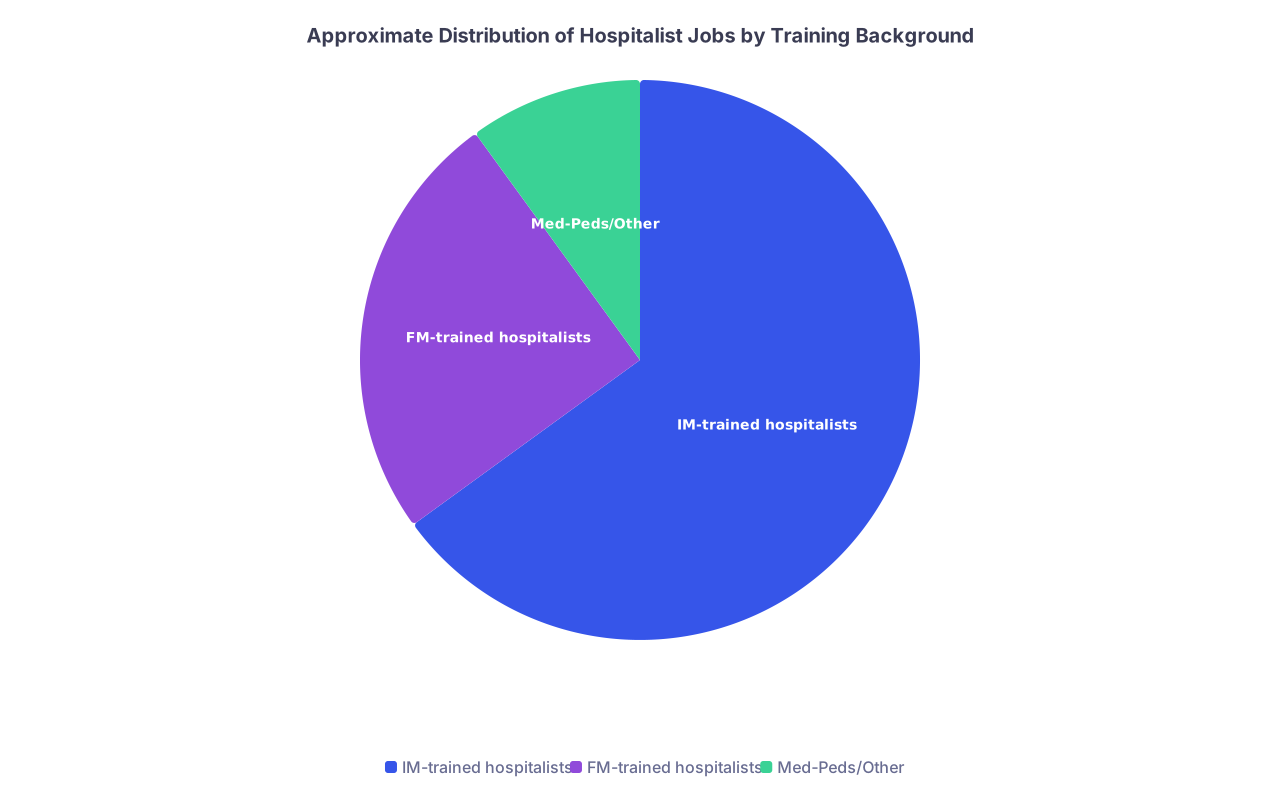
| Category | Value |
|---|---|
| IM-trained hospitalists | 65 |
| FM-trained hospitalists | 25 |
| Med-Peds/Other | 10 |
No, this is not a rigorous national census figure. But it’s in the ballpark of what many regional recruiters report:
- Majority IM
- Substantial minority FM
- Smaller slice Med-Peds, DO transitional, or others
Hospitals that refuse FM hospitalists usually fall into one of two camps:
- High-acuity tertiary/academic centers with culture and credentials built around IM
- Systems with standard HR language that copied “IM only” from some template and never revisited it
In both cases, that’s a local policy choice, not a universal rule.
The Real Selection Criteria: Signal, Not Label
Let me be direct: The letters “IM” vs “FM” are shorthand. Employers are using them as a signal of how much adult inpatient you’ve probably done.
But that signal is noisy as hell.
I’ve seen:
- IM grads from outpatient-heavy community programs who were uneasy with sick floor patients.
- FM grads from heavy-inpatient, no-OB programs who could run circles around many IM interns on the wards.
Smart hiring groups look deeper. They ask things like:
- How many months of adult inpatient did you have?
- How much ICU? Nights? Stepdown?
- Did you do a hospitalist track or hospitalist elective?
- Can your PD or hospitalist director vouch for your inpatient competence?
If your goal is to maximize your hospitalist options with either specialty, you do not just “pick IM” or “pick FM” and coast. You:
- Choose a program with strong inpatient exposure
- Load your electives with inpatient, nights, ICU, hospitalist rotations
- Get letters from hospitalist leaders saying “This person can practice independently on day one”
That’s what hiring committees actually read.
Myth #4: “FM Hospitalists Can’t Work in ICUs or Higher Acuity Settings”
There’s some truth buried in here, but it’s not what people think.
Many high-acuity ICUs and closed units want fellowship-trained intensivists or at least IM with strong critical care exposure. Some tertiary centers won’t credential FM for ICU attending roles at all.
But that’s ICU. Not “hospitalist.”
For hospitalists who occasionally:
- Manage step-down patients
- Admit and stabilize before transferring to ICU
- Co-manage stable vents or trachs with intensivists
FM physicians absolutely do this in a lot of community and regional hospitals.
Where the line gets sharper:
- Running a closed medical ICU independently as an FM grad with no extra training? Harder to get credentialed, and in some systems, impossible.
- Doing a pulmonary/critical care fellowship? That path is overwhelmingly IM-based.
So yes, if you’re dreaming of being an intensivist, FM is swimming upstream. IM is the more realistic—and frankly expected—path.
But “I want to handle reasonably sick inpatients, sometimes on high-flow or low-dose pressors in a community setting” is not automatically off-limits for FM. I’ve watched FM hospitalists do exactly that in hospitals where the intensivist is off-site and on-call.
How to Think About FM vs IM if You’re Hospitalist-Curious
Strip the noise away and ask yourself three practical questions:
Do I want big academic centers, subspecialty doors, or ICU-heavy careers?
If that’s a strong yes, IM is the cleanest route. Most tertiary and academic hospitals are built around IM-trained hospitalists and subspecialists.Do I want mix-and-match practice (clinic + inpatient, rural generalism, maybe some ED), and I’m okay with community rather than big-name academic centers?
FM is not only feasible; in many rural places it’s the norm. And you can still be a full-time hospitalist if you structure your training right.How much do I actually enjoy outpatient continuity vs inpatient medicine?
- If clinic drains you and wards give you energy → IM aligns better, and you’ll be surrounded by people who feel the same.
- If you genuinely like cradle-to-grave coverage, families, and continuity, but still want regular inpatient blocks → FM gives you a broader toolset.
Here’s a crude but useful mental model:

| Step | Description |
|---|---|
| Step 1 | Want to work as hospitalist? |
| Step 2 | Choose IM |
| Step 3 | Choose FM with strong inpatient focus |
| Step 4 | IM or FM; prioritize program with strong wards |
| Step 5 | Big academic or ICU career goal? |
| Step 6 | Want broad scope rural or mix clinic plus inpatient? |
That’s closer to how programs and employers actually behave than the absolutist “IM or bust” mantra.
Tactical Advice: How to Protect Your Inpatient Options Either Way
If you’re still on the fence, here’s the unglamorous truth: your residency environment matters more than the letters on your diploma.
You want to be a hospitalist? Then during residency:
- Don’t hide from sick patients. Seek out the busy services.
- Volunteer for nights and cross-cover when you can do so safely.
- Get face time with the hospitalist group. They’re often the ones hiring or networking you later.
- Ask your PD directly: “How many grads in the last 5 years are hospitalists? Where?”
If you match FM and you’re serious about inpatient, you should be borderline annoying about it—in a good way. Ask for:
- Extra inpatient blocks
- ICU electives
- Hospitalist rotations at the big referral center your program feeds into
If you’re IM, don’t assume you’re automatically “hospitalist-ready” just because of the label. I’ve seen IM grads need a gentler onboarding because their particular shop shielded them from the uglier cases.
Your CV should scream: “I live on the wards and I can handle it” if you want the best hospitalist jobs, regardless of IM vs FM.
Common Myths vs Reality Snapshot
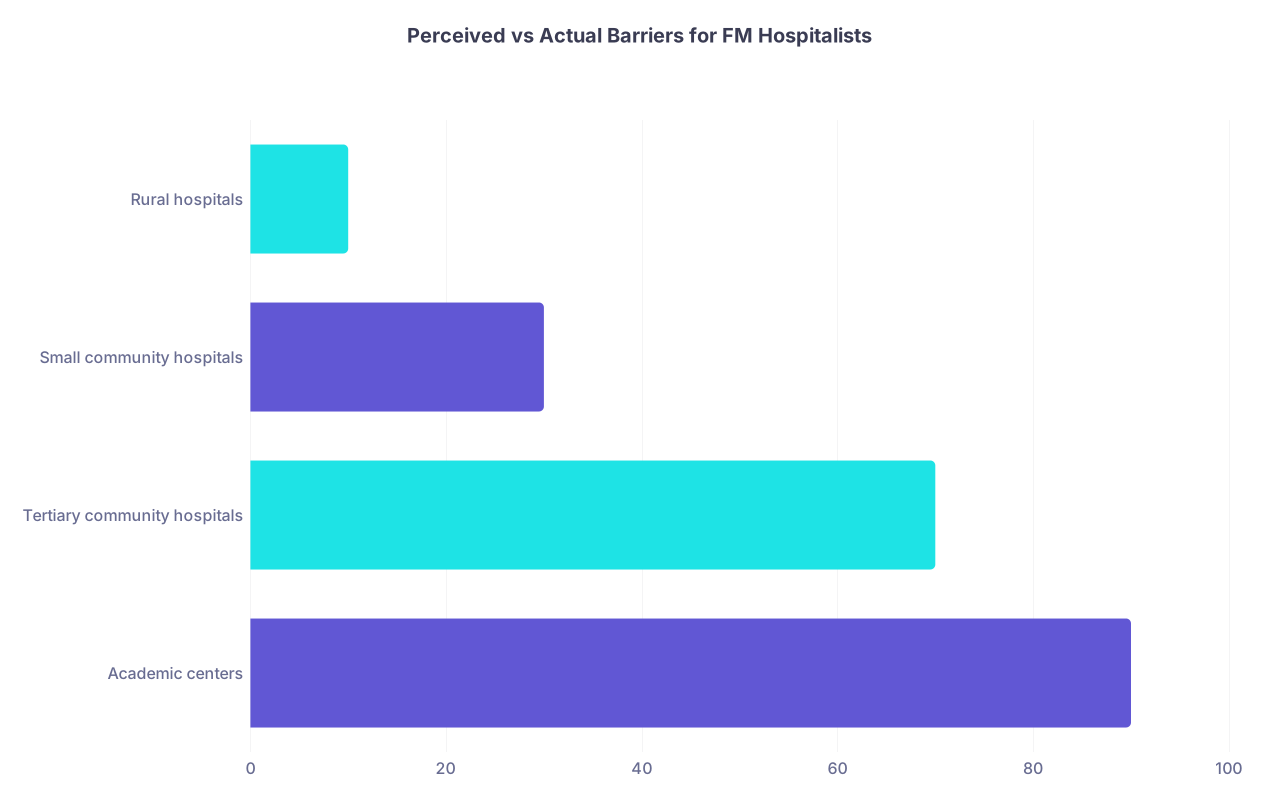
| Category | Value |
|---|---|
| Academic centers | 90 |
| Tertiary community hospitals | 70 |
| Small community hospitals | 30 |
| Rural hospitals | 10 |
Think of those percentages as “how often FM is perceived to be blocked,” not absolute bans. Reality is always messier, with plenty of exceptions.
Academic centers really do often prefer or require IM. That part is not a myth. But the leap from “harder at academic centers” to “FM cannot be hospitalists” is where the logic dies.
FAQs
1. Can a family medicine doctor work as a full-time, inpatient-only hospitalist?
Yes. Thousands do. You’ll see this especially in small and mid-size community hospitals and rural systems. The trick is making sure your FM training includes substantial adult inpatient and ICU exposure, and ideally that you have letters from hospitalist leaders attesting to your competence.
2. If I know I want to be a hospitalist at a big academic center, should I still consider FM?
Realistically, IM is the better bet. Many academic and tertiary centers write “IM only” into their bylaws or HR templates. Could FM occasionally slip through, usually via niche pathways or unique experience? Sure. But if your non-negotiable dream is “academic hospitalist at a big-name center,” IM aligns with the existing system instead of fighting it.
3. Do FM hospitalists get paid less than IM hospitalists?
In most markets, no meaningful difference. Hospitalist pay is driven by employer, region, workload, and RVU/shift structure far more than by whether your board certificate is IM vs FM. Recruiters tend to quote the same range for “BC/BE in IM or FM.” The discount—if any—usually comes from leverage (how desperate they are) and how strong your CV looks, not your specialty title.
4. Is it harder for FM hospitalists to get procedure-heavy or ICU-adjacent jobs?
Often yes, especially in systems where procedures and ICU management are more tightly controlled or aligned with subspecialties. If your goal is a procedure-heavy, ICU-heavy hospitalist role or you’re flirting with critical care fellowship, IM is clearly the smoother path. FM can still do procedure-focused work in some community settings, but credentialing is more variable and you’ll hit more closed doors at higher-acuity centers.
Key points:
- Both IM and FM physicians can and do work as hospitalists; the real constraint is hospital type and local policy, not a universal rule.
- IM makes high-acuity, academic, and ICU-adjacent hospitalist roles easier; FM shines in community and rural settings and can still support full-time inpatient careers.
- Your actual training environment, inpatient volume, and the way you build your CV matter more than the simplistic “FM vs IM” label if your goal is to live on the wards.