The prestige obsession around academic vs community internal medicine is mostly nonsense.
You have been sold a simple story: academic internal medicine = “real medicine, smart people, doors open.” Community internal medicine = “fallback, less rigorous, limited options.” That story is comfortable. It is also wrong, or at least badly outdated and wildly oversimplified.
Let’s walk through what the data actually say, where prestige mythology came from, and how to make a rational choice that fits your goals instead of your classmates’ egos.
The Core Myth: Academic = Better Training, Community = Settling
The dominant myth sounds like this:
“If you can match at an academic IM program, you should. Community is what you do if you cannot.”
I hear this constantly from MS3s on IM rotations. Usually parroted from someone one or two years ahead of them, rarely grounded in outcomes.
Here’s the inconvenient reality:
- Board pass rates for internal medicine are high at both academic and community programs.
- Fellowships take tons of residents from community programs every year, including competitive subspecialties.
- Procedural experience is often better at community programs.
- Research participation is skewed toward academic programs, but research output per resident is more nuanced.
- Patient complexity and case mix are not purely an “academic hospital thing” anymore.
So the clean hierarchy in your head—academic > hybrid > community—is mostly an artifact of reputation, not robust evidence.
What the Outcomes Really Show
Let’s start with the metrics people claim they care about: board pass rates, fellowship match, and jobs.
Board Pass Rates: Not the Divide You Think
ABIM publishes pass rates by program, and if you actually look instead of just assuming, you will find:
- Plenty of “prestige” academic programs with a 3-year rolling ABIM pass rate in the low 90s.
- Plenty of community programs with 3-year pass rates also in the 90–100% range.
The gap you imagine—elite academic at 100%, community at 75%—is mostly fantasy.
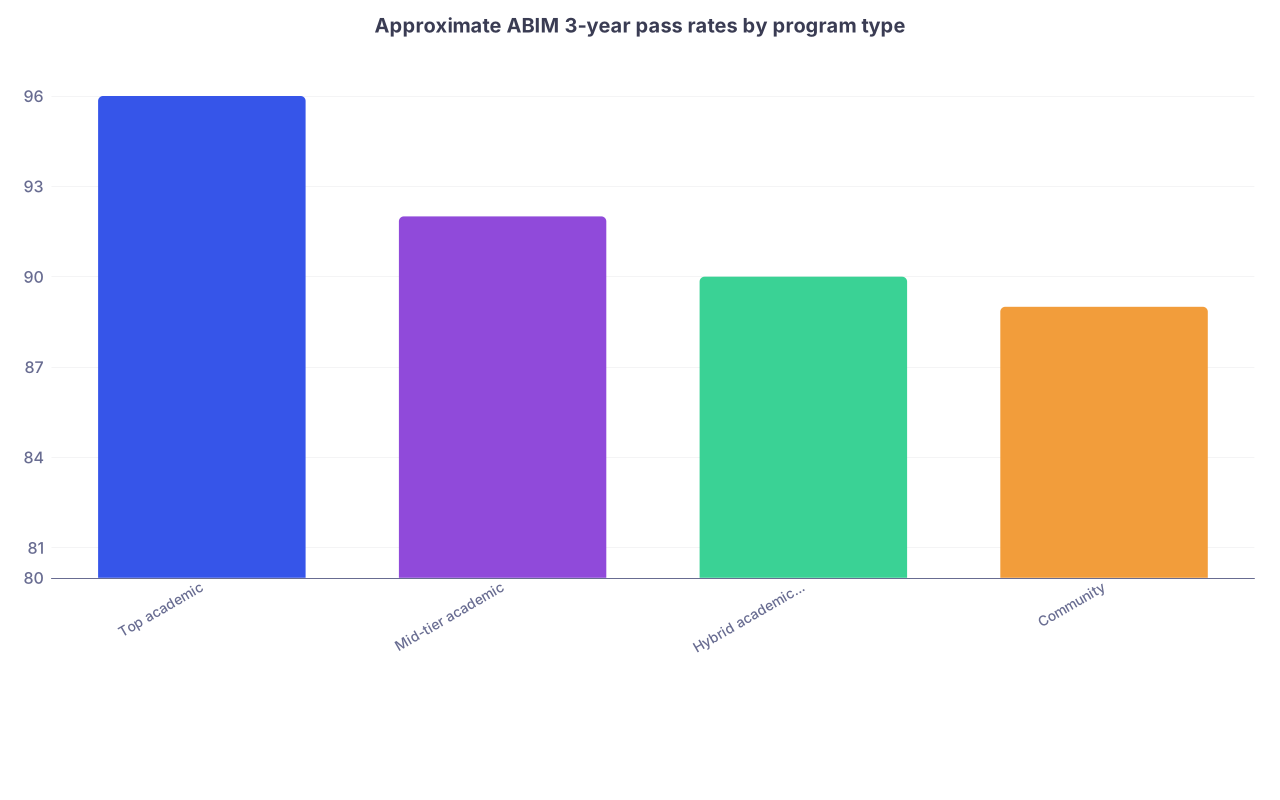
| Category | Value |
|---|---|
| Top academic | 96 |
| Mid-tier academic | 92 |
| Hybrid academic-community | 90 |
| Community | 89 |
Are there weak community programs with poor board performance? Yes. There are also mediocre academic programs coasting on a university name while their residents cram for ABIM because the teaching is disorganized.
Board outcomes are program-specific, not simply “academic vs community.” Lazy thinking to assume otherwise.
Fellowship Placement: Community is Not Locked Out
This is where the fear is loudest: “If you want cards/GI/heme-onc, you must go academic.” That was closer to true 20–30 years ago. It is not how the match looks now.
Several things are real:
- Competitive fellowships (cards, GI, heme-onc, pulm/crit) are still numerically dominated by academic IM residents.
- Program reputation and letters from well-known attendings help.
- Major academic centers often prefer people “from similar environments.”
But here’s the part people conveniently ignore: a huge number of fellows in competitive subspecialties come from strong community IM programs. I have seen community residents match:
- GI at regional academic powerhouses
- Cards at big-name university hospitals
- Heme-onc at NCCN-designated cancer centers
They tend to share a profile:
- Top of their class at their community program
- Strong letters, excellent clinical reputation
- Some research or scholarly activity (case series, QI, retrospective chart reviews)
- Good fellow “fit” and interview performance
If you sit in a community program, do zero scholarly work, hover in the middle of the class, and then demand UCSF GI—sure, that’s unlikely. But that would also be weak odds from most mid-tier academic programs.
What matters most is:
- Your rank within your program
- The advocacy of your PD and key attendings
- Whether you deliberately build a fellowship application, not just hope your program’s name does the work for you
The Stuff That Actually Differs (And Why It Matters)
The difference between academic and community IM is real, but it’s not what Instagram medfluencers think. It sits in the details of your day-to-day training.
Case Mix and Acuity
Old story: academics get the zebras and sickest ICU cases; community gets bread-and-butter.
Reality now: mixed.
- Large community hospitals with trauma designations, robust ICUs, and subspecialty coverage see plenty of septic shock, complex HF, and multi-organ failure.
- Academic centers still see more rare diseases, transplant medicine, advanced oncology trials, and often the sickest of the sick referred in from the whole region.
If you are the person who wants daily exposure to:
- LVADs
- Post-liver transplant complications
- Complex immunotherapies
then yes, a major academic center has a structural advantage.
But if what you want is:
- To be the primary doc managing DKA, COPD exacerbations, NSTEMIs, upper GIBs—without 14 layers between you and the attending
then many community programs will give you more autonomy and direct responsibility.
Autonomy vs Layered Teams
Academic centers love hierarchy.
You often have:
- Interns
- Senior residents
- Fellows
- Attendings
- Sometimes advanced practice providers layered in
It can be great for teaching, but it can also mean you “own” less of the decision-making early.
At many community hospitals, the team is lean:
- Resident(s)
- One attending
- Maybe an NP/PA
Residents often:
- Call consults themselves
- Talk directly to families more
- Own discharge decisions
- Do more cross-cover without a fellow buffering everything
That autonomy accelerates maturation. It also scares people who secretly want the emotional safety blanket of big-name supervision.
Procedures, Continuity Clinic, and Bread-and-Butter Skill
This is where community programs quietly outperform more often than people admit.
Procedural Volume
At some high-prestige academic IM programs, every LP, central line, and paracentesis is eaten by:
- Procedure services
- Interventional radiology
- Fellows
I’ve seen PGY-3s at fancy university hospitals scramble to hit minimum procedural numbers before graduation.
At midsize community programs, it is common to hear:
- “Our residents fight to give away lines because everyone has already met numbers by mid-PGY2.”
- “We have a paracentesis almost every call night.”
If you care about being a competent general internist or hospitalist and not just a subspecialty fellow, this matters. A lot.
Continuity Clinic
Academic clinic can be:
- Great, with subspecialty preceptors and deep resources
- Or a chaotic revolving door packed with underinsured patients, high no-show rates, and almost no longitudinal continuity because residents and attendings keep rotating out
Community clinic often means:
- Smaller teams
- Better chances of actually seeing the same patients over time
- A workflow closer to what real-world outpatient IM looks like
Is that always true? No. But the automatic assumption that academic outpatient training is superior is fantasy.
Research and “Academic Career” Paths
This is the one area where academic training really does have structural advantages. But again, nuance.
Research Opportunities
If you want a career heavy in:
- Clinical trials
- Basic science
- Outcomes research
- Grants and K awards
then yes, an academic IM program with strong departmental infrastructure is objectively better.
You will often have:
- Dedicated research faculty
- Biostats support
- Ongoing registries and databases
- A culture that respects protected time (at least on paper)
Community programs, by comparison:
- May have little or no formal research structure
- Often rely on motivated faculty and residents to bootstrap projects
- Focus more on QI, case reports, and small retrospective projects
If your long game is “I want to be an NIH-funded investigator,” choosing a small community program with almost no research is just self-sabotage.
But a lot of you are not actually aiming for that, even if you say “I want to keep doors open.” You want:
- Good clinical training
- Maybe a hospitalist job
- Maybe a clinically-focused fellowship with some teaching
For that track, you do not need a research powerhouse. You need:
- A program that supports basic scholarly output (posters, QI, some publications)
- Mentors who will push your work forward and write strong letters
Those mentors exist in many community and hybrid programs. You just do not see them advertised as aggressively.
What Actually Predicts Training Quality
Let’s stop letting the “academic vs community” binary do the thinking for you. There are more useful variables.
| Factor | Academic vs Community Label Relevance |
|---|---|
| ABIM pass rate (3-year) | Program-specific, not label-based |
| ICU and floor autonomy | Often higher at community |
| Procedural volume | Often higher at community |
| Rare/tertiary cases | Higher at academic |
| Research infrastructure | Higher at academic |
| Fellowship reputation | Depends on program, not just label |
If you want a checklist for evaluating any IM program, it’s closer to this:
- ABIM pass rates and in-training exam support
- ICU exposure and who actually manages the sickest patients
- Realistic procedural opportunities
- Where recent graduates went (hospitalist vs cardiology vs GI, and where)
- Research and QI opportunities for non-superstars, not just the one golden resident
- Culture: support, burnout, how the PD actually talks about residents
None of that requires the words “university” or “academic medical center” in the hospital’s name.
The Quiet Trap: Prestige as a Proxy for Security
Here is the uncomfortable psychological layer.
A lot of medical students use “academic vs community” as a stand-in for: “Am I good enough?” Matching a big-name academic IM program feels like social validation. It tells your peers and your family you “made it.”
The problem is simple: prestige does not feel nearly as good at 2 a.m. when:
- You are spread across 18 patients
- You are not supported
- You are undertrained for the tasks you are given
- Half your time is spent fighting EMR workflows and paging wars
I have watched people miserable at “top” academic programs, regretting not ranking a smaller, more supportive community program higher. And yes, I have seen the reverse—people bored or suffocated by a small community environment when they crave the academic ecosystem.
The smart move is to treat prestige as a minor tiebreaker, not a primary variable. Fit, training structure, and outcomes should dominate your decision.
A Simple, Honest Framework
Strip away the noise. Ask yourself three things.
Do I realistically want a research-heavy, academic career?
If yes, favor strong academic programs with real research. If you are “maybe” but have zero concrete interest or experience, stop lying to yourself just to justify chasing prestige. Your behavior is already answering the question.
How much do I value autonomy and procedures vs rare cases and layered teaching?
If you want more hands-on responsibility and procedural comfort, many community or hybrid programs are better aligned. If you crave big tertiary care medicine and don’t mind less autonomy early, major academic centers will scratch that itch.
What do graduates from this specific program do?
Not “what does Academic vs Community do.” This program. This PD. Look at their list of fellowship matches and hospitalist jobs. That’s your best predictor of what doors you’ll have.
Visualizing Career Paths: Both Routes Lead Everywhere
To really drive this home, here’s a rough sketch of career paths from both settings.

| Step | Description |
|---|---|
| Step 1 | Academic IM residency |
| Step 2 | Academic fellowship |
| Step 3 | Community fellowship |
| Step 4 | Hospitalist - academic |
| Step 5 | Hospitalist - community |
| Step 6 | Community IM residency |
Every arrow in that diagram exists in the real world. I’ve seen them. Multiple times. The idea that community IM “closes doors” is lazy thinking propagated by people who have not actually looked at where residents end up.
Quick Data Reality Check: Application Behavior
Look at how students actually apply and where they match. A large chunk of the IM workforce is trained at community or hybrid programs. Yet hospitalists and subspecialists across both community and academic settings function side by side with similar competencies.
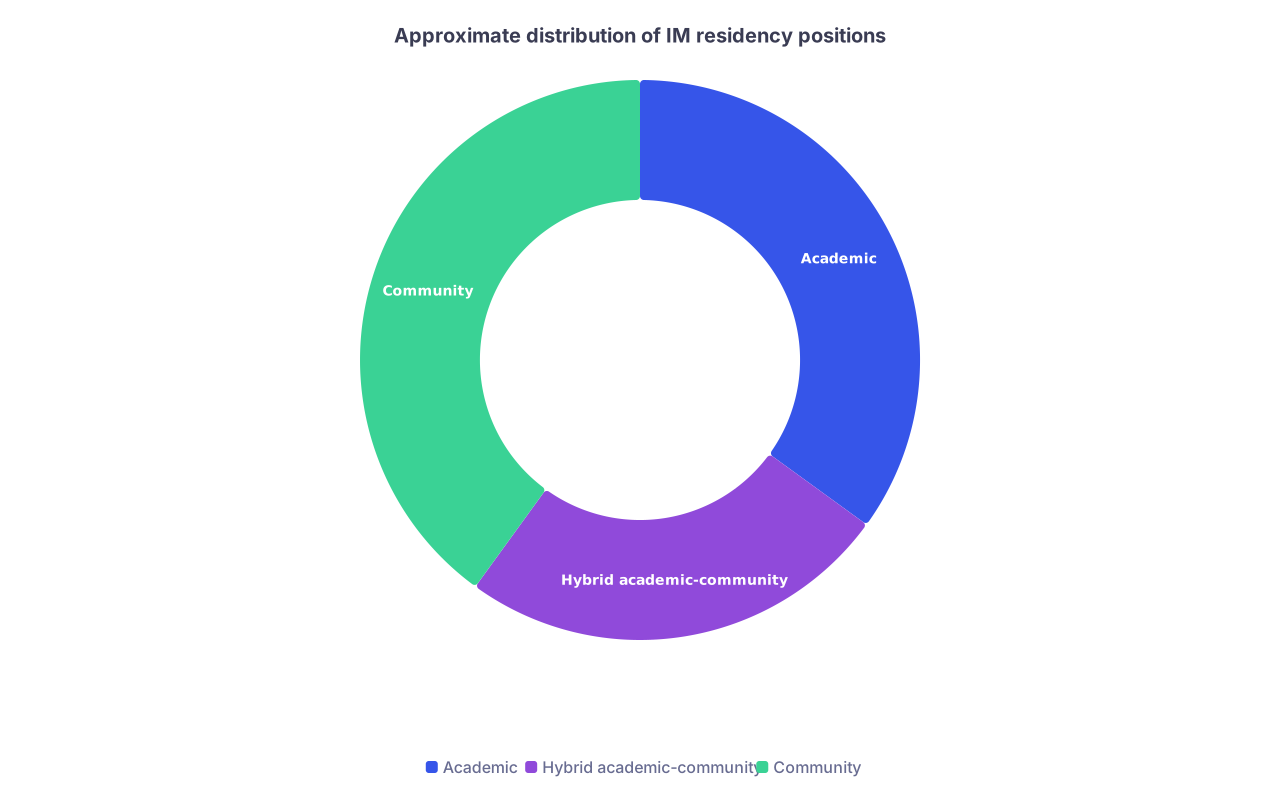
| Category | Value |
|---|---|
| Academic | 35 |
| Hybrid academic-community | 25 |
| Community | 40 |
If community training were truly inferior across the board, you’d see it in:
- Dramatically worse patient outcomes for their graduates
- Systematic inability to pass boards
- Large gaps in competency
You do not. What you see instead is variation within each category. Great academic programs and bad ones. Great community programs and bad ones.
So stop asking “academic vs community?” and start asking “strong vs weak program?”
FAQs
1. If I want a competitive fellowship (cards, GI, heme-onc), should I avoid community IM?
No. You should avoid weak programs, not community ones. If you aim for a competitive fellowship, you need:
- A program with a track record of placing people into that fellowship type
- Faculty in that specialty who can mentor you and write serious letters
- At least some opportunity for scholarly output
There are community and hybrid programs that check all three boxes. If a community program has zero recent graduates in your target subspecialty, minimal research, and no subspecialists in-house, then yes, that’s a red flag. But category alone—community vs academic—is not the deciding factor.
2. Will choosing a community IM program hurt my chances of ever working at an academic medical center?
Not inherently. Academic hospitals hire:
- Fellows who did IM in community or hybrid programs
- Hospitalists who trained in community settings but show strong clinical skills and interest in teaching
- Clinician-educators without major research footprints
What matters is your trajectory: fellowship performance, teaching evaluations, letters, and evidence that you function well in academic environments. If you want a physician-scientist role with heavy grants, then a very research-light residency may be a handicap. But plenty of academic clinicians started in community IM and built academic careers through fellowships and later moves.
3. So how many “prestige points” should I give to academic vs community when making my rank list?
Very few. Treat “academic vs community” as a context label, not a quality score. You should weigh:
- Training environment and culture: high weight
- Outcomes for graduates: high weight
- Your personality and goals: high weight
- Geographic and personal life factors: medium to high weight
- Brand name / perceived prestige: low weight
If two programs are truly equal on those first three factors, then yes, pick the academic one if it gives you peace of mind. But if a community program clearly offers better support, more autonomy, and outcomes aligned with your career goals, choosing the shinier logo instead is not strategy. It is insecurity dressed up as logic.
Years from now, you will not brag about where you trained; you will quietly live with how you were trained. Choose the program that makes you into the physician you actually want to be, not the one that just looks best on someone else’s slide deck.