
You do not choose psychiatry because you are “bad at procedures.” If that’s your decision algorithm, you’re already thinking about residency backwards.
I’ve heard this exact line from more MS3s than I can count: said half-jokingly on surgery, muttered on OB nights, or whispered after a clumsy IV attempt on medicine. It usually comes right after a rough day in the OR or a failed attempt at a central line:
“I’m just not a hands-on person. I should probably do psych.”
No. That’s not career planning. That’s avoidance dressed up as insight.
Let’s destroy this myth systematically.
The False Premise: “I’m Bad at Procedures”
The entire “I need psych” reasoning starts from a bad assumption: that your current procedural skill (or lack of it) as an MS3/MS4 is predictive of your long‑term performance or fit in a specialty.
It isn’t.
Early clinical years are basically designed to make you feel incompetent with your hands. You’re doing:
- A handful of half‑supervised blood draws.
- One or two suturing attempts when the attending remembers you exist.
- Maybe an NG tube or foley when the resident is in a generous mood.
That’s not a sample. That’s statistical noise.
Here’s the uncomfortable truth: almost everyone is “bad at procedures” at your stage. The few who aren’t usually had EMT, paramedic, OR tech, or nursing backgrounds. You’re comparing your first 10 attempts to their first 500. Of course you look clumsy.
Procedural skill is a trainable domain. Very trainable. There’s decent evidence that:
- Simulation training and deliberate practice can significantly improve procedural performance and complication rates.
- Most learners show steep improvement curves with repetition, not “talent.”
You don’t have a fixed “procedural quotient” that determines your specialty. You have exposure, practice, supervision, and feedback. Or you don’t. That’s the variable.
What Psychiatry Actually Is (And Is Not)
The “I need psych because no procedures” mindset also seriously misrepresents what psychiatry involves.
Psychiatry is not the refuge of the clumsy. It’s a cognitive, relational, and systems-heavy specialty that demands skills many procedurally-averse students haven’t actually thought through.
Psychiatry does not mean:
- Sitting quietly, giving generic advice, and avoiding “hard things”
- Never touching a patient
- A stress-free, 9–5 life of simple med refills and vibes
Psychiatry does mean:
- Long, intense interviews where your full attention is the procedure
- Risk assessments that carry real stakes: suicide, homicide, child safety
- Legal and ethical complexity: involuntary holds, capacity evaluations, forensic issues
- Managing patients who may be agitated, paranoid, or violent
- Balancing polypharmacy with incomplete data and unreliable histories
- Interfacing constantly with families, courts, social workers, and primary care
I have watched students who “hate procedures” light up on psych. But not because they escaped needles. Because they discovered they actually enjoy:
- Parsing narratives and inconsistencies
- Sitting in discomfort and ambiguity
- Negotiating, persuading, and motivating change
- Thinking in biopsychosocial models, not just biochemistry
If you’re picking psychiatry to avoid technical skills rather than because you want to do that work, you’re solving the wrong equation.
Procedures Do Not Define Most Specialties
There’s another bad assumption buried under this myth: that specialties are either “procedural” (surgery, EM, anesthesia) or “non‑procedural” (psych, maybe rheum), and that defines your daily life.
Reality is messier.
Take internal medicine. Supposedly “cognitive.” In residency you will be asked to:
- Do paracenteses, thoracenteses, LPs
- Place lines in some programs
- Run codes with CPR, airways, and ACLS protocols
Same for family medicine: skin biopsies, joint injections, IUD placements, suturing, abscess I&Ds. Depends heavily on practice setting and personal preference.
Yes, some fields lean heavily procedural. But even in procedure-heavy specialties, the mental work often matters more. The best interventional cardiologist is not just the steadiest hand—it’s the person who actually knows when not to stent.
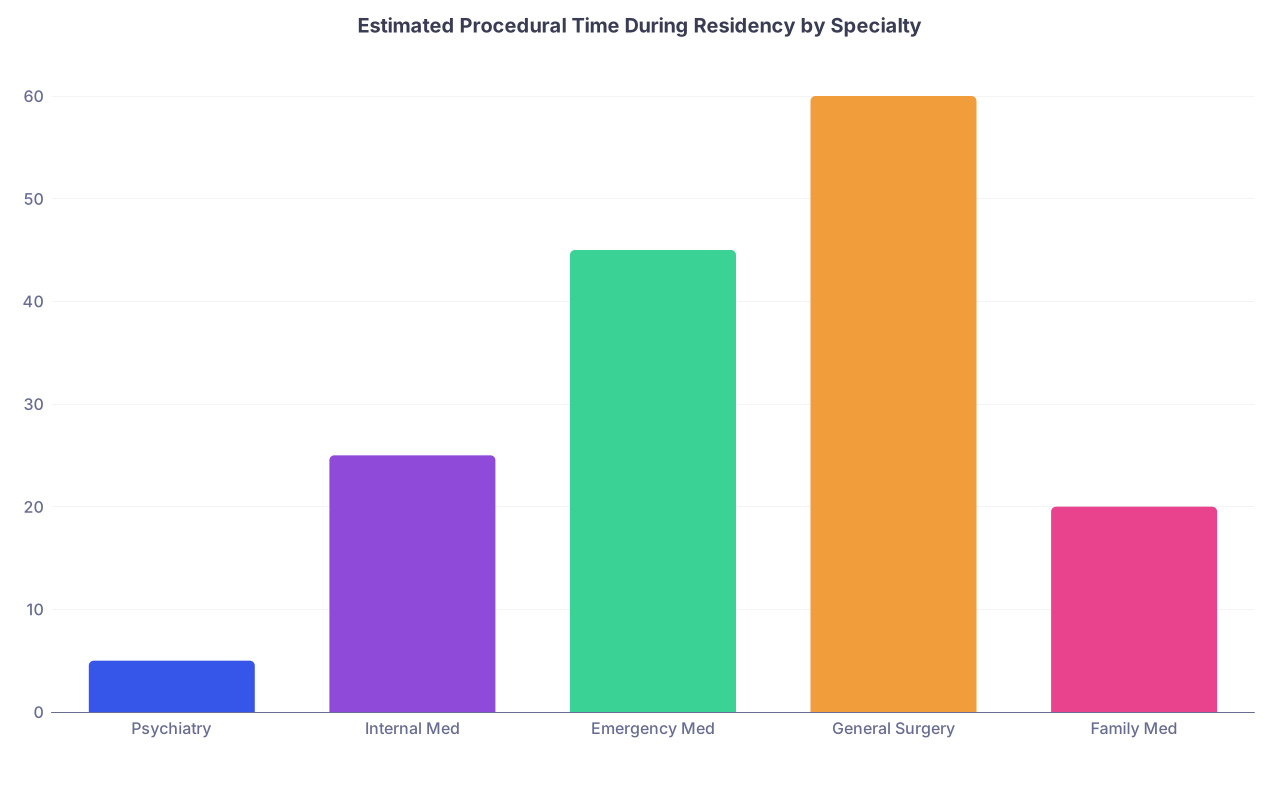
To ground this, here’s a rough comparison of how much procedure time various specialties realistically involve in residency. These are estimates, not gospel, and they vary by program.
| Category | Value |
|---|---|
| Psychiatry | 5 |
| Internal Med | 25 |
| Emergency Med | 45 |
| General Surgery | 60 |
| Family Med | 20 |
Psych really does have fewer procedures. But fewer doesn’t mean none. And it definitely does not mean you get to opt out of the “hard” parts of medicine.
The Real Skill Set Psychiatry Demands
If you strip away the noise, psychiatry favors a completely different phenotype than “non‑procedural.”
From watching residents, attendings, and students over years, the people who thrive in psych usually share some of these traits:
They can tolerate ambiguity. Diagnostic categories blur. Comorbidities are rampant. You often don’t get labs or imaging that give you a neat answer. The diagnosis is a moving target, not a solved puzzle.
They are willing to confront distress head‑on. Not in a trauma bay way. In a “I will sit in a room with someone describing their plan to kill themselves and not look away” way. That’s not neutrality. That’s emotional stamina.
They can manage long games. Psych patients do not get “fixed” by next Tuesday. You’re playing in months, years, sometimes decades. Progress is nonlinear. Relapses happen. If you need constant fast wins, this will frustrate you.
They communicate. Constantly. With patients who are mistrustful, disorganized, or frankly psychotic. With families in denial. With inpatient teams, outpatient teams, addiction services, shelters, law enforcement. Conversation is your main instrument.
They think in systems. If your idea of managing depression is “just prescribe an SSRI,” you’re missing 70% of the work. Housing, drugs, trauma, job loss, dysfunction—all of that sits on your plate.
I’ve seen high‑performing psych residents who were fantastic proceduralists as students. They left medicine or EM or anesthesia not because they were bad with their hands, but because they wanted to work where language, narrative, and meaning are the real tools.
That’s the actual attractor for psych. Not “I kept fumbling IVs.”
What “Bad at Procedures” Usually Really Means
Listen closely when students say, “I’m bad at procedures so I need psych.” They usually mean one of five things:
“No one taught me properly.”
They got a 30‑second demo, were thrown into a central line attempt, and—shockingly—didn’t nail it. This isn’t a talent problem. It’s a systems problem.“I’m anxious being watched.”
Completely human. Almost everyone stiffens when three people stare at their hands. That’s not “I can’t ever do procedures.” That’s social performance anxiety under supervision.“I hate the OR culture I just saw.”
This one is huge. A toxic OR, a belittling scrub tech, or a malignant attending can make surgery and procedures feel like punishment. You’re not reacting to suturing. You’re reacting to hostility.“I don’t like the type of procedures I’ve seen.”
Some students hate 6‑hour cases but love quick bedside procedures. Others are bored by laceration repairs but fascinated by endoscopy. “Procedures” is not one thing.“I felt stupid, and I’m trying to avoid that feeling forever.”
This is probably the core. Students conflate temporary incompetence with permanent identity. “I struggled on this once” becomes “This is not who I am.”
None of those are good reasons to pick—or avoid—an entire field.
The Dangerous Logic of Avoidance-Based Career Choice
Choosing a specialty mainly to avoid a discomfort is almost always a bad move. You’re anchoring your entire career on your current fear, not your future growth.
Two common trajectories I’ve seen:
Scenario 1: The Avoider in Psych
MS3 hates procedures, feels clumsy, chooses psych to escape them. Turns out:
- They dislike long talks.
- They find chronic, relapsing illness demoralizing.
- They’re drained by constant emotional intensity.
- They miss the immediate, tangible “I did something” feedback of procedures.
In PGY‑2, they realize they ran from the wrong thing. Now they’re stuck in a specialty that doesn’t match their temperament, and the thing they ran from (awkward supervision, steep learning curves) exists here too—just in different form.
Scenario 2: The Grower in a Procedural Field
MS3 feels bad at procedures, but is curious about EM or anesthesia. Decides to actually work at the skill:
- Asks residents for extra practice
- Uses sim lab deliberately
- Watches videos and mentally rehearses steps
- Accepts early clumsiness as normal
By PGY‑2, they’re not a magician, but they’re competent. And suddenly, the field that once terrified them is where they feel most alive.
The psychological difference is huge. One made a decision to minimize pain. The other made a decision to maximize fit and accepted some pain along the way.
Residency is hard no matter what you do. If you choose based on avoidance, you get suffering with resentment. If you choose based on alignment, you get suffering with purpose.
Yes, There Are Wrong Reasons to Choose Psychiatry
Let me be very explicit: there are legitimate, excellent reasons to go into psychiatry. I’m not anti‑psych. I’m anti‑lazy‑logic.
Good reasons to consider psychiatry include:
- You’re genuinely fascinated by how people think, feel, and behave.
- You like long, complex stories more than short, crisp differentials.
- You’re okay with diagnostic categories that are descriptive, not mechanistic.
- You want lots of longitudinal patient relationships.
- You’re comfortable with risk management as a regular feature of your day.
- You enjoy working at the interface of medicine, law, and society.
Bad reasons:
- “I’m bad at procedures.”
- “I want an easier life.” (Ask a C‑L psychiatrist in a county hospital about “easy.”)
- “I want to avoid nights/weekends forever.” (Call, consults, CPEPs/ED psych—welcome.)
- “I don’t like sick patients.” (Psych patients get medically sick, and you still need to manage or recognize it.)
Psychiatry is not your escape hatch. It is its own form of intensity, just with different weapons.
How to Actually Decide If Psych Fits You
Strip your ego out of this. Forget your last fumbled central line. Focus on what your day-to-day brain enjoys doing.
On psych, do you leave the unit wondering about your patients’ stories, or counting down the hours until discharge summaries are done?
When you sit with someone suicidal, do you feel a grounded seriousness and a pull to understand more? Or do you feel a strong internal “get me out of this room” impulse?
When you listen to a long, wandering account of hallucinations or trauma, do you become more curious or more irritated?
On other rotations: when you get a chance at a procedure, does time speed up or drag? Even if you’re clumsy, do you want to try again?
Here’s a simple (and admittedly crude) mental model: think less about whether you’re good at something right now. Ask whether you are drawn toward or away from the core tasks, even when you’re bad at them.
I’ve seen MS3s be absolutely terrible at psych interviews—yet be thrilled to practice, read, and improve. Those people often become very strong residents.
I’ve also seen students be naturally smooth with patients on psych but utterly bored by the work. They would have been much happier elsewhere, despite being “good” at it from the start.
And About “Not Being a Hands-On Person”…
One more myth to kill: the idea that talking to patients is somehow “less real” than doing procedures, so if you’re not good at the latter, you’re secondary.
This is nonsense.
The psychiatric interview is a procedure. A high-stakes one. It requires:
- Structured method
- Sequencing and scaffolding
- Attention to safety steps
- Mastery through repetition and feedback
The fact that it does not involve a needle does not make it soft work.
If you are going into psych, you’re signing up to become technically excellent at different procedures: diagnostic interviews, risk assessments, medication management in complex systems, psychotherapy modalities. You’re not escaping skill acquisition. You’re just moving it to another domain.
Bottom Line
Pick psychiatry because you love the work of psychiatry. Not because you blew a central line.
Three key points to keep straight:
Being “bad at procedures” as a student is almost never a stable trait. It’s usually inexperience, poor teaching, or performance anxiety—none of which should dictate your specialty.
Psychiatry is not a non‑technical, low‑intensity refuge. It demands a different, equally rigorous skill set: deep interviewing, risk management, systems thinking, and emotional endurance.
Avoidance-based career decisions age badly. Choose a field whose core daily tasks you’re drawn to, even when you’re currently terrible at them. Your present fear is a lousy compass for a 30‑year career.