
The biggest mistake applicants make is pretending child and adolescent psychiatry is just “general psych but with smaller patients.” It is not. It is a different job, a different training pathway, and a different daily stress load.
Let me walk you through this in a way that matches how programs actually think, not how brochure copy reads.
1. Training Pathways: How You Actually Get There
First, the skeleton of both pathways. If you do not have this absolutely clear, everything else gets fuzzy.
Standard training routes
| Pathway | Total Years | Board Certification Outcome |
|---|---|---|
| General Psychiatry Only | 4 | Psychiatry |
| General Psych + Child & Adolescent Fellowship | 6 | Psychiatry + Child & Adolescent Psychiatry |
| Triple Board (Peds/Psych/CAP) | 5 | Pediatrics + Psychiatry + Child & Adolescent Psychiatry |
Now, detail.
General Psychiatry Residency (Standard Path)
Structure for a typical 4-year general psychiatry program (US):
- PGY-1: Mix of medicine/neurology + intro psych
Usually 4–6 months medicine (wards, ED, maybe ICU), 1–2 months neurology, the rest inpatient psych and night float. - PGY-2: Heavy inpatient psychiatry + emergency psych
Inpatient units (adult), consult-liaison, ED psych, some addiction, maybe forensics. - PGY-3: Outpatient psychiatry
Longitudinal adult outpatient clinics, some child clinic for many programs, plus electives. - PGY-4: Electives, leadership, niche experiences
Chiefs, research, specialty clinics, more C/L, more psychotherapy, etc.
If you finish here, you are a general psychiatrist. You can treat adults, some adolescents (depending on comfort and setting), do inpatient, outpatient, C/L, etc. No formal CAP board eligibility unless you do a fellowship.
Child and Adolescent Psychiatry (CAP) Fellowship
The classic pathway is:
- 4 years: General psychiatry
- 2 years: Child and adolescent psychiatry fellowship
So 6 years total, with an extra board certification in CAP.
The fellowship itself:
- Year 1 (CAP-1): Mostly clinical, mixed inpatient and outpatient
Inpatient child units, adolescent units, partial programs, intensive outpatient, school-based programs, and family work. - Year 2 (CAP-2): Heavier outpatient and electives
Specialized clinics: autism, early psychosis, eating disorders, gender clinic, residential treatment programs, juvenile justice, etc. Often more psychotherapy and systems work.
The “Fast-Track” into CAP
Here is where people get confused.
You do not have to complete all 4 years of general psychiatry before starting CAP. The ACGME allows:
- 3 years general psychiatry
- 2 years child and adolescent psychiatry
Total: 5 clinical years. But most CAP programs operationalize this as:
- Match into general psychiatry
- During PGY-2 or early PGY-3, apply to CAP
- Use PGY-4 general psych year as “credit” and move into CAP fellowship for 2 years
- Net: 5 total post-graduate clinical years (3 psych + 2 CAP), but most places still present it as 4+2 with one year overlapped; the practical experience is what matters.
The catch:
Your general psychiatry training must satisfy ACGME requirements by the time you leave for CAP. Some programs are built for this, some are not. Some integrated tracks guarantee fast-tracking from the start.
Triple Board Pathway (Pediatrics / Psychiatry / CAP)
If you really want to combine medical pediatrics with psych, there is the Triple Board route.
Structure (5 years total, tightly structured, limited programs):
Rough breakdown:
- 24 months pediatrics
- 18 months general psychiatry (adult)
- 18 months child and adolescent psychiatry
At the end you are board-eligible in:
- Pediatrics
- Psychiatry
- Child and Adolescent Psychiatry
You then choose how to practice. I have seen triple board grads become: inpatient CAP attendings in children’s hospitals, developmental-behavioral style outpatient clinicians, hospitalists on pediatric psych units, even consult-liaison across peds and psych.
Triple board is small, heavily scheduled, and not something to “dabble” in. You need real conviction, because there is no fluff in the schedule.
2. Day-to-Day Work: Who You Actually See and What You Actually Do
Let me be direct. If you do not like family dynamics, schools, and systems-of-care drama, you should not go into CAP. The patients are not just the kid. The unit is the kid plus their entire environment.
Typical General Psychiatry Practice
Post-residency, a “standard” general psychiatrist might:
- Run an adult outpatient clinic: mood, anxiety, PTSD, personality disorders, ADHD in adults, psychosis.
- Work on an adult inpatient unit: acute suicidality, mania, psychosis, severe depression, substance-related crises.
- Do consult-liaison in a general hospital: delirium, capacity evaluations, post-op confusion, psych syndromes with medical triggers.
- Handle call for adult psych ED or inpatient units.
Key features:
- Most patients can speak for themselves.
- Systems involvement exists (probation, social services), but much less school + parent + therapist + case manager traffic.
- More direct focus on individual symptoms, meds, and therapy, though families still play a role.
Typical Child and Adolescent Psychiatry Practice
Now, child and adolescent psychiatry.
Common clinical settings:
- Outpatient CAP clinic
ADHD, autism, anxiety, depression, OCD, early-onset bipolar, first-episode psychosis, learning issues, trauma, school refusal, eating disorders, gender dysphoria. - Inpatient child/adolescent units
Suicidality, aggression, severe mood or psychotic episodes, severe eating disorder crises, neurodevelopmental kids in behavioral crisis. - Partial hospital / IOP
Bridge level of care between outpatient and inpatient, heavy family and group involvement. - School-based or community programs
Working with teachers, counselors, IEP teams.
Key features:
- You are always working with parents or guardians. Sometimes 2, sometimes 4 (separated parents, step-parents). Usually not united.
- Your treatment plan interacts with school: IEPs, 504 plans, attendance issues, bullying, academic failure.
- Development is foreground, not background. You constantly think: Is this pathology or age-appropriate? Is this autism or a rigid 8-year-old? Is this bipolar or adolescent moodiness + trauma?
You also see pathology earlier. That sounds rewarding and it can be, but it is also heavy. Suicidal 13-year-olds, 7-year-olds with trauma histories, 10-year-olds with early-onset psychosis. You manage complicated families with their own unaddressed mental illness.
Cognitive vs Emotional Load
Be honest with yourself about this equation:
- General psych: broader range of adult pathology, heavier burden of chronic severe mental illness, frequent comorbid medical/surgical issues, less pure “systems-of-care” complexity in the day-to-day logistics.
- CAP: layered systems complexity (schools, CPS, juvenile justice, pediatricians, therapists), family conflicts, developmental nuance. Diagnostic puzzles often involve multiple informants who disagree.
If you hate dealing with parents now as a med student, that will not magically improve. CAP magnifies that interaction. If you enjoy explaining, mediating, educating parents who are confused or anxious, CAP can fit beautifully.
3. Competitiveness, Match Strategy, and Program Culture
Let us talk about the match, because planning this wrong can cost you years.
General Psychiatry Competitiveness
Over the past decade, psychiatry has become more competitive. Not dermatology-level, but absolutely not the “backup” specialty your older attending tells you it used to be.
Rough reality:
- Mid-tier US MD with solid scores and decent clinical performance: psychiatries at a wide range of programs are realistic.
- IMG / DO: matchable, but you need to be strategic about program lists, research, and letters. Psych is no longer a soft landing by default.
General psych programs vary a lot in:
- Inpatient vs outpatient balance
- Psychodynamic vs biological orientation
- Emphasis on research vs clinical practice
- Exposure to child psychiatry
Finding programs that take training seriously—not just filling service gaps on understaffed inpatient units—matters.
CAP Fellowship Competitiveness
Here is the surprising part to many students:
Child and adolescent psychiatry fellowship is, on average, less competitive than general psych residency.
Why?
- Many general residents do not want extra years of training.
- Some fear the emotional toll of CAP.
- Others are trying to get out and earn attending money as soon as possible.
Result: Plenty of CAP programs have unfilled spots each year, especially outside the biggest academic centers.
Top-tier CAP fellowships (large children’s hospitals, big-name universities) want:
- Strong psych residency performance
- Strong faculty letters (especially from CAP attendings)
- Genuine interest in CAP (research, QI, electives, advocacy)
You do not need to be a Step superstar to match CAP. You do need to be serious and reliable.
Integrated / Early-Commit Tracks
Some programs offer:
- Combined “General + CAP” tracks you match into as an MS4.
- Guaranteed fast-track from that residency into the program’s own CAP fellowship.
Upside:
- Security. You know your CAP pathway from day one.
- More early exposure to CAP, more mentorship, easier planning.
Downside:
- You commit early. If you change your mind and decide you prefer adult, this can be awkward.
- You may be “tracked” in ways that make broad adult exposure less emphasized.
If you are 100% sure about CAP and want an academic career in it, these combined tracks can be smart. If you are not sure, keep your options open with standard psych, then decide in residency.
4. Training Content: What You Actually Learn Differently
There is overlap. But the emphasis diverges.
General Psych Core Skill Set
The “baseline” you gain regardless:
- Diagnose and manage:
- Major depression, bipolar spectrum, schizophrenia and other psychotic disorders
- Anxiety disorders, PTSD, OCD
- Substance use disorders
- Personality disorders (especially borderline, antisocial, narcissistic)
- Psychopharmacology:
- Antidepressants, antipsychotics, mood stabilizers, anxiolytics
- Clozapine management
- Long-acting injectable antipsychotics
- Psychotherapies:
- Basic CBT, supportive therapy, some programs emphasize psychodynamic
- Group therapy, milieu interventions in inpatient settings
- Systems:
- Hospital legal processes, involuntary holds, capacity assessments
- Team leadership: working with nurses, social work, case management
All of this is foundational. CAP builds on this, not replaces it.
CAP-Specific Competencies
Child and adolescent fellowship focuses on:
Development
You live and breathe developmental trajectories:- Language, cognitive, social milestones
- Typical vs atypical behaviors at each age
- When to suspect autism, intellectual disability, learning disorders.
Family systems and parenting
You learn:- How to structure a family meeting.
- How to discuss parental psychopathology without alienating them.
- How to integrate parents into treatment without letting them completely hijack the session.
Education systems
IEPs, 504 plans, special education law basics. You learn:- How to write a letter that gets taken seriously by a school.
- How to advocate without promising miracles.
- When to push for testing, accommodations, or alternative schooling.
Pediatric psychopharmacology
Dosing, black box warnings, long-term safety data (or lack thereof), weight and metabolic monitoring.
You get very good at:- Balancing symptom control versus developmental impact.
- Managing side effects that are more intrusive in kids (e.g., appetite changes, growth, activation).
Specialty populations
Many CAP fellowships give dedicated time in:- Autism spectrum clinics
- Eating disorder programs
- Early psychosis clinics
- Gender-affirming care teams
- Juvenile justice / residential treatment centers
This training changes how you think. An adult patient with depression is one person in a room. A 14-year-old with depression is that plus two anxious parents, four teachers, a guidance counselor, and sometimes the family’s lawyer.
5. Lifestyle, Burnout Patterns, and Career Flexibility
People love to say “psych has great lifestyle.” That is half-true and half-marketing.
General Psychiatry Lifestyle
Outpatient general psychiatry can be:
- High flexibility in scheduling
- Often 4-day clinical weeks with one admin day, depending on the job
- Decent pay with increasing demand; locums options are very strong
Burnout tends to cluster around:
- Community clinics with high volume, low support, and complex patients
- Understaffed inpatient units where you are constantly patching holes
- Administrative pressure: metrics, RVUs, documentation hell
On the flip side, a well-structured job in a group practice or academic center can be sustainable and even comfortable.
CAP Lifestyle
Two truths:
- CAP is in severe workforce shortage. Demand is absurdly high.
- That shortage cuts both ways: more job control, but more pressure.
CAP attendings often report:
- Shorter waiting lists than they would like? No. The opposite. Months-long waits.
- Ability to negotiate: part-time, telehealth, niche clinics, academic protected time.
- Emotional exhaustion from dealing with suicidal young patients, complex trauma, and parental distress.
But here is the key advantage: CAP training does not lock you into only seeing kids. With dual boards, you can:
- See only children and adolescents
- See both children and adults in mixed practice
- Lean more into systems-level work, school consulting, administrative roles
- Shift over time: e.g., heavy CAP early in career, then blend adult work later
General psych without CAP fellowship makes it harder (ethically and often institutionally) to build a predominantly child-focused practice, especially in academic or hospital settings.
Burnout Patterns: Different Flavors
- General psych burnout: “I am a prescription machine for chronic, complex adults who are getting crushed by social determinants I cannot change.”
- CAP burnout: “I am watching very young patients in distress, in systems that are failing them, with parents who are exhausted or impaired.”
Neither is trivial. The difference is in where you want your frustration to land: the adult social safety net or the pediatric/family/school system.
6. How to Decide: Concrete Signals from Your Own Experience
Stop abstracting this. Look at your actual reactions in rotations.
Clues You Are More Aligned with General Psych
On psych clerkship, your favorite patients were:
- The older manic patient you followed for weeks.
- The person with chronic schizophrenia who finally stabilized.
- The trauma survivor who could articulate their history and preferences.
Family meetings felt tedious rather than energizing.
You liked ED consults and adult C/L more than the afternoon you spent in child clinic.
You are drawn to forensics, addiction, CL psych, neuromodulation (ECT, TMS), or psychopharm-heavy practice.
Clues You Are More Aligned with CAP
- You naturally engaged adolescents on the unit. Even the “difficult” ones.
- On peds rotations, psychosocial cases stuck with you more than asthma or appendicitis.
- You found parent meetings challenging but meaningful, not just draining.
- Behavioral pediatrics / developmental peds consults felt interesting, not like extra work.
- You keep thinking about kids you saw: the 12-year-old who self-harmed, the 9-year-old with autism who melted down in the ED.
Concrete Steps as a Student or Early Resident
Do these if you are even vaguely considering CAP:
- Get an elective in child/adolescent psychiatry early: MS4 or PGY-1/2.
- Find one CAP mentor at your home institution. Not five, one good one.
- Ask blunt questions: “What part of your job makes you want to quit?” and “What would you do differently in training?”
- Read a real CAP text (e.g., Dulcan’s) and see if it feels like “this is how I already think” or “this is a foreign language.”
For residency applications:
- If you are leaning CAP but not 100% sure:
Apply to solid general psych programs with strong CAP divisions and integrated fellowships. You want options. - If you are absolutely certain and like pediatrics too:
Consider triple board, but talk to at least two current triple board residents first. It is intense and not a casual decision.
7. Long-Term Career Arcs: Where Each Path Can Take You
Most students only imagine “clinic” when they picture future practice. That is too narrow.
With General Psychiatry Only
Common directions beyond pure clinical work:
- C/L attending in a general hospital
- Inpatient unit director
- Addiction program leadership
- Forensic psychiatry (with fellowship)
- Neuropsychiatry, psychosomatic medicine, TMS/ECT specialization
- Medical director of community mental health center or inpatient psych service
Academic tracks often involve:
- Research in mood disorders, psychosis, addiction, health services, etc.
- Teaching med students and residents on adult services.
With CAP Fellowship
Additional or distinct avenues:
- Medical director of a child/adolescent inpatient unit or partial program
- Leadership in school-based mental health programs
- Roles in state or national child mental health policy
- Specialized programs:
- Early psychosis in youth
- Autism and neurodevelopment clinics
- Eating disorder units
- Gender-affirming care programs
Research directions open up in:
- Developmental psychopathology
- Longitudinal studies of early-onset disorders
- School- and community-based interventions
- Suicide prevention in youth
In short: the CAP credential lets you own a slice of mental health care that very few physicians are trained to cover. And that scarcity translates into both leverage and responsibility.
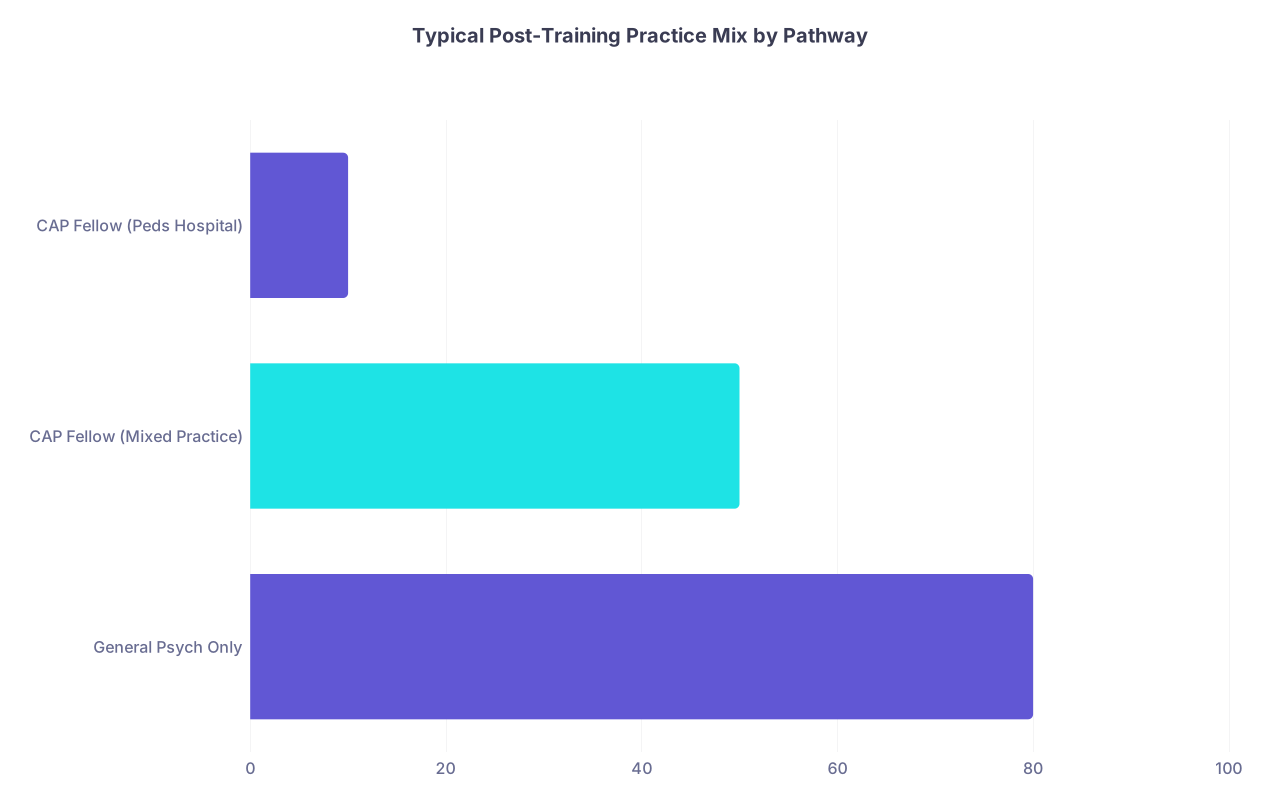
| Category | Value |
|---|---|
| General Psych Only | 80 |
| CAP Fellow (Mixed Practice) | 50 |
| CAP Fellow (Peds Hospital) | 10 |
(Think of those values not as percentages, but as an approximate “adult case load share.” General psych = mostly adults. CAP mixed practice = roughly half adults, half youth. CAP in pure peds settings = almost no adults.)
8. Strategy Summary: Mapping Your Pathway Intentionally
Let me tie this together into actual moves you can make.
If You Are Early in Med School (MS1–MS2)
- Shadow both adult and child psychiatrists. Minimum one full clinic day each.
- On peds rotations, pay attention to your emotional reactions to psychosocial visits.
- Build baseline psych knowledge; it helps everywhere.
If You Are Approaching Residency Applications (MS3–MS4)
Decide if you want general psych only or to keep CAP wide open.
Prioritize psych programs that:
- Have strong, visible CAP faculty
- Offer clear fast-track options if you might want them
- Protect outpatient and psychotherapy training (this helps in any psych career)
If very CAP-leaning: include a few programs with integrated psych+CAP tracks or triple board in your list, but do not overconcentrate unless you are certain.
If You Are Already in Psychiatry Residency
- PGY-1/2: Get on CAP rotations early. Do electives. Attend CAP case conferences.
- PGY-2: Decide about fast-tracking. Talk with your PD and the CAP program director.
- PGY-3: Solidify your CV with at least one CAP-oriented project (QI, research, curriculum) and strong CAP letters.
- Apply for fellowship on time; do not assume “CAP always has spots” means you can be casual. The better fellowships do not stay empty.
Final Takeaways
General psychiatry and child/adolescent psychiatry are not “the same with different ages.” CAP adds an entire layer of development, family, and systems work that you must actually enjoy to sustain a career in it.
The training pathways are flexible but not infinite: standard 4-year psych, 4+2 with CAP, fast-track 3+2, or triple board 5-year combined. Know which structure fits your tolerance for training length and your certainty about working with kids.
Your real-world reactions on rotations—whether you are energized or drained by families, schools, and system-level chaos—are more predictive of fit than any abstract idea about “helping kids” or “better lifestyle.” Listen to those reactions and plan your pathway accordingly.