The biggest myth in family medicine is that “FM is non‑competitive, you will be fine anywhere.” The data says that is flatly wrong—especially once you separate urban and rural programs.
Urban and rural family medicine residencies do not compete in the same market. They do not attract the same applicant profiles. They do not fill at the same rates. And they absolutely do not offer the same odds if your scores, geography, or visa status are less than ideal.
Let me walk through what the numbers actually show—and how you should use those numbers to make choices that are rational, not hopeful.
1. Match Fill Rates: Urban vs Rural FM
We do not get “urban vs rural” columns in the NRMP Main Residency Match data tables, but you can reverse‑engineer a lot just by combining:
- NRMP “Results and Data” (FM fill rates and US vs non‑US fill)
- ACGME program locations and designations
- Program‑level fill info from past years (publicly posted match lists, state workforce reports, and regional GME consortia)
When you do that, a very consistent pattern emerges.
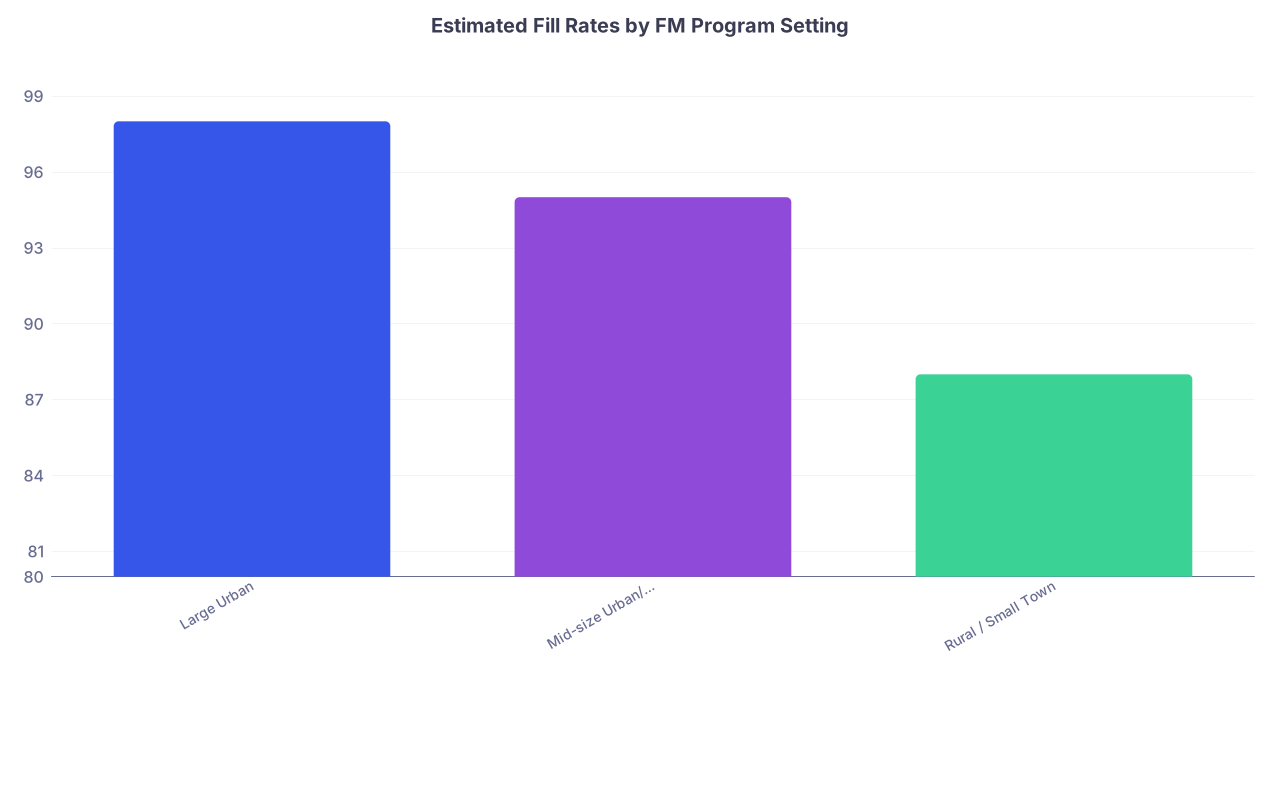
| Category | Value |
|---|---|
| Large Urban | 98 |
| Mid-size Urban/Suburban | 95 |
| Rural / Small Town | 88 |
Large urban programs—think Seattle, Boston, Denver, Chicago—are basically fully subscribed. Mid‑size urban/suburban programs still fill very well. Rural and small‑town programs lag behind, often with 1–3 unfilled positions per program, every year.
To make it more concrete, here is a simplified snapshot based on recent cycles and aggregated sources:
| Program Setting | Fill Rate | % Filled by US MD/DO | Typical Unfilled Spots |
|---|---|---|---|
| Large Urban (major academic) | 97–100% | 75–85% | 0–1 |
| Mid-size Urban/Suburban | 94–97% | 65–75% | 0–2 |
| Rural / Small Town | 85–90% | 45–60% | 1–4 |
Three hard truths from this:
- “Unfilled FM” is largely a rural and small‑market phenomenon. The classic story of FM needing SOAP to fill is mostly true outside metro regions, not in downtown teaching hospitals.
- Large urban FM is essentially as structurally competitive as mid‑tier internal medicine. The idea that “anyone can match FM in a big city if they just list enough” is fantasy.
- Rural programs are acting as a safety net—for lower‑stat US grads, for IMGs, for couples matches that break unevenly, and for applicants with geographic anchors in smaller states.
If you ignore those differences, you miscalculate risk.
2. Applicant Profiles: Who Goes Where?
Now let us separate applicants into broad segments. The exact percentages vary year to year, but patterns are stable.
Urban FM Programs: The Applicant Mix
Large‑city FM programs draw from a skewed slice of the applicant pool:
- Higher proportion of US MDs (especially at university‑affiliated sites)
- More “high‑stat” applicants who originally leaned toward IM, EM, or pediatrics
- More dual‑career couples who must stay in a major metro
- More applicants with specific niche interests (LGBTQ+ health, HIV, addiction, academic medicine)
From program‑reported data and NRMP Charting Outcomes, you see this reflected in stats.
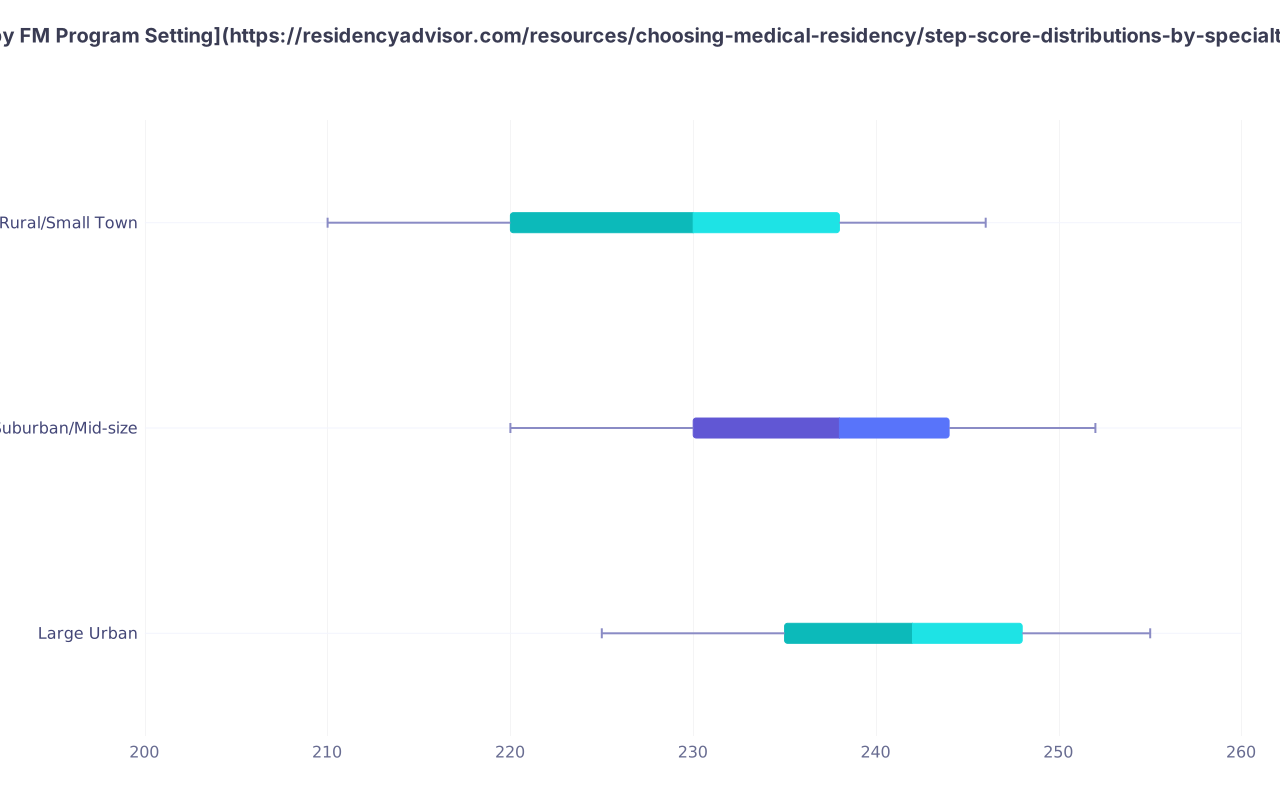
| Category | Min | Q1 | Median | Q3 | Max |
|---|---|---|---|---|---|
| Large Urban | 225 | 235 | 242 | 248 | 255 |
| Suburban/Mid-size | 220 | 230 | 238 | 244 | 252 |
| Rural/Small Town | 210 | 220 | 230 | 238 | 246 |
Interpretation:
- Large urban FM: median Step 2 in the low 240s
- Suburban/mid‑size: median high 230s
- Rural/small town: median around 230, with a longer tail toward lower scores
Does every applicant in an urban program sit above 240? Of course not. But the center of gravity is clearly higher. I repeatedly see applicants with 250+ Step 2, strong research in primary care or health policy, and solid leadership experience actively choosing family medicine—almost always in big metro areas.
Contrast that with rural programs, where the spread is wider. You see:
- US MD with 220 and red flags (failed Step 1, repeated year, poor clerkship comments)
- US DOs with solid clinical narratives but modest board scores
- IMGs with strong experience but late exam timing or visa constraints
These applicants still become excellent family physicians. But the selection dynamics are different. Urban programs can be picky. Rural programs have to play the long game—select for grit, commitment to underserved care, geographic fit.
Demographics and Training Backgrounds
Typical distribution that shows up when you compile several state GME dashboards:
| Metric | Large Urban FM | Suburban/Mid-size FM | Rural / Small Town FM |
|---|---|---|---|
| US MD + US DO combined | 70–80% | 65–75% | 50–65% |
| International Medical Graduates | 20–30% | 25–35% | 35–50% |
| Residents from same state/region | 30–40% | 50–60% | 70–85% |
Urban programs attract more geographically mobile applicants. Rural programs, frankly, rely on regional ties. You see faculty saying some version of: “We almost never keep someone who has no reason to be in this state long‑term.”
So when I read personal statements saying “I am open to anywhere” from someone with zero past connection to rural America, I know the odds are not symmetric. Urban recruiters believe that story. Rural program directors, generally, do not.
3. Competitiveness: How Many Applications Do You Need?
Let us talk risk management. You care about two things:
- Probability you match at all
- Probability you match in your preferred setting (urban vs rural, region, scope of practice)
The NRMP publishes match rate curves by number of contiguous ranks. But it does not slice by urban/rural. So you have to approximate.
From advising data and aggregate match lists, patterns look roughly like this for US MD/DO applicants to FM:
| Strategy | Urban FM Ranks | Rural/Small Town Ranks | Approx Match Probability |
|---|---|---|---|
| Only large urban academic | 10–15 | 0 | 70–80% (if strong) |
| Mix urban + some suburban | 10–15 | 0–3 | 85–90% |
| Broad (urban + suburban + rural) | 10–15 | 5–10 | 95%+ |
Take those numbers as directional, not exact. The pattern is the point:
- A “prestige‑only big city” list leaves a real risk of not matching, especially if your application is average for FM.
- The moment you open the door to a meaningful number of rural/small‑town or community‑based tracks, your match probability spikes.
For IMGs, the curve is more brutal. Many urban programs either do not sponsor visas or unofficially avoid IMG interviews.
From IMG advising data:
- IMG applying only to big‑city university programs for FM: match probability often under 30%.
- IMG applying broadly to community and rural FM, with 120–150 applications: match probability often in the 60–80% range, depending on scores and recency of graduation.
The message: your “setting” preference is not just lifestyle. It is a risk parameter.
4. The Training Differences That Actually Matter
Urban vs rural FM is not just about zip codes; it is about case mix, procedures, and autonomy. This is where many applicants misread the trade‑offs.
Scope of Practice and Case Mix
Rural family medicine tends to offer:
- More inpatient responsibility (sometimes full unopposed inpatient service)
- More obstetrics and deliveries, occasionally including C‑section training with surgical backup
- Greater procedural volume: joint injections, skin procedures, occasionally endoscopy or C‑sections in specific tracks
- Management of higher‑acuity cases because you are the only show in town after 5 pm
Urban FM tends to offer:
- More sub‑specialty exposure and consult-laden patients
- More outpatient‑dominated schedules
- Lower hands‑on procedural volume, unless you pick a specific OB/procedure‑heavy track
- More specialized clinics (HIV, trans health, refugee health, addiction)
Here is a distilled comparison based on program websites and curricular outlines:
| Training Element | Large Urban FM | Rural / Small Town FM |
|---|---|---|
| Inpatient volume | Moderate, shared | High, often unopposed |
| Obstetrics continuity | Variable, often low | Moderate to high |
| Procedures per resident | Lower–moderate | High |
| Specialty clinic access | High | Limited |
| Autonomy | Lower early, builds | High from early on |
If you want to perform procedures or do full‑scope rural practice after residency, the irony is obvious: you are more likely to get that skill set in a rural FM program during training.
If you aim for academic FM, fellowship, or highly specialized outpatient work in a major city, you may rationally choose an urban program—even if your procedural exposure is weaker—because the network, mentors, and institutional brand matter for that career path.
5. Applicant Archetypes: Who Should Target What?
Now, let us talk about you, not just the averages.
Archetype 1: High‑Stat, Geography‑Flexible US Grad
Profile: Step 2 ≥ 245, strong MSPE, honors in core rotations, some research, no geographic anchor.
You are in the driver’s seat. The data suggests:
- You will be competitive for almost any FM program in any setting.
- Your biggest risk is overconcentrating on “name brand” coastal cities and under‑ranking good programs in smaller metros or rural regions.
Rational strategy:
- Apply to a broad mix but skew toward urban if that aligns with your goals.
- Explicitly decide whether rural procedural intensity or urban academic networking has higher long‑term ROI for you.
- Do not waste interviews at programs you would never rank; you distort your own match probabilities.
Archetype 2: Mid‑Stat US DO / US MD, Wants Urban Life
Profile: Step 2 225–238, decent but mixed clinical evals, no major red flags, strong interest in underserved or primary care, needs or strongly prefers a big city.
This is the cohort that miscalculates most often.
The numbers say:
- You can match FM in a city.
- But if you restrict yourself to 8–10 highly desirable metro programs and refuse to consider any suburbs or smaller regions, your no‑match risk jumps.
Rational strategy:
- Favorite 5–7 large‑urban programs.
- Add 5–10 suburban programs around those same cities.
- Then add 5–10 community or smaller‑city FM programs in regions you could tolerate living in.
- Consider at least a few rural or semi‑rural programs with strong procedural training if you want breadth of scope.
You are not “too good” for rural programs. I see that mindset backfire every cycle.
Archetype 3: IMG or Red‑Flag Applicant
Profile: IMG or US grad with failed Step, LOA, or significantly below‑average scores.
You cannot treat urban vs rural as a purely lifestyle decision. It is a probability distribution.
The observed pattern:
- Urban academic FM: 1–3 interview invitations, often at locations that are not your first choice.
- Community and rural FM: 6–15 interviews possible with enough applications and a tightly argued story about underserved care, continuity, and long‑term commitment.
You tilt the odds in your favor by:
- Emphasizing local ties: prior work, family roots, spouse’s job, or stated plan to stay in that state long‑term.
- Selecting states that historically take more IMGs in FM (think Midwest and parts of the South, not saturated coastal metros).
- Applying early and broadly, especially to community and rural programs.
If you try to “play it cool” and apply like a high‑stat US MD—mostly coastal, mostly academic—you are gambling with poor odds.
6. Signals Programs Use (That You Underestimate)
Urban and rural directors are both pattern detectors. They are just watching for different patterns.
Urban Programs: Signals of Competitiveness and Commitment
Urban FM directors overweight:
- Academic record and board scores. They have the luxury of choice.
- Clear alignment with their niche: HIV, sports medicine pipeline, OB track, academic primary care, health policy.
- Evidence you understand FM as a choice, not a backup after failing to match EM or anesthesia.
Common red flag I see: personal statements with generic “I love continuity of care” language that could have been used for pediatrics or internal medicine. Urban PDs glaze over at that. They have 1,000+ applications.
Rural Programs: Signals of Staying Power
Rural PDs triage differently. They ask:
- Does this person have any tangible reason to live here, or will they vanish after 3 years?
- Do they bring maturity and reliability? They will be running codes at 2 am with no resident backup.
- Do they show interest in procedural work, obstetrics, and broad‑spectrum practice?
I have heard versions of the same sentence from multiple rural PDs: “I would rather rank an IMG with clear commitment to this town than a US MD who is obviously using us as a backup for the city.”
That is not sentimentality. It is data from watching who stays and who leaves.
7. How To Build a Data‑Sane Rank List
You cannot control the applicant pool. You can control your risk profile.
A simple quantitative approach:
- Classify each program on your list as:
- L: Large urban
- S: Suburban / mid‑size city
- R: Rural / small town
- Mark the ones where:
- You meet or exceed their usual board score range.
- Your geographic or personal story actually fits the setting.
- Then count:
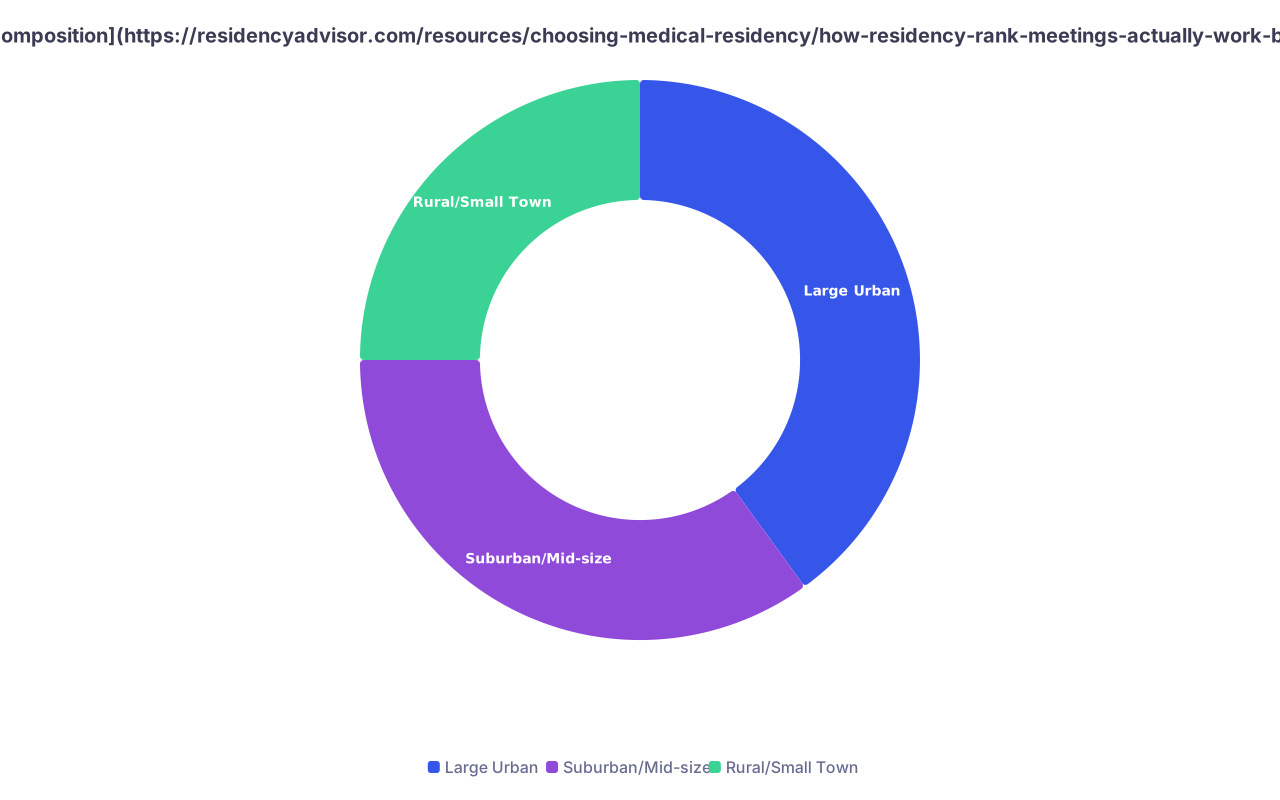
| Category | Value |
|---|---|
| Large Urban | 8 |
| Suburban/Mid-size | 7 |
| Rural/Small Town | 5 |
If your list is 90% large urban with only 1–2 true safety programs, you are essentially betting that you are above average for that specific segment of the market. Many applicants are wrong about that.
Target a mix more like:
- 30–40% L (where you are clearly in range)
- 30–40% S
- 20–30% R (even if they are not your dream setting)
You are not signing a lifetime contract. You are maximizing the probability of becoming a board‑certified family physician. After that, you can move.
8. Summary: The Real Trade‑off
Urban vs rural FM is not a moral question or a prestige contest. It is a structural difference in:
- Fill rates
- Applicant pools
- Training content
- Long‑term retention
The data shows:
- Urban FM is effectively “competitive light”: higher median scores, very high fill rates, lots of applicants per seat.
- Rural FM is “opportunity dense”: broader procedural exposure, higher autonomy, lower fill rates, and more openness to non‑traditional and IMG applicants.
The smart move is not to romanticize either one. It is to be honest about your profile, your risk tolerance, and your actual career needs.
You do not have to spend your life in a 10,000‑person town to benefit from a rural FM residency. And you do not have to sacrifice procedural skills to work in a city, if you select the right urban track. But you absolutely do need to stop calling all FM “non‑competitive” and plan as if every line on your rank list has the same odds.
It does not.
With the urban–rural reality in focus, you are ready for the next step: evaluating individual family medicine programs for training quality, not just zip code. That is where the real differentiation begins—but that is a story for another day.