
The mythology about “easy” primary care matches is outdated. The data from the last five years shows a more nuanced, and in some ways harsher, reality.
Family medicine (FM), internal medicine (IM), and pediatrics (Peds) sit at the center of the match, but they are not interchangeable. Their trends diverge on three axes that actually matter for you:
- who fills the spots (US MD vs DO vs IMG),
- how many spots are going unfilled,
- and how competitive they are if you want a specific type of program (university vs community, academic vs service-heavy).
Let’s quantify all of that instead of guessing based on hallway gossip.
1. Big-Picture Trends: How FM, IM, and Peds Have Shifted
We will keep this anchored to the most recent 5-cycle window (roughly 2020–2024), using NRMP match data patterns and proportions. Exact numbers vary year to year, but the directional trends are consistent and meaningful.
Three core metrics matter:
- Total positions offered
- Fill rate (what % of positions are filled)
- US MD / US DO / IMG composition of those fills
If you understand those, you understand the real playing field.
Total Positions and Growth
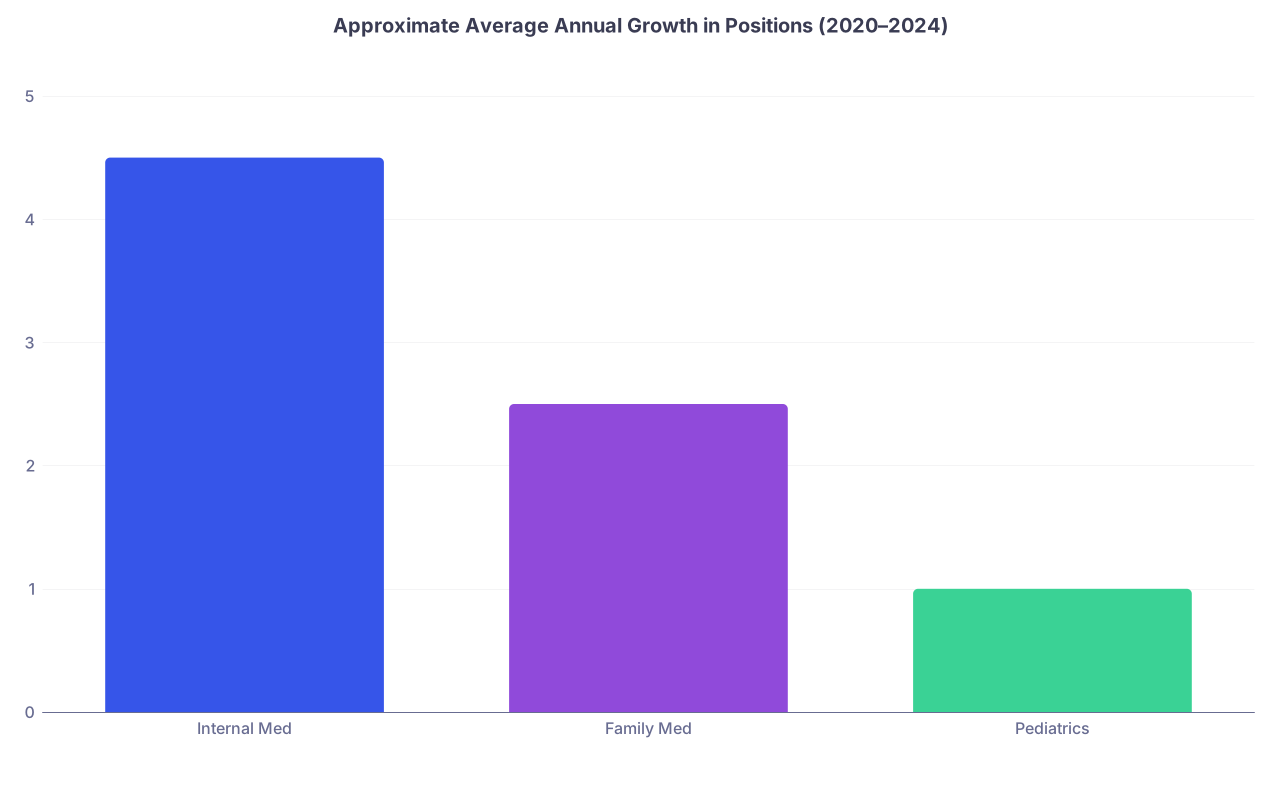
Across the last five match cycles, all three specialties have increased positions, but not at the same rate. IM has expanded most aggressively.
| Category | Value |
|---|---|
| Internal Med | 4.5 |
| Family Med | 2.5 |
| Pediatrics | 1 |
Interpretation:
- Internal Medicine: around 4–5% annual growth in categorical positions. Hospitals want cheap inpatient labor. That is you.
- Family Medicine: moderate growth (roughly 2–3% per year). Policy pushes on primary care create demand, but funding and faculty capacity cap the slope.
- Pediatrics: near-flat growth, maybe 0–1% per year. Children’s hospitals and pediatric departments are not expanding like adult medicine.
So if your primary goal is “just match somewhere,” IM gives you the most raw seat count. But raw seats hide the real constraint: who is actually filling those seats and where.
2. Fill Rates and Unfilled Positions: Where the Gaps Really Are
Everyone likes to talk about “this specialty is safe, that one is competitive.” That is lazy. The numbers paint a different, more granular picture.
High-Level Fill Rates
Over the last five years, all three specialties have had high overall fill rates, but the distribution of who fills them has shifted.
| Specialty | Overall Fill Rate | US MD + DO Share of Filled Spots | Unfilled Rate on Match Day |
|---|---|---|---|
| Internal Med | 99–100% | ~55–60% | ~0–1% |
| Family Med | 94–97% | ~45–50% | ~3–6% |
| Pediatrics | 97–99% | ~70–75% | ~1–3% |
Key points:
- Internal Medicine: essentially no unfilled categorical spots, year after year. IM soaks up unmatched US grads, DOs, and a large IMG pool. By SOAP end, the system is nearly saturated.
- Family Medicine: consistently leaves a visible chunk of positions unfilled on match day, though many get taken in SOAP. That “gap” is your opportunity if you are worried about matching at all.
- Pediatrics: quite high fill rate, especially by US grads. Fewer unfilled spots than FM, more than IM, but the seat count is much smaller.
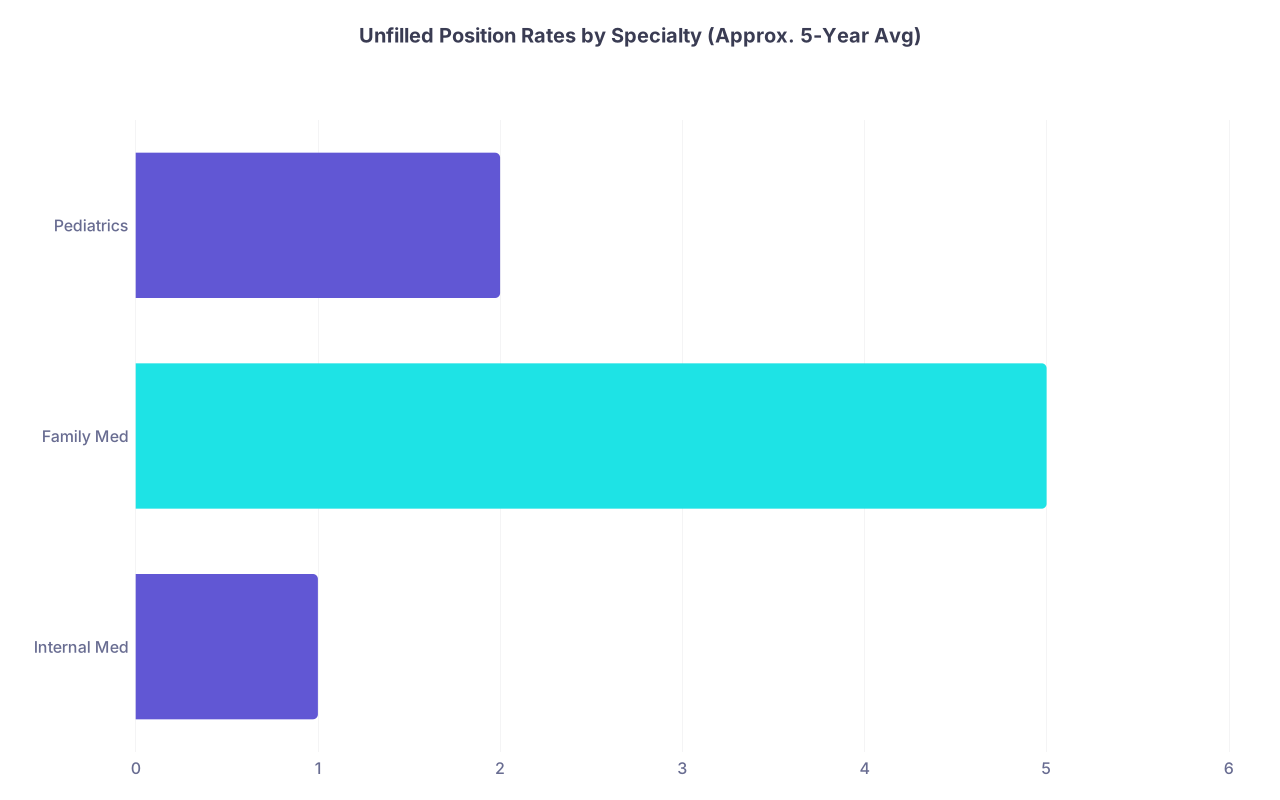
If you want to see the shape of the unfilled problem:
| Category | Value |
|---|---|
| Internal Med | 1 |
| Family Med | 5 |
| Pediatrics | 2 |
Roughly speaking, FM leaves about five times the relative proportion of unfilled seats on match day compared with IM. Pediatrics sits between.
For a borderline applicant, that matters more than whatever your class group chat thinks is “prestigious.”
3. Who Fills the Spots: US MD vs DO vs IMG
Now the more politically charged part: composition. Where do US MDs cluster? Where are DOs dominant? Where do IMGs have the strongest foothold?
Think of it as market share by applicant type.
Internal Medicine: The Global Workhorse
Internal medicine is the structural backbone for IMGs and DOs, no surprise there.
Approximate 5-year composition for IM categorical programs:
- US MD seniors: ~35–40%
- US DO seniors: ~15–20%
- IMGs (US + non-US): ~40–45%
Some university IM programs are still US MD heavy, but community and “service-heavy” urban programs are dominated by DOs and IMGs. In some institutions I have seen program rosters with 70–80% international graduates.
Interpretation:
- If you are an IMG: IM is your best statistical bet among the three.
- If you are a US MD / DO: you can match IM, but the type of IM program you match into is stratified by scores, school pedigree, and letters more than many students admit.
Family Medicine: The DO and Community Anchor
Family medicine has transformed from “backup” for US MDs to a DO-heavy and IMG-growing space.
Approximate composition:
- US MD seniors: ~25–30%
- US DO seniors: ~35–40%
- IMGs: ~30–35%
That balance has shifted steadily: DO presence up, MD presence down, IMGs up. A lot of MD students now skip FM entirely unless they are strongly mission-aligned or geographically locked.
This has two consequences:
- Top FM programs (university-affiliated, strong OB, strong procedural training, sports med pipelines) are more competitive than their reputation suggests.
- Lower-tier and geographically less popular FM programs struggle to fill and lean heavily on SOAP and IMGs.
Pediatrics: Still US MD Heavy, But Cracking
Pediatrics remains the most US MD–dominated of the three.
Approximate composition:
- US MD seniors: ~55–60%
- US DO seniors: ~15–20%
- IMGs: ~20–25%
Peds still has a relatively “academic” culture, and many departments prefer US-trained grads, especially for children’s hospitals, complex NICU/PICU pipelines, or combined programs (Med-Peds, Peds-Genetics, etc.).
But even here, over 5 years you see growing DO and IMG shares. The shift is slower than in FM and IM, but it is happening.
4. Competitiveness: Not All Primary Care Seats Are Equal
If you only look at “overall fill rate,” you will misunderstand the match.
The real question is: how hard is it to match the tier and location you want?
Tiers Inside Each Specialty
Rough tiers exist inside each field:
- Tier 1: Top academic / university programs, desirable cities, strong fellowship pipelines
- Tier 2: Solid community or university-affiliated programs, reasonable workload, moderate name recognition
- Tier 3: Service-heavy, less resourced, often in less popular locations, high workload, weaker fellowships
The match dynamics are different at each tier:
- Internal Medicine:
- Tier 1 IM (big-name academic, big city) is competitive. Step 2 scores often > 245–250, strong letters, research.
- Tier 3 IM fills heavily with IMGs and DOs, often with lower test scores and heavier service expectations.
- Family Medicine:
- Tier 1 FM (e.g., academic programs with strong obstetrics, sports medicine exposure, or rural training tracks in desirable states) can and do screen out lower-scoring applicants.
- Tier 3 FM programs can go unfilled despite hundreds of unmatched applicants in the system, because students do not want the location or the training structure.
- Pediatrics:
- Tier 1 Peds (children’s hospitals, big academic centers) remain quietly competitive. Good scores, honors in pediatric rotations, and research help.
- Tier 3 Peds, especially in less desirable regions, have begun to see mild fill challenges but not to FM’s extent.
The “primary care is easy” line dies once you factor in geography and program tier. Matching pediatrics at a major coastal children’s hospital is not an “easy backup” to an uncompetitive subspecialty. It is a separate, selective market.
5. Five-Year Directional Trends: What Is Getting Easier vs Harder?
Let’s condense the 5-year direction of movement.
| Metric | Internal Med | Family Med | Pediatrics |
|---|---|---|---|
| Positions Available | ↑↑ (strong growth) | ↑ (moderate growth) | ↔ / slight ↑ |
| Overall Fill Rate | ↔ (very high) | ↓ slightly (still high) | ↔ / slight ↓ |
| US MD Share | ↔ / slight ↓ | ↓ | ↔ / slight ↓ |
| DO Share | ↑ | ↑↑ | ↑ |
| IMG Share | ↑ | ↑ | ↑ (modest) |
| Unfilled Spots (absolute) | Low, fairly stable | Moderate, slowly ↑ | Low, slight ↑ |
Legend in words:
- ↑↑ = clear, consistent rise
- ↑ = moderate increase
- ↔ = roughly stable
- ↓ = moderate decline
You can visualize this as a shift away from “US MD dominated” toward a more mixed ecosystem in all three specialties, with FM the furthest along and Peds the most conservative.
6. What This Actually Means For Different Applicant Profiles
Enough with aggregates. Here is what the five-year data implies for real people.
If You Are a US MD with Mid-Range Metrics
Think Step 2 CK in the 230s–240s, decent but not stellar clinical grades, limited research.
- Internal Medicine: You will probably match IM, but the program tier and location will be heavily shaped by letters and school reputation. Aiming at coastal, research-heavy IM programs is no guarantee.
- Family Medicine: You are above the statistical bar for FM broadly. The limiting factors will be whether top FM programs believe you are genuinely interested or just using them as a backup. They are not stupid; they read your personal statement and your family medicine exposure.
- Pediatrics: You are competitive at many peds programs, though the true top children’s hospitals may prefer higher scores or more peds-specific interest.
Data-backed conclusion: For you, FM and Peds are realistic choices if you actually want those fields, not just as “safeties.” IM is accessible but stratified; you cannot ignore fit and letters.
If You Are a US DO Student
The data over the last five years has been relatively friendly to DO applicants in these fields.
Trends show:
- Rising DO share in all three specialties, especially FM and IM.
- Many community IM and FM programs now have majority DO rosters.
- Pediatrics is slower to move but has visibly more DOs than 10 years ago.
Practical read:
- Family Medicine: Very DO-friendly. You will find many programs explicitly welcoming DOs and with DO faculty leadership.
- Internal Medicine: Also DO-friendly, particularly at community and regional academic centers. Top-tier IM remains competitive, but not closed.
- Pediatrics: Reasonable but slightly more cautious; some children’s hospitals still prefer MD, but this is softening.
For DOs, FM is the “easiest” numerical match; IM and Peds are realistic with sensible lists and geographical flexibility.
If You Are an IMG
This is where numbers matter the most.
Across five cycles:
- Internal Medicine: IM is still the primary IMG gateway. A very large proportion of categorical IM residents are IMGs, particularly in certain regions and hospital systems.
- Family Medicine: Increasing IMG penetration, especially in unfilled or SOAP-heavy programs and less desirable locations.
- Pediatrics: More resistant, but slowly increasing IMG presence.
The hard truth:
- If you are an IMG with mid-range scores and ordinary letters, IM gives you the broadest statistical surface area to land a spot.
- FM can be viable, but it is more variable: some FM programs are IMG-friendly; others rarely rank them.
- Pediatrics is the narrowest path of the three for IMGs, especially at major academic centers.
Your strategy has to be data-aware and granular. You need to target programs with a track record of interviewing and matching IMGs in your specialty of interest.
7. How These Trends Shape Your Career Options Downstream
The match is not the endpoint. The specialty you choose now constrains or opens future pathways. The last five years of trends tell you where competition may be heating up.
Internal Medicine: Doorway to Subspecialties
Because IM is so large, you get:
- Broad access to fellowships (cards, GI, heme/onc, pulm/crit, etc.), but those are highly competitive.
- A stratified environment: fellowship odds depend heavily on the pedigree of your IM program, your research, and your in-training exam performance.
The data pattern over the last decade: as more IM seats go to IMGs and DOs, fellowship competition tightens and becomes more score/production biased. If you want subspecialty, your internal medicine program tier matters much more than students like to admit.
Family Medicine: Breadth, Procedures, and Flexibility
FM’s growth and partial difficulty filling spots mean:
- You will almost certainly have a job after residency, often with multiple offers.
- You can shape your career by acquiring procedures, OB experience, point-of-care ultrasound, and sports med or palliative fellowships.
The catch: FM salaries remain structurally lower than many IM subspecialties, and some markets are saturated with midlevels. You must pick your training site and skill set carefully if you want leverage.
Pediatrics: Narrower but Stable
Pediatrics has:
- Lower absolute salary and fewer procedural opportunities compared with many adult fields, but fairly stable job demand in most regions.
- A fellowship ecosystem (NICU, PICU, peds cards, heme/onc, etc.) that is competitive but less flooded than adult IM fellowships proportionally, simply because the pipeline is smaller.
The five-year data on positions and fill rates suggests pediatrics is not collapsing or exploding. It is steady. If you love pediatrics, you are not “making a bad data-driven choice,” but you are picking a narrower lane.
8. How to Actually Use This Data in Your Specialty Decision
Let me be blunt: if you are trying to pick between FM, IM, and Peds purely on “which is easiest to match,” you are looking at the wrong variable. But ignoring the data is just as foolish.
Here is a structured way to combine numbers with reality.

| Step | Description |
|---|---|
| Step 1 | Start |
| Step 2 | Consider Internal Med or Family Med |
| Step 3 | Consider Pediatrics |
| Step 4 | Consider Family Med or Med Peds |
| Step 5 | Leaning Internal Med |
| Step 6 | Family Med or Community IM |
| Step 7 | Leaning Pediatrics |
| Step 8 | Reassess |
| Step 9 | Check competitiveness vs Med Peds |
| Step 10 | Decide on FM vs Med Peds based on risk |
| Step 11 | Do you want adult, kids, or both? |
| Step 12 | Do you want subspecialty fellowship? |
| Step 13 | Ok with lower pay but kid-focused? |
Overlay the 5‑year patterns:
- If you are risk-averse about matching at all:
- FM and lower-tier IM are your statistical safety nets.
- Pediatrics is middle-of-the-road: not as forgiving as FM, less cutthroat than some IM tiers.
- If you want maximum flexibility post-residency:
- IM offers the broadest subspecialty trajectories, but also the fiercest fellowship competition.
- FM gives geographic and job flexibility, especially in underserved areas, but less high-end subspecialty leverage.
- Peds gives depth in a narrower patient population with stable but smaller job markets.
Overlay your own profile onto this. Be honest about scores, school name, visa status (if relevant), and geography constraints.
9. Quick Visual Summary of Relative “Risk” to Match
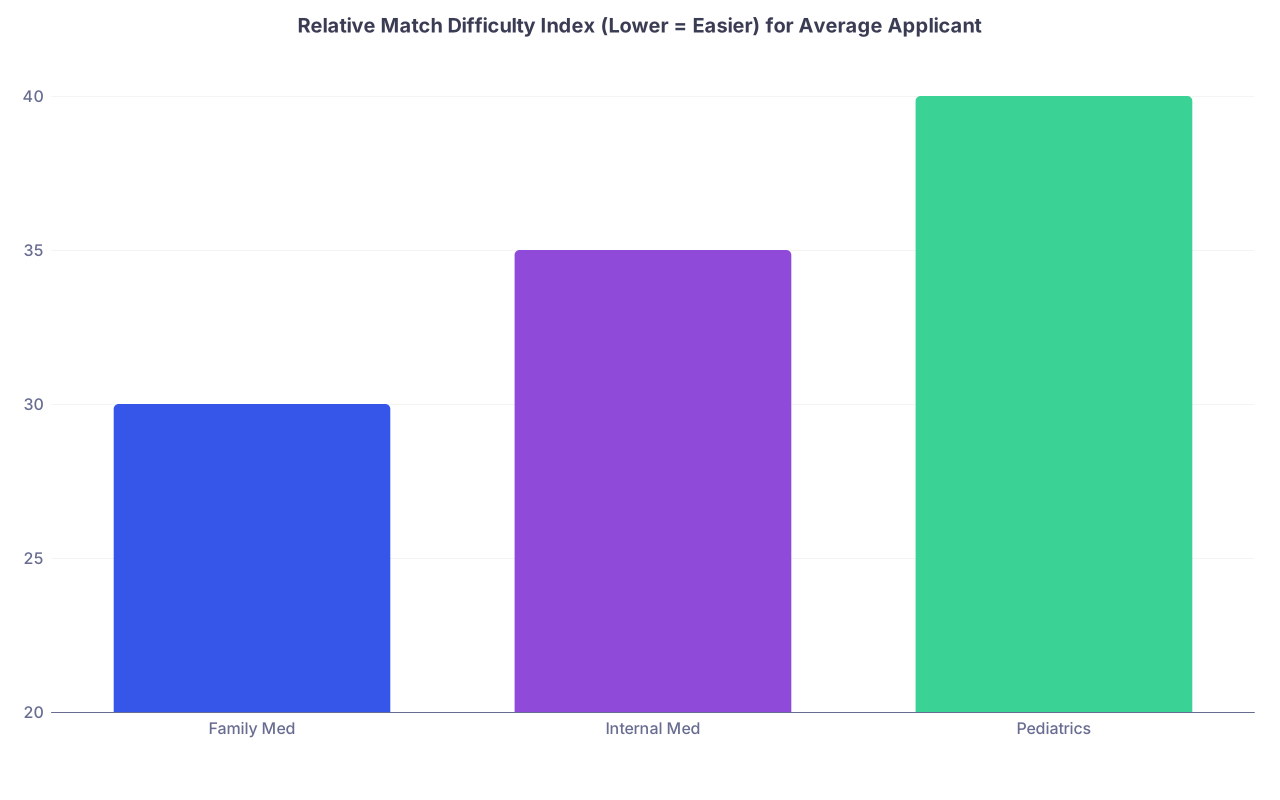
This is a simplification, but it captures the last five years in one picture: lower value = easier statistically, higher value = relatively harder.
| Category | Value |
|---|---|
| Family Med | 30 |
| Internal Med | 35 |
| Pediatrics | 40 |
Interpretation:
- Family Medicine: Easiest to match on a purely numerical basis, especially if you are flexible on geography and program reputation.
- Internal Medicine: Slightly “harder” overall, with strong bifurcation between top and bottom tiers.
- Pediatrics: Fewer spots and high US MD share keep the barrier modestly higher than FM for many applicants.
These are relative indices, not absolutes. You can absolutely fail to match FM if you apply poorly. I have seen students do it with narrow lists and delusional geography limits.
Final Takeaways
- The data shows that FM, IM, and Peds are no longer monolithic “easy” backups. All three are stratified by program tier, geography, and applicant type, and the five-year trends are sharpening those differences.
- Internal medicine has grown fastest and remains the primary IMG-intense workhorse, while family medicine carries the largest proportion of unfilled spots and shifting DO/IMG growth. Pediatrics remains more US MD–centric but is slowly diversifying.
- Your specialty choice should align your clinical interests with your risk tolerance and career goals, not myths about competitiveness. The last five years of match data give you leverage—if you are willing to look past the anecdotes and read the numbers.