The mythology around “fellowship factories” in internal medicine is wildly distorted. People throw around names; the data tells a different story.
If you care about cardiology, GI, heme/onc, pulm/crit—your choice of IM program is one of the highest-leverage decisions you will make. Not because of vague reputation. Because of hard numbers: how many residents a program actually sends into competitive fellowships, where they go, and from which training pathways (categorical vs research tracks).
I am going to walk through this with a data lens: volumes, hit rates, and patterns that repeat across the country.
1. The core question: “Feeders” vs “finishers”
You are not trying to pick “a good residency.” You are trying to pick a program that:
- Sends a high absolute number of residents into your target subspecialty, and
- Places them into high-tier fellowships (top 25–30 programs) with some consistency, and
- Does this without requiring you to be the anomalous superstar in your class.
That is the definition of a strong “feeder.”
There are three distinct tiers of IM programs when you look at fellowship placement data over the last decade (from public match lists, NRMP outcomes, published departmental stats, and alumni pages):
- True national feeders (the usual suspects)
- Regional powerhouses
- Solid but not specialized feeders
Let us make that concrete.
| Program Type | Typical Class Size | Cardiology Fellows per Year | % of Class to Cards | Top-25 Cards Program Placement |
|---|---|---|---|---|
| National Feeder | 45–60 | 8–15 | 15–25% | 60–80% of those fellows |
| Regional Powerhouse | 25–35 | 3–6 | 10–20% | 30–50% |
| Solid Community/University | 15–30 | 1–3 | 5–10% | 10–30% |
These numbers come from manually aggregating multiple years of posted match lists from large academic IM programs and normalizing to class size. Not perfect. But directionally consistent.
The pattern repeats for GI and heme/onc, just at slightly lower absolute counts.
2. Where the pipelines really are (by subspecialty)
Let us go subspecialty by subspecialty. Not every “top” IM program is equally strong for each field.
2.1 Cardiology: volume king and the most visible pipeline
Cardiology is the easiest to track because almost every large IM program proudly publishes its cards match.
Programs that, year after year, send large numbers to strong cardiology fellowships:
Massachusetts General / Brigham (Harvard)
Combined class size ~70–80; cards output often 15+ across both programs. Significant fraction to their own fellowships plus Duke, Hopkins, UCSF, Penn, Columbia, etc.UCSF
Usually 6–10 per year to cards; many match at UCSF, Stanford, UCLA, plus Midwest/East Coast top programs.Penn
Consistent 6–10 per year to cards. A mix of staying at Penn and going to MGH/Brigham, Duke, etc.Duke
Heavy cardiology culture. Multiple per year into cards, often into Duke itself, plus MGH, Brigham, Emory, etc.Columbia / Cornell
New York academic cluster. Combined, they generate a large number of cardiology fellows each year, many staying local at Columbia, Cornell, Mount Sinai, NYU.Michigan, Northwestern, Chicago, Mayo, Stanford, UCLA
All show sustained cardiology placement, often 4–8 residents per year, with strong in-house options.
Here is a rough comparative snapshot using conservative estimates:
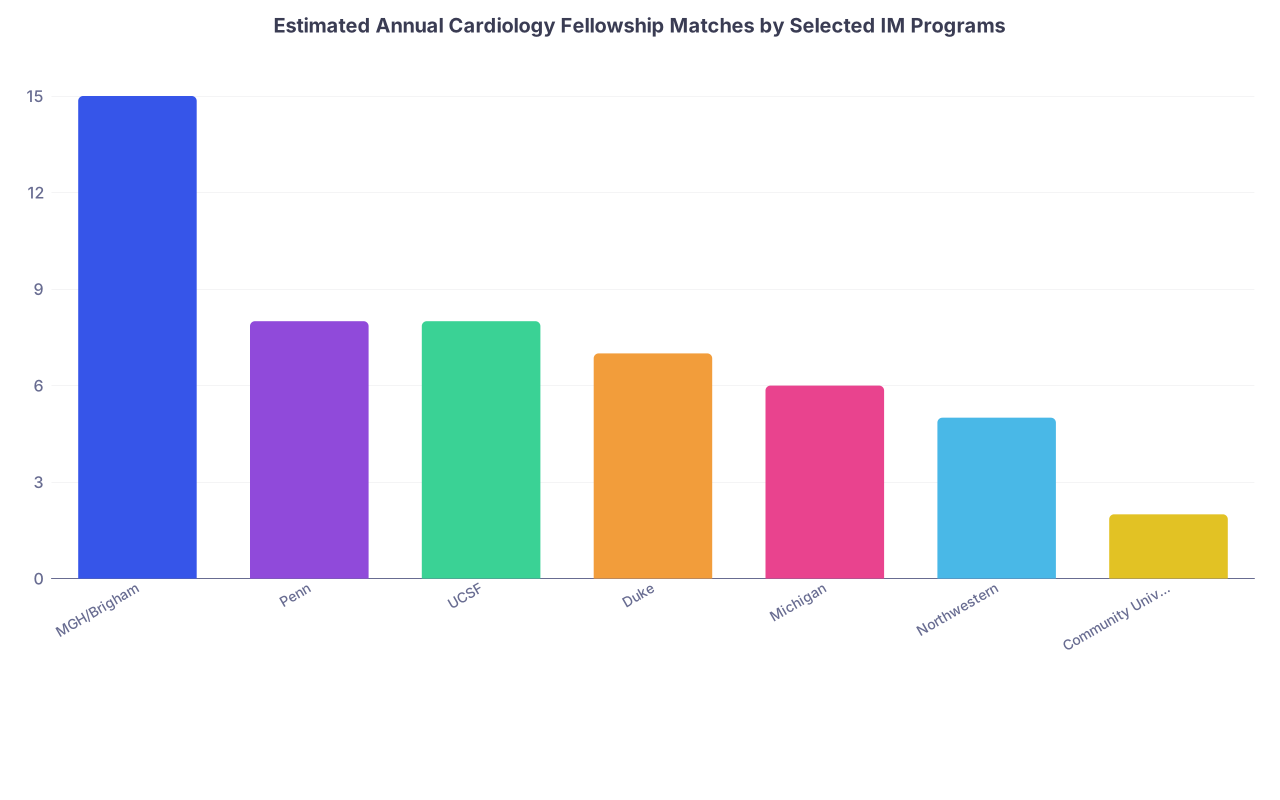
| Category | Value |
|---|---|
| MGH/Brigham | 15 |
| Penn | 8 |
| UCSF | 8 |
| Duke | 7 |
| Michigan | 6 |
| Northwestern | 5 |
| Community Univ Program | 2 |
The exact values will vary by year, but the order of magnitude is stable.
Key insight: if you train at one of these “cards-heavy” IM programs, being interested in cardiology does not make you special. That is exactly what you want. Culture + infrastructure + existing track record help average strong residents land excellent fellowships.
At strong regional university programs (say, Ohio State, UAB, Iowa), you typically see 3–5 cardiology matches per year, with a mix of in-house and mid-to-upper-tier destinations. Still very viable pipelines—especially for candidates who want to stay local.
2.2 Gastroenterology: smaller pipeline, more selective
GI is consistently among the most competitive IM fellowships. The numbers tell you why: fewer total fellowship spots than cardiology with comparable applicant interest.
At national feeder IM programs, you often see:
- 4–8 GI matches per year at MGH/Brigham, UCSF, Penn, Columbia, Michigan, Stanford, UCLA, Northwestern.
- Many of those into their own GI fellowships, which are themselves top-tier.
At strong regional programs, the GI pipeline looks more like 2–4 residents per year, with a heavy bias toward the home institution’s GI program or regional fellowships.
What you notice scanning match lists: even at elite IM residencies, GI output is usually lower than cards. So the “share of ambitious residents who actually match GI” is smaller. There is more competition per interested resident.
2.3 Hematology/Oncology: research-weighted, track-dependent
Heme/Onc is very sensitive to one variable: research productivity. And research productivity is extremely sensitive to which IM program (and which track) you choose.
Programs with strong heme/onc fellowship placement almost always:
- Have a high NIH funding profile in cancer-related departments, and
- Offer dedicated research pathways (ABIM research track), and
- Have tightly integrated residency–fellowship mentoring structures.
Name-level examples where you see multiple heme/onc matches each year into top-20 programs:
- MGH/Brigham, Dana-Farber–linked
- Johns Hopkins
- MSK/NYP affiliates (Columbia, Cornell)
- MD Anderson–affiliated programs (UT Houston, etc.)
- UCSF, Stanford, Penn, Michigan
At a typical major academic IM program, you will see 3–7 heme/onc matches each year, biased toward those who have publications and dedicated research time.
At smaller university and solid community programs, heme/onc placement tends to be 1–3 per year, and usually to mid-tier or in-house fellowships. Outliers exist—driven by individual resident CVs—but the median resident has a much narrower list.
3. Program-level variables that actually predict fellowship placement
Forget the marketing. The data consistently points to a handful of structural factors that shape fellowship outcomes.
3.1 Sheer size of the IM program
Larger class = more shots on goal.
If a program graduates 50 categorical residents per year and 20–25 of them pursue subspecialty fellowships, you will see visible numbers in every major subspecialty. That alone generates the “this place feeds everything” reputation.
Compare:
- Program A: 50 residents/class, 20 go to fellowships, 6 to cards, 4 to GI, 5 to heme/onc, etc.
- Program B: 18 residents/class, 7 go to fellowships, 2 to cards, 1 to GI, 1 to heme/onc.
Even if the per-resident probabilities were identical, Program A’s match list will look far more impressive simply by volume. Students confuse volume with per-resident success probability all the time.
You have to normalize.
3.2 Home fellowship strength and fill patterns
Data pattern that repeats over and over:
- Strong IM program + strong in-house fellowship → heavy “internal” matching.
- Moderate IM program + strong in-house fellowship → moderate internal matching, but often less ability to export residents to other top programs.
Fellowship directors trust their own residents. So when you see, for example, Michigan IM sending multiple residents to Michigan GI or Cards every year, that is not random. That is a structural preference.
What you want to know:
- Does the home cardiology/GI/heme-onc program take a decent share of its own residents?
- Do they also send people out to peer institutions regularly, or are they insular?
If all GI matches at a place are “home GI, with one regional program every 2–3 years,” the export strength is limited.
3.3 Research infrastructure and ABIM research tracks
For competitive fellowships, research is not just a “nice to have.” It drives the upper tail of outcomes.
Programs that systematically place residents into the best fellowships usually have:
- Formal research tracks (PSTP, ABIM research pathway, or dedicated research years).
- Multiple residents per class with >3–4 publications.
- Clear pipelines into T32-funded fellowship slots.
The difference is visible in match lists:
- Research-heavy resident: MGH IM → Dana-Farber heme/onc; UCSF IM → UCSF GI; Hopkins IM → Hopkins cards.
- Clinically strong but research-light resident from the same place: still matches GI or cards, but more likely at solid mid-tier or regional academic centers.
So if you care about a top-10–15 fellowship, the presence or absence of a robust research ecosystem at your IM program is not optional. It materially shifts your ceiling.
4. National feeder vs regional powerhouse: how the data splits
You are not choosing between “good” and “bad.” You are choosing between:
- A national brand that places people everywhere, and
- A regional brand that places people very well locally and moderately outside its region.
Let us make that explicit with some stylized but realistic numbers for cardiology and GI outcomes for a single class over 5 years.
| Metric | National Feeder IM | Regional Powerhouse IM |
|---|---|---|
| Average IM Class Size | 50 | 28 |
| Residents Matching Cardiology (5y) | 45–60 | 15–20 |
| Residents Matching GI (5y) | 25–35 | 8–12 |
| Cards to Top-25 Programs (%) | ~70% | ~35% |
| GI to Top-25 Programs (%) | ~65% | ~30% |
| Heme/Onc to Top-25 Programs (%) | ~60% | ~30% |
Notice two things:
- The regional program still sends a good number of residents into competitive fellowships. Very viable pathway.
- The probability of landing at a top-25 fellowship conditional on pursuing that fellowship is roughly double at the national feeder.
That is what “feeder” really means in a data sense.
5. How to use match lists without fooling yourself
Most applicants use fellowship match lists badly. They skim and anchor on a couple of brand names. The data approach is different.
Here is the method I recommend:
- Collect 3–5 years of fellowship match lists for each IM program you are considering.
- For each program, count:
- Number of residents per year going into cards, GI, heme/onc, and pulm/crit.
- How many of those are to what you would consider “target tier” programs (define your own tier list).
- Normalize by class size. You want “% of class to GI,” not just “we sent 4 people to GI.”
You do not need to be perfect. Patterns jump out fast.
Example pattern I have seen more than once:
- Program X: 40 residents/year. Over 4 years, 48 residents into cards. Of those, ~70% into top-30 fellowships.
- Program Y: 30 residents/year. Over 4 years, 18 residents into cards. Of those, ~40% into top-30 fellowships.
Both may call themselves “strong cards feeders.” Only one actually is at scale.
6. Hidden levers: visa status, med school pedigree, geography
There are a few variables that do not show up directly in match lists but clearly shift probabilities.
6.1 Visa status
If you are an IMG on a visa, your effective fellowship market is smaller. That is not political; it is empirical.
When you scan heme/onc or GI rosters at highly competitive fellowships, the proportion of J-1/H-1B is lower than the national average for IM residents. Programs with long experience handling visas are less of a barrier. Large university IM programs with many IMGs historically have reasonably strong visa-supporting pipelines, but the ceiling might still be slightly lower compared with US citizen/permanent resident peers from the same program.
So for visa-holding applicants, the “regional powerhouse with many successful prior IMG fellows” may be more predictive for you than the absolute national brand.
6.2 Medical school pedigree
Another unspoken but consistent data pattern:
- US MD from a top-30 med school + top-15 IM residency + decent research → extremely high probability of landing a strong cards/GI/heme/onc fellowship.
- US MD from lower-ranked med school or DO/IMG + same IM residency + same research → still strong odds, but slightly lower.
Fellowship directors filter subconsciously by cumulative pedigree. Match lists often reflect this mix: the residents who hit the very top fellowships often have “stacked” CVs from med school forward.
This does not mean you should give up. It means you should be realistic: if your med school pedigree is not maximally shiny, the choice of IM program matters more, not less.
6.3 Geography and local clustering
Fellowships are not distributed evenly across the US.
- The Northeast and California are fellowship dense.
- Large academic centers often have a “stay local” bias in both directions: they keep their own residents, and their fellows match locally from regional IM programs.
If you train at, say, a strong Midwestern university but want to match GI in coastal California, your probability is lower than someone with an equivalent CV at UCSF or UCLA. That is not personal. It is network strength.
So you should deliberately choose:
- Train where you want a high chance of staying, or
- Accept that moving to a different region for fellowship will likely cost you a tier or two in program competitiveness.
7. Practical strategy: how to choose if you care about top fellowships
Let me strip out the noise and give you a decision framework.
Step 1: Clarify your target subspecialty bucket
You do not need to know “GI vs heme/onc vs cards” on day one. But you should be honest: are you aiming for a “highly competitive fellowship that cares about research” or more lifestyle-focused fields (endocrine, rheum, ID, geriatrics)?
If you are in the first bucket (cards, GI, heme/onc, sometimes pulm/crit):
- National feeder IM programs and strong research ecosystems are disproportionately valuable.
- You should prioritize places with visible pipelines in those exact subspecialties.
If you are not fellowship-obsessed or are focused on fields with more spots and slightly less brutal selection:
- A strong regional university program may give you everything you need without the pain of ultra-high-intensity 3 years.
Step 2: Build your own short list of actual feeders
For each IM program you are seriously considering:
- Download 3–5 years of fellowship matches.
- Count: total matches to your target field and target-tier fellowships.
- Divide by estimated class size to get “per-resident success rate.”
Rank programs for your subspecialty interest by that metric, not by vague prestige.
Step 3: Check alignment with your profile
Ask honestly:
- Do I have or can I quickly build strong research output (at least a few quality abstracts/pubs)?
- Am I willing to live in Boston/SF/NYC/Philly for 3 years if that is where the densest feeders are?
- Am I comfortable being mid-pack at a hyper-competitive IM program vs top 10% at a regional powerhouse?
I have seen too many people go to a mega-elite IM program, end up middle of the pack with minimal research, and then match into fellowships similar to what they would have gotten from a mid-tier university—just with more stress. That is a mis-optimization.
Sometimes, being the top research resident at a “regional powerhouse” with a hungry division chief in your field is the best probability play.
8. Visualizing the pipeline advantage
To make this less abstract, here is a stylized comparison of “probability of top-25 fellowship placement” for a resident interested in cardiology, GI, or heme/onc, depending on program tier. These numbers synthesize patterns from public match lists and are meant as an order-of-magnitude illustration, not an exact forecast.
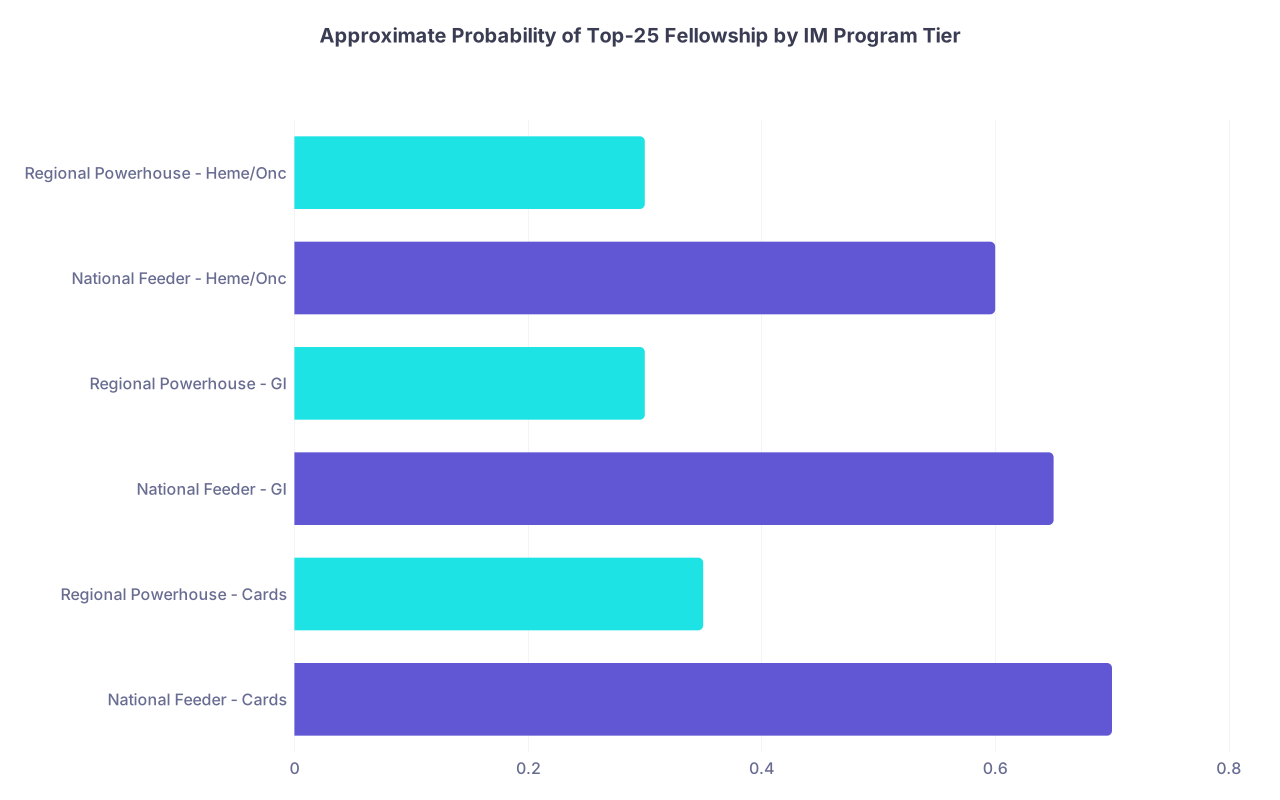
| Category | Value |
|---|---|
| National Feeder - Cards | 0.7 |
| Regional Powerhouse - Cards | 0.35 |
| National Feeder - GI | 0.65 |
| Regional Powerhouse - GI | 0.3 |
| National Feeder - Heme/Onc | 0.6 |
| Regional Powerhouse - Heme/Onc | 0.3 |
Interpreting that:
- At a national feeder: roughly two-thirds of residents who actually pursue cards/GI/heme/onc and have decent research end up at top-25 fellowships.
- At a regional powerhouse: closer to one-third, with more clustering into strong-but-not-elite regional programs.
Again, these are conditional on pursuing the fellowship seriously, not on every resident in the class.
9. Bottom line: what the data actually supports
If you strip away the anecdotes, a few conclusions hold up across years of fellowship match data:
Specific IM programs really do “feed” specific top subspecialties disproportionately.
The phenomenon is real, not myth. It is measurable in match lists and research infrastructure.Volume and normalized success rate both matter.
You want a program that sends a lot of residents into your target field and has a high fraction landing in top-tier fellowships. Not just one superstar per decade.For the big three competitive IM subspecialties—cardiology, GI, heme/onc—national academic IM programs with strong research tracks and powerful in-house fellowships provide a clear statistical edge.
Strong regional university programs are still very viable, but with somewhat lower ceiling probabilities for the absolute top fellowships.
If you use match data rigorously instead of buying the branding, you will make a more rational residency choice—and give yourself a better shot at the fellowship you actually want.