
What actually happens to your advocacy dreams once you are drowning in notes, prior auths, and cross-cover—does pediatrics, internal medicine, or psychiatry give you real policy leverage, or just nice talking points on your CV?
Let’s be blunt: most students who say they “love advocacy and policy” end up doing almost none of it after residency. Not because they do not care, but because their day-to-day job leaves them no time, no energy, and no runway.
Your specialty choice will either make advocacy easier to build into your actual work… or push it into the “maybe on a random Sunday” category. So if you are hesitating between pediatrics, IM, and psych specifically because of advocacy/policy, you are asking the right question.
I’ll walk you through what advocacy really looks like from each of these three chairs—and how to choose based on the type of systems work you actually want to do, not the vague “I like advocacy” line we all put on our applications.
Step 1: Get Very Clear on the Kind of Advocacy You Actually Mean
Before you pick a specialty, you need to stop saying “advocacy” like it is one thing. It is not.
There are at least four very different categories:
Patient-level advocacy
Fighting insurance denials, securing meds/equipment, writing letters, calling school officials or social workers, arranging safe discharge plans. This is frontline, daily grind stuff.Institutional / hospital-level advocacy
Quality improvement, revising hospital policies, protocols for restraints, vaccination programs, clinic access changes, EMR changes, creating new consult services, etc.Community / public health advocacy
Working with schools, shelters, community orgs, health departments; addressing housing, food insecurity, gun violence, overdose prevention, immigrant access.Regional / national policy
Testifying at state legislature, writing policy briefs, working with AAP/ACP/APA, CMS/Medicaid policy, research that informs guidelines, leadership within professional societies.
You do not need to know everything you want. But you should have a bias:
- “I want to fight insurers and get my patients what they need, every single day” → patient-level.
- “I want to change how our hospital handles X” → institutional.
- “I want to work with city or state programs, schools, health departments” → community/public health.
- “I want to shape Medicaid rules, firearm policy, mental health parity laws” → regional/national.
Keep that in your head as we contrast pediatrics, internal medicine, and psychiatry.
Step 2: What Each Specialty Actually Buys You for Advocacy

Quick Comparison
| Dimension | Pediatrics | Internal Medicine | Psychiatry |
|---|---|---|---|
| Natural policy topics | Strong | Strong | Very strong |
| Frequency of patient-level advocacy | Very high | High | Very high |
| Community/public health tie-in | Very strong | Moderate-strong | Strong |
| National org advocacy culture | Very strong (AAP) | Strong (ACP, subspecialties) | Strong (APA, subspecialties) |
| Typical schedule control post-training | Moderate | High (esp. outpatient/hospitalist) | Moderate-high (esp. outpatient) |
Now the real version, not the brochure.
Pediatrics: If You Want to Be the “Face” of Social Policy Arguments
Pediatrics is the most advocacy-saturated specialty culturally. The AAP has made “child health advocacy” half its personality. If you say “I want to work on policy for vulnerable populations,” pediatrics is the default door.
What advocacy looks like in pediatrics
Daily patient-level advocacy is intense:
- Prior auth for ADHD meds, asthma controllers, biologics.
- Writing letters to schools for IEPs/504 plans.
- Fighting for DME (wheelchairs, feeding pumps, oxygen, etc.).
- Coordinating with CPS, foster care, juvenile justice.
- Arguing with insurance to cover specialist visits or therapies (OT, PT, speech, ABA).
From a policy angle, peds is closely tied to:
- Medicaid / CHIP coverage
- Vaccination policy and exemptions
- School health policies
- Gun safety and injury prevention
- Nutrition, lead exposure, environmental toxins
- Child welfare, foster care, immigration concerns for minors
If you want to be in rooms where people discuss “how state policy impacts kids,” being a pediatrician gets you through the door fast. Legislators like photos with pediatricians talking about “our children.”
Where pediatrics shines for advocacy
- Professional home: The AAP is a monster in advocacy. They train you how to talk to media, testify, write op-eds, push state legislation. Many pediatric residencies have advocacy tracks and continuity clinics that are explicitly “advocacy heavy” (foster care clinics, medical-legal partnerships, refugee clinics).
- Community interfaces: Schools, public health departments, child protective services, juvenile courts. You naturally end up collaborating with public systems.
- Emotional leverage: “Child” + “health” + “inequity” is a potent combo in policy narratives. It moves people more easily than, say, diabetes in 60-year-olds.
Where pediatrics is tougher
- Money and burnout: Pediatricians are usually among the lower-paid physicians. Couple that with emotional burnout from child abuse, neglect, structural poverty, and you may have less bandwidth for external advocacy if you are not intentional about job design.
- Narrow(er) population: If you want to impact adult homelessness, incarceration, geriatrics, or end-of-life policy, peds is an indirect route. You will always be speaking from the child perspective.
- Schedule during residency: Peds residency can be intense. Many programs talk a big game about advocacy but give you very little true “protected time.” Check that, do not just believe the website.
Peds fits best if:
- You want to work on child-focused policy (Medicaid/CHIP, school health, child poverty, foster care).
- You like the idea of being “the pediatrician voice” at city/state or national policy discussions.
- You enjoy high-volume clinic and are okay with lots of emotional labor and family-centered advocacy.
If you imagine your big wins being things like testifying on school vaccine requirements, gun safety, or child mental health access, peds lines up nicely.
Internal Medicine: If You Want to Work on Big Systems, Budgets, and Adult Chronic Disease
Internal medicine is where a lot of the “macro” stuff lives: Medicare, hospital financing, chronic disease burden, value-based care, readmissions penalties, ACOs. It is the backbone of adult health policy.
What advocacy looks like in IM
Daily patient-level advocacy is less “school letters” and more:
- Fighting for rehab/SNF placement
- Getting insurance to cover NOACs, GLP-1s, DOACs, SGLT2 inhibitors, etc.
- Managing prior auth hell for imaging and procedures
- Negotiating complex discharge plans for patients with no housing or caregiver support
Policy topics that naturally flow from IM:
- Medicare/Medicaid reimbursement
- Hospital readmission penalties
- Value-based care / ACOs
- Diabetes, hypertension, COPD, heart failure, dialysis policy
- Hospital quality metrics, safety, sepsis protocols
- End-of-life care and advanced care planning legislation
Where internal medicine shines for advocacy
- Versatility: You can become a primary care doc, hospitalist, subspecialist, academic researcher, public health leader. Many paths to policy influence run through IM—think people at CMS, big academic centers, health systems CMO roles.
- Data and research: If you want your advocacy to have a strong health services research backbone, IM has a deep bench. Tons of faculty doing cost-effectiveness, outcomes research, guideline development.
- Institutional power: Internal medicine is often politically strong inside hospitals. If you want to change institutional policy (sepsis bundle, discharge planning, screening programs, equity metrics), IM is a comfortable power base.
Where internal medicine is tougher
- Culture: IM talks a lot about “systems” but not all residents or attendings genuinely care about social policy. Some do. Many just want their patient list to be shorter. You will need to deliberately seek out the policy-minded mentors.
- Less automatic community connection: Peds naturally connects to schools and community agencies. IM can do this (especially via community health centers or academic primary care), but you have to build it more yourself.
- Subspecialization risk: If you head into something like interventional cardiology purely, your day may revolve around procedures and RVUs. That can quietly kill your advocacy time unless you are explicit about protecting it.
IM fits best if:
- You care about adult health systems, chronic disease policy, Medicare, hospital quality, and cost.
- You could see yourself in a health system leadership or health policy research role.
- You want diversity of options and are not entirely sure yet which disease area or policy niche you will fall in love with.
If you picture yourself in a role like “Director of Population Health for a large system” or “CMS policy advisor on reimbursement,” IM is a very logical route.
Psychiatry: If You Want to Live at the Intersection of Health, Law, and Social Systems
Psychiatry is glued to the ugliest edges of the system: homelessness, incarceration, substance use, forced treatment, mental health parity, disability, and public safety. Policy is baked into the work whether you ask for it or not.
What advocacy looks like in psych
Daily advocacy is often intense and morally messy:
- Fighting for inpatient beds or step-down programs
- Arguing against unsafe discharges back to the street
- Negotiating with courts, jails, probation about diversion programs and treatment mandates
- Dealing with insurance refusal to cover certain levels of care or meds
- Managing involuntary treatment laws, seclusion/restraint policies, guardianship issues
Policy topics connected to psych:
- Mental health parity and reimbursement
- Civil commitment and involuntary treatment law
- Criminal justice reform and diversion to treatment
- Homelessness, housing-first, supportive housing
- Substance use policy, harm reduction, overdose prevention
- School mental health, suicide prevention, crisis lines
Where psychiatry shines for advocacy
- Direct line to law and civil liberties: Very few specialties put you in such direct contact with legal structures. If you want to work on how the legal system interacts with medicine, psych is a prime lever.
- High societal attention: Politicians care—often clumsily—about mental health, addiction, and public safety. You’ll have no shortage of policy debates where psych expertise is desperately needed.
- Strong narratives: Patients’ stories in psych are incredibly powerful in advocacy: incarceration because of untreated schizophrenia; repeated ED visits for untreated bipolar; overdose deaths after forced detox and no follow-up.
Where psychiatry is tougher
- Emotional and moral weight: Advocacy in psych often means repeated fights against systems that criminalize illness. Burnout and moral injury are not theoretical.
- Fragmented funding streams: Mental health care is notoriously underfunded, badly reimbursed, and siloed. Pushing policy in that environment can feel like trying to move a mountain with a spoon.
- Stigma barrier: Even inside medicine, psych gets dismissed. That can make institutional advocacy harder if you’re trying to change hospital-wide policy and your colleagues quietly think psych is “less real.”
Psych fits best if:
- You care deeply about mental health, addiction, incarceration, homelessness, and civil rights.
- You want to work at the seam between medicine, law, and social services.
- You can tolerate high emotional load and slow systemic progress without giving up.
If you imagine yourself testifying on mental health parity laws, helping redesign crisis response systems, or working on jail diversion programs, psych is a natural tool.
Step 3: Match Specialty to the Level of Policy You Want to Reach

| Step | Description |
|---|---|
| Step 1 | You want to do advocacy |
| Step 2 | Pediatrics |
| Step 3 | Internal Medicine |
| Step 4 | Psychiatry |
| Step 5 | Main focus |
That is the bumper-sticker version. But let’s be more surgical.
If you want mostly patient-level + community work
Honestly, any of the three will do. This decision should then be made by:
- Which patient population you like more in real life
- Which clinical problems you’re willing to think about daily for 30 years
- What kind of clinic/hospital environment you like
If you love kids and families, pick peds.
If you connect more with adult chronic disease and maybe like ICU/hospital work, pick IM.
If you’re drawn to mental health stories and can sit in uncomfortable emotional space, pick psych.
The advocacy at this level is portable across all three.
If you want institutional and health system policy
IM has an edge here, closely followed by psych (because psych repeatedly crashes into ED throughput, boarding, and safety policies).
Peds can absolutely do this too, but many hospital-wide quality/safety conversations are run by IM, anesthesia, EM, surgery. If your dream is “CMO of a major academic hospital” or “VP of Population Health,” IM is the most straightforward starting point.
If you want big-picture, regional or national policy
All three can get you there. The differences:
- Pediatrics: Best if your long game is child health policy specifically—Medicaid/CHIP, early childhood development, school policy, child poverty, gun safety focused on kids.
- Internal Medicine: Strong if you want broad health policy (Medicare, payment reform, health disparities among adults, chronic disease burden). Many physician-policy leaders come from IM backgrounds.
- Psychiatry: Perfect if your target is mental health law, addiction policy, carceral systems, homelessness, and public safety issues.
Your credibility in policy conversations is partly driven by alignment: pediatrician pushing child hunger policy? Makes sense. Psychiatrist arguing mental health parity? Natural fit. Internist leading Medicare reform work? Exactly what people expect.
Step 4: Reality-Check – How Much Time Will You Actually Have?
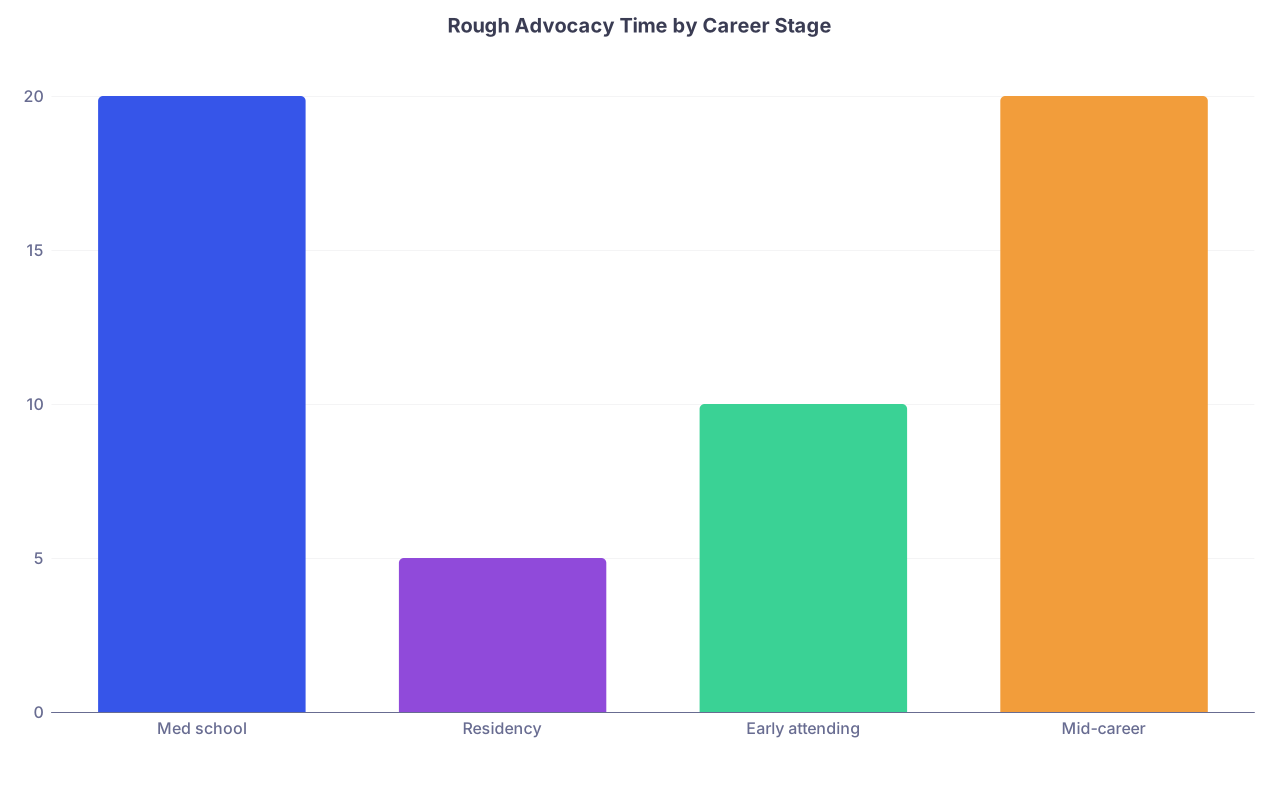
| Category | Value |
|---|---|
| Med school | 20 |
| Residency | 5 |
| Early attending | 10 |
| Mid-career | 20 |
Approximate weekly hours you can realistically devote to advocacy/policy if you are intentional (not fantasy numbers):
- Med school: 10–20 hours some weeks if you prioritize it.
- Residency: 2–5 hours, often in bursts during electives or specific rotations.
- Early attending: 5–10 hours if you deliberately carve out protected time or reduce clinical load.
- Mid-career: 10–20+ hours if you’ve structured your job around it (academic, public health, admin, or policy roles).
Specialty does not magically give you time. You will have to design your job.
But some specialties lend themselves better to building in non-clinical FTE:
- Academic IM and psych: many jobs are explicitly 0.6–0.8 clinical, 0.2–0.4 “other” (research, admin, advocacy, education).
- Peds: similar, especially in academic general peds, adolescent medicine, child abuse, complex care.
When you interview for residency and later jobs, you must ask direct questions:
- “Which residents/attendings here are actively involved in policy or advocacy now?”
- “How much actual protected time do they get?”
- “Can I talk to them?”
- “What institutional structures exist—centers for health policy, community health offices, etc.?”
Do not settle for, “We really value advocacy here.” That is code for “You can do it on your own time if you’re still awake at midnight.”
Step 5: Concrete Signals You’re in the Right Specialty Lane

You are probably aligned if all three are true:
- When you picture your clinic/ward days, the clinical problems you’ll manage actually sound interesting. Not just tolerable.
- The policy topics that spin out of those clinical problems are things you could imagine working on for a decade without getting bored.
- You can name at least 2–3 role models in that specialty who are doing the kind of advocacy or policy work you admire.
If you cannot find examples in that specialty at all, that is a red flag. Either you are not looking hard enough, or the field may not be the right home for your specific flavor of advocacy.
Practical Scenarios: What to Do in Your Situation
Scenario 1: You’re MS3, torn between all three, but you light up around social determinants
You like kids on peds. You found psych emotionally powerful. You enjoyed complex multimorbidity on your IM rotation.
Here is the play:
- Make a list: For each rotation, write 5 clinical problems that made you want to do something beyond the chart. Asthma in kids? Homelessness + psychosis? Uncontrolled diabetes and no meds?
- Match those to policy topics. See which cluster is strongest.
- Do one focused elective in each: outpatient peds in a community clinic, psych consult-liaison or addiction, IM in a safety-net hospitalist or primary care setting.
- Pay attention to which patient stories stay with you a week later. That is usually your answer.
Scenario 2: You already know you want to do a public health degree or policy fellowship
Then you should choose the specialty whose patients you want to represent for the rest of your life.
The MPH or fellowship will give you generic policy tools. Your specialty gives you credibility and day-to-day stories. Ask yourself: when I’m in a room with legislators, do I want to say:
- “I am a pediatrician who cares for kids affected by…”
- “I am a primary care internist who sees adults dealing with…”
- “I am a psychiatrist working with patients facing…”
Pick the sentence that feels most like you.
Scenario 3: You’re worried about money and lifestyle but still want advocacy
Advocacy does not pay your loans. Be realistic.
- Internal medicine → can get you relatively higher-paying gigs (hospitalist, subspecialist) with block schedules that sometimes make carving out advocacy time easier.
- Psychiatry → strong market demand, good outpatient lifestyle in many settings. Allows 0.8 FTE clinical + 0.2 FTE advocacy-type roles.
- Pediatrics → lower pay on average, but plenty of satisfying advocacy roles in academic centers, children’s hospitals, NGOs.
If debt and financial stability are major stressors, IM or psych give slightly more flexibility. You can still do heavy advocacy in either.
Two Non-Negotiables No Matter What You Pick

You must protect your advocacy time on your calendar like a clinic session.
If it is always “I’ll do it when I have time,” you will never have time. Start in residency: write that op-ed, join that city task force, help your hospital draft a policy.You need a team.
Policy work is not solo heroics. Find the local health policy center, community orgs, legal aid, or advocacy office at your hospital. Attach yourself to them during residency and early attending life. That is how you build real leverage.
FAQs
1. Is there a “best” specialty for going into a full-time policy career later?
No single “best,” but internal medicine and pediatrics are slightly more common among physicians who end up in big federal roles (CMS, HHS, major think tanks), mainly because they cover huge swaths of the population. Psychiatry dominates in mental health and criminal justice policy spaces. The right one is the one whose patients you want to speak for when you are sitting in those rooms.
2. If I choose psychiatry, am I locking myself out of broader health policy?
Not at all. You’ll have a natural anchor in mental health/addiction policy, but those domains intersect with housing, Medicaid, employment, disability, criminal justice, and emergency care. Many psych-trained folks sit on broader health equity and public health policy teams. You will just always bring a mental health lens to the table—which is a strength, not a limitation.
3. Should I prioritize programs with explicit “advocacy tracks” when applying?
Yes—if those tracks come with real structure and protected time. Ask programs for concrete details: dedicated advocacy elective blocks, mentorship with people actually on state committees, ongoing community partnerships, measurable projects that residents have completed. If it is just a couple of noon conferences and a photo-op at “lobby day,” do not overvalue it.
4. What can I do right now (pre-residency) to set myself up for a policy-focused career regardless of specialty?
Pick one issue and go deep for 1–2 years: housing, child mental health, Medicaid access, whatever. Work with a local org or policy lab, produce something tangible (policy brief, QI project that changed a protocol, testimony support, op-ed, data report). Build relationships with mentors who are already in the policy world. When you hit residency, you will not be starting from scratch; you will be continuing a story.
Key points:
- Choose the specialty whose patients and problems you want to represent in policy rooms for decades—peds for kids and schools, IM for adult systems and chronic disease, psych for mental health and law.
- Advocacy is possible from any of these three, but only if you ruthlessly protect time and seek out real mentors and structures, not just “we value advocacy” slogans.