
The biggest mistake married medical students make is pretending specialty choice is “just about passion.” It is not. It is about call schedules, who does daycare pickup, how many anniversaries you miss, and whether your spouse secretly grows to resent medicine.
You asked the right question: family first, then FM vs IM vs psych.
Let’s get concrete.
Step One: Be Brutally Clear About Your Spouse’s Reality
Before we talk FM, IM, or psych, you need to understand what your non-physician spouse is actually signing up for. Not in theory. In their specific job, city, and temperament.
Here’s what I tell couples in your position: have a 60–90 minute, phones-off meeting where you answer 4 questions in writing.
- How many evenings per week can you be realistically unavailable for family things (physically or mentally)?
- How many weekends per month can you miss or be half-present?
- How much moving are you both willing to tolerate after residency (for fellowship, jobs)?
- Who owns which load: childcare, elder care, finances, emotional labor, social life?
You’re not negotiating yet. You’re mapping reality.
If your spouse works a rigid 8–6 with a hellish commute, that’s very different from someone remote with flexible hours. A K–12 teacher with limited time off is different from a consultant who can move cities every 2–3 years.
Now hold that picture. Because that context will make some “family-friendly” advice you hear from classmates completely wrong for you.
Step Two: How FM, IM, and Psych Actually Feel on the Ground
Forget brochures and “lifestyle specialty” talk. Here’s what I’ve actually seen in residents’ lives across large community programs, mid-tier university programs, and a few big academic centers.
| Specialty | Average Week | Weekends | Typical Call Burden |
|---|---|---|---|
| Family Med | 55–65 hrs | 2–3/4 | Heavy on certain rotations, lighter clinic months |
| Internal Med | 60–80 hrs | 2–3/4 | Significant inpatient call, ICU, nights |
| Psychiatry | 50–65 hrs | 1–2/4 | Nights and weekends, but usually less intense pace |
Family Medicine: Jack-of-All-Trades, Variable Lifestyle
Family med residents live in two parallel universes.
World 1: Community programs with strong outpatient focus
World 2: Large academic programs loaded with inpatient, OB, and procedures
In World 1, your life might look like:
- 7 a.m.–5 p.m. most days
- Early morning pre-rounds on inpatient months, but heavy-obstetrics tracks are optional or limited
- Some nights and weekends, but often predictable and decently spaced
- More continuity clinic and scheduled patients, less constant crisis care
In World 2, I’ve watched FM residents getting hammered on OB, nursery, inpatient services:
- Long stretches of q4 call on OB (every 4th night)
- Being called at 2 a.m. for “patient pushing now” when you were finally asleep
- Very real risk of ruined sleep schedules and multiple blown family events in a row
So “family-friendly” in FM depends heavily on:
- How OB-heavy the program is
- How much inpatient they do
- How much they lean into 24-hour shifts vs night float
For attendings after residency, FM can be incredibly family-friendly if you choose:
- Outpatient clinic with no OB, limited call, and no hospital work
- Part-time or 4-day workweeks (more common in FM than IM or psych in many markets)
- Rural or smaller communities where schedules can be customized if you’re in demand
But FM can also be brutal if you add:
- Full-scope practice with OB and hospital rounds
- A poorly staffed clinic that double-books you
- Underserved areas with high need and low backup
Internal Medicine: The Training Is Rougher, the Exit Options Are Broader
IM residency is usually the hardest of the three on a spouse in the moment.
Most IM programs:
- Run heavier inpatient services
- Have intensive care units that demand serious hours and emotional bandwidth
- Still use versions of q4 or q5 call, even if labeled as “long call / night float”
- Expect more academic work or QI projects on top of clinical time
I’ve seen IM residents routinely:
- Miss weekday dinners, most weeknights
- Get home “early” at 7:30–8 p.m. and still be charting on the couch
- Sleep through weekend mornings because they’re wrecked from call
But there’s a tradeoff that matters long-term: IM has powerful family-friendly landing spots if you avoid subspecialties that eat your life.
Examples:
- Outpatient primary care IM: 8–5 clinics, no OB, limited or no inpatient call
- Hospitalist with 7-on/7-off: rough weeks, but true full weeks off
- Concierge or direct primary care: fewer patients, lots of control (where available)
- Non-clinical or hybrid roles: industry, admin, informatics
If you’re married to a non-physician who cares more about your life after residency than the 3 hardest years, IM opens a lot of doors once the pain is over. The key is whether your partnership can withstand those residency years.
Psychiatry: Fewer Hours, Different Kind of Drain
Psych as a specialty leans more family-friendly in residency for many programs, but with some caveats.
On paper, psych residents often:
- Work 8–5 or 9–5:30 on outpatient and consult months
- Have fewer overnight calls, more home call (depending on program)
- Rarely do 28-hour shifts except maybe on inpatient psych at a few institutions
- Get more holidays and weekends off compared to IM
In reality, here’s what residents and their spouses deal with:
- Emotional exhaustion: sitting with trauma, SI/HI, psychosis all day
- Safety stress: especially in ED psych and inpatient psych units
- On-call intensity: while fewer hours, those calls can be psychologically demanding
From a family perspective, psych is often the most “schedule-predictable” of the three, especially in later years of residency and in attending life. Outpatient psych with no call can be extremely stable. But you must be someone who can leave work at work; otherwise your spouse gets a partner who’s physically present but emotionally empty.
Step Three: Look at Your Spouse’s Job Against Each Specialty
Now we stop talking in the abstract.
Take your spouse’s likely work pattern and smash it up against each path. Ask: what actually happens to our life?
Scenario A: Spouse in a Demanding 9–6 Office Job
Think: corporate, finance, tech, law firm associate, mid-level management. Commute 30–60 minutes. Limited schedule flexibility.
Here’s how this usually plays out:
Internal Med:
- Short term (residency): brutal. Childcare is outsourced. Housework is outsourced or just…doesn’t get done.
- You will miss school events, parent-teacher meetings, appointments. Your spouse becomes the default parent and default adult for everything.
- Medium term: better once you graduate, but only if you choose outpatient or hospitalist jobs wisely.
Family Med:
- If you match at a lower-intensity, community-heavy outpatient-focused program, this can work well.
- Still some rough rotations (OB, inpatient), but more months where you’re actually home for dinner.
- Long term, outpatient FM with minimal call can pair quite well with a spouse in a demanding job.
Psych:
- Easiest pairing in residency, in most cases. Predictable clinic days, fewer true emergencies.
- You’re more likely to be doing daycare pickup sometimes, or actually present in evenings.
- Long-term, outpatient psych with no or minimal call is almost tailor-made for this setup.
Scenario B: Spouse with Flexible / Remote Job
Think: remote tech, design, consulting, freelance, part-time work.
This setup gives you more breathing room.
Internal Med:
- Doable even in tough programs, because your spouse can adapt to calls and weekends.
- You can survive 3 tough IM years if they can move their schedule for pickups and appointments.
- Long-term: if you want fellowship, academic jobs, or hospitalist work, this is the strongest specialty.
Family Med:
- Very reasonable. The two of you can trade off kid logistics and house admin more fluidly.
- Long-term, you can choose community jobs that line up beautifully with your spouse’s flexibility (e.g., 4-day clinic weeks).
Psych:
- Probably the most “chill” combination for the household.
- Watch out for the tendency to oversubscribe yourself because “you’re the one with the lighter schedule.” That resentment shows up in a lot of psych marriages.
Scenario C: One Partner Will Likely Stay Home with Kids
Maybe you, maybe your spouse, but someone will be primary home-based for several years.
Internal Med:
- This is often the only way IM residency is not a disaster at home.
- A stay-at-home spouse can absorb unpredictability and emergencies.
- Long-term: you have leverage to choose jobs first for fit and second for schedule.
Family Med:
- Really nice combination if you aim for outpatient-heavy practice later.
- The stay-at-home partner can handle weekday logistics; you still need boundaries to avoid being consumed by “just one more add-on patient.”
Psych:
- Very comfortable on a day-to-day basis.
- If you’re the sole breadwinner, psych’s earning potential may be somewhat lower than a procedure-heavy IM subspecialty, but outpatient psych is still more than enough for most families.
Step Four: Training Pain vs Long-Term Life — Choose Which You Want to Minimize
You’re making two decisions at once:
- How much pain you and your spouse can tolerate during 3–4 years of residency
- What your next 20–30 years reasonably look like
Different couples prioritize differently.
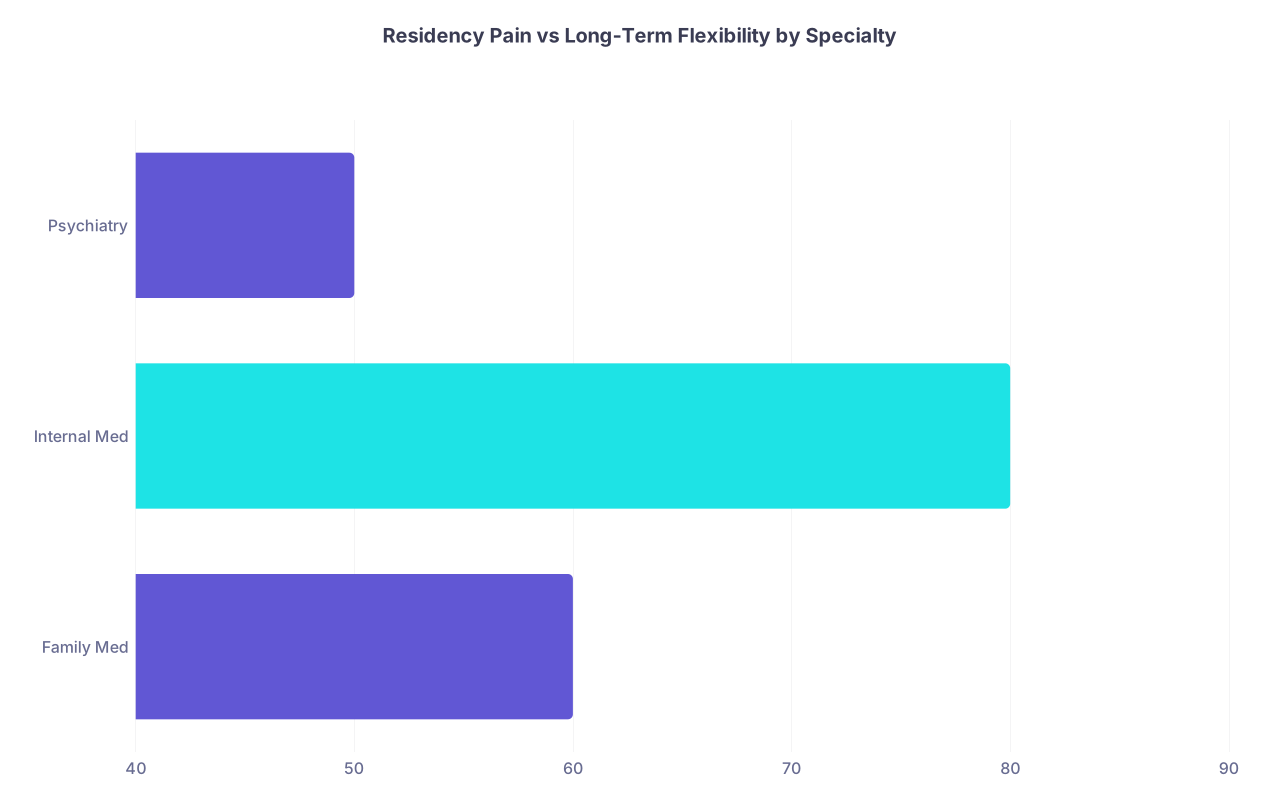
| Category | Value |
|---|---|
| Family Med | 60 |
| Internal Med | 80 |
| Psychiatry | 50 |
Think of it like this (numbers are “pain points” out of 100 for residency, and “flexibility points” out of 100 post-residency):
| Specialty | Residency Pain (higher = worse) | Long-Term Flexibility (higher = better) |
|---|---|---|
| Family Med | 60 | 80 |
| Internal Med | 80 | 95 |
| Psychiatry | 50 | 75 |
These aren’t evidence-based. They’re “what it feels like for most people most of the time.”
If your spouse is already at the edge (young kids, no local support, demanding job), you probably cannot afford the IM residency pain unless you have strong backup (family nearby, money for help).
If you two are playing the long game, with decent support and realistic expectations, IM’s long-term flexibility can be huge.
Step Five: Red-Flag and Green-Flag Program Features for Your Marriage
You’re not just choosing a specialty. You’re choosing a specific residency culture. That matters as much as the letters.
When you interview or email current residents, ask about specific features.
Green Flags
For a married applicant with a non-medical spouse, you want things like:
- Night float instead of q4 28-hour calls
- Stated (and enforced) rule about leaving on time post-call
- Protected golden weekends (e.g., at least one full weekend off per month)
- Reasonable commute from family-friendly neighborhoods
- Childcare resources or at least a hospital culture that doesn’t roll its eyes at parents
- Residents who actually have kids and seem…not destroyed
I’ve watched couples survive scary IM programs because the program meant it when they said: “Post-call goes home by 11 a.m. No exceptions.” That extra half-day matters.
Red Flags
These are patterns that crush marriages:
- Culture of bragging about working extra off-the-books hours to “show commitment”
- Regular “just stay a bit later to help the team” nonsense that becomes normalized
- Zero residents with kids or stable long-term partners (huge signal)
- Leadership who laughs off questions about work-life balance
- Program in a city where you cannot afford help, with no family nearby
If you’re torn between FM and IM or between IM and psych, the presence or absence of these flags can break the tie.
Step Six: Honest Self-Assessment — What Kind of Spouse Are You Going to Be in Residency?
I’ve seen well-intentioned residents absolutely tank their marriages not because of the specialty, but because of how they handled residency.
Ask yourself:
- Do you shut down under stress or can you communicate even when tired?
- Are you the type who says yes to every extra shift, every research project, every QI idea?
- Are you willing to protect 1–2 “sacred” family windows per week, no charts, no Epic?
If you know you’re bad at boundaries, then:
- IM is more dangerous, because it will take everything you offer.
- FM can also eat your life with admin and doing “just one more thing for my patients.”
- Psych can be insidious — people think it’s lighter so they pile on more outside things.
If you’re actually good at saying “no”:
- You can survive an IM residency and still be halfway present at home.
- You can make FM or psych incredibly family-friendly, especially in attending life.
So, What Should You Choose?
Let me be specific. If you’re:
Married, thinking about kids during residency, limited local family support, spouse in a rigid job
- Strong lean toward: Psychiatry or a very outpatient-focused Family Medicine program.
- Internal Medicine only if you:
- Delay kids
- Have paid help
- Or your spouse is unusually resilient and on board with a rough 3 years.
Married, kids likely after residency, spouse flexible/remote or willing to adjust
- Internal Medicine is very reasonable, especially if you’re ambivalent between inpatient and outpatient.
- FM is excellent if you want more outpatient, more holistic practice, maybe early attending stability.
- Psych is best if you know you like mental health work and want a more predictable schedule from day one.
Married, one partner likely to be stay-at-home or very part-time
- All three are realistic.
- Choose by clinical interest, with a small bias toward IM if you care about long-term flexibility and leadership opportunities, or psych if you value schedule predictability over raw variety.
Spouse cares a lot about you being emotionally available, not just physically present
- Be careful with psych if you’re prone to carrying other people’s pain home.
- Be honest that IM and FM inpatient months will leave you wiped out enough that you come home as a zombie some days.
- In any specialty, you must build decompression rituals (podcast on drive home, 10-minute walk alone before you walk in the door).
A Simple Decision Flow You Can Use Together
Print this, talk it through with your spouse. No BS.

| Step | Description |
|---|---|
| Step 1 | Start - Married to non physician |
| Step 2 | Internal Medicine |
| Step 3 | Psychiatry |
| Step 4 | Family Medicine |
| Step 5 | Internal Medicine or Family Medicine |
| Step 6 | Psychiatry or light Family Medicine |
| Step 7 | Psychiatry |
| Step 8 | Outpatient focused Family Medicine |
| Step 9 | Spouse job flexible? |
| Step 10 | Want broad long term options? |
| Step 11 | Kids during residency? |
| Step 12 | Prefer mental health work? |
| Step 13 | Local support or paid help? |
| Step 14 | Strong psych interest? |
Final Word
You’re not choosing between FM, IM, and psych in a vacuum. You’re choosing how your next 3–4 years and your next 30 will feel in your kitchen, your kids’ school events, and your spouse’s nervous system.
If you remember nothing else:
- Look at specific programs and their culture — not just the specialty label. A chill psych program beats a malignant FM program every day of the week; a sane community IM program may be easier on your marriage than an OB-heavy FM one.
- Decide together whether you want to minimize residency pain or maximize long-term flexibility. That tradeoff is different for every couple, and you’re allowed to choose either side.