
You’re a 4th year in the US (or about to be), ERAS is looming, and you’ve got this nagging truth in the back of your mind:
“I might not stay here forever.”
Maybe your partner’s from the UK or EU. Maybe your entire family is in Canada. Maybe you’re burned out on US healthcare and fantasize about New Zealand or Australia. Or you’re an IMG who knows you’ll eventually want to go back home.
But right now, you’re stuck on one question:
If I think I’ll move abroad in 5–10 years, what residency should I pick to keep the most doors open?
This is where people make huge, expensive mistakes. Matching into a super-niche US-only field that no one abroad recognizes. Training in a program that international boards don’t respect. Ignoring licensing pathways until it’s basically too late.
Let’s walk through this like someone who actually expects to move, not “maybe one day” fantasy talk.
Step 1: Get Real About Where You Might Go
“Portability” means nothing without a destination. A US-trained psychiatrist is gold in some systems and a bureaucratic headache in others.
You do not need a final answer, but you do need a short list. Pick 1–3 likely regions:
- UK / Ireland
- Canada
- Australia / New Zealand
- Western Europe (EU/EEA)
- Gulf States (UAE, Qatar, Saudi Arabia)
- Back to your home country (if IMG)
Different regions respect different training paths.
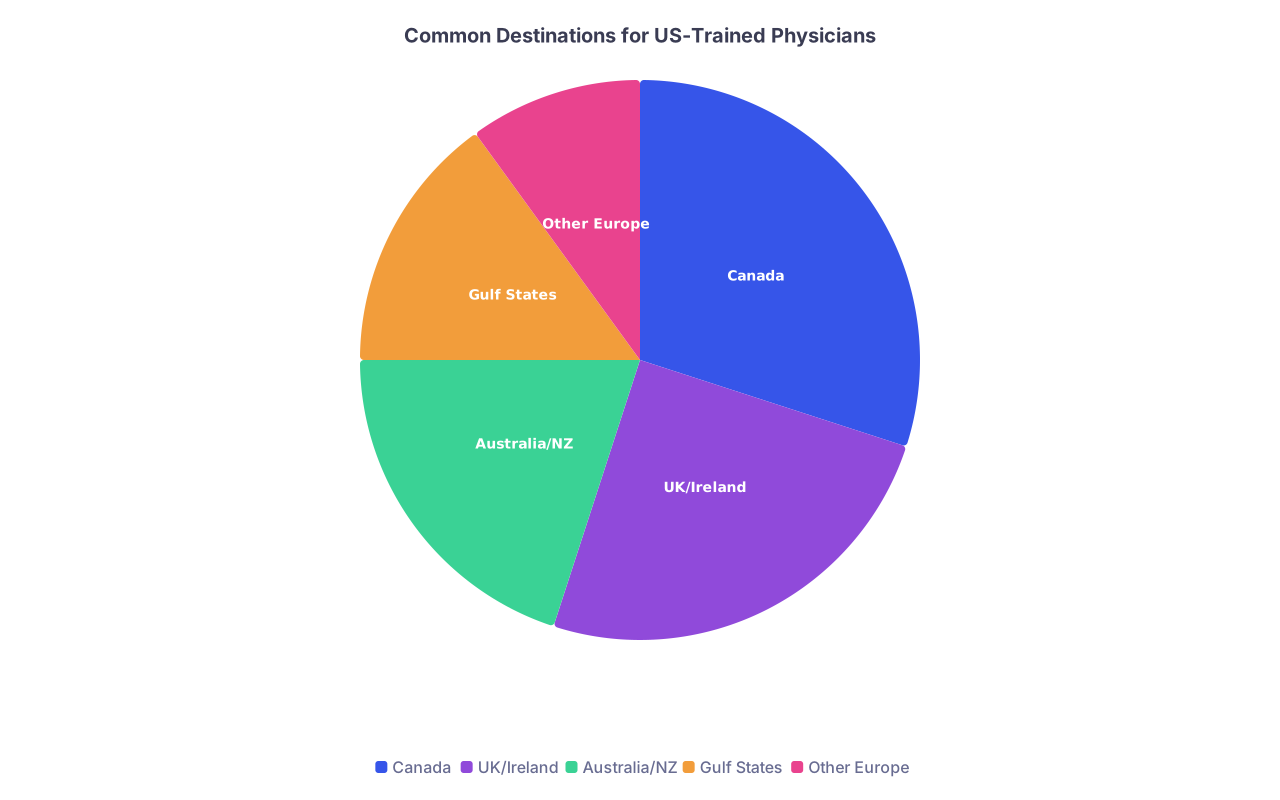
| Category | Value |
|---|---|
| Canada | 30 |
| UK/Ireland | 25 |
| Australia/NZ | 20 |
| Gulf States | 15 |
| Other Europe | 10 |
If you’re even vaguely serious, spend one hour on each target country’s medical board website. Look for:
- Do they recognize US residency directly?
- Do they require specific exams (e.g., PLAB for UK, MCCQE for Canada, AMC for Australia)?
- Are there specialty-specific rules (e.g., EM and FM are areas with big variation)?
You’ll notice patterns quickly. Some specialties and some training structures are clearly easier to port.
Step 2: Big Picture – Which Specialties Travel Best?
If you want maximum portability, there are clear winners and losers.
Generally Good Bets (high portability)
These are the “currency” specialties. Almost every system needs them. Most boards understand what this training looks like.
- Internal Medicine (IM)
- General Surgery
- Pediatrics
- Anesthesiology
- Obstetrics & Gynecology
- Psychiatry
- Radiology
- Pathology
If you stop reading here: any of those, done in a solid US ACGME program with board certification, will be usable in many countries with some additional steps.
Good But Trickier
These are often portable but can be more regulated:
- Emergency Medicine
- Family Medicine
- Neurology
- PM&R (Physiatry)
- Critical Care as a subspecialty
There’s more variation globally in how these are defined and certified. Still workable, just more paperwork and sometimes extra training.
Red Flags for Portability
Not “don’t do it,” but do it with your eyes open:
- Very US-specific fields:
- Interventional pain (without anesthesia or PM&R base)
- Hospitalist-only paths if you never completed IM residency
- Ultra-niche subspecialties:
- Some fellowships that don’t exist as stand-alone specialties abroad
- Brand-new board certifications with little global recognition
Outside the US, systems care far more about “Are you a trained specialist in X?” than about a hyper-narrow US subspecialty.
Step 3: Region-by-Region Reality Check
You’re not choosing a residency in abstract. You’re choosing in relation to your most likely landing zone.
UK / Ireland
The UK (GMC) and Ireland (IMC) both tend to respect US postgraduate training, but the path is rigid.
Strong portable choices:
- Internal Medicine → especially if you complete 3 years + board certification. You’ll usually enter as a specialty doctor or on a CESR pathway.
- Psychiatry → huge demand, US psych is well-respected.
- Pediatrics, Anesthesiology, General Surgery, Radiology, Pathology → all reasonably recognized.
- EM and FM → more nuance; UK “GP” and “EM” are structured differently.
Problem areas:
- Family Medicine: US FM doesn’t map perfectly to UK GP training. You may not be able to drop in as a GP equivalent. You’re often treated more like an internal/generalist doctor working toward CESR.
- Emergency Medicine: UK EM is its own run-through training pathway. US EM can be recognized, but expect some friction and potential need for extra steps.
If you think UK/Ireland is serious:
- Pick a core specialty that exists clearly in their system: IM, Psych, Peds, Anesthesia, Gen Surg, Radiology, Pathology.
- Aim for full US board cert. GMC loves documents and defined training outcomes.
- Keep procedure logs / case logs. CESR routes (alternative certification) can depend heavily on proof.
Canada
Canada likes US training, but they’re picky. The Royal College (for most specialties) and CFPC (for Family Med) are the gatekeepers.
Best bets:
- Internal Medicine
- General Surgery
- Anesthesiology
- Pediatrics
- Psychiatry
- Radiology
- Pathology
- Most standard fellowships off those cores
Family Medicine is doable, but you want a strong US FM program with heavy continuity clinic and maybe some OB if you want broad practice.
Canada-specific quirks:
- They may require:
- Exams: MCCQE, Royal College exams, or CFPC exams.
- Training length equivalence: some Canadian specialties are longer than the US. You may be told to do extra fellowship or extra supervised practice.
- EM: Canada has CCFP-EM and FRCP-EM pathways. US EM doesn’t map cleanly into both pathways. It’s not impossible, but it’s not “flip a switch and you’re licensed.”
If Canada is high on your list:
- Avoid ultra-niche or short-track programs.
- Do a mainstream residency with standard duration (3–5 years) and recognized boards.
- Strongly consider IM, Anesthesia, Peds, Psych, Gen Surg or Radiology if portability is the top priority.
Australia / New Zealand
Australia (AHPRA, specialist colleges) and NZ are often the most friendly to US-trained specialists. There’s bureaucracy, but they generally respect ACGME and ABMS boards.
Great portable specialties:
- IM (and subspecialties)
- General Surgery
- Anesthesia
- EM
- Psychiatry
- Peds
- Radiology
- Pathology
- Obs/Gyn
Family Medicine equivalent there is “General Practice.” US FM is often accepted, but again, details matter (scope of training, procedural skills, length).
This region is where US EM and US Anesthesia do especially well. They’re in demand, and the training is understandable to their colleges.
If you’re Australia/NZ-focused:
- EM, Anesthesia, Psych, IM, and GP (via FM) are very reasonable choices.
- Make sure your residency has strong, documentable training: procedure logs, evaluations, clear curriculum.
Step 4: Specialty-by-Specialty – What Actually Plays Well Abroad
Here’s where you’re probably skimming for “your” field. Fair enough.
| Specialty | Overall Portability | Typical Extra Steps |
|---|---|---|
| Internal Med | Excellent | Exams, paperwork |
| General Surgery | Excellent | Exams, maybe extra year |
| Psychiatry | Excellent | Exams, supervision |
| Emergency Med | Good, variable | Often extra training |
| Family Med | Good, mismatched | May not equal GP |
Internal Medicine
If you want maximum future-proofing, Internal Medicine is king.
Why?
- Every system understands “adult internal medicine specialist.”
- From IM, you can subspecialize (cardio, GI, pulm, etc.), which many countries recognize via their own college systems.
- Hospitalist work abroad often routes through IM training.
Best move for IM with portability in mind:
- Do a solid categorical IM residency (3 years).
- Get ABIM board certification.
- Keep procedure and case logs, especially if you plan ICU, cardiology, or another high-skill field.
This is the safest bet if your future is foggy but you know you won’t want a purely outpatient primary care life.
General Surgery
Strong portability, but countries might demand:
- Proof of operative volume.
- Sometimes extra fellowship or a “transition” year within their system.
If you’re surgery-bound:
- Choose a program with high case numbers and good reputation.
- Keep meticulous logs. This matters later when foreign colleges assess “substantial equivalence.”
- If considering later subspecialty (e.g., colorectal, HPB), pick fellowships that actually exist abroad too.
Psychiatry
One of the most in-demand and exportable US specialties right now.
Psychiatry tends to travel well because:
- There’s a global shortage.
- The concepts and approaches align reasonably across Western systems.
Weak spots:
- Some boards want proof of child/adolescent exposure, community psych, and in certain systems, psychotherapy training.
If you do psych:
- Go to a residency with broad exposure (inpatient, outpatient, CL, community, addiction).
- Document psychotherapy training if you get it.
- Expect exams + maybe a period of “supervised practice” abroad before full recognition.
Anesthesiology
Very portable, especially to Canada, Australia, NZ, Gulf, many parts of Europe.
Crucial factors:
- Case mix: peds, OB, cardiac, ICU exposure all help your file abroad.
- Board certification and letters from department heads carry weight.
If anesthesia is your thing and you’re thinking abroad:
- Avoid super-narrow, cushy programs that leave holes (no peds, no complex cases).
- You want a program that can stand up to scrutiny by a foreign college.
Pediatrics
Solid portability, but sometimes undervalued compared to IM or anesthesia because of pay and competition.
Key details:
- Some countries divide primary care vs hospital-based pediatrics more sharply.
- Neonatology, peds ICU, or subspecialty peds can be a big asset if you want better jobs abroad.
If you train in peds:
- Get hospital-heavy exposure if you can.
- Extra fellowship (NICU, PICU, cards) often increases portability and demand.
Radiology & Pathology
These travel decently well but are highly regulated:
- Many systems want you to pass local college exams (Royal College of Radiologists, Royal College of Pathologists, etc.).
- Availability of jobs varies a lot by country and year.
If you choose one of these:
- Do not pick a weak community program with limited volume. Foreign boards will dig into your training.
- Expect serious studying if you want to pass external exams.
Obstetrics & Gynecology
Generally portable, but some systems separate obstetrics more distinctly.
You’ll need:
- Proof of surgical skill and obstetric volume.
- Clear detailing of training time in gyn oncology, urogyne, MFM, etc., if applicable.
Choose a program with robust obstetrics and major gynecologic surgery exposure if you think you’ll be applying internationally.
Step 5: The More Awkward Fields – EM, FM, Neurology, Others
These are the “don’t write them off, but do your homework” specialties.
Emergency Medicine
US EM is fantastic training. Other systems… don’t always know what to do with it.
In the UK, Canada, and elsewhere, EM may:
- Be shorter or longer than US EM.
- Be built on a different base (sometimes via IM or surgery pathways).
You may be told:
- You can work as an EM doctor but need more exams or extra supervised time to be fully recognized.
- Or you’re “substantially equivalent” but still must pass local college assessments.
If you love EM and still want portability:
- Choose a university or high-volume program with strong trauma, peds, and critical care. That makes your case stronger with foreign colleges.
- Accept that there may be an extra hoop or two abroad. EM is still portable, just messier than IM.
Family Medicine
US FM ≠ GP in every country.
In the UK, for example, GP training is its own defined, regulated pathway. In Canada, FM is closer, but still structured differently.
Abroad, your US FM residency might get interpreted as:
- Advanced primary care training…
- …but not necessarily a direct plug-in to their “GP specialist” status without more exams or time in their system.
If you know you want primarily outpatient, continuity care and still want options abroad:
- FM can work, especially for Australia/NZ and Canada.
- Just be realistic that in some places you may initially be slotted below fully recognized GP specialists until you complete their hoops.
Neurology, PM&R, Others
Neurology: usually recognized, but exam-heavy abroad. Portability is decent. Better if you’ve done standard-length accredited training and board certification.
PM&R (Physiatry): variable recognition. Some countries barely have it as a clear specialty. You may end up shoehorned into pain, rehab medicine, or neuro categories. Not impossible, but not the easiest international ticket.
If you love one of these:
- Do it. But plan on a specific destination early and study that country’s recognition of your field.
Step 6: Program-Level Choices That Affect Portability
Even within the same specialty, some residencies are more portable than others.
Things that help:
- University-affiliated or large academic programs
- ACGME accredited (obviously, but this matters if you’re in a “hybrid” situation)
- Strong case mix and volume
- Clear documentation systems: procedure logs, evaluations, curriculum

Avoid, if portability is a key concern:
- Barely accredited, low-volume community programs that might look weak to a foreign college.
- Programs with huge gaps in core training (e.g., an anesthesia program with almost no peds or OB).
- Anything where logging procedures and cases is an afterthought.
You want a training record that you can hand to a foreign board and say: “Here. Everything is clearly laid out.”
Step 7: Exams and Timing – Do Not Wait Until PGY-5
If you know you may move, handle the exam strategy early. You don’t want to be an attending studying from scratch for PLAB or MCCQE.
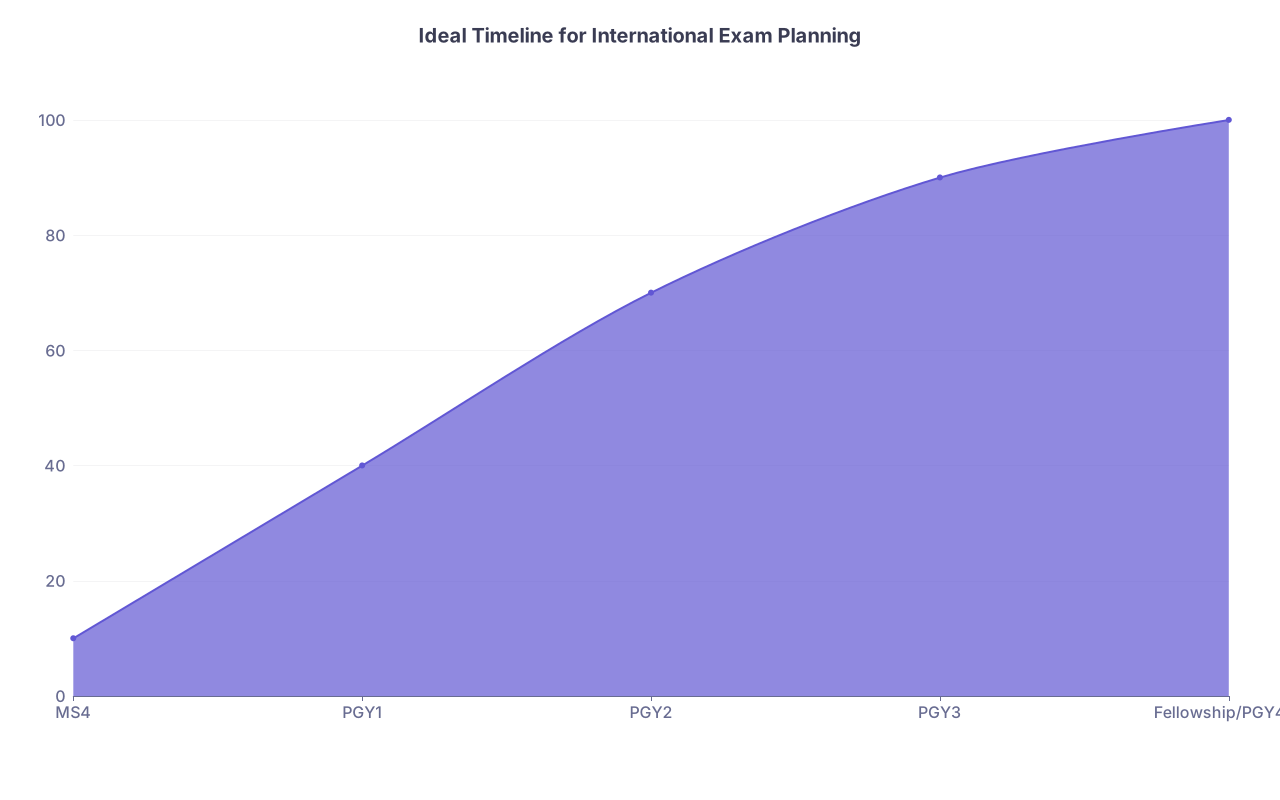
| Category | Value |
|---|---|
| MS4 | 10 |
| PGY1 | 40 |
| PGY2 | 70 |
| PGY3 | 90 |
| Fellowship/PGY4-5 | 100 |
Rough guide:
MS4 / PGY1:
- Identify likely destination(s).
- Read their medical council pages. Make a list of required exams.
PGY2:
- If UK is likely, figure out if you’ll need PLAB or if your residency/boards can waive pieces.
- If Canada is likely, understand MCCQE and Royal College/CFPC timing.
- If Australia/NZ, look at AMC or college assessments.
PGY3–4:
- Schedule at least one of the needed foreign exams while you’re still in “exam mode” from US boards.
- Keep obtaining letters that explicitly describe your skills in international-readable terms.
Step 8: If You’re an IMG Who Might Go Back Home
Different angle, same problem.
You’re training in the US, but you might:
- Return to India, Pakistan, Nigeria, Brazil, etc.
- Move to the UK / Gulf as an intermediate step.
You must balance:
- Matching into anything (real constraints), with
- Choosing something at least somewhat recognized back home.
I’ve seen IMGs do US FM, then discover their home country barely recognizes FM as a “real” specialty and pays it terribly. Meanwhile, US-trained anesthesiologists and internists are welcomed with far more status and options.
If this is you:
- Ask actual consultants back home what US specialties they see returning doctors succeed with.
- Usually, classic hospital specialties (IM, Gen Surg, Anesthesia, Peds, Psych, Radiology, Pathology) travel better than FM or super-niche things.
- Factor this in before you rank a US FM or very niche program #1 just because it felt “easier to match.”
Step 9: Gut Check – What If Portability Isn’t #1, But Still Matters?
Some of you are thinking: “I really want EM/FM/PM&R, but I might leave in 10 years. Do I force myself into IM just for portability?”
No.
You need a life you can stand waking up to. Not just a passport strategy.
If portability is a secondary but real factor, here’s a compromise approach:
- Pick the specialty you actually want.
- Within that, choose:
- A strong, respected program.
- With broad training and excellent documentation.
- And explicitly plan early for 1–2 target countries.
What you should not do:
- Ignore this conversation completely, then panic at age 38 when you burn out and suddenly want to move to New Zealand with zero exam prep, no understanding of licensing, and a weird training path nobody there recognizes.
Step 10: The Playbook – If You’re Serious About Moving
Let me lay out a simple plan. This is what I tell residents who bring this up early.

| Step | Description |
|---|---|
| Step 1 | MS3-MS4 |
| Step 2 | Choose likely regions |
| Step 3 | Pick portable specialty or accept tradeoff |
| Step 4 | Rank strong, well-documented programs |
| Step 5 | Track procedures and cases carefully |
| Step 6 | Research foreign exams by PGY1-2 |
| Step 7 | Take at least one foreign exam before graduation |
| Step 8 | Get letters highlighting skills clearly |
| Step 9 | Apply abroad with complete documentation |
And a quick comparison of strategy by destination:
| Destination | Safest Specialties | Higher Friction Fields |
|---|---|---|
| UK/Ireland | IM, Psych, Anesthesia, Peds | EM, FM, PM&R |
| Canada | IM, Anesthesia, Peds, Psych | EM, FM, some subspecialties |
| Australia/NZ | IM, EM, Anesthesia, Psych | FM (documentation heavy) |

Rapid-Fire Mistakes To Avoid
These are things I’ve actually seen:
- Doing US Family Medicine, then discovering your target country doesn’t treat you as an equivalent GP and you’re stuck in limbo.
- Matching a tiny, low-volume community surgery program, then being unable to prove “substantial equivalence” to a foreign surgical college because your logbook is weak.
- Ignoring foreign exam requirements until after US boards, then not wanting to study again and abandoning the move entirely.
- Assuming “Any US board certification = automatic consultant abroad.” It doesn’t. They care about structure and details.
Do not let your future options die because you didn’t spend 3–4 hours reading licensing pages and talking to someone who actually did the move.
Final Check: If You’re Ranking Tomorrow
If you’re down to the wire and reading this late in the game, here’s the lean version.
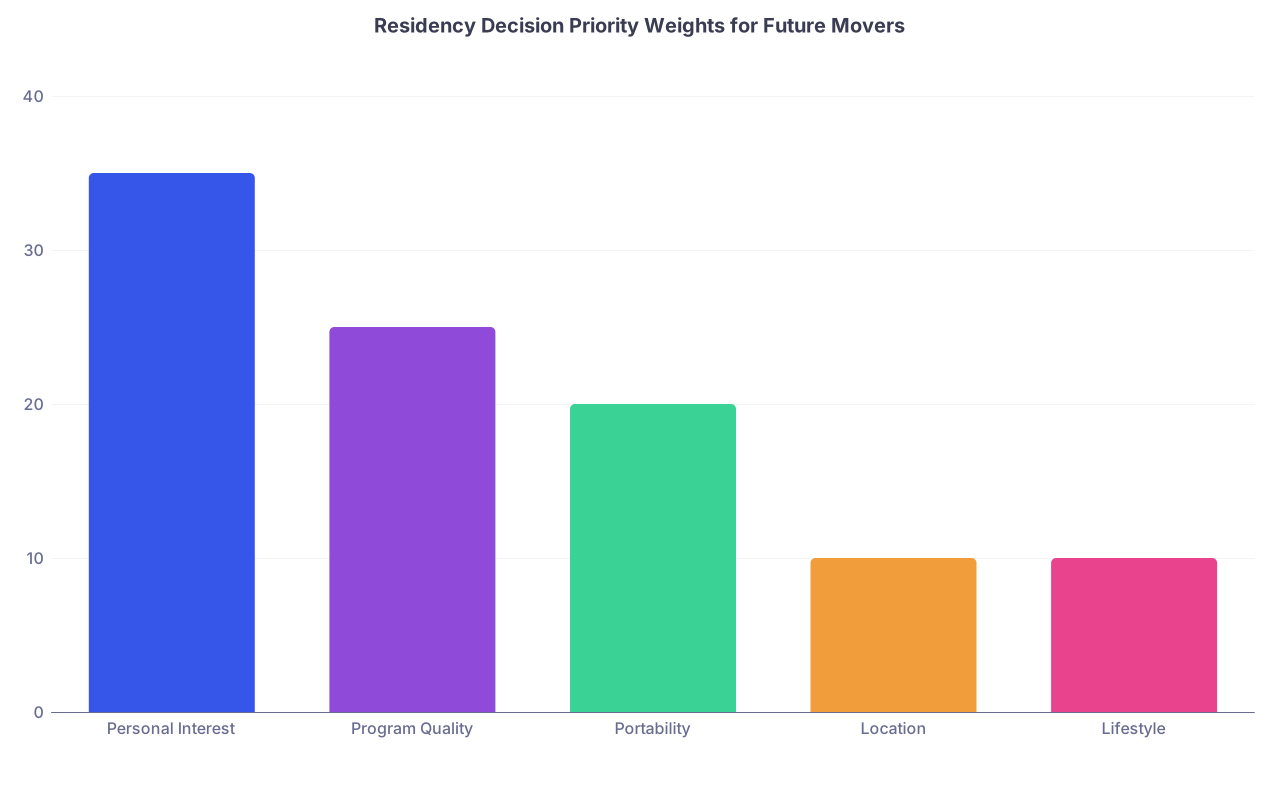
| Category | Value |
|---|---|
| Personal Interest | 35 |
| Program Quality | 25 |
| Portability | 20 |
| Location | 10 |
| Lifestyle | 10 |
Ask yourself:
- Do I seriously believe I might move to UK/Ireland, Canada, Australia/NZ, or back home within 5–15 years?
- If yes, am I choosing:
- A specialty that exists clearly in those systems?
- A strong program whose training will stand up to foreign review?
- Do I have at least a loose plan for:
- Which foreign exams I’ll need?
- When I’ll take at least one of them?
If the answer to all three is “yes,” you’re already ahead of 90% of people who fantasize about moving but never plan.
Key Takeaways
- The most portable specialties from US training are the classic cores: Internal Medicine, General Surgery, Anesthesia, Psychiatry, Pediatrics, Radiology, and Pathology. Emergency Medicine and Family Medicine can work, but you need country-specific planning.
- Program quality and documentation matter as much as the specialty. High volume, clear logs, and respected training make foreign recognition far easier.
- If you’re serious about a future move, pick 1–3 likely destination countries now, learn their licensing rules during residency, and knock out at least one foreign exam before you get too comfortable as an attending.