
Already Signed Up for Surgery Rotations but Leaning Psych? How to Pivot
You’ve got two away surgery rotations on VSLO, your home surgery sub-I locked in, and maybe even a friendly trauma attending already talking about letters.
And then on psych clinic last week, something clicked.
You liked the pace. The conversations. The way your brain worked in that space. You’ve caught yourself reading about SSRIs instead of surgical approaches. Now you’re staring at your schedule thinking:
“I’m already committed to surgery blocks. But I think I want psychiatry. Am I about to screw myself if I pivot now?”
You’re not the first person to be in this exact bind. I’ve seen people go from ortho to psych, gen surg to psych, EM to psych — all after they’d already loaded up on “the wrong” acting internships. The ones who handled it well did a few concrete things early, instead of passively hoping it would sort itself out.
Here’s how to handle it like a grown-up instead of spiraling.
Step 1: Get Clear on Whether This Is a Real Pivot or a Passing Phase
Before you blow up your schedule, you need one thing: clarity.
Not certainty forever. Just enough clarity to justify retooling your M3/M4 path.
Ask yourself three blunt questions:
- On my psych exposure so far, did I feel more “this fits how I think and live” than on surgery?
- When I imagine being 3 AM exhausted, which would I rather be called for: a suicidal patient in the ED or a perforated bowel in the OR?
- Am I reacting to surgery being rough… or to liking psych more?
If you’re just burned out from early surgical clerkships, that’s not the same as actually wanting psych. I’ve seen people swing hard away from surgery right after a brutal resident or malignant team, then swing right back after they see a healthier surgical culture elsewhere.
So, do this in the next 1–2 weeks:
Schedule a short meeting with a psych attending you liked on your rotation. Tell them directly:
“I’m seriously considering psych over surgery. I’m already scheduled for several surgical rotations. Can I get your perspective on psych as a career and what I’d need to make a competitive application?”Shadow or pick up extra time in psych if you can:
- Another day in CL psych
- A few evenings in the ED with psych consults
- One half-day in outpatient if they’ll let you slide in
You’re not trying to overhaul everything. Just enough extra exposure to know you’re not making this call off a single “good week.”
If, after that, you still feel drawn to psych? Treat it as real. Then you pivot.
Step 2: Take Inventory of What You’ve Already Locked In
You can’t change what you don’t see clearly. Pull up your schedule and literally list what’s real, not hypothetical.
Make 4 buckets:
Core graduation requirements
- Required sub-I / acting internship (often in IM, FM, peds, or surgery)
- Required EM rotation (at some schools)
- Required psych rotation (already done or scheduled)
Signed-up electives / aways (with dates and locations)
- Surgery sub-I at Home: July 1–28
- Trauma surgery away: Aug 5–30
- Surgical ICU elective: Sept 2–27
etc.
Deadlines & policies
- VSLO drop deadlines
- Home school add/drop deadlines
- Any penalties for late changes
Application timeline
- ERAS opens and submission timing
- When psych programs typically want psych letters
- When you can realistically fit a psych sub-I before apps
Write it out. You’ll start to see the actual constraints: what you can cancel, what you can repurpose, and what’s basically locked.
This is where most students mess up: they panic or procrastinate. You’re going to do neither. You’re going to work inside the rules.
Step 3: Stop Thinking “Waste” and Start Thinking “Story”
You worried yet about this question?
“Why so much surgery on your schedule if you’re applying to psych?”
Programs will notice. But if you handle it right, it’s not a red flag. In fact, handled well, it’s a strength: shows you explored, chose intentionally, and can explain your thinking.
Here’s how you reframe your “surgery-heavy” schedule:
- You’re not “someone who changed their mind late and wasted time.”
- You’re “someone who explored a highly procedural specialty seriously, then realized your strengths and long-term interests fit psychiatry better.”
Program directors hear this all the time when someone shifts from surgery/anesthesia/EM to psych. The red flag is not the shift. It’s a vague, flimsy explanation.
So you want a crisp narrative like:
“I started out very drawn to procedural medicine and team-based acute care, which is why I loaded my early fourth-year schedule with surgery rotations. Through those experiences I realized the parts I enjoyed most were the complex decision-making around patients’ goals, coping, and mental status — things that continued to stand out from my psych clerkship as where I was most engaged. Over time it became clear that my strengths and long-term satisfaction would align better with psychiatry, especially in [consult/CL, ED psych, whatever resonated]. The surgery rotations gave me a strong foundation in acute medical issues and systems-based care, which I think will make me a better psychiatrist.”
You don’t need that polished yet. But that’s the shape. And it to be honest and specific. Programs are good at spotting canned nonsense.
Step 4: Decide What to Cancel, What to Keep, and What to Add
You’ve got three levers:
- Rotations you cancel or swap
- Rotations you repurpose
- Psych-specific things you add
What to cancel or swap
Look at everything that is:
- An away surgical elective marketed as “audition” for surgery
- Redundant surgical electives that don’t help you as a psych applicant
- Easily dropped before penalty
If you have two or three surgery aways, being blunt: you don’t need them if you’re going psych. One at most may still be useful if it’s trauma, ED-adjacent, or heavy on medically/psychiatrically complex patients. But a hepatobiliary elective at a random institution? That’s not helping you.
Prioritize dropping:
- Aways at places you no longer care about
- Electives that are pure OR all day, zero psych relevance
- Late rotations when you’ll be deep in interview season anyway
Then immediately ask:
- Can I swap any of these for psych electives at the same site?
- Can I convert any of them to something like CL psych, addiction, or ED consults?
Sometimes the answer is surprisingly yes, especially at big academic centers with psych slots that don’t always fill.
What to repurpose
Some surgery/ICU/ED rotations can still help if you frame them right:
- Trauma surgery / SICU / ED → Great for psych applicants who want CL, ED psych, or are comfortable with medically complex patients.
- Transplant, oncology, burn → Psychologically intense patients. Rich material when you write about understanding patient coping, delirium, mood, substance use, etc.
Don’t pretend they’re psych rotations. But think about the psych-adjacent aspects you can highlight when you need to write about clinical experiences.
What to add (if at all possible)
You need at least:
- One solid psych sub-I / acting internship where you act like a baby resident
- Preferably at your home institution if you don’t have much time left
- If you can manage a psych away at a target program, that’s nice, not mandatory
You also want:
- 2 letters from psychiatrists, minimum one very strong
- Evidence of interest: extra psych clinic time, a small psych project, QI, case report, or just clear mentorship
If your schedule is packed with surgery early and you’re scared you “missed the window,” look at this very typical salvage plan:
| Month | Rotation Type | Specialty Focus |
|---|---|---|
| July | Required Sub-I | Medicine or Surgery |
| August | Psych Sub-I (Home) | Inpatient Psych |
| Sept | Psych Elective | CL or Outpatient |
| Oct | Keep 1 Surgery Elective | Trauma or ICU |
| Nov | Open / Interview Flex | Light Elective |
| Dec | Psych Elective | Addiction or ED Psych |
You’re not trying to erase surgery. You’re trying to make sure by the time ERAS is submitted, there’s enough psych in view that your application reads clearly: this person is serious about psychiatry.
Step 5: Fix Your Letter Strategy Early
This is where people really wreck themselves. They wait until October with 3 glowing surgery letters and nothing from psych.
You want to walk into ERAS season with:
- 2 psych letters (1 from someone who saw you act like a near-PGY1)
- 1 medicine/surgery/ICU or similar letter that shows you’re solid clinically
- Optional: dean’s or department letter as required by your school
If you already told surgeons you’d get a letter, you do not have to ghost or feel trapped. You can handle it cleanly:
- Do the rotation well.
- Ask for the letter if they’d write a strong general letter for residency.
- You can still upload it to ERAS and just choose not to assign it to psych programs if it’s not helpful.
For psych, be aggressive about this:
On day 1–2 of any psych sub-I or solid psych elective, say:
“I’m planning to apply to psychiatry this cycle and would really like to earn a strong letter. Can you give me feedback along the way and let me know what I should focus on?”
Attendings are much more likely to write detailed, strong letters if they know you’re counting on them and they’re watching you with that in mind.
Step 6: Reposition Your Application Materials Around Psych
You can’t just swap the ERAS specialty and hope the rest tells the right story. You have to deliberately tilt it.
Personal statement
You are not writing a confession that you “failed” surgery. You’re explaining why psych is the right match.
Structure it roughly like this:
- A clinical psych-leaning story or moment that captures what draws you in.
- A short paragraph acknowledging your early interest in surgery/procedural care and what you learned there.
- The pivot: What you realized about yourself — how you think, where you’re at your best, what gives you meaning — that points to psych.
- Specific areas of psych that interest you and how your surgical / acute care experiences will help.
- A grounded closing: what kind of psychiatrist you want to become and how you’ll contribute.
Do not write:
- “I hated surgery.” That makes you look reactive, not thoughtful.
- “I’m choosing psych because lifestyle.” Even if you care about lifestyle, that can’t be the heart of it.
Experiences section
Go back through your experiences and rewrite the bullet points to highlight:
- Communication with distressed patients and families
- Managing medically and psychologically complex cases
- Working in teams under stress
- Any encounters that involve delirium, substance use, mood disorders, etc.
Your surgery work didn’t vanish. It just needs a different lens.
Step 7: Talk to Your Dean / Advisor Before You Burn Bridges
This is the boring administrative piece, but it’s where you save yourself from dumb mistakes.
Run this conversation with:
- Your dean of students or career advisor
- The psych clerkship director or residency program leadership at your school
- Optional: surgically-inclined advisor if they’ve invested in you and you want to handle the pivot gracefully
Topics to hit:
- “Here’s my current schedule. Where would you plug in a psych sub-I and psych letters?”
- “What’s our internal psych department’s typical timeline and expectations?”
- “Am I okay dropping or swapping these surgery aways this late?”
- “What psych electives here are most respected / most helpful for letters?”
You might be surprised how supportive psych departments are of “late deciders.” They see this pattern constantly. Many of their best residents once thought they’d be surgeons.
And yes, you should eventually tell your surgery mentors you’re pivoting. But you can wait until your psych plan is concrete. When you do tell them, keep it gracious and future-focused:
“I’m incredibly grateful for what I learned working with you and the team. Over the last X months, with more exposure to psych, I’ve realized that’s where I’m best suited long-term. The work I did with you has made me a stronger clinician and will absolutely carry over.”
If someone reacts badly, that’s about them, not you.
Step 8: Reality Check – How Late Is Too Late?
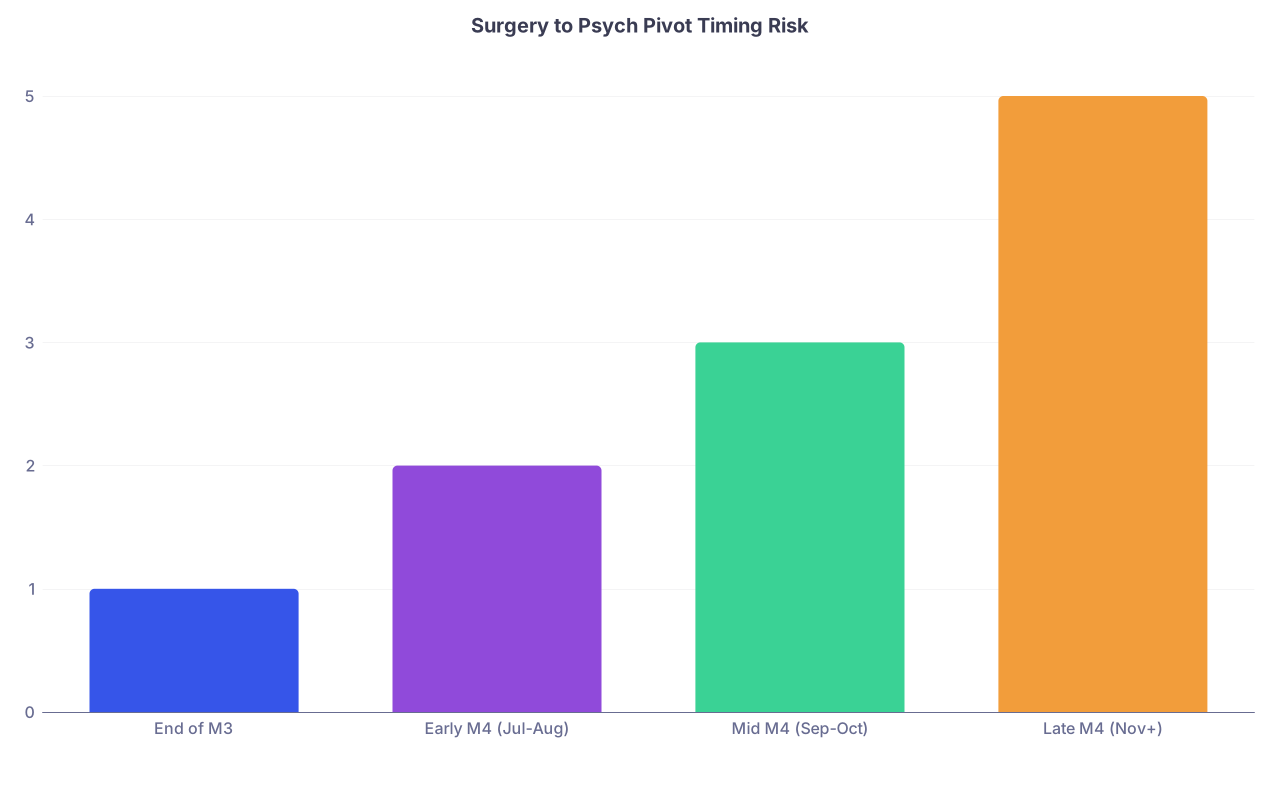
People always ask, “Is it too late?” Let me give a blunt scale.
| Category | Value |
|---|---|
| End of M3 | 1 |
| Early M4 (Jul-Aug) | 2 |
| Mid M4 (Sep-Oct) | 3 |
| Late M4 (Nov+) | 5 |
1 = very manageable, 5 = high-risk circus.
- End of M3: You’re fine. You have time for a psych sub-I early M4, get letters, and build a clean application.
- Early M4 (July–August): Still very doable. You need to move fast on adding psych rotations, but psych is used to this.
- Mid M4 (Sept–Oct): Possible but tight. You’ll need at least one psych rotation and letter before most interviews.
- Late M4 (Nov+): You’re in scramble territory. You’re either taking a research year or accepting that your app will look light and targeting less competitive programs heavily.
Most people reading this are in the middle two categories. It’s not ideal, but it’s absolutely workable with a plan.
Step 9: Prepare to Explain the Pivot in Interviews
This will come up. It should. Don’t panic. Prepare.
You want a calm, consistent answer:
- 60%: What draws you to psychiatry now
- 30%: What you learned from your surgery-heavy background that will help you in psych
- 10%: Brief acknowledgment of the transition itself
Example:
“Entering third year I was very drawn to procedural medicine and team-based acute care, so I structured my schedule toward surgery and trauma. Those experiences were valuable for learning to work under pressure and manage medically complex patients. But even on surgery, I found myself most engaged with the patients whose care centered around coping, mood, substance use, and how illness affected their lives, and that kept bringing me back to what I’d liked best on psych.
Over time — through more psych exposure and some honest reflection — it became clear that my strengths align much more with the longitudinal, relational, and diagnostic work psychiatry offers. So I shifted my focus, completed a psych sub-I and additional electives, and I’m confident this is where I can contribute most.”
Notice what’s missing: defensiveness, apology, long saga about burnout.
Stick to that energy.
Step 10: Mentally Let Go of “But I Already Committed”
Sunk cost is vicious in med school. You’ve put in hours. People have vouched for you. Feels like betrayal to walk away.
Here’s the hard truth: you’re not choosing between keeping people happy now and choosing what you want. You’re choosing between:
- 3–4 awkward conversations and some rescheduling now
vs - 30–40 years of a career that doesn’t fit how you think and live
I’ve watched residents try to tough it out in the wrong field because they were “too deep” into it. Some switch later (which is much harder). Some stay and are quietly miserable. Very, very few say, “I’m so glad I stayed in the field that never felt right, because I didn’t want to annoy a couple attendings fourth year.”
If psych feels right, you’re not crazy, and you’re not weak for changing course. You’re doing the one adult thing med school weirdly discourages: updating your plan based on new information.
Quick Recap: What Actually Matters
Keep your eyes on three things:
- Get at least one strong psych sub-I and two psych letters on the calendar as early as you can. Everything else is secondary.
- Actively reshape your story. Your schedule, letters, and application should read “serious psychiatry applicant who explored surgery” — not “surgeon who panicked.”
- Have the conversations early. With psych faculty, your dean, and, when you’re ready, your surgery mentors. Clarity and a plan beat quiet anxiety every time.
You can pivot from surgery-heavy planning to psychiatry without blowing up your career. But you do have to treat it like a real decision, not a vague vibe, and then move.