
Last recruitment season, I sat in a program director’s office at a mid-tier family medicine program while she flipped through a stack of ERAS printouts. She didn’t raise her voice. She just drew a small “X” in the top corner of a few files and said, almost casually, “We’re never interviewing these.”
None of those applicants had failed Step 1. None had obvious professionalism violations. On paper they were fine. But they were done. Quietly blacklisted. And they have no idea.
Let me walk you through why that happens, especially in fields students think are “friendly” and “non-competitive”: family medicine and pediatrics.
The Myth: “FM and Peds Take Everyone”
This is the first mistake students make.
They think: less competitive specialty = programs are desperate = they will bend over backwards to help borderline applicants. That’s cute. And wrong.
Here’s what’s actually true behind closed doors:
Family medicine and pediatrics programs get absolutely flooded with applications. Especially community and lower/mid-tier academic programs in desirable locations. They’re not short on applicants. They’re short on time.
So what do busy FM and peds program directors do?
They create shortcuts. Hard filters. Unwritten rules. Quiet “do not rank” lists. Not just for people with bad scores—often for people with certain patterns, certain home schools, certain red flags that don’t show up as “red flags” to you.
They rarely say this out loud at info sessions. But in private ranking meetings, you hear:
- “We’re not touching anyone from that school again.”
- “Anyone who ghosted our interview last year is on my permanent no list.”
- “If they didn’t show up to that sub-I, I’m out.”
This is what you’re up against.
The Real Reasons Programs Quietly Blacklist Applicants
Let me break down the main categories where FM and peds programs blacklist people. Some of these are obvious. Some are absolutely not.
1. Institutional Memory: “We Got Burned Once”
This one you never see coming.
A program takes a chance on a resident from a certain med school, offshore Caribbean school, or even a particular transitional year program. That resident:
- chronically calls out sick,
- fails in-service exams repeatedly,
- has professionalism issues,
- or—worst of all—needs to be let go or pushed out.
What happens after that?
The faculty sit around a conference table and someone says the sentence that changes the trajectory for everyone who comes after you from that same place:
“Remind me not to take anyone from [X school] again.”
And that’s it. No memo is sent to you. No email goes out. But inside the program:
- That school gets mentally tagged.
- Future applications from there are “reviewed” much more harshly.
- Often they’re quietly auto-screened out when there’s any borderline aspect—scores, gaps, visa needs, weak letters.
I’ve seen entire Caribbean schools effectively blacklisted at certain FM and peds programs because of 1–2 prior disasters. Not official. But very real.

2. The “Toxic Letter” You Never Saw
This one’s brutal, and it happens more than people want to admit.
You think you have four “strong” letters. You may even have been told, “I’m happy to write you a strong letter.” Meanwhile that attending writes:
“Student was adequate but needed more supervision than usual. I would hesitate to place them in a busy residency without close oversight.”
Or:
“I cannot comment on their work ethic because they occasionally disappeared during shifts.”
To a program director, that’s poison. Any whiff of “needs close supervision,” “concerns about professionalism,” “not one of our top students” in FM or peds—where independence and reliability are non-negotiable—and they’re done.
That applicant’s name goes on the mental blacklist. If they reapply in a future cycle? The PD remembers. I’ve heard this in real time:
“Didn’t we see them two years ago? Yeah, no thanks. That letter from [X attending] was a mess.”
You’ll never see that letter. You’ll just experience a weird pattern: dozens of applications, no interviews at certain places, even though your scores and experiences look fine.
3. Category Change Reapplicants: The “Bounced From Competitive” Problem
FM and peds get a ton of “backup plan” applicants.
The PDs know it. They’re not stupid. They’ve been watching this pattern for years.
You apply one year to orthopedic surgery, radiology, derm, ENT, or anesthesia. You don’t match. Next year, you show up in the FM or peds pile acting like you’ve “always been passionate about primary care” or “working with children.”
They look at your history:
- Prior ERAS list shows no FM or peds programs.
- Your MS4 schedule is all surg subspecialties or advanced electives.
- No FM or peds sub-I, no primary care continuity clinic experience.
- Suddenly your personal statement is full of “lifelong dedication to underserved children.”
Here’s the unsanitized reaction in many FM/peds rooms:
- “So we’re their consolation prize.”
- “They’ll leave for fellowship the first chance they get.”
- “They’ll be miserable in clinic.”
Many programs will give some of these folks a chance. But some? They create an unspoken rule: “We do not take reapplicants who originally aimed for competitive surgical subspecialties unless they have a very convincing story and at least one strong FM/peds rotation with letters.”
If your story looks like a pivot built on panic, not genuine interest, certain FM and peds programs will quietly blacklist your entire category of application.
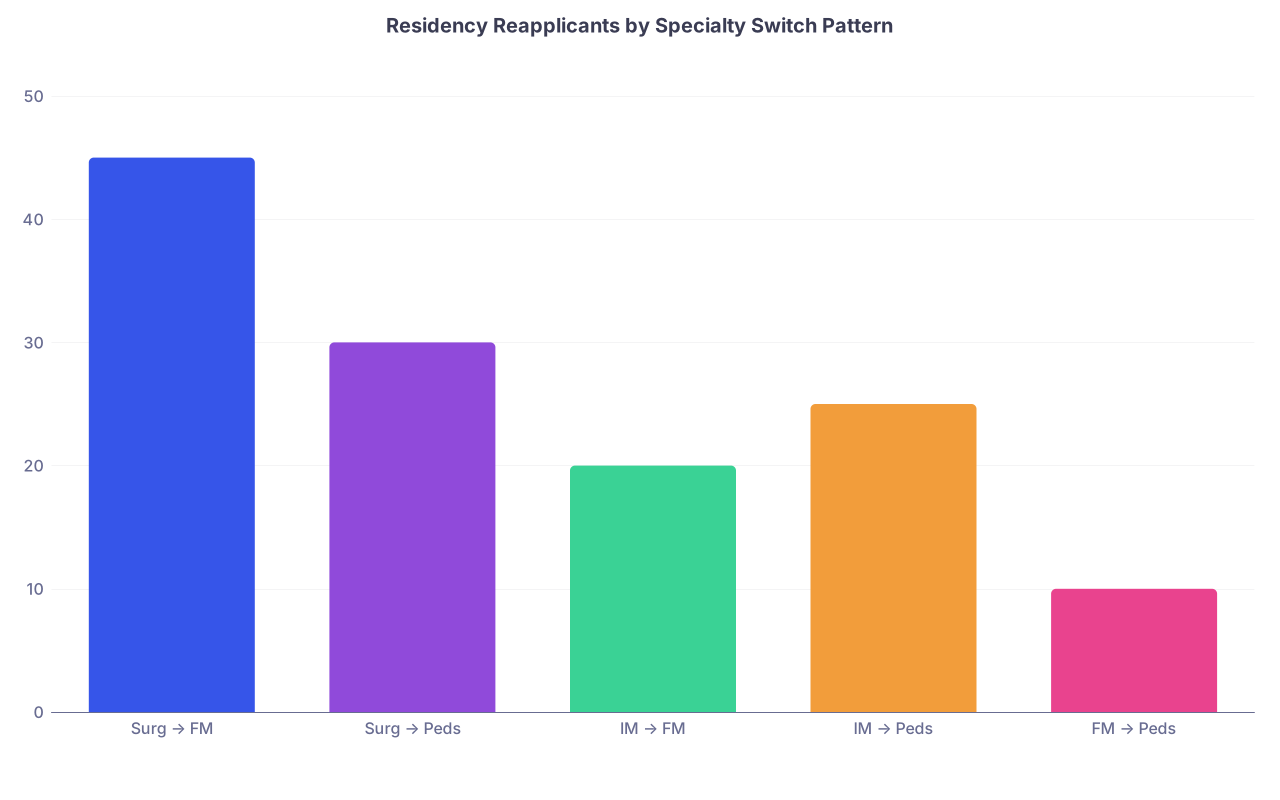
| Category | Value |
|---|---|
| Surg → FM | 45 |
| Surg → Peds | 30 |
| IM → FM | 20 |
| IM → Peds | 25 |
| FM → Peds | 10 |
4. Behavior on Interview Day (and Pre-Interview)
This is where people underestimate how long program directors hold grudges.
A few behaviors get you—or even your entire med school cohort—quietly blacklisted for years:
No-showing or last-minute canceling interviews without a real emergency.
I’ve sat in rooms where a PD pulled up a spreadsheet and said, “Anyone from [X school]? Flag them. We had three no-shows from them last year.”Showing up late, unprepared, or with attitude.
This is FM and peds. They expect you to be nice. If you’re condescending to staff, rude to residents, or visibly disinterested, they remember. Your name will be brought up with, “Do not invite this person or any of their friends back.”Talking badly about other programs or specialties.
I once heard a candidate on a pediatric interview day say to a resident, “Well, at least it’s not FM, I could never do that.” That quote made it into the report. The PD blacklisted them and told their FM PD friend. Two blacklists for the price of one.
You get 20 minutes with a PD and a handful of casual conversations with residents. That’s it. If you blow it, they’ll never write to you saying, “By the way, we’re blacklisting you.” They just quietly flag your file as “do not rank” and remember your name if it ever comes up again.
Score-Based and Application Pattern Blacklists
Even in “less competitive” specialties, programs still use hard screens. Some are explicit, many are not.
5. Step Scores, Attempts, and Inconsistencies
USMLE Step 1 is pass/fail now, but FM and peds PDs still care about:
- Step 2 CK score
- Number of attempts
- Timing (late Step 2 = suspicion for hiding a bad score)
At some community FM and peds programs, the director will say out loud in committee:
- “Anyone below 215, I’m not looking at.”
- “Multiple Step failures? We’ve been burned. Hard pass.”
You might think, “But FM is lifestyle, not competitive.” That’s not how they think. They think: busy service, thin margin for weak residents, low board pass rates affect our accreditation.
So they quietly draw a line and never tell you where it is.
6. The “Spray-and-Pray” Applicant
Some FM and peds programs get suspicious of:
- Applicants who apply to crazy broad ranges of programs (community FM, academic peds, categorical IM, TYs, prelim anything).
- Applicants whose personal statement is generic and clearly reused across specialties.
They can see your application list. They see:
- You applied to anesthesia, IM, FM, peds, EM.
- Your statement could be dropped into any outpatient field with a few word swaps.
Many FM and peds PDs take that as: “They don’t care where they end up, they just want a paycheck.” Some don’t mind. Some absolutely do. And some will quietly blacklist that pattern of application.
| Filter Type | Typical Quiet Cutoff / Reaction |
|---|---|
| Step 2 CK Score | Below ~215–220 often hard screened |
| Multiple Step Attempts | Often auto-reject unless strong story |
| Late Step 2 | Suspicion, file often deprioritized |
| No-showed Interview | Applicant and sometimes school flagged |
| Toxic Letter | Applicant blacklisted permanently |
Institutional and Demographic Patterns That Create Blacklists
No one likes to talk about this. That doesn’t mean it’s not happening.
7. Certain Schools, Certain Pathways
Some FM and peds programs have distinct opinions about:
- Specific Caribbean schools that send huge volumes of applications with weak clinical evaluations.
- Certain newer DO schools with limited track record.
- International programs where documentation and letters are repeatedly vague or unreliable.
Again, this is almost never written down. But I’ve heard it:
- “We’ve never had a successful resident from [X Caribbean school]. I’m done.”
- “We had three residents from [Y international school] fail boards. I don’t want to go through that again.”
So they stop interviewing from there. Or they set the bar much higher: only interview from that pool if scores and US clinical experience are exceptional and letters are glowing.
You, as an individual, might be excellent. But you’re fighting the shadow of people who came before you.
8. Visa Fatigue
FM and peds often attract a lot of IMGs needing visas. Many programs are extremely IMG-friendly. Some are frankly exhausted.
Behind closed doors, you hear:
- “We had to scramble for that H-1B last year.”
- “J-1 paperwork delays killed us.”
- “We got audited and it was a nightmare.”
Result: a quiet shift to “let’s minimize visa-dependent residents.” They’re not required to post, “We now prefer green card/citizen only.” They just:
- Stop shortlisting visa-dependent applicants unless they’re stellar.
- Create a de facto blacklist of “borderline CV + visa need = no interview.”
Not personal. But very real.
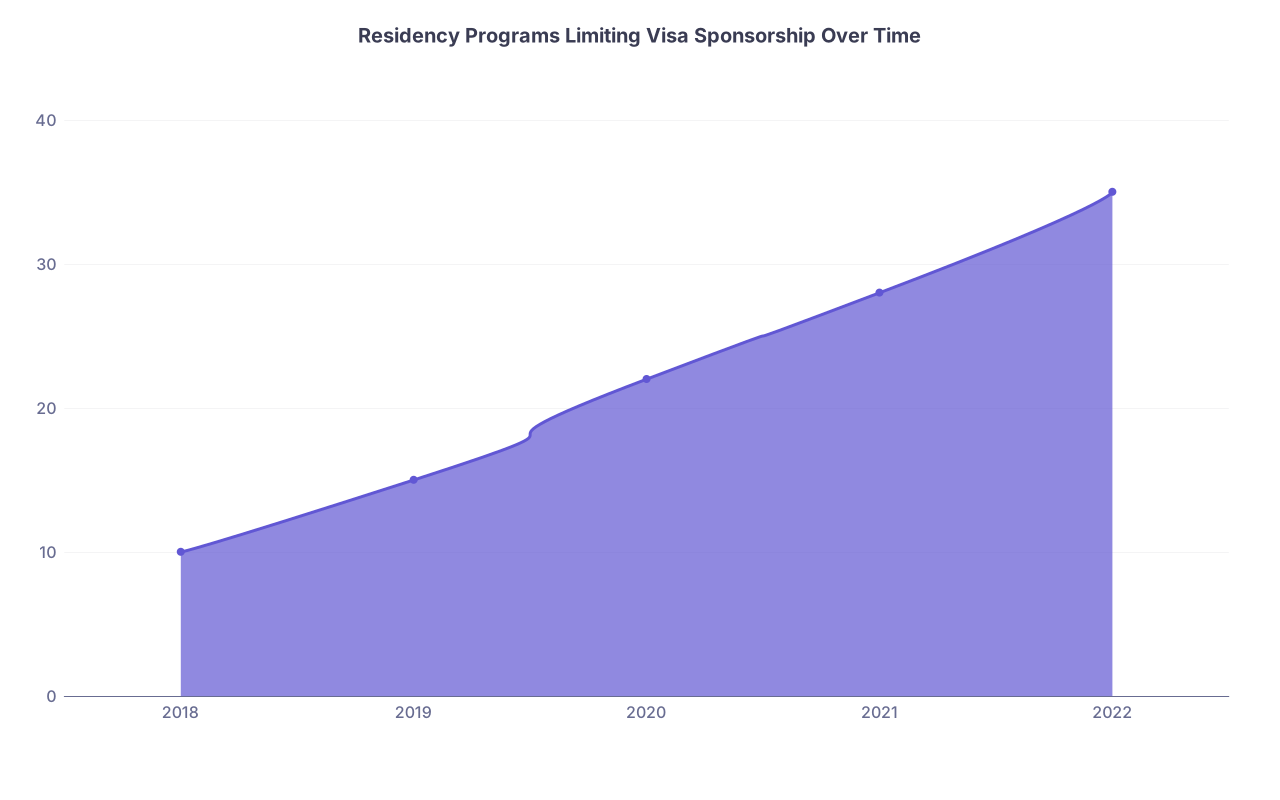
| Category | Value |
|---|---|
| 2018 | 10 |
| 2019 | 15 |
| 2020 | 22 |
| 2021 | 28 |
| 2022 | 35 |
Professionalism: The Fastest Way Onto a Blacklist
If you remember nothing else, remember this section.
FM and peds live and die on trust. Outpatient clinics, continuity, kids, social work, multidisciplinary care. PDs obsess over professionalism because one bad resident destroys morale and reputation.
There are behaviors that almost guarantee a quiet blacklist:
9. Inconsistent Stories and Half-Truths
If your personal statement says one thing, your MSPE implies another, and your interview answers are a third, PDs smell it.
- You say you took a leave for “family reasons,” but your dean’s letter hints at academic remediation.
- You talk about loving underserved populations, but your rotations and electives were all at private suburban hospitals.
- You downplay a Step failure like it was nothing.
FM and peds PDs have a low tolerance for this. They’re often clinically less “flashy,” but they are very good at reading people. If they clock you as evasive, they don’t argue with you. They just flag you. Permanently.
10. Social Media and Reputation
Do some PDs and residents stalk applicants online? Yes. Not all. Enough.
They are not looking for you holding a beer at a wedding. They’re looking for:
- Openly disparaging patients, attendings, or specialties.
- Anti-vax, racist, sexist, or hateful content.
- Chronic unprofessional posts about work.
In one cycle I watched a peds program pull an interview invite the day before because a resident found the applicant publicly mocking a disabled patient population on a personal account. The PD said, “If I ever see that name again, delete it.”
That’s not just a no for this year. That’s a silent blacklist.

How You Avoid Becoming “That Applicant” in FM and Peds
You can’t control whether some prior grad from your school blew up their residency. You can control how many of these silent criteria you trip.
Here’s what actually moves the needle from the PD side.
Own Your Story, Don’t Spin It
If you’re switching from a competitive specialty to FM or peds:
- Be explicit about why.
- Get at least one very strong FM or peds letter from a rotation where you worked hard.
- Make your application look like a pivot with depth, not desperation.
PDs can forgive a career change. They do not forgive obvious lying.
Choose Letter Writers Carefully
Before you ask for a letter, ask this out loud:
“Do you feel you can write me a strong and supportive letter for family medicine/pediatrics?”
If they hesitate even a second, do not use them. That half-hearted “sure” turns into a lukewarm or toxic letter that follows you around.
Do Not Ghost or Disrespect Programs
If you’re going to cancel an interview:
- Do it early.
- Do it clearly.
- Do it professionally and apologetically.
You’re not just representing yourself. You are representing your med school. Programs absolutely track no-shows and late cancellations by school.
Stop Treating FM and Peds as Backups Publicly
If you’re on an FM or peds rotation, and you say to a resident:
“Honestly this is just my backup, I’m going into anesthesia,”
do not be surprised when that resident writes a “meh” evaluation, and the PD remembers your name.
FM and peds want residents who want them. Not people who treat them like a soft landing.

| Step | Description |
|---|---|
| Step 1 | Applicant |
| Step 2 | Higher Scrutiny |
| Step 3 | Standard Review |
| Step 4 | Quiet Blacklist |
| Step 5 | Interview Possible |
| Step 6 | Rank List Consideration |
| Step 7 | Prior Red Flags |
| Step 8 | Toxic Letter or Step Fail |
| Step 9 | Interview Behavior |
Final Reality: Why Programs Won’t Tell You Any of This
FM and peds like to market themselves as nurturing, supportive, team-based, family-friendly. And many are.
They’re also running an ACGME-accredited training operation under constant pressure: patient safety, board pass rates, faculty burnout, hospital politics. The margin for a problematic resident is small.
So they quietly:
- Remember names.
- Remember schools.
- Remember patterns.
- And they talk to each other—FM PD to peds PD, academic to community, over GME council meetings and text threads.
What looks to you like “bad luck” is sometimes just a conversation you were never privy to.
FAQs
1. If a program blacklists me, is it forever?
Often yes, for that specific program—especially if the issue was professionalism, a toxic letter, or an interview-day disaster. For score-based cutoffs or school-based bias, the door can reopen slowly if institutional leadership changes or if you genuinely strengthen your profile and get a direct advocate to call the PD.
2. Can I ever find out if I was blacklisted?
Almost never formally. No one will email, “You’re blacklisted.” The only indirect clues are odd patterns: strong metrics but zero responses from a region or group of programs, or a PD you know personally hinting that a prior letter or incident damaged your file.
3. I failed Step 1/2—am I automatically blacklisted from FM and peds?
No. Some programs will hard-screen you out, but others will still consider you if there’s clear improvement, a solid Step 2 (if Step 1 failed), strong clinical performance, and serious advocacy from letter writers. The failure must be addressed directly and maturely in your story.
4. I switched from surgery to FM/Peds. How do I avoid the “backup plan” blacklist?
You need evidence. A real FM or peds sub-I with an excellent letter, continuity or primary care experiences, and a coherent timeline of when and why you changed direction. Vague “I found my passion later” paragraphs with no concrete actions to back them up are exactly what puts you on the mental “no” list.
5. My school has a bad reputation at certain programs. Is there anything I can do?
You can’t erase institutional history, but you can outrun it by: scoring well, getting nationally recognized FM/peds letters (away rotations, research mentors, national orgs), and having someone those PDs respect pick up the phone for you. Strong individual advocacy can override a quiet school-level blacklist—if you’re truly excellent.
Key points: FM and peds aren’t “everyone gets in” safety nets; they quietly blacklist patterns and people the same way competitive specialties do. Most of that happens through unwritten rules, toxic letters you never see, and institutional memory of being burned. Your job is to stay off those lists by being honest, professional, and deliberate—because once your name’s in the wrong PD’s memory, you rarely get a second shot.